Raising your daily movement without a gym comes down to adding small, repeatable things to an ordinary day: short walks, stairs instead of lifts, a few minutes of bodyweight strength work, and movement breaks between sitting blocks. Most people can start with ten minutes a day and build from there. The first week should feel almost too easy, because the habit has to survive a bad Tuesday before it ever gets hard.
This guide walks through six steps in the order that works best for someone starting from a sedentary baseline. It takes about twenty minutes to read and a couple of minutes each day to actually do. There is no equipment list longer than a chair and a water bottle.
One note before you start, because it changes how you read everything below: the U.S. Physical Activity Guidelines for Americans, which the CDC builds its activity advice around, recommend 150 minutes of moderate-intensity activity a week plus muscle-strengthening work on two days. That is a target, not an entry fee. A ten-minute walk counts. It counts just as much on a week when nothing else happened.
Table of Contents
- What You Need
- Step-by-Step: How to Raise Your Daily Movement Without a Gym
- 1. Set a Comfortable Baseline First
- 2. Add Short Walks Throughout the Day
- 3. Use Everyday Objects for Strength Without a Gym
- 4. Add Mobility and Balance Practice
- 5. Reduce Sedentary Time to Raise Your Daily Movement
- 6. Increase Gradually and Repeat
- Common Mistakes
- Frequently Asked Questions
- How many steps per day should I walk to be healthy?
- Is walking enough to stay fit without going to the gym?
- How can I break up sitting at a desk job?
- How do I start moving more after being sedentary?
- Can household chores and daily errands replace a workout?
- Should I see a doctor before increasing my activity?
- Conclusion
What You Need
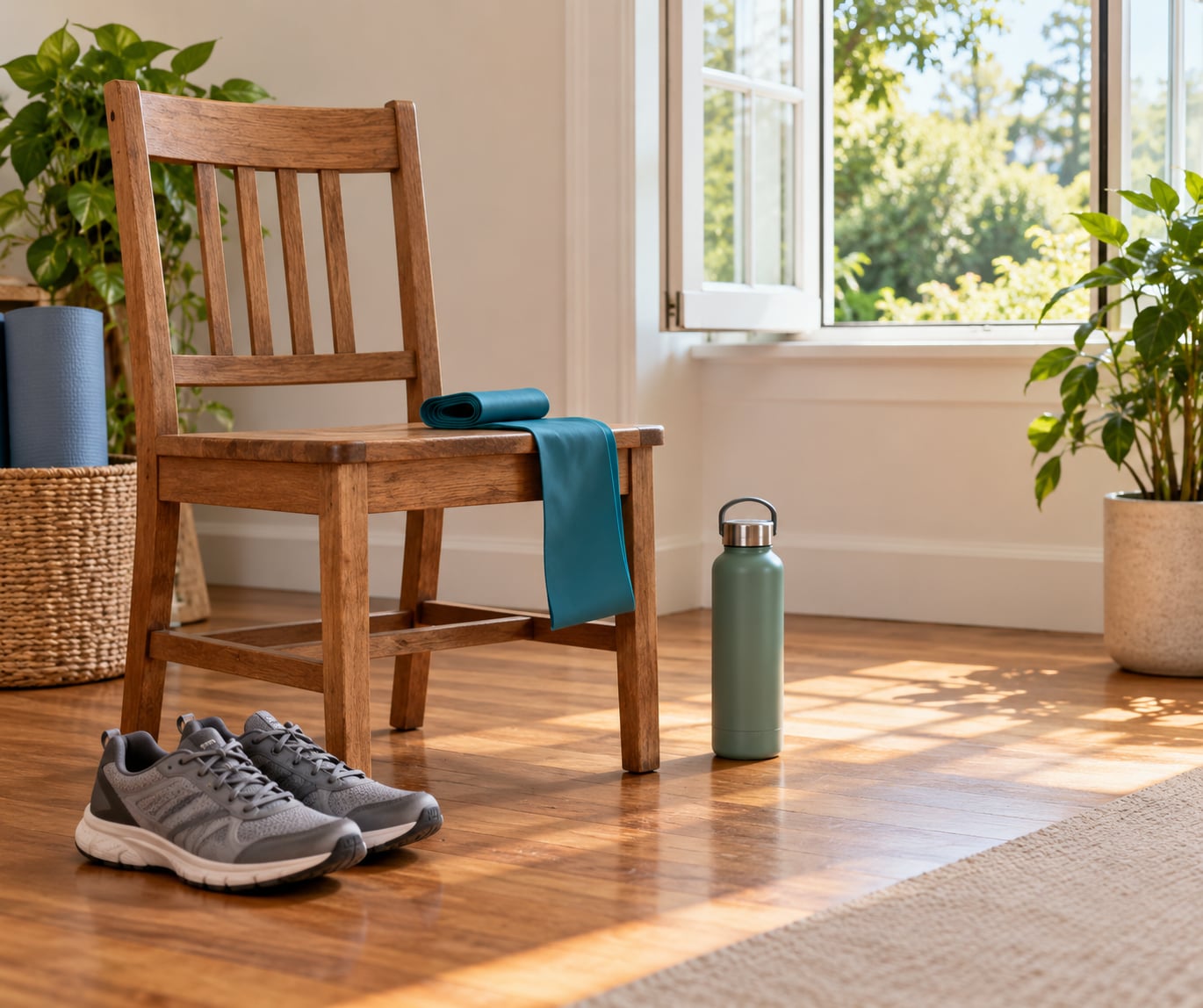
You do not need a gym membership, a mat, or any equipment at all to begin. That is the whole point of the approach, and it is why it survives a busy month.
What helps is small and ordinary:
- Clothing you can move in. Anything you would walk ten minutes in. You are not going anywhere.
- Supportive footwear. Shoes already in your closet that you have walked a long way in, or new ones if yours have flattened out. Shoes matter more than any gadget.
- A water bottle. Especially in warm weather or if you plan to walk farther than usual.
- A phone or watch, optional. Useful for step counts and timers, but not required. The first step below covers how to track your baseline without one.
- A realistic starting week. Ten extra minutes a day, most days. Not an hour, not a target you will fail on day four.
Step-by-Step: How to Raise Your Daily Movement Without a Gym
1. Set a Comfortable Baseline First
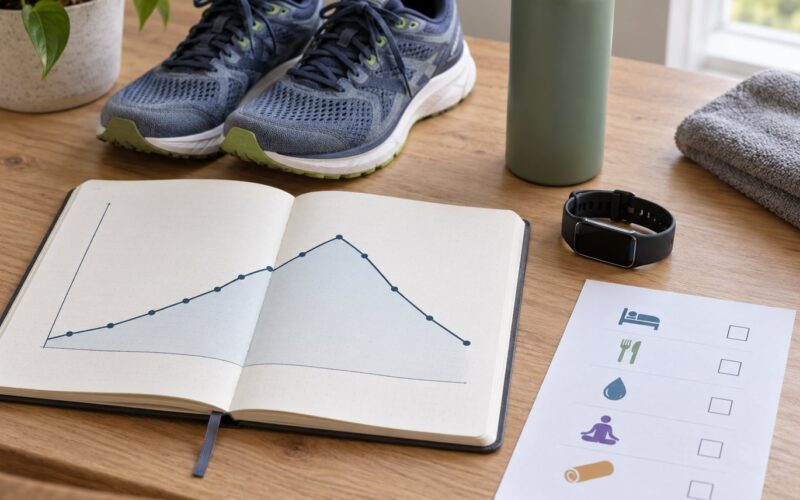
Find out roughly what a normal day looks like for you, then do not try to change it yet. Open the step counter on your phone for a full weekday and a full weekend day and write both numbers down. That is your baseline.
Most phones have a built-in step counter under Health, Fitness, or Steps. If yours does not, a free pedometer app works. The number matters far less than having one, because it is the only way you will know next month whether anything actually changed.
Then choose an easy starting level, and I mean easy. If your average is 4,000 steps, add 500. If your average is 9,000, add a ten-minute walk rather than chasing a number. The first week is a place to build the habit, not a test of endurance, and treating it as a test is how people end up sore and quit inside a month.
A useful rule: if you could hold a conversation during the activity, the intensity is about right for week one. That maps to what guidelines call moderate-intensity physical activity, and it is more effective than most people expect.
2. Add Short Walks Throughout the Day
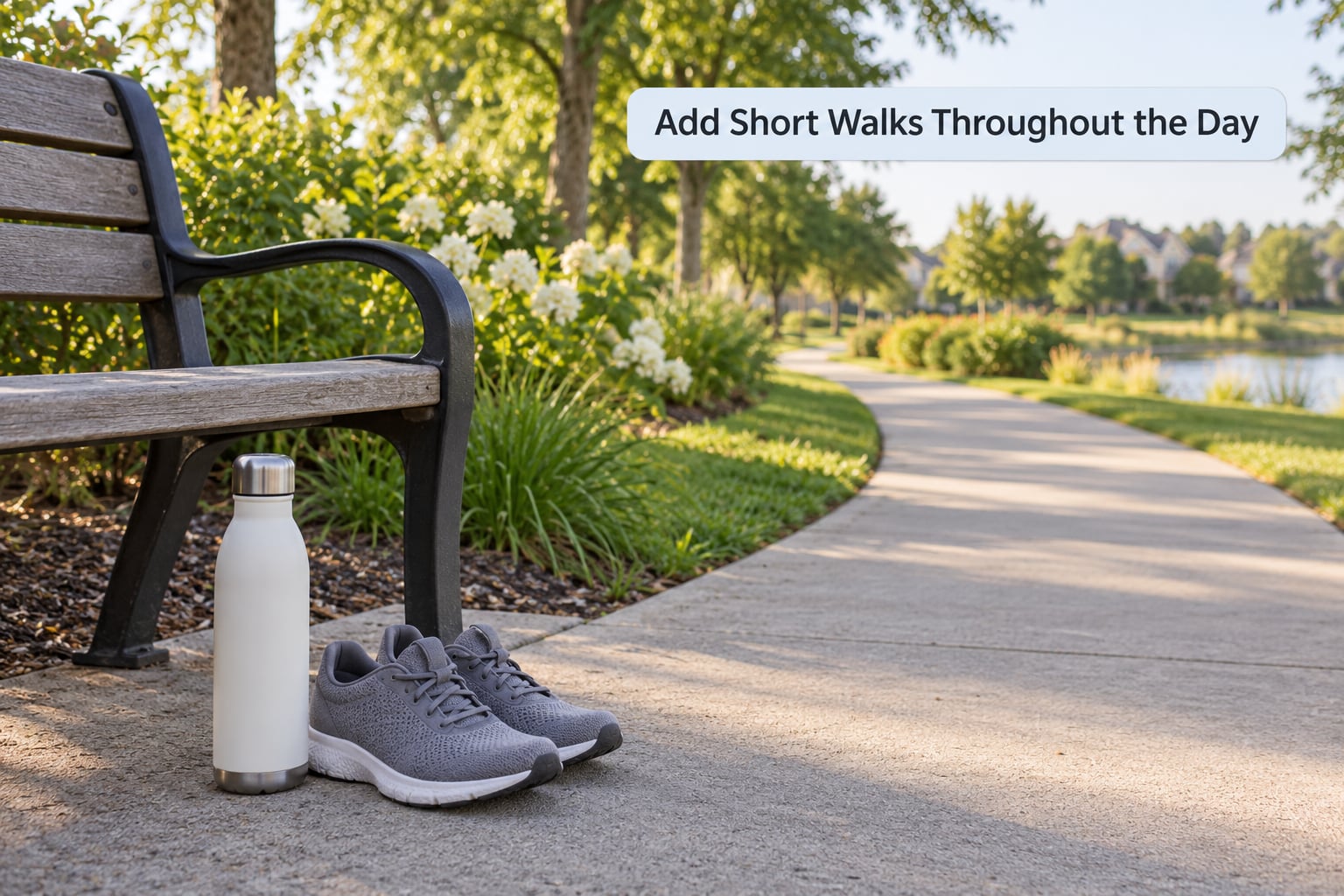
Short walks beat one long walk for most beginners, because they are easier to keep doing. People on weight-loss and fitness forums repeatedly describe the same pattern: climbing from around 6,000 steps to around 10,000 by adding a ten-minute walk here and there worked better than trying to protect a free hour every evening. Consistency beats intensity, and several small bouts protect the habit from a single bad schedule.
Where to put them:
- After meals. A ten-minute walk after lunch or dinner. It also helps with digestion, and attaching it to a meal means you never have to decide whether to do it.
- During work breaks. Fifteen minutes at lunch, or two five-minute breaks spread through the afternoon.
- Phone calls. Stand up and walk the length of a room, a hallway, or a block. This is a movement swap with zero planning involved.
- Parking and stairs. Park at the far end of the lot. Take the stairs, or get off one floor early and walk the rest.
- Social time. Walk-and-talk instead of sitting down for a call. Walkers regularly name this as the version of exercise that does not feel like exercise, which matters more than it sounds.
Pick two of these and do them for two weeks. Two, not five.
3. Use Everyday Objects for Strength Without a Gym
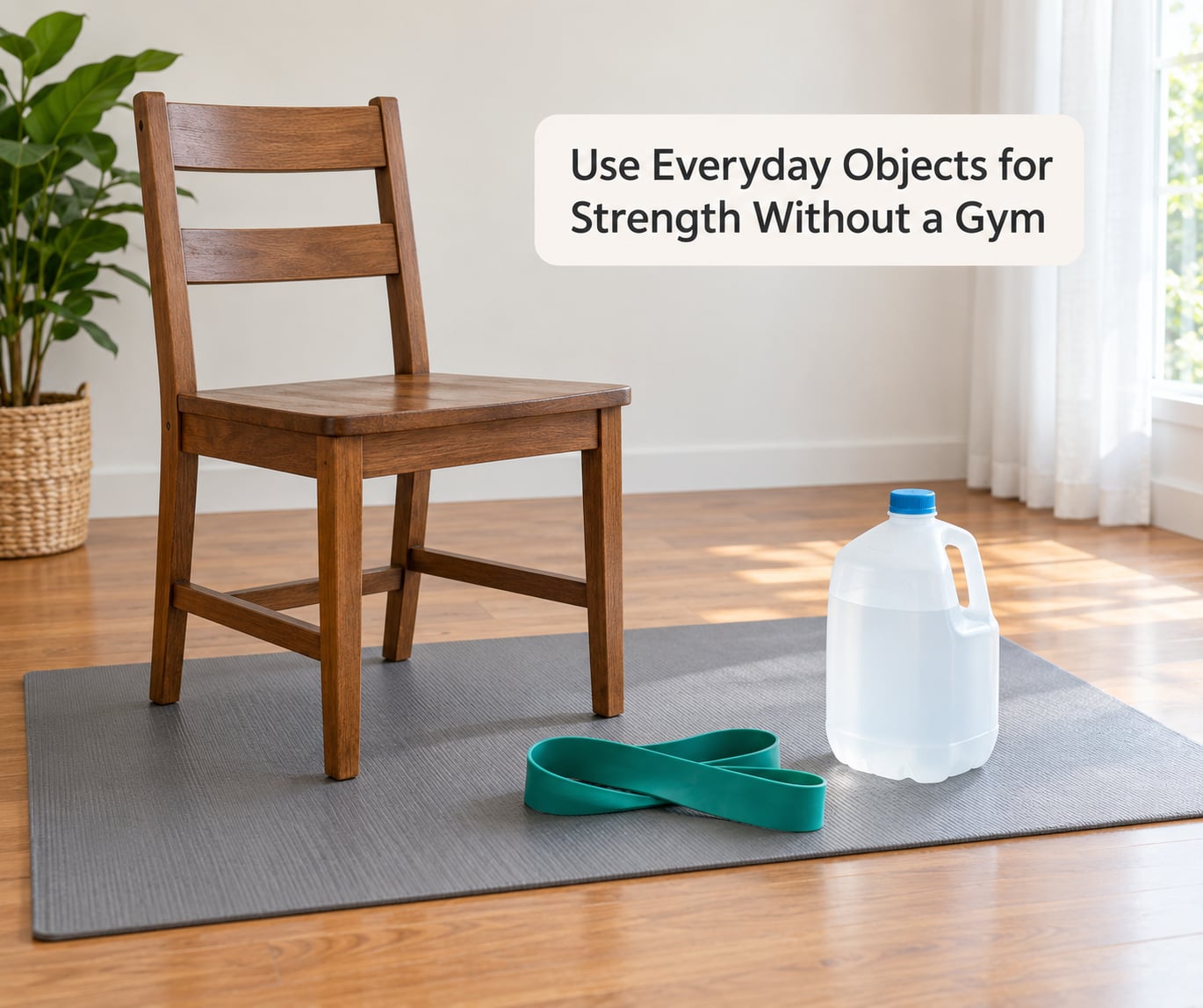
Walking is cardio. For muscle and bone, you need resistance, and resistance does not require a gym. Your own body weight, a sturdy chair, and a light household container are enough for a full session.
A five-minute routine you can do in a small room:
- Chair squats. Stand in front of a stable chair, lower until you lightly touch the seat, stand back up. Ten to fifteen reps.
- Wall push-ups. Hands on a wall at chest height, body in a straight line. Fifteen to twenty reps. Move the feet further back as it gets easier.
- Hip hinges. Hands on the chair back, hips pushing back, chest staying long. Fifteen reps. This one trains the back of the legs and the lower back.
- Step-ups. Step up onto a bottom stair or a low step, step down slowly. Ten per leg. Good for balance as well as legs.
- Carries. Hold a light container in each hand and walk across the room with a tall posture. Two or three trips.
Do the whole set two or three times a week. Control the lowering phase rather than the number, and stay inside a range where you could still talk. If you feel a sharp pain in a joint, stop and get individualized advice from a clinician rather than pushing through it. Muscle soreness a day later is normal when you are starting out; joint pain is not.
4. Add Mobility and Balance Practice
Ten minutes of mobility work makes everything else easier, and it is the part people skip. Stiff hips and ankles quietly make a walk feel harder than it needs to, so a few minutes of range work pays for itself.
Try this, holding a counter or chair back for balance work:
- Shoulder circles and wall slides. Ten each direction, then press your back gently against a wall and slide your arms up and down five times.
- Hip flexor stretch. Half-kneel, tuck the pelvis, shift forward gently. Thirty seconds each side.
- Ankle circles and calf raises. Ten circles each foot, then fifteen slow raises holding a counter.
- Single-leg stand. Three per side. Progress by closing your eyes or putting your arms overhead.
- Cat and cow. On hands and knees, ten slow cycles. Works well after a long seated day.
Everything stays inside a comfortable range. Mobility work should feel like a gentle stretch, never like forcing a position. Breathe normally through all of it, and skip anything that pinches or shoots.
5. Reduce Sedentary Time to Raise Your Daily Movement
For a desk worker or a fully remote day, the sitting blocks are the real problem, and a single evening walk does not fully cancel eight hours in a chair. Long stretches of sitting carry risk on their own, independently of how much you exercise in a planned session.
What helps, in rough order of usefulness:
- Set a timer for every 30 to 45 minutes. Stand, walk to the kitchen, refill water. The timer is the whole trick; the movement is incidental.
- Take standing calls standing. Most video calls work fine on your feet.
- Batch your sitting. Grouping the desk work into 90-minute blocks with a movement break between them is easier than constant micro-fiddling.
- Walk for some calls. The ones that do not need your face or your keyboard.
- Use stairs as a between-meeting habit. Go up one flight, or down and back up. It is a natural timer.
Nobody needs a standing desk to start. A floor, a doorway and a timer cover most of it.
6. Increase Gradually and Repeat
At the end of each week, look at your numbers and your feel. Add one thing at a time: more minutes, one extra day, or one new habit. Changing everything at once is how a plan becomes something you abandon.
Then set the habits into your week rather than leaving them to chance. A morning walk works better as a fixed anchor than as an optional extra, because people who walk in the morning report that the rest of the day follows more easily. Put the strength sessions on two specific weekdays, put the walking on the days you already take a break, and let the rest of it happen around them.
Keep something you enjoy in the mix. Walking with a person, a podcast you only allow on walks, or a dance playlist in the kitchen all count as movement that sticks, and a routine you dislike is a routine you drop.
One rule for lapses, which is where most plans die: never go to zero. Missing a day is noise, but missing three days turns into a new baseline. The recovery move is one short walk, nothing more. That is the whole restart.
Common Mistakes
Starting too hard. The first week feels like proof, so people start at the level they want to be at in three months. Fix: pick a number that feels slightly boring. Boring is what survives contact with a bad week.
Counting only workouts. If the only thing that counts is a planned session, a sedentary day reads as a failed day. Fix: count the small things too, and let a short walk or a set of chair squats on a hard day count as a complete day.
Chasing step targets. Step goals feel like judgment, and a bad day becomes a reason to give up on the goal itself. Fix: use a weekly average instead of a daily one, and treat a single bad day as noise in the data.
Skipping recovery. Soreness from a new routine is normal. Soreness that changes your gait, or sharp joint pain, is a signal. Fix: keep at least one easier day between harder strength days, and get personalized advice about anything that hurts sharply.
Using movement to cancel out food. This is the most common and most durable mistake. A long walk does not undo a large meal, and the attempt tends to end badly. Fix: treat movement as movement, and let food decisions be food decisions.
Dropping everything after a lapse. The all-or-nothing pattern is the reason people cycle between months of doing nothing and a punishing week. Fix: no-zero rule. One short walk resets the week, and that is all the recovery a lapse needs.
Frequently Asked Questions
How many steps per day should I walk to be healthy?
There is no single magic number, and 10,000 is a marketing milestone rather than a medical threshold. A common adult range is 7,000 to 10,000 steps, but the right target is the number you can hold on a normal week. If you currently average 4,000, add 500 at a time and let the baseline move up over several months. A weekly average tells you far more than any single day.
Is walking enough to stay fit without going to the gym?
Walking is genuinely good cardio and it is the easiest habit to keep, but on its own it builds less muscle than resistance work. For most adults, walking for heart health and daily energy, plus two short bodyweight sessions a week, covers a solid amount of ground. A gym is helpful for progression and for people who enjoy it, but it is not required to be meaningfully fitter than last year.
How can I break up sitting at a desk job?
Set a timer for every 30 to 45 minutes and stand, walk to the kitchen, or refill your water. Take standing video calls on your feet. Group desk work into blocks of about 90 minutes with a movement break between them instead of fidgeting constantly. You do not need a standing desk to start: a timer, a doorway and a five-minute walk handle most of it.
How do I start moving more after being sedentary?
Measure your current average for a few days, then add one small habit, such as a ten-minute walk after lunch, and keep it for two weeks before adding another. Add two short bodyweight sessions a week, using a chair and your own weight. Build by one variable at a time, keep one easy day between harder sessions, and use the no-zero rule so a missed day never becomes a missed week.
Can household chores and daily errands replace a workout?
They count as real movement, especially carrying, cleaning, laundry and walking errands, and they add up across a week. But chores rarely provide the same continuous moderate-intensity load or the progressive resistance needed to build muscle. The useful approach is to let chores raise your baseline, then add two short deliberate sessions a week for the part chores do not cover.
Should I see a doctor before increasing my activity?
Yes, if you have a heart condition, high blood pressure, diabetes, significant joint problems, are pregnant, or have been inactive for a long time and feel unwell when you exert yourself. It also makes sense after an injury or illness, or if you take medication that affects heart rate during exercise. General movement advice is not a substitute for individual medical guidance, and any sharp pain, chest discomfort, or unusual shortness of breath while moving is a reason to stop and get advice.
Conclusion
Start with one thing: a ten-minute walk after a meal, tomorrow, before anything else changes. Check your step count this week so next week has something to compare against, then add a second habit once the first one feels boring rather than impressive.
Slow is fast here, and the version of this you can still be doing in three months is the one worth building. If you have a health condition, an injury, or a long period of inactivity, a doctor or physical therapist can turn this general plan into safe, specific advice for you.