Nonexercise activity and why it matters for fat loss comes down to one simple fact: fat loss happens when you consistently take in less energy than you use, and everyday movement is the part of that energy use you control most easily. Walking to the shop, doing the dishes, climbing stairs and pacing around while you talk all burn calories without anyone planning them. Most people can add a meaningful amount of daily movement without a gym membership, without equipment and without spending an hour on it.
That does not mean movement alone will make you lose weight. What it means is that your total daily energy expenditure is the sum of several parts, and the everyday part is often the one that quietly shrinks first.
Table of Contents
- What Is Nonexercise Activity and Why Does It Matter for Fat Loss?
- How Does Nonexercise Activity Help With Fat Loss?
- What Are Everyday Examples of Nonexercise Activity?
- How Much Nonexercise Activity Is Enough?
- How Can You Add More Movement to Your Day?
- How Do You Know If You Are Progressing?
- Are There Limits or Safety Concerns?
- Frequently Asked Questions
- Does nonexercise activity cause fat loss on its own?
- How is nonexercise activity different from exercise?
- Do everyday movements such as housework and walking count toward 150 minutes?
- Can nonexercise activity help if I cannot do formal workouts?
- Will increasing daily activity always produce weight loss?
- Conclusion
What Is Nonexercise Activity and Why Does It Matter for Fat Loss?
Nonexercise activity is any movement you burn energy on that was not a planned workout. That includes walking, standing, taking stairs, housework, gardening, walking the dog, carrying shopping, commuting on foot and small movements such as fidgeting. It is often called non-exercise activity thermogenesis, usually shortened to NEAT, a term Dr. James Levine’s group at Mayo Clinic popularised in the late 1990s.
The reason it matters for fat loss is that it is the largest part of your daily energy burn you can still change without a training plan. Every extra hour of sitting swapped for standing adds up quietly, and unlike a hard workout you skip for a week, everyday movement keeps happening on the days you are tired.
Your total daily energy expenditure, usually shortened to TDEE, has four moving parts.
| Component | What it covers | Rough share of your daily burn |
|---|---|---|
| Basal metabolic rate | What your body spends simply staying alive: breathing, heartbeat, organ function | About 60-70% |
| Thermic effect of food | Energy used chewing, digesting and absorbing what you eat | About 10-15% |
| Nonexercise activity | Standing, walking, stairs, chores, errands, fidgeting – all unplanned movement | About 15-30% |
| Planned exercise | Anything you deliberately train: a run, a class, a gym session, a sport | About 0-10% |
Estimates for the nonexercise share vary widely, from under 15% in very sedentary people to well over 30% in people who are on their feet for hours. The honest version is that the number depends far more on how you spend a normal day than on how hard you train once a week.
How Does Nonexercise Activity Help With Fat Loss?
It helps mainly by raising what you spend each day while preserving what your body needs. The work happens through several separate mechanisms, and no single one of them overrides the basic arithmetic of energy balance.
| What it does | How it happens | Why it matters for fat loss |
|---|---|---|
| Raises daily energy expenditure | Muscles working outside a workout still consume fuel | More energy spent at the same intake means a larger deficit |
| Helps preserve muscle | Regular light loading keeps muscle tissue from shrinking during a deficit | More lean mass keeps spending energy at rest |
| Improves insulin sensitivity | Muscle contractions move glucose out of the bloodstream | Blood sugar is easier to manage as you eat less |
| Supports appetite regulation | Movement and regular meals tend to settle hunger signals | Fewer unplanned late-night snacks |
| Improves how you function | Better sleep, mood and energy through the working day | Harder adherence when you are tired or flat |
Here is the part most articles leave out: adding movement while keeping your intake exactly the same does not guarantee fat loss. If you eat back every calorie you walked off, nothing changes. What everyday movement reliably does is give you a deficit you can actually hold, because it does not trigger hunger or fatigue the way a hard session does.
What Are Everyday Examples of Nonexercise Activity?
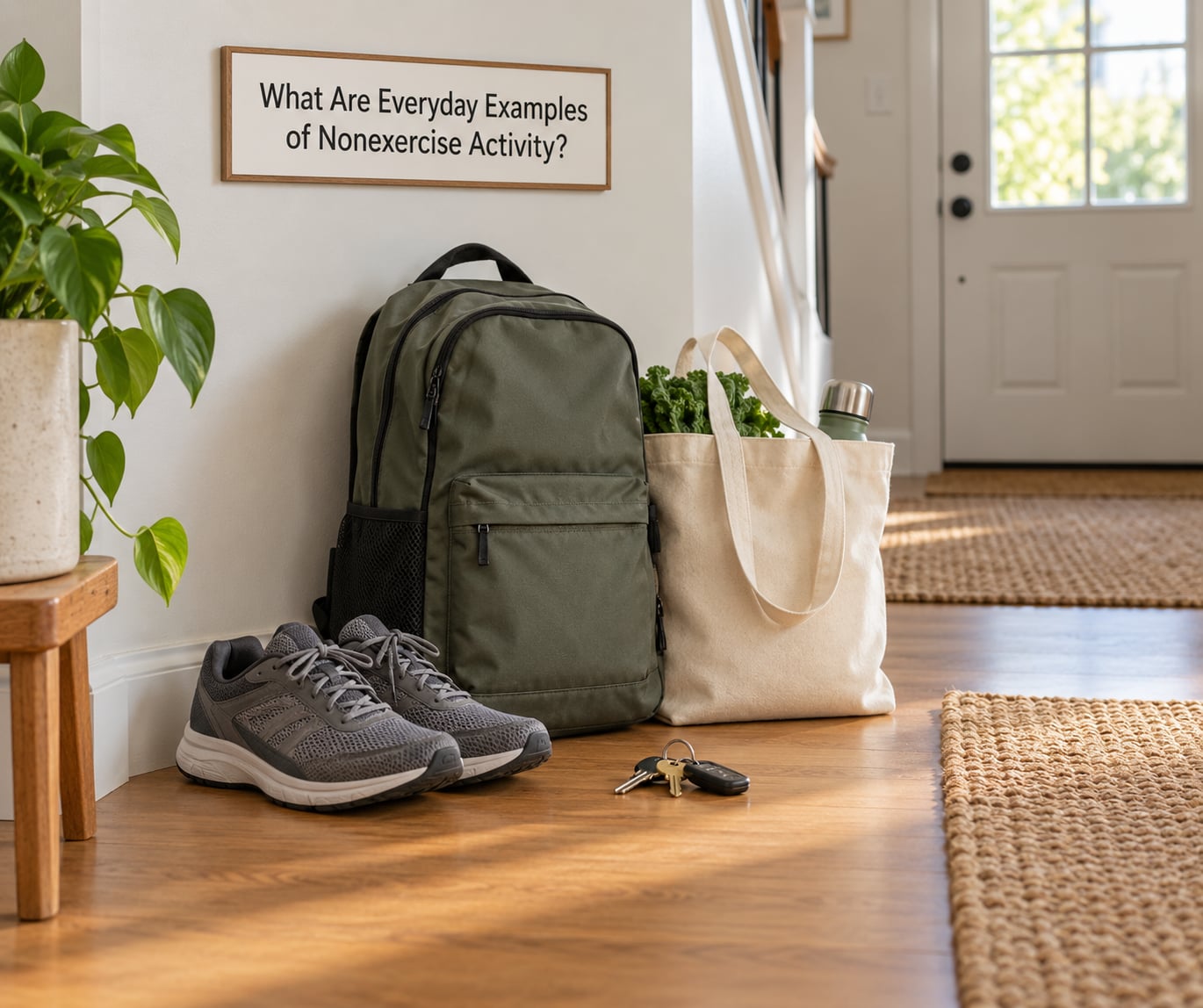
Everyday nonexercise activity is any ordinary task that keeps you on your feet. The list is longer than most people expect, and the useful part is matching the examples to your actual week rather than to an ideal one.
At home: vacuuming, mopping, wiping down counters, scrubbing the bathroom, tidying a garage, hanging washing out, carrying bins, watering plants, walking laps while a slow cycle runs.
At work: standing during a phone call, taking the stairs instead of the lift, walking to a colleague’s desk instead of messaging, walking the long way to the kitchen, standing during a presentation, pacing while you think through a problem.
On errands: walking to the shop, carrying bags, pushing the trolley instead of loading it into the car, parking at the far end of the lot, getting off the bus a few stops early.
Outdoors: gardening, washing the car, walking the dog, walking with a friend, taking children to the park, mowing, walking to a swimming pool or a library.
Intensity and duration both matter. Standing still for an hour and walking briskly for ten minutes are not the same thing, and neither is identical between two people of different sizes. Ten minutes of easy pottering is worth more than nothing and less than twenty minutes of purposeful walking.
How Much Nonexercise Activity Is Enough?
There is no single number that counts as enough, because the guidance covers different purposes. Mainstream public health guidance sets a weekly aerobic target for adults, and everyday movement matters well below that target.
| Guideline | What it covers | Notes |
|---|---|---|
| Some movement every day | Light walking, standing, chores, moving around the house | Useful on its own, especially for people who sit for long hours |
| Break up long periods of sitting | Short stands or walks spread through the working day | Sitting in one unbroken block carries more risk than the total hours alone |
| At least 150 minutes of moderate aerobic activity per week | Walking briskly, cycling, swimming, anything that raises breathing | Across the week, not all in one session; about 30 minutes on five days |
| Two days of muscle-strengthening work | Resistance work with bands, weights or bodyweight | Helps hold on to lean mass during weight loss |
The 150-minute figure is a target, not a gate. People who move well for 30 minutes a day and reach 7,000 to 8,000 steps are getting real metabolic benefit, and plenty of that movement never gets labelled as exercise. If a week goes badly, the ordinary walking you did to the shops still counted.
How Can You Add More Movement to Your Day?
Start with the cheapest wins and build from there, because the changes that last are structural rather than heroic. Most people who fail at this try to do a hard thing too briefly rather than an easy thing consistently.
Take short walks that you would do anyway. Ten minutes after a meal, a walk around the block after lunch, a lap of the park before work. Short and repeated beats long and occasional for building a habit.
Stand during tasks you can do standing. Phone calls, reading, a shower, the kettle boiling. Standing uses more energy than sitting, though less than most people assume.
Take the stairs and walk the long way whenever you have a genuine choice. Five flights twice a day is real, repeatable movement with no planning involved.
Pace your chores instead of doing them in the shortest possible time. Vacuuming at half speed, carrying shopping up in two trips, cleaning with music on so you move for twenty minutes rather than eight.
Build movement into your breaks. Two minutes every half hour across a nine-hour desk day adds up to roughly an hour of movement you barely notice.
How Do You Know If You Are Progressing?
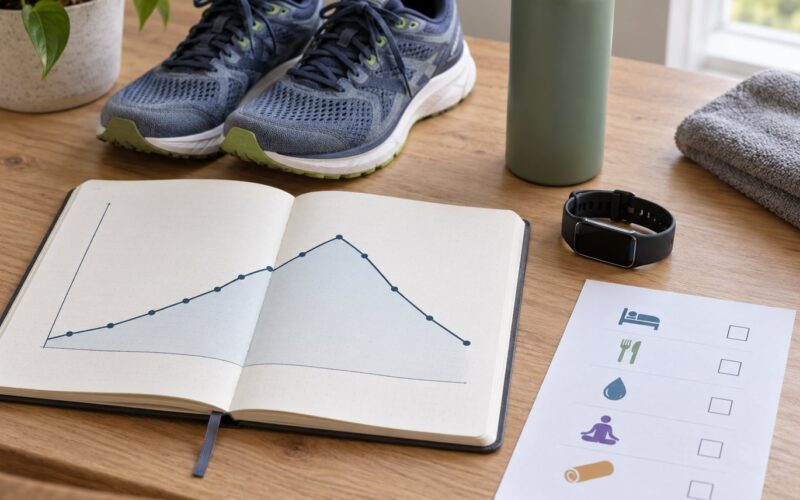
Track several signals instead of one, because any single number lies. A step count on a bad day tells you almost nothing, and a weigh-in that has not moved tells you very little either.
Look at weekly averages rather than daily totals. A phone step counter or a smartwatch will give you a rough idea of whether your average has drifted, and over weeks that is enough to notice a change you cannot feel day to day.
Notice active minutes. Most devices estimate how long you spent moving at a moderate pace, which is a more useful comparison than raw steps if your walking pace has changed.
Measure your waist once a week, at roughly the same point in the week and under similar conditions. Waist trend over a month or two tends to reflect fat loss more honestly than weight alone, especially when you are also building muscle.
Track consistency rather than intensity. Five mediocre days beat two heroic ones every single month.
Set realistic expectations on the timeline. Visible change takes time, and the first two weeks of any change are mostly water, glycogen and adjustment. If something feels wrong or you want a plan tailored to you, a registered dietitian or doctor can help you read your own numbers properly.
Are There Limits or Safety Concerns?
More movement is generally safe, but it is worth being sensible about how you add it, particularly if you have been sedentary for a long time or have an existing health condition.
Increase gradually. Going from no exercise to long daily walks in one week is how people end up with shin splints and sore backs. Add a little every week and let your body catch up.
Wear something sensible. Supportive footwear and clothing you can move in matters more than any gadget, and it matters more for daily walking than people expect.
Drink water, especially in hot weather or during long sessions. Movement makes you thirsty even when the weather is cool.
Adapt rather than abandon. If you cannot walk far, chair exercises, light resistance work, swimming or short standing stretches all keep you moving. Reduced range of motion does not mean zero activity.
See a doctor or a qualified health professional before starting if you have persistent pain, feel dizzy, get chest pain, experience unusual shortness of breath, or have a condition a doctor has told you to be careful with. Stop and seek advice rather than pushing through any of those.
Frequently Asked Questions
Does nonexercise activity cause fat loss on its own?
Not by itself. Everyday movement raises what you spend each day, which widens a calorie deficit only if your intake stays the same. Most people who add steps without watching intake eat back the difference without noticing. What nonexercise activity does reliably is make a deficit easier to hold, because it does not leave you hungry or exhausted the way a hard workout does.
How is nonexercise activity different from exercise?
The difference is planning, not effort. Exercise is movement you schedule on purpose, such as a run, a gym session or a class. Nonexercise activity is everything else that keeps you moving during a normal day, like walking to the car, doing housework or pacing while you talk. Both burn energy, but only the second happens on the days you skip the gym.
Do everyday movements such as housework and walking count toward 150 minutes?
They count toward a broader goal, though brisk walking, cycling or swimming meet the moderate aerobic standard more easily than chores do. Household activity is usually light to moderate, so it adds up over a day rather than in one block. If you are far from the weekly target, purposeful walking is the simplest way to close the gap without joining anything.
Can nonexercise activity help if I cannot do formal workouts?
Yes, and it is often the realistic starting point for people managing an injury, a disability, pain or simply no interest in gyms. Pacing around a room, standing during daily tasks, light resistance work with bands and short walks all raise daily energy use and support blood sugar and mood. Adapt the movement to what your body allows rather than treating formal training as the only option that counts.
Will increasing daily activity always produce weight loss?
No. Activity increases your energy expenditure, but weight still depends on the gap between what you spend and what you take in. Some people add a long walk and an extra portion without noticing, and the scale stays put. Some people eat the same and lose weight steadily. Watch the trend over several weeks rather than expecting a change from any single day.
Conclusion
Nonexercise activity matters for fat loss because it is the part of your daily energy use you can change without a training plan, and because it keeps working on the weeks when a workout does not happen. Start with one habit you would do anyway – a ten-minute walk after lunch, stairs instead of the lift, or standing through a phone call – and pair it with eating habits you can actually keep.