
Fatigue, breathlessness on stairs, pale skin, cravings for ice — these are the signs you may be low on iron that doctors hear about most. But symptoms alone never confirm a deficiency. Iron is a mineral your body needs to build haemoglobin, the protein inside red blood cells that carries oxygen around. When iron runs short, every tissue gets less oxygen, and that shows up in ways that range from barely noticeable to genuinely disabling. The only reliable way to know is a blood test ordered by a healthcare professional.
What follows is what a clinician would want you to recognise, why each clue happens, and what to do about it. None of it is a diagnosis. If several of these land at once for you, or they are getting worse, book an appointment rather than guessing.
General health information only. This article is not medical advice, and it cannot diagnose or treat you. Please talk to a doctor, pharmacist or registered dietitian about anything that concerns you. Last reviewed for 2026.
Table of Contents
- What Are the Signs You May Be Low on Iron?
- Energy and thinking
- Heart and breathing
- Skin, hair and nails
- Everyday quirks
- The quick reference
- Do these signs always show up?
- How Do Low Iron Levels Affect the Body?
- What Can Cause Iron Deficiency?
- Who Is More Likely to Have Low Iron?
- How Can Low Iron Levels Be Checked?
- What Should You Do If You Think You Are Low on Iron?
- Frequently Asked Questions
- Does fatigue mean I am low on iron?
- Can you be low on iron without having anemia?
- Do vegetarian and vegan diets always cause iron deficiency?
- Should I take an iron supplement if I feel tired?
- When should low iron symptoms need urgent medical care?
- What to Do First
What Are the Signs You May Be Low on Iron?
Iron sits at the centre of a lot of your body’s daily work, so a shortfall shows up in several systems at once. Here are twelve of the most commonly reported clues, grouped so you can scan the section that fits you.
Energy and thinking
1. Fatigue that sleep does not fix. A night off does not help, and you feel tired in a way that no weekend recovers from. Your muscles and brain are competing for less oxygen than usual.
2. Weakness and heavy legs. Ordinary tasks — carrying shopping upstairs, lifting a child — feel harder than they used to. Many people describe their legs as heavy rather than weak.
3. Trouble concentrating or brain fog. Reading a page and taking it in gets harder. Iron supports the enzymes involved in making neurotransmitters, so thinking slows before you notice anything else.
4. Frequent headaches. Dull, recurring headaches that arrive without any obvious trigger are a commonly reported sign.
Heart and breathing
5. Shortness of breath on light activity. Climbing two flights, walking briskly or talking while walking leaves you catching your breath. The body is compensating for reduced oxygen-carrying capacity.
6. Heart racing or fluttering. Palpitations, a pounding chest or a fast pulse when you have barely moved are signs your heart is working harder than usual.
7. Dizziness or lightheadedness. Standing up too quickly makes you wobbly. Low blood pressure and reduced oxygen to the brain are both common explanations.
Skin, hair and nails
8. Paler skin or a yellowish tone. Notice the inner eyelid, the gums or the nail beds. Reduced haemoglobin shows up most clearly in these pale spots.
9. Brittle, cracking or spoon-shaped nails. Nails that break at the edges, or that curve upward like a spoon (koilonychia), are among the longest-standing signs.
10. Hair thinning or shedding. More in the shower drain, more strands on the pillow, a widening parting. Hair cells are among the fastest-dividing cells in your body, so they suffer first when iron runs low.
Everyday quirks
11. Craving ice or other non-food items. This is called pica, and ice is the classic version. It is one of the more specific clues, which makes it worth taking seriously.
12. An uncomfortable urge to move your legs at night. Restless legs syndrome is linked to low iron stores even when haemoglobin is normal, and it gets worse in the evening.
The quick reference
Here is the same list in a scannable form, with what is going on underneath each sign.
| Sign | Body system | Why it happens |
|---|---|---|
| Unrelenting fatigue | Energy | Less oxygen reaches muscle and brain tissue |
| Weakness, heavy legs | Muscles | Reduced oxygen for normal contraction |
| Brain fog | Thinking | Iron-dependent enzymes slow down |
| Headaches | Neurological | Reduced oxygen supply to the brain |
| Breathlessness on stairs | Respiratory | Lungs compensate for lower oxygen-carrying capacity |
| Palpitations | Cardiovascular | Heart rate rises to compensate |
| Dizziness | Circulatory | Lower blood pressure and oxygen to the brain |
| Pale skin, gums or inner eyelids | Skin and mucous membranes | Less haemoglobin colours the blood |
| Brittle or spoon-shaped nails | Nails | Slow turnover of keratin |
| Hair thinning | Hair | Rapidly dividing cells lose iron first |
| Craving ice (pica) | Behavioural | Iron status is low, craving is the signal |
| Restless legs at night | Neurological | Linked to depleted iron stores |
Do these signs always show up?
No, and that is the part that trips people up. Iron stores usually fall gradually, so you adapt to feeling lower energy and stop noticing it. By the time fatigue registers, the shortage has often been building for months.
There are other reasons these clues can appear. Feeling cold, aches, ringing in the ears, easy bruising, headaches and low stamina all show up in thyroid problems, vitamin B12 or folate deficiency, sleep apnoea, chronic fatigue and plain old stress. That is exactly why a checklist cannot stand in for a test.
How Do Low Iron Levels Affect the Body?
It helps to picture iron as a delivery van rather than a nutrient floating around. The body stores iron in ferritin, then uses it to build haemoglobin, the oxygen-carrying molecule packed inside every red blood cell. Those cells are oxygen taxis: they pick it up in the lungs and drop it off at the muscles, brain, skin and heart.
When stores dip, the first thing to shrink is the reserve in ferritin. Blood counts can stay completely normal at this stage, which is why symptoms can appear long before a clinician calls anything anaemic. Only when the shortage continues does haemoglobin production get squeezed, red cells come out smaller than normal (microcytic anaemia), and oxygen delivery drops far enough for breathlessness, palpitations and marked fatigue to show up.
Iron is not only about blood, either. It works in enzymes that handle energy production, DNA and cell division, immune response and temperature regulation. That is how low iron touches hair, nails, immunity and concentration rather than just the circulation.
Being low on iron and having anaemia are two separate things. You can have depleted stores with a normal haemoglobin, and you can have anaemia from causes that are not iron at all. Only blood tests separate them.
What Can Cause Iron Deficiency?
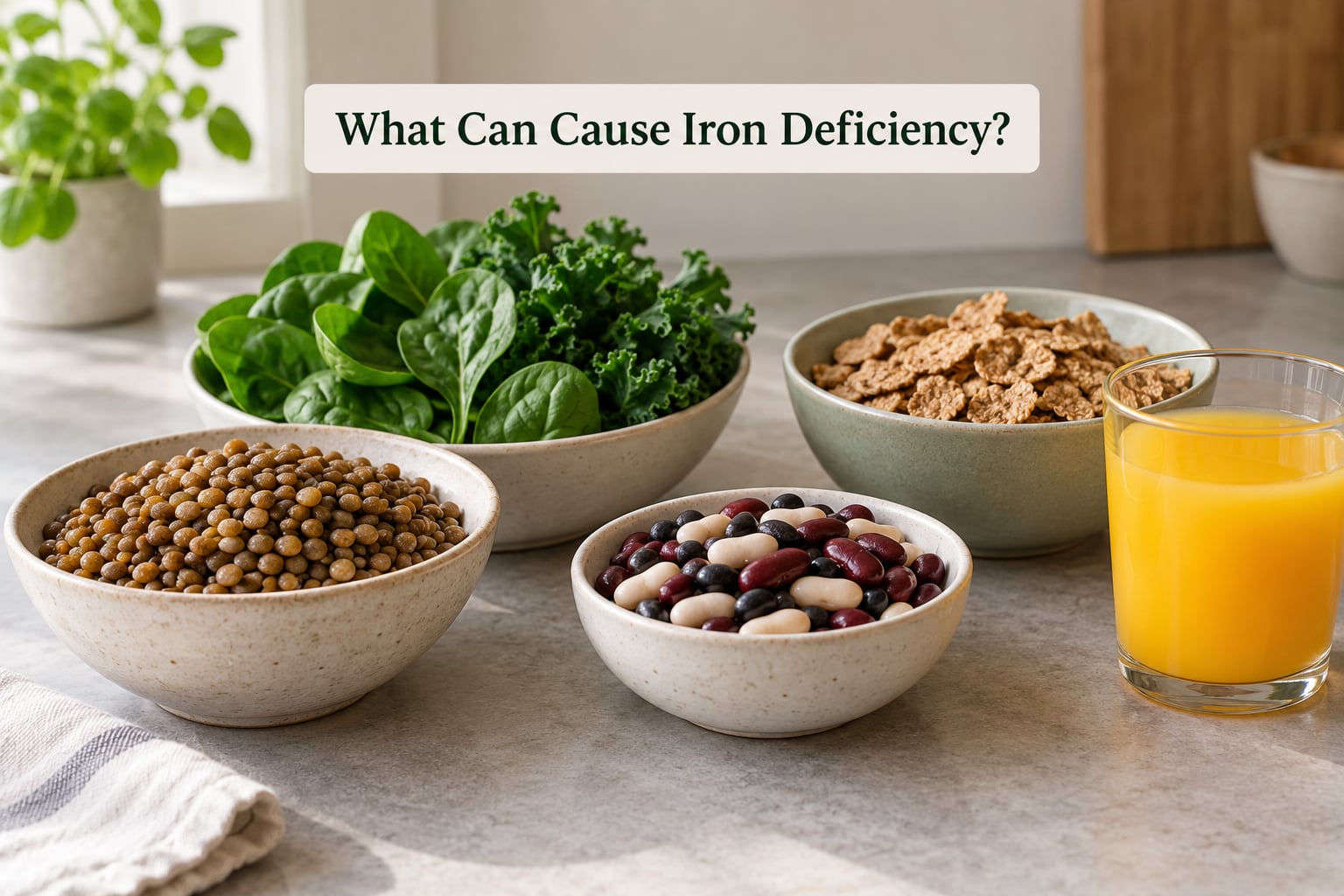
Causes fall into four groups, and working out which one applies to you is often more useful than the symptom list itself.
Not enough coming in. Dietary iron needs differ by diet. Meat, fish and poultry supply heme iron, which absorbs readily. Plant sources — beans, lentils, tofu, fortified cereals, leafy greens — supply non-heme iron, which absorbs less easily and is also blocked by tea, coffee, calcium and some plant compounds eaten alongside it.
Higher demand. Pregnancy, breastfeeding and adolescence all increase the amount of iron the body needs. Blood loss increases it further: heavy menstrual bleeding (menorrhagia), bleeding fibroids, stomach ulcers or bowel conditions.
Blood loss. Heavy periods are the most common cause in premenopausal women. Postmenopausal bleeding from the gut is a specific reason to see a doctor promptly. In men, gastrointestinal blood loss is a leading cause and is easy to overlook. Frequent blood donation is another.
Poor absorption. Coeliac disease, Crohn’s disease, ulcerative colitis and other gut conditions limit absorption. Bariatric surgery, long-term antacid or proton pump inhibitor use, and frequent NSAID use can contribute too.
Pregnancy and menopause also change the picture. Heavy periods can lighten after menopause but the risk does not disappear; any unexplained bleeding then needs checking rather than assuming.
Who Is More Likely to Have Low Iron?
Anyone can develop iron deficiency. These groups simply have more reasons stacked up against them.
- People who menstruate — especially with heavy or long periods.
- Pregnant or breastfeeding people — demand rises sharply and reserves often were not high to begin with.
- Adolescents — growth spurts and menstrual losses arrive at once.
- Endurance athletes — heavy sweating, foot-strike haemolysis and reduced gut absorption during intense training all count.
- Frequent blood donors — each donation removes a meaningful store.
- People with digestive disorders such as coeliac disease, Crohn’s disease or ulcerative colitis, and anyone who has had bariatric surgery.
- Adults with chronic conditions — kidney disease, chronic inflammation, heart failure — where iron handling gets disturbed.
- Men and postmenopausal women — where an underlying bleed, rather than the diet, is usually the reason to look further.
- Infants and young children — with their own needs around birth, growth and nutrition.
Being in one of these groups does not mean you are low on iron. It means a test is a reasonable first move rather than an afterthought.
How Can Low Iron Levels Be Checked?
You cannot check iron levels yourself at home. The tests are specific blood measurements, and they need to be read together — one number on its own will mislead you.
What a clinician does first is take stock: your symptoms and how long they have lasted, your menstrual history, medications and supplements, your diet, recent blood donation, any surgery, and your weight. The point is to look for the cause, not just the result.
| Test | What it measures | Why it matters |
|---|---|---|
| Complete blood count (CBC) | Haemoglobin, red cell count and cell size | Shows whether anaemia is present and what type |
| Ferritin | Your stored iron | Falls first; below about 30 ng/mL is widely treated as depleted |
| Serum iron | Iron circulating in blood right now | Varies day to day, so read it with the panel |
| TIBC and transferrin saturation | How much your blood can carry and what fraction is filled | Fills out the picture alongside ferritin |
A ferritin result below roughly 30 ng/mL is the number most often quoted as depleted iron stores. Some clinicians prefer a higher cut-off, particularly where fatigue and exercise tolerance are the complaint, while others treat 30 as the floor. There is genuine disagreement here, so ask what threshold your clinician is using and why.
One caution matters: ferritin also rises during infection and inflammation, so a level can look reassuring while stores are actually low. That is why it is never read on its own.
Do not start iron on the strength of symptoms. Iron is a real medicine with real side effects, it interacts with some medications, and in a small number of people it is harmful. If a test shows low stores, the cause still needs finding.
What Should You Do If You Think You Are Low on Iron?
Book an appointment with a healthcare professional rather than self-prescribing. Ask for a ferritin test alongside the full blood count if only the count has been done, since the count alone can miss depleted stores entirely.
Before you go, write a short history. Note when the fatigue started, whether it changed suddenly or crept in, your heaviest days of bleeding and how many pads or tampons you use, whether you donate blood, your cycle timing, your diet, and any supplements or medications you take. Two minutes of notes gives a clinician far more to work with.
Meanwhile, iron-containing foods still support normal nutrition. Pair non-heme sources such as lentils or fortified cereal with something high in vitamin C like citrus or peppers, and keep tea and coffee away from iron-rich meals by an hour or so. Food helps maintain normal status, but it cannot outrun ongoing blood loss or an absorption problem.
Seek urgent medical care rather than a routine appointment if you have chest pain, breathlessness at rest, fainting or near-fainting, a racing or irregular heartbeat that will not settle, black or bloody stools, vomiting blood, or any bleeding you cannot account for. Those need same-day attention.
Frequently Asked Questions
Does fatigue mean I am low on iron?
Not on its own. Fatigue is the most commonly reported sign of low iron, but it is also the most common symptom of poor sleep, stress, under-eating, thyroid problems, vitamin B12 deficiency and dozens of other conditions. What makes iron worth checking for is fatigue alongside clues like breathlessness on stairs, pale inner eyelids, brittle nails, ice cravings or restless legs. A blood test is the only reliable way to tell.
Can you be low on iron without having anemia?
Yes, and it is more common than most people realise. Iron stores measured by ferritin fall well before haemoglobin does, so you can have depleted iron with a normal full blood count and still feel real symptoms. Many people describe exactly this: tired, dizzy, achy and short of breath, with a count that looks fine. Some clinicians treat ferritin above the usual cut-off as acceptable, others prefer higher levels, so the conversation matters.
Do vegetarian and vegan diets always cause iron deficiency?
No. Plant-based diets supply non-heme iron, which absorbs less readily than the heme iron in meat, but plenty of people following them have healthy iron levels. Absorption improves when non-heme sources are eaten with vitamin C, and when tea, coffee and large calcium servings are kept away from iron-rich meals. Risk rises with heavy menstrual loss or an absorption condition, so regular checks make sense during pregnancy, adolescence and for frequent blood donors.
Should I take an iron supplement if I feel tired?
Best not to start one on your own. Iron causes side effects including constipation, nausea and dark stools, it interacts with several medications, and more iron is not automatically better. Taking it without a confirmed deficiency also masks the real cause, which is often blood loss or a gut condition that needs its own treatment. Have a test first, and follow any plan your doctor or pharmacist agrees with you.
When should low iron symptoms need urgent medical care?
Some symptoms should never wait for a routine appointment. Seek same-day or emergency care for chest pain, breathlessness at rest, fainting, a racing or irregular heartbeat that will not settle, black or tarry stools, vomiting blood, or bleeding you cannot account for. Unusual bleeding after menopause matters for the same reason. These can point to something needing same-day attention rather than a routine iron check.
What to Do First
The signs you may be low on iron are worth taking seriously, including when your haemoglobin comes back normal — depleted stores can leave you feeling rough long before anything shows on a blood count. So if these symptoms have been there for more than a few weeks, are getting worse, or come with bleeding or unexplained weight loss, arrange a professional assessment and ask for a ferritin test with your full blood count.
What not to do is diagnose yourself or start iron from a symptom checklist. Getting tested, and finding out why your iron dropped, is the step that actually moves things forward.