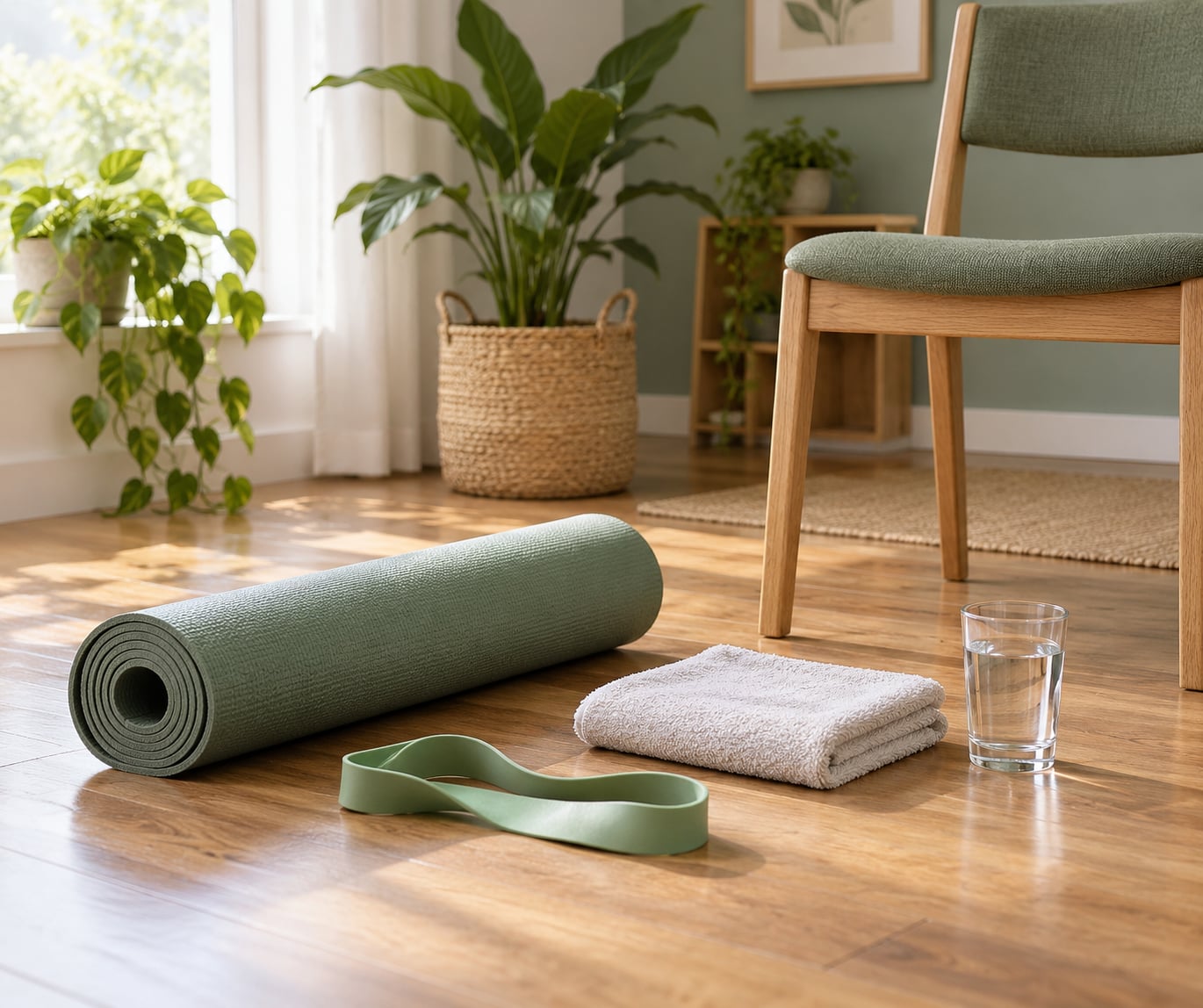
Yes — most people can keep moving with back pain, as long as the movement stays gentle, stays in a range that does not aggravate symptoms, and gets built up slowly. Total rest is usually the wrong response: inactivity stiffens the joints and weakens the muscles that support the spine, and pain that lingers tends to linger longer because of it. Gentle mobility, walking and core stability work are the approach clinicians most often recommend for uncomplicated, recent back discomfort.
This guide covers movement only. It is general information, not a diagnosis or an individual treatment plan, and it cannot tell you what is causing your pain. If your symptoms are severe, persistent or worsening, or you have a diagnosed spine condition, talk to a doctor or physiotherapist before you start. This page was last reviewed in October 2026.
Before anything else, three rules for daily movement. They matter as much as the exercises themselves, because most flare-ups start with an ordinary task done badly rather than with a workout.
- Bend at the hips and knees, not at the waist. Keep your spine in a neutral, tall position as you lower yourself. Think about sending your hips back rather than tipping your chest down.
- Get close to what you lift. Hold loads near your body and brace your abdomen gently before you lift, rather than reaching out with straight arms to grab something far away.
- Turn with your feet, not your spine. Pivot on the ball of the foot and take small steps to rotate. Twisting through the middle of the back while carrying or lifting puts the most load on the part that already hurts.
Table of Contents
- What You Need
- Step-by-Step: How to Exercise With Back Pain Safely
- 1. Check Your Symptoms Before Moving
- 2. Warm Up Without Aggravating Your Back
- 3. Try Gentle, Pain-Free Mobility
- 4. Add Gradually Without Jumping to Heavy Exercise
- 5. Monitor How Your Back Responds
- 6. Finish With a Gentle Cool Down
- Common Mistakes and What to Do Instead
- Exercises to Avoid Until You Know They Are Safe
- When to Ask a Doctor or Physiotherapist
- Frequently Asked Questions
- Is walking safe when I have back pain?
- Should I exercise if my back pain is worsening?
- What type of exercise is best for back pain?
- How long should I wait before exercising after hurting my back?
- Can stretching help relieve back pain?
- How do I know when back pain needs medical attention?
- Start Slowly and Keep What Feels Safe
What You Need
You need almost nothing to start. Clear floor space about six feet by three feet is enough for most of the movements below, and a wall you can lean against is handy.
These optional items make things more comfortable, and none of them are essential:
- An exercise mat for cushioning on hard floors, or a folded towel if you do not have one.
- A stable chair without wheels, for seated balance work and for support during standing mobility.
- A light resistance band for gentle strengthening later on, once pain-free movement feels easy.
- A water bottle and a timer or phone, so you are not guessing at hold times.
- Loose clothing and a flat, non-slip surface for the floor work.
Skip all of it if the pain is severe, has been there for weeks without improving, or is getting worse week to week. Getting individual guidance first is the safer use of your time in that case, not a slower path to the same result.
Step-by-Step: How to Exercise With Back Pain Safely
The process below takes about 15 to 20 minutes on a day when back discomfort is mild and recent. Follow the steps in order, and stop if any of the warning signs in step 1 apply to you.
1. Check Your Symptoms Before Moving
Gentle movement is a reasonable thing to try when your pain is dull or achy, stayed within the muscles around the spine, and came from something ordinary such as a long drive, a new exercise, or lifting something awkward.
Stop and contact a doctor instead if you notice new weakness in your legs, numbness around the groin or inner thighs, loss of bladder or bowel control, fever alongside back pain, or pain following a significant fall or accident. Severe pain that is worsening rather than settling also belongs in that group, and so does pain that wakes you from sleep at night.
2. Warm Up Without Aggravating Your Back
Warm up for 3 to 5 minutes with slow, easy movement rather than static stretching. Slow walking, an easy cycling pace, ankle pumps, shoulder rolls and gentle posture shifts all get blood moving without loading the spine.
Work only in a comfortable range and keep breathing normally. Holding your breath while you move is a common habit and a counterproductive one, since bracing without exhaling tightens exactly the muscles you are trying to relax.
3. Try Gentle, Pain-Free Mobility
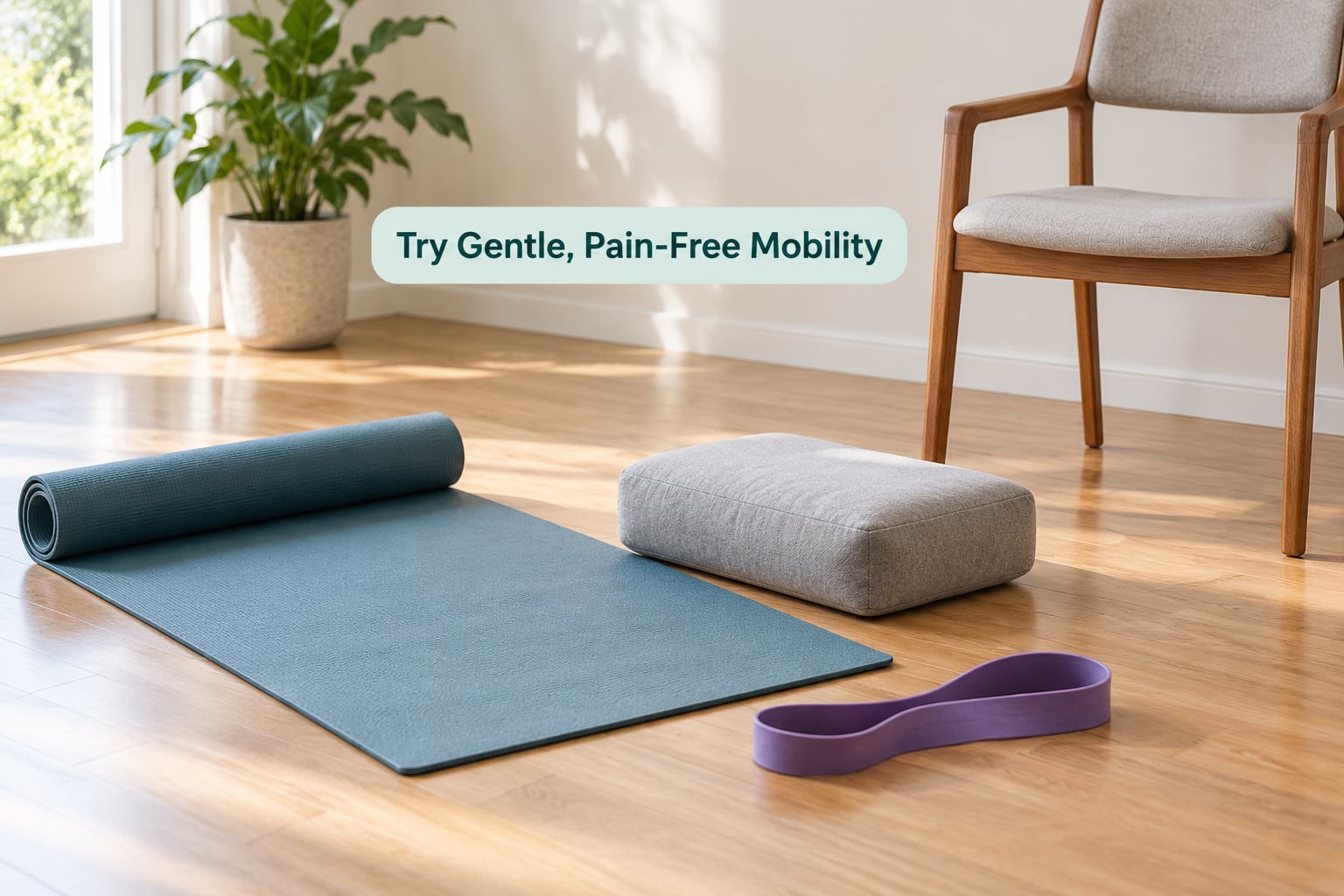
Start small. Small knee bends while holding the chair, supported hip shifts, a few minutes of walking, and slow cat-cow movements on hands and knees cover most of what a beginner needs. Do not force range of motion, and drop any movement that clearly increases your symptoms.
The table below shows how much to do of each. Difficulty is for a beginner with no training background, and the timings are starting points, not targets to push toward.
| Movement | Main target | How much | Difficulty |
|---|---|---|---|
| Pelvic tilt | Lower back and deep core | 10 slow reps | Easy |
| Cat-cow | Spinal mobility | 8 to 10 cycles | Easy |
| Knee-to-chest, lying down | Lower back and glutes | Hold 20 to 30 seconds each side | Easy |
| Child’s pose with support | Lower back and hips | Hold 20 to 30 seconds | Easy |
| Glute bridge | Glutes and core stability | 2 sets of 10, hold 3 seconds | Moderate |
| Bird-dog | Core stability and balance | 2 sets of 8 each side, hold 5 seconds | Moderate |
| Wall slide | Upper back and posture | 2 sets of 10 | Moderate |
| Supine hamstring stretch | Hamstrings | Hold 30 seconds each side | Easy |
| Walking | General conditioning | 5 to 10 minutes | Easy |
These are general mobility and stability movements, not treatment for a specific spinal problem. If you have been told you have a disc issue or another diagnosed condition, a physiotherapist should show you which movements suit it, since the advice differs by diagnosis.
4. Add Gradually Without Jumping to Heavy Exercise
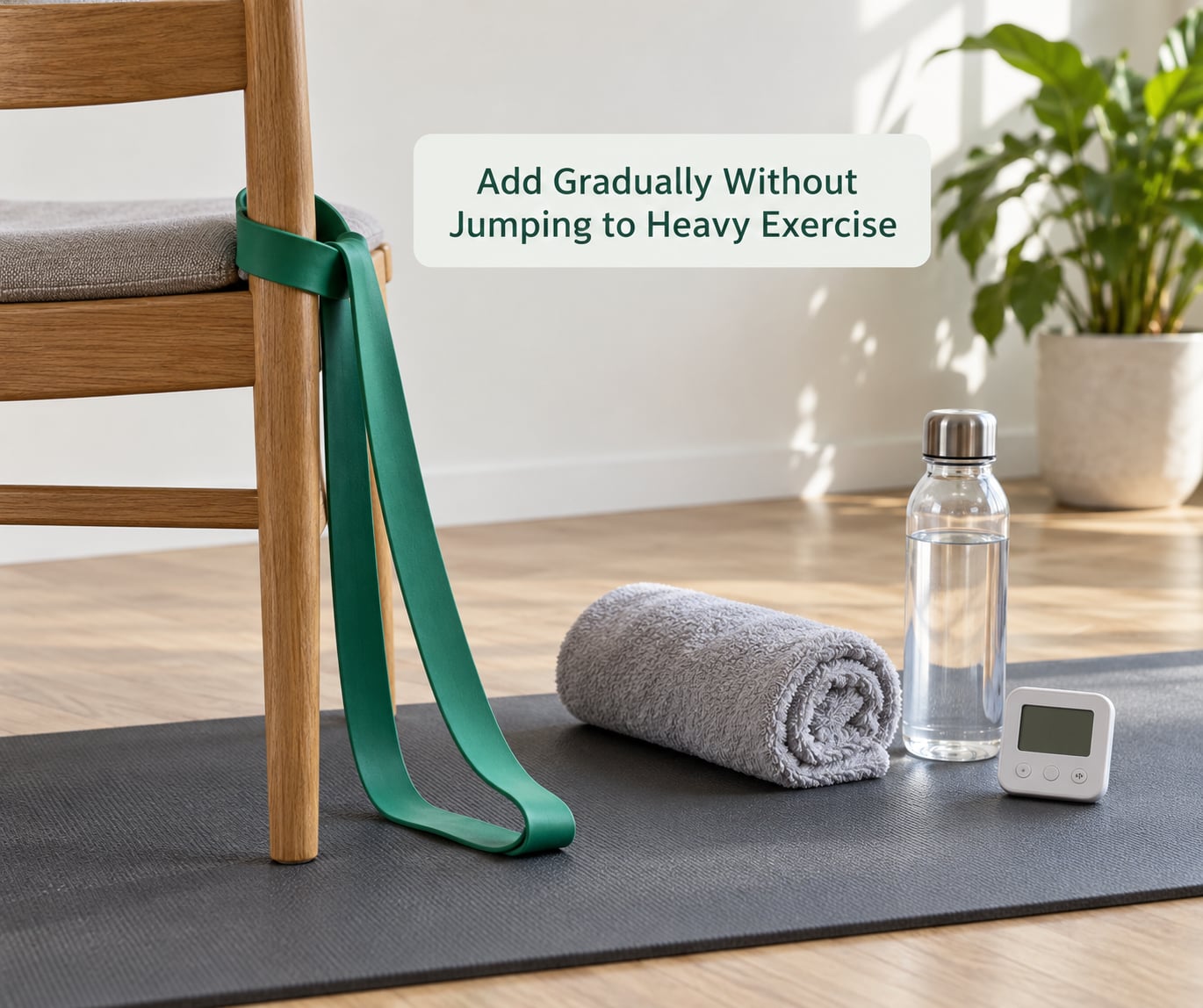
Progress one variable at a time, and time comes first. Add a minute or two to your walking before you add resistance, and add resistance before you add speed. A sensible rhythm is one set to start, two to three sessions a week, and an increase of roughly ten percent in volume once a movement has felt comfortable for a week.
Avoid abrupt changes, and treat anything your clinician has not cleared as off the table for now. Where a movement feels uncomfortable, substitute rather than push: if a barbell squat aggravates your back, try a lighter box squat or a hip-hinge drill with a very light load, or drop to walking that week and try again later.
5. Monitor How Your Back Responds
A neutral response, or mild discomfort that settles while you keep moving, means you are in a workable range. Temporary muscle fatigue or a dull ache during a set is not the same thing as pain that lingers or worsens afterward.
Stop if the pain becomes sharp or shooting, radiates farther down the leg than before, or keeps building through the set. Also stop if you feel worse for more than a day or two afterwards — that is your signal to drop back to the previous level rather than press on.
6. Finish With a Gentle Cool Down
Finish with 3 to 5 minutes of slow walking and relaxed breathing, and return to normal activity gradually rather than snapping straight back into whatever you were doing before.
Skip aggressive stretching and end-of-range spinal movements after the session. Pushing into a position that felt tight during a workout often leaves people more sore than the workout itself did.
Common Mistakes and What to Do Instead
- Pushing through sharp pain. Sharp or shooting pain is information, not a challenge. Switch to the movement you did earlier in the warm-up instead.
- Copying a high-impact routine online. A workout built for a healthy 25-year-old is not a beginner’s program with a sore back. Use movements where you control the range.
- Increasing duration too fast. Going from nothing to 45 minutes is the most reliable way to end up worse. Add time in small increments instead.
- Twisting under load. Rotating while holding something heavy or while your back is rounded concentrates stress on the lumbar spine. Turn with your feet.
- Skipping warm-up and cool-down. Cold, stiff tissue responds worse than warm tissue. Five minutes at each end of the session costs very little.
- Ignoring warning signs. Weakness, groin numbness, bowel or bladder changes, fever or night pain need a clinician, not a modified workout.
Exercises to Avoid Until You Know They Are Safe
These movements are commonly the wrong choice during unexplained back discomfort. Suitability varies with your symptoms and medical history, so treat this as a holding list rather than a permanent ban.
- Running, jumping, hopping and burpees. Impact needs core control to absorb; when attention lapses mid-set, that control is the first thing to go.
- Loaded twisting such as cable woodchops or heavy rotational lifts.
- Sit-ups and crunches, which repeatedly flex the spine under load.
- Standing forward bends and toe touches, where gravity does most of the work at end of range.
- Heavy deadlift-style loading with poor bracing or a rounded back.
- Deep loaded spinal flexion such as the good morning with heavy weight.
- Aggressive standing hamstring stretching, which rounds the lower back while pulling on the hamstrings.
When to Ask a Doctor or Physiotherapist
Short-lived muscular discomfort after unusual activity — a dull ache that settles with gentle movement and eases within a day or two — is usually the kind of thing that responds to the conservative approach above.
Get professional assessment if pain persists beyond a few weeks, continues to worsen instead of improving, or keeps flaring up each time you increase activity. The same applies to pain that wakes you at night, that keeps you awake or stiff in the morning, or that comes with leg weakness, numbness or tingling.
Symptoms that follow a fall, a car accident or a sudden twist deserve a look too, as does back pain with a fever. A physiotherapist can also be useful without anything being seriously wrong, because they can show you the right progressions for your particular pattern of pain.
Frequently Asked Questions
Is walking safe when I have back pain?
Walking is usually one of the safest ways to keep moving with back pain, because it loads the body gently and rhythmically without bending or twisting under load. Start with five to ten minutes at an easy pace on flat ground and build from there. Shorten your stride slightly and keep your chest tall rather than leaning back. If walking clearly increases your symptoms, shorten the session and stop.
Should I exercise if my back pain is worsening?
Not until you understand why it is worsening. A temporary increase in pain during a session is different from pain that keeps rising over several days, and the second is a reason to pause exercise and contact a clinician. New leg weakness, groin numbness, bowel or bladder changes, fever or night pain need assessment regardless. Resting completely for more than a day or two usually makes things worse, so seek advice rather than simply stopping.
What type of exercise is best for back pain?
Gentle mobility work combined with walking is the usual starting point, followed by slow core stability exercises once basic movement feels comfortable. Nothing works for everyone: the right choice depends on where your pain is, whether it is recent or long-standing, and whether you have a diagnosed condition. Pelvic tilts, cat-cow, knee-to-chest and glute bridges are common early options for uncomplicated discomfort.
How long should I wait before exercising after hurting my back?
There is no fixed number of days that suits everybody. Many people start very gentle movement within a day or two and find that walking eases stiffness, while others need a few days to settle first. The practical guide is whether pain is easing or climbing: if a short, easy walk does not make things worse, that is a reasonable level to start at. Severe or escalating symptoms warrant professional advice first.
Can stretching help relieve back pain?
Gentle stretching can help with stiffness and often feels better in the short term, but it is not a cure and aggressive end-of-range stretching can aggravate symptoms. Stick to mild positions held for 20 to 30 seconds, breathe normally, and stop before the position becomes painful. If a stretch triggers pain that travels down a leg, drop that stretch and speak to a clinician about what is going on.
How do I know when back pain needs medical attention?
Seek medical attention for new leg weakness, numbness around the groin, loss of bladder or bowel control, fever with back pain, pain after a significant injury, or pain severe enough to be worsening steadily. Also book an assessment if discomfort lasts more than a few weeks, disturbs sleep, or returns every time you increase activity. This article offers general guidance only and cannot diagnose your symptoms or build you an individual treatment plan.
Start Slowly and Keep What Feels Safe
If you do one thing from this guide, take a five-minute walk and notice how it feels during, then again an hour later. That gives you a baseline, and it is far more useful than any list of exercises read without trying them.
Build from what stayed comfortable, keep the warning signs above in mind, and get a clinician involved if the pain persists, worsens, or comes with weakness, numbness or sleep disruption. Slow progress beats no progress, and it beats pushing through symptoms that were telling you something.