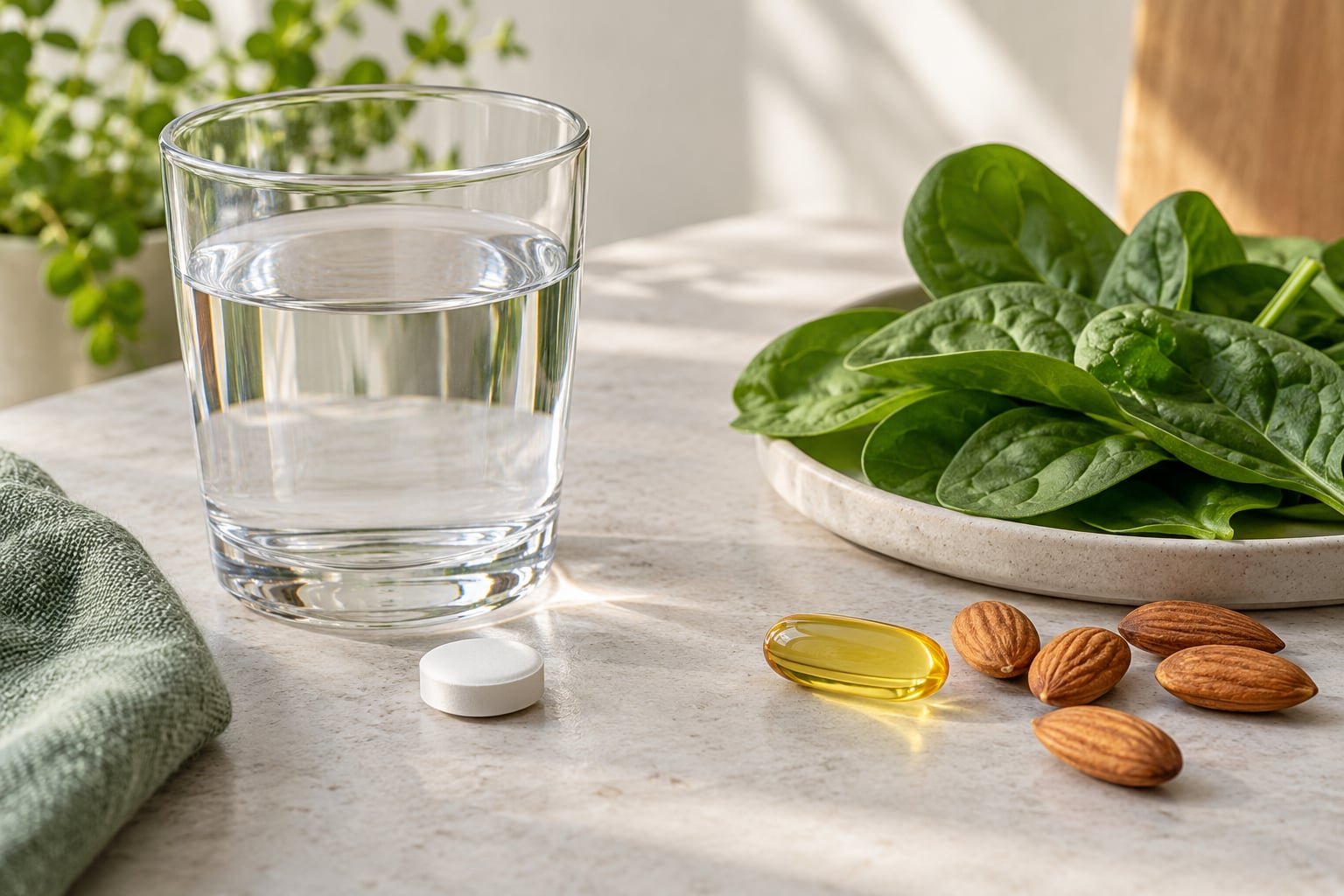
Fat-soluble vitamins (A, D, E and K) dissolve in fat and are stored in your liver and fatty tissue. Water-soluble vitamins (the eight B vitamins and vitamin C) dissolve in water, are used right away, and any surplus leaves your body in urine. That single difference decides how a supplement behaves: whether it builds up or gets cleared out.
It also decides practical things that supplement labels never explain. Fat-soluble vitamins need dietary fat at the same meal to be absorbed properly, while water-soluble vitamins do not. And a fat-soluble supplement taken daily for months can drift toward a harmful level, because the body has no quick way to dump the excess.
Table of Contents
- Water Soluble vs Fat Soluble Vitamins Explained: At a Glance
- What Is the Difference Between Water-Soluble and Fat-Soluble Vitamins?
- Water Soluble vs Fat Soluble Vitamins Explained
- How fat-soluble vitamins travel from your plate to your bloodstream
- Which vitamins should not be taken together?
- Which Vitamins Are Water-Soluble and Which Are Fat-Soluble?
- The four fat-soluble vitamins: A, D, E and K
- The eight B vitamins and what each one does
- Is vitamin B12 water soluble?
- Is magnesium a vitamin?
- What Foods Provide Each Type of Vitamin?
- Fat-soluble vitamins in food
- Water-soluble vitamins in food
- Are Water-Soluble Vitamins Safer Than Fat-Soluble Vitamins?
- Which Type of Vitamin Should You Choose?
- Frequently Asked Questions
- Are B vitamins water soluble?
- Do fat-soluble vitamins need to be taken with food?
- Can I take vitamins A, D, E, and K together?
- What happens if I take too many water-soluble vitamins?
- Do I need a multivitamin if I eat a varied diet?
- Conclusion
Water Soluble vs Fat Soluble Vitamins Explained: At a Glance
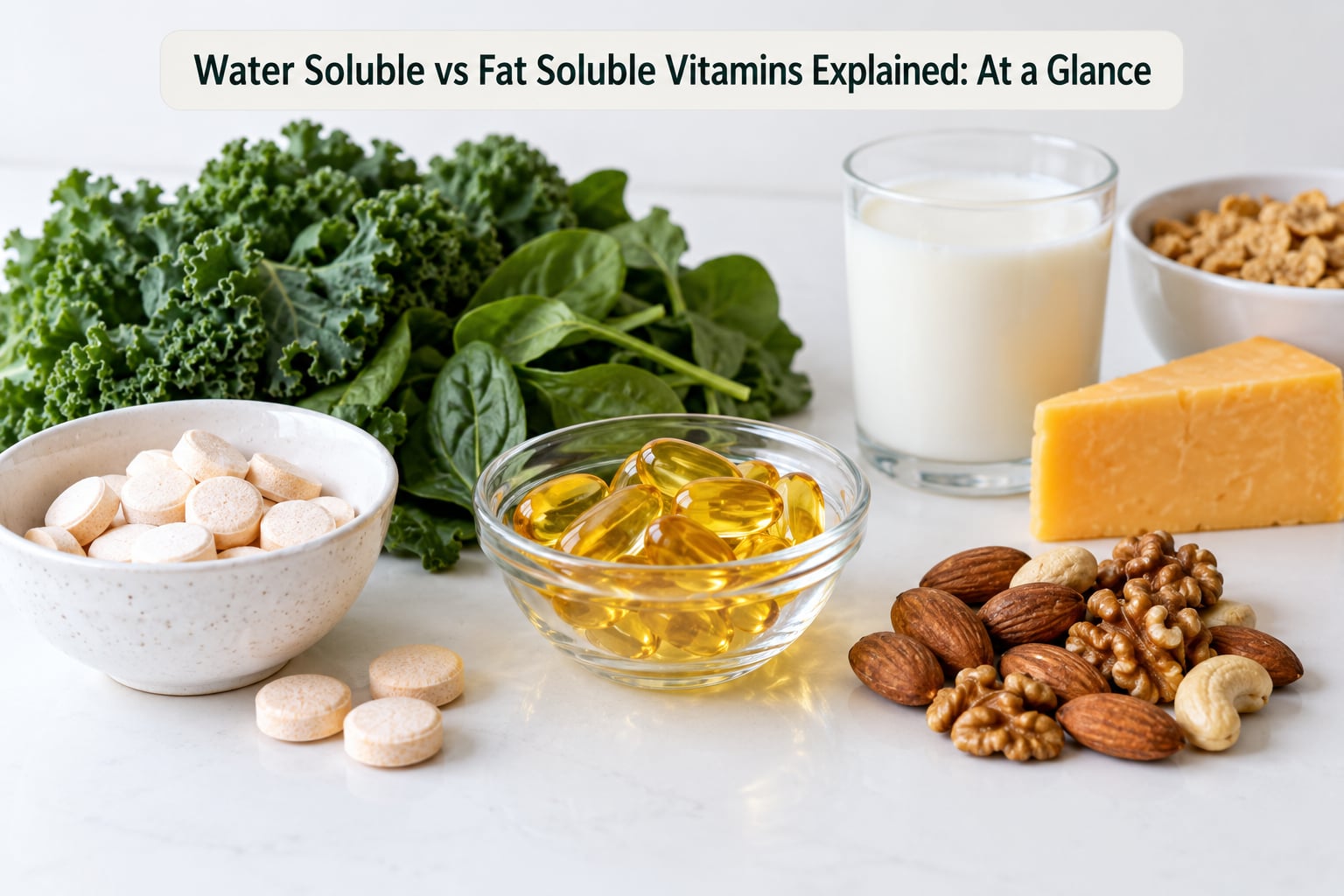
Here is the short version most people are looking for. Everything below is explained in more detail further down.
| Factor | Fat-soluble vitamins (A, D, E, K) | Water-soluble vitamins (B vitamins and C) |
|---|---|---|
| Dissolve in | Fat and oil | Water |
| Need dietary fat to absorb | Yes, plus bile acids from the liver | No |
| Route into the blood | Absorbed through the lymph first | Straight into the bloodstream |
| Stored in the body | Yes, in the liver and fatty tissue | Very little, mostly in the liver |
| What happens to a surplus dose | Accumulates over time | Excreted in urine |
| Overdose risk | Higher, because levels can build up | Lower, with a few exceptions |
| Main food sources | Egg yolks, oily fish, leafy greens, nuts, fortified dairy and oils | Whole grains, meat, legumes, citrus, berries, fortified cereals |
| Time to correct a deficiency | Slower, since stores fill gradually | Faster, because intake is used immediately |
Quick memory trick: ADEK is stored, B and C are flushed. If you are ever looking at a label and cannot tell which group a vitamin falls into, the first four letters of the alphabet are your shortcut for the stored ones.
What Is the Difference Between Water-Soluble and Fat-Soluble Vitamins?
Water Soluble vs Fat Soluble Vitamins Explained
Water-soluble vitamins travel through body fluids and get used as needed, so they need to arrive regularly through food or supplements. Fat-soluble vitamins need fat and bile to be absorbed, then travel through the lymph before reaching your blood, and they settle into fatty tissue where they can pile up.
How fat-soluble vitamins travel from your plate to your bloodstream
The process takes four steps, and each one can fail on its own.
- Fat arrives in the small intestine. A meal containing oil, butter, avocado, nuts or fatty fish supplies the fat that the vitamin needs to hitch a ride on.
- Bile gets released. Your liver produces bile, and the gallbladder empties it into the intestine when fat shows up. Bile breaks the fat into tiny droplets.
- Micelles form. These tiny droplets carry the fat-soluble vitamin across the watery gut lining, which is the only way it can get through.
- Lymph and then blood. The fat enters the lymphatic system before reaching the bloodstream, which slows the trip and spreads it through the tissues.
That is why a fat-soluble supplement taken on an empty stomach is wasted. People argue about exactly how much fat is needed, and the honest answer is that a normal mixed meal is more than enough. You do not need to chase an exact gram count, and you do not need a fattier meal than the one you were already planning to eat.
Water-soluble vitamins skip all of it. They dissolve freely in the gut fluid and pass into the bloodstream directly, which is why there is a widespread myth that water-soluble vitamins need a fatty meal. They do not. Drinking water with them is fine, and the bright yellow urine some people notice after a B vitamin is simply excess leaving the body, not a sign that the supplement failed.
Cooking is where the two classes separate again. Water-soluble vitamins such as vitamin C and several B vitamins break down with heat and long cooking times, so boiling vegetables and pouring the water down loses a real fraction of them. Fat-soluble vitamins are considerably more stable in a pan.
Which vitamins should not be taken together?
This is the most searched question in this whole topic, and the honest answer is that most vitamin pairs are fine together. A few are worth separating, mainly because of minerals that compete for the same absorption pathway rather than vitamins clashing with each other.
- Calcium and iron, or calcium and magnesium. Large mineral doses taken at the same time can reduce how much of each one the gut takes up. Splitting them across the day is the simple fix.
- Zinc over the long term, in high doses. Sustained high zinc intake can interfere with copper absorption, which is why it does not belong in an unsupervised daily routine.
- Iron alongside coffee, tea or dairy. This is not a vitamin interaction, but it is the most common reason a supplement seems not to work. Iron pairs best with vitamin C and a normal meal.
Taking A, D, E and K in one multivitamin is common and not a problem by itself. The concern with those four is stacking: a multivitamin plus a separate high-dose vitamin D, plus a fish oil capsule that already contains vitamin A, plus a fortified drink can quietly push one of them over its upper intake level. Read the label of everything you take and add up the totals.
Which Vitamins Are Water-Soluble and Which Are Fat-Soluble?
There are thirteen vitamins that the body needs in small amounts. Four of them are fat-soluble. The other nine are water-soluble. Everything else sold as a vitamin is either a mineral, a herb or something your body makes itself.
The four fat-soluble vitamins: A, D, E and K
- Vitamin A. Supports vision, immune function and skin. It exists as preformed retinol from animal sources and liver, and as beta-carotene from plants. Too much preformed vitamin A over time can cause real harm, while beta-carotene from food carries much less risk.
- Vitamin D. Helps calcium absorption and bone health, and it is the one most people run short on. Your skin makes it from sunlight, which is why indoor workers and people in winter at higher latitudes are the usual at-risk groups.
- Vitamin E. A group of antioxidant compounds that protect cell membranes. Almonds, sunflower seeds and vegetable oils are the richest everyday sources. Cooking does not destroy it.
- Vitamin K. Needed for normal blood clotting and also for bone proteins. Leafy greens such as kale and spinach are extremely concentrated sources, one cooked cup of kale delivering far more than a full day’s requirement.
The eight B vitamins and what each one does
The B complex is a group, not a single vitamin. Eight of them carry the name, and they travel together in foods.
- B1 (thiamine) turns carbohydrates into energy. Found in pork, whole grains and legumes.
- B2 (riboflavin) helps break down fats and proteins. Found in dairy, eggs and almonds.
- B3 (niacin) supports metabolism and the normal function of skin and nerves. Found in meat, fish and fortified grains.
- B5 (pantothenic acid) helps convert food into usable energy. Widely spread across animal and plant foods.
- B6 (pyridoxine) is involved in over a hundred enzyme reactions, including neurotransmitter production. Found in fish, potatoes and bananas.
- B7 (biotin) supports fat and carbohydrate metabolism. Eggs, nuts and sweet potatoes are solid sources.
- B9 (folate) is essential for cell division and pregnancy. Leafy greens, beans and fortified cereals are the main sources.
- B12 (cobalamin) helps with red blood cell formation and nerve function. It is found almost entirely in animal foods.
Vitamin C completes the water-soluble group. It is best known for collagen formation, iron absorption and immune function, and it is the vitamin people reach for when they feel a cold coming on.
Is vitamin B12 water soluble?
Yes, B12 is water soluble, which surprises people who assume it behaves like D because it is tied to animal foods. It is grouped with the B vitamins, not with A, D, E and K. The catch is different: B12 absorption depends on stomach acid and a protein called intrinsic factor, and both of those weaken with age. So an older adult can eat a normal amount of B12 and still end up deficient, and vegans and vegetarians get very little of it from food at all. That is the group most often advised to check their intake with a professional.
Is magnesium a vitamin?
No, magnesium is a mineral, not a vitamin, and it does not fit neatly into either column. It is absorbed in both ways, so the water-soluble versus fat-soluble framing does not really apply to it. It usually comes in forms whose absorption differs a lot from one another, which is why some people tolerate one form and not another.
What Foods Provide Each Type of Vitamin?
For most people, a varied diet covers both categories without any thought at all. It helps to know what each class looks like on a plate, though, because most diets over-cover one group and skip the other.
Fat-soluble vitamins in food
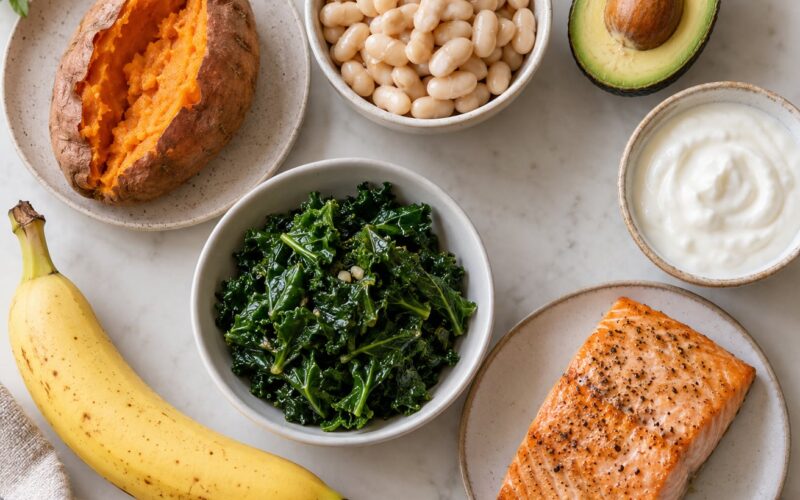
- Egg yolks for vitamin A and D.
- Salmon, sardines and mackerel for vitamin D and A.
- Spinach, kale and broccoli for vitamin K and carotenoids.
- Almonds, sunflower seeds and olive oil for vitamin E.
- Fortified milk or plant milks for vitamins D and A.
- Cod liver oil and other fish oil supplements, which carry both A and D.
Water-soluble vitamins in food
- Citrus, peppers and berries for vitamin C.
- Fortified cereals for B vitamins, often in meaningful amounts.
- Meat, fish and eggs for B6, B12 and niacin.
- Beans, lentils and chickpeas for folate and thiamine.
- Whole grains for B vitamins and magnesium.
- Potatoes, bananas and avocado for B6 and potassium.
Because fat-soluble vitamins ride along with fat, whole foods tend to solve the absorption problem before it starts. A plate of spinach with olive oil and a hard-boiled egg delivers vitamin K, vitamin A and vitamin E in a form your body absorbs better than any separate pill. That pairing habit is the single most useful thing on this whole page.
Two other diet patterns are worth flagging. Vegans need to plan for B12 and vitamin D specifically, since neither is naturally present in plant foods in any meaningful amount. And people following very low-fat or weight-loss diets should know that cutting fat to almost nothing works against absorption of A, D, E and K, so a little fat in each meal matters more than the total fat in the day.
Heat is the other practical factor. Short steaming and stir-frying preserve the water-soluble vitamins far better than long boiling, and cooking in a broth you then drink keeps the water-soluble fraction in the meal.
Are Water-Soluble Vitamins Safer Than Fat-Soluble Vitamins?
Generally yes, in the specific sense that water-soluble vitamins are far harder to overdose on through ordinary food and supplements. That is because your body filters them into urine. But lower risk is not the same as no risk, and the exception matters.
Fat-soluble vitamins can reach a harmful level through accumulation, a condition sometimes called hypervitaminosis. It usually shows up after long-term use of high doses rather than after a single dose, and the signs are vague enough to be easy to miss: nausea, headaches, fatigue, hair loss or changes in skin and bone. Vitamin A and vitamin D are the two that cause the most concern, and both have established upper intake levels for that reason.
Water-soluble vitamins are not automatically safe. Vitamin B6 in high doses over time can damage nerves, and there is no early warning sign people reliably notice. Niacin can cause flushing and liver problems at high doses. Both are common in large-dose supplement stacks, which is exactly the situation where the usual reassurance fails.
So the answer is a qualified yes. Water-soluble vitamins clear out quickly, fat-soluble ones can build up, and neither class should be taken in high doses on your own initiative. If you take any prescription medication, have kidney or liver conditions, are pregnant, or are supplementing for a specific deficiency, talk to your doctor, pharmacist or registered dietitian first. The same goes for anyone who wants to take more than the recommended dietary allowance for extended periods.
Which Type of Vitamin Should You Choose?
Neither type is better in general. The honest answer depends on what your diet already does for you and what a professional has told you about your levels.
Water-soluble vitamins make sense when your diet misses the obvious categories. Someone eating mostly refined carbohydrates and few vegetables or animal products is the classic case, and a plain multivitamin covers the B vitamins and vitamin C without much risk. Because these vitamins leave the body quickly, they do not stockpile, so a missed day matters more with them than with the fat-soluble group.
Fat-soluble vitamins come into play when intake is genuinely low or a deficiency has been diagnosed. Vitamin D is the most common one, particularly for people who work indoors, live somewhere with long dark winters, or cover most of their skin. Vitamin K matters for anyone who eats very little leafy greenery. Vitamin E and vitamin A are usually fine from a mixed diet, which is a good reason to check the label of a high-dose product rather than assume more is better.
A few decisions make the choice easier.
- Start from food. Can a realistic change to your meals fill the gap? Adding a vegetable at lunch and eggs at breakfast beats a bottle for most people.
- Fix your diet pattern first. If the issue is a low-fat diet, a vegan diet or a rushed routine, the supplement is covering a habit, not a nutrient gap.
- Read the full panel, including the vitamin A and D amounts per serving and how many servings the label assumes.
- Watch for stacking. Adding one supplement on top of a fortified drink, a fortified cereal and a fish oil capsule is the most common route to excess.
- Take fat-soluble vitamins with a meal that contains some fat, and water-soluble ones whenever suits you.
- Split large mineral doses across the day rather than stacking them together.
If your reason for supplementing is a specific symptom, a blood test result or a pregnancy, none of this general advice replaces that conversation. Get the individual assessment first.
Frequently Asked Questions
Are B vitamins water soluble?
Yes. All eight B vitamins, B1 through B12, are water soluble, and so is vitamin C. They dissolve in body fluids, get used as needed, and any surplus is excreted in urine rather than stored, which is why they need a regular supply from food or supplements. That also means they are easy to lose through cooking, since heat and long boiling degrade several of them. Two exceptions to the low-overdose rule are vitamin B6 and niacin, which can both cause problems at high doses.
Do fat-soluble vitamins need to be taken with food?
Yes, ideally with a meal that contains some fat. Fat-soluble vitamins, meaning A, D, E and K, cannot cross the intestinal wall without dietary fat and bile acids forming micelles that carry them across. A normal mixed meal with oil, butter, avocado, nuts or fatty fish is plenty. Taking them on an empty stomach or with dry crackers wastes much of the dose. Water-soluble vitamins need no such pairing, so they can be taken whenever is convenient.
Can I take vitamins A, D, E, and K together?
Yes, and most multivitamins do exactly that. There is no rule against combining the four fat-soluble vitamins, since they are frequently found in the same foods and the same products. The real issue is total intake. Because they accumulate, taking a high-dose vitamin D on top of a fortified drink, plus a fish oil capsule that already contains vitamin A, can push one of them over its upper intake level. Read every label and add up the amounts per day before stacking products.
What happens if I take too many water-soluble vitamins?
Most of the surplus leaves through your urine within a day or two, which is why the brighter colour some people notice after a high-dose B vitamin is normal and harmless. However, water soluble does not mean risk free. Sustained high doses of vitamin B6 can damage nerves, and niacin can cause flushing and liver problems at large amounts. Corrections for deficiencies should follow a professional plan rather than extra doses on your own, especially if you take medication or have kidney conditions.
Do I need a multivitamin if I eat a varied diet?
Most people eating a genuinely varied diet do not need one, because the thirteen vitamins come easily from that mix. A supplement makes more sense when your diet repeats the same foods, when you avoid a whole category such as animal products or leafy greens, or when a professional has identified a specific shortfall. If you do take one, choose a product near the recommended dietary allowance rather than a high-dose version, and take it with a meal containing some fat so the fat-soluble fraction is absorbed.
Conclusion
The distinction is simple once you have it. Water soluble vitamins dissolve in water, are used straight away and leave through urine. Fat-soluble vitamins dissolve in fat, need a fatty meal to be absorbed and settle into the liver and fatty tissue, which is why they can build up over time.
Start by looking at your last week of eating rather than a supplement shelf. If one category is clearly missing, fix that first with food, and pair vegetables with a source of fat. If you still think you need a supplement, keep the dose near the recommended dietary allowance, take fat-soluble vitamins with a meal, and check the labels of every product you use so nothing is being doubled up. Above all, do not start high-dose vitamins or stop a prescribed one without speaking to your doctor, pharmacist or registered dietitian.