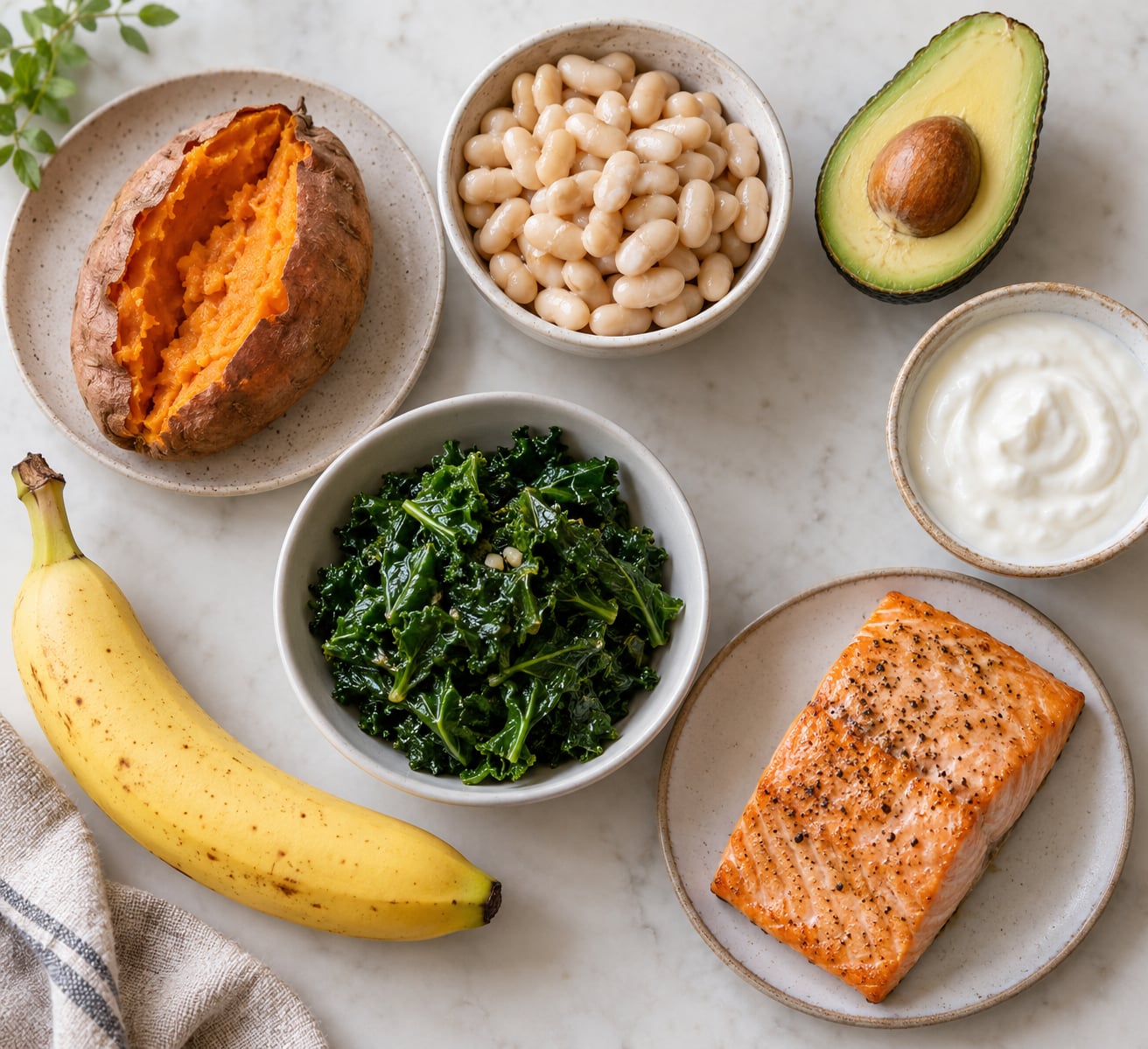
Potassium rich foods are everyday staples like potatoes, beans, leafy greens, bananas, yogurt and salmon, and you need them because your body makes none of this mineral on its own. Potassium keeps fluid inside your cells, lets nerves fire and muscles contract, and helps hold blood pressure steady. Most adults fall short, and the gap is easy to close.
This guide is general nutrition information, not medical advice. If you have kidney disease, heart disease, or take medicine that affects potassium levels, talk to your doctor or a registered dietitian before you change how you eat.
Updated for 2026.
Table of Contents
- What are potassium rich foods and why do you need them?
- How much potassium do adults need?
- Which foods are highest in potassium?
- Fruit high in potassium
- Vegetables and leafy greens
- Beans and lentils
- Dairy, fish, nuts and seeds
- What are the best everyday sources of potassium?
- How to read potassium on a nutrition label
- How can you add more potassium to your meals?
- Are there risks from getting too much potassium?
- How do potassium-rich foods support weight loss and healthy living?
- Frequently Asked Questions
- Are bananas the best potassium-rich food?
- How can I eat more potassium if I have kidney disease?
- Can I get enough potassium without eating fruit or vegetables?
- Are potassium supplements safer than getting potassium from food?
- Do canned and frozen foods still contain potassium?
- Can too much potassium be dangerous?
What are potassium rich foods and why do you need them?
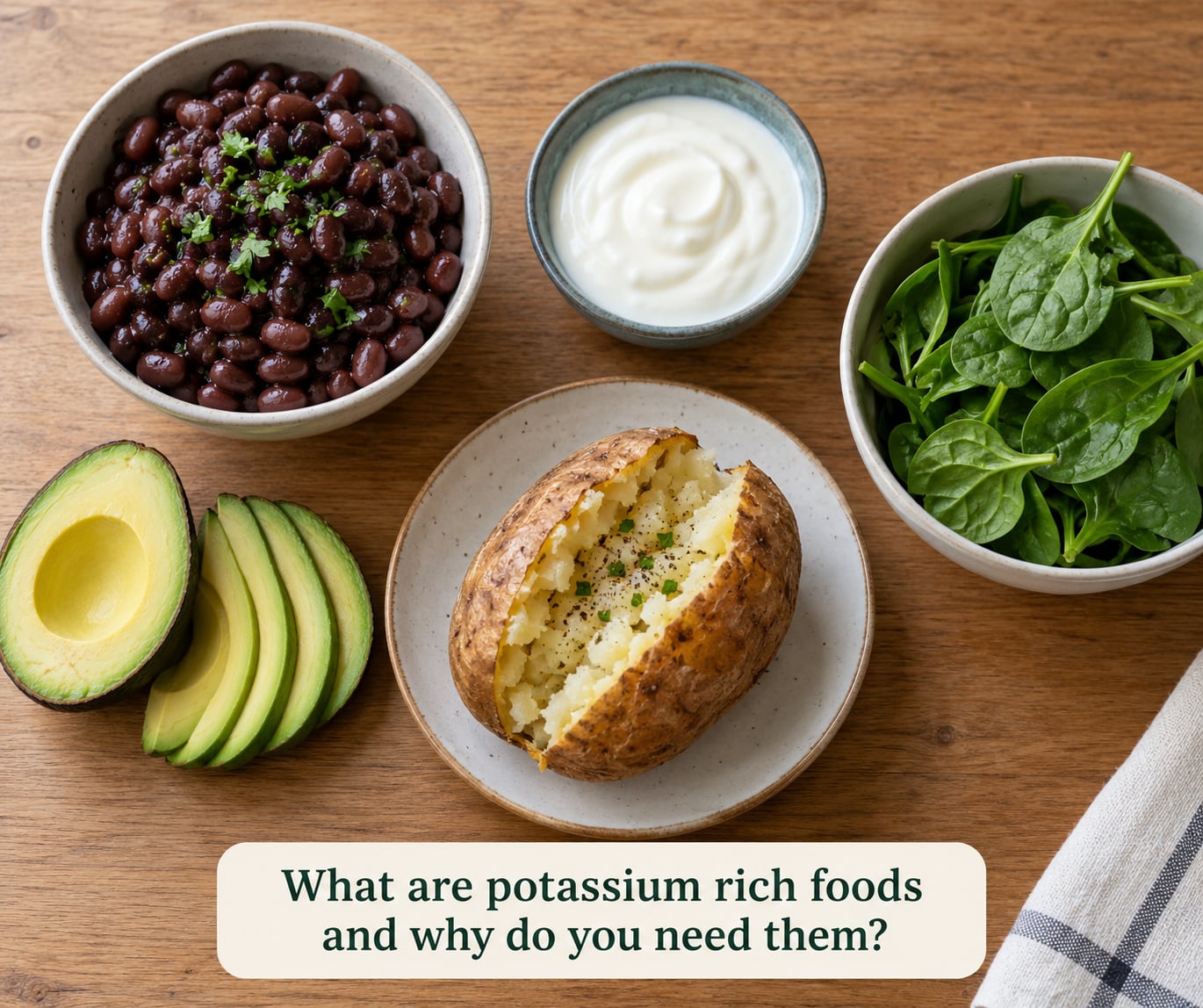
Potassium rich foods are any foods that supply a meaningful amount of the mineral potassium, and you need it because it is an essential electrolyte that regulates fluid balance, transmits nerve signals, powers muscle contraction, maintains heart rhythm and helps keep blood pressure under control. Your body makes no potassium of its own, so every bit comes from what you eat or drink.
It sounds abstract until you think about what goes wrong without it. Potassium sits on one side of the cell membrane, sodium on the other, and the balance between the two drives almost everything cells do. Shift that balance and muscles get sluggish, nerves misfire, and the heart can lose its steady rhythm.
Here is what potassium actually does day to day:
- Fluid balance. It works against sodium to keep water inside cells, which is why hydration and blood pressure are tied together.
- Nerve signalling. Every nerve impulse is an electrical event, and potassium is part of that charge.
- Muscle contraction. Including the involuntary squeeze of the heart, which is why potassium matters for heart rhythm.
- Blood pressure regulation. More potassium in the diet generally means less pressure on blood vessels, and research reported in 2026 has found potassium-rich eating patterns may help blood pressure at least as much as cutting back on salt.
- Bone and metabolic health. Higher potassium intakes are associated with healthier bones, and potassium works alongside magnesium and calcium in normal metabolism.
Most adults in the US fall short of the daily target, mostly because potatoes, beans and leafy greens get crowded out by refined grains and packaged food. That gap is easy to close, and the foods that close it are cheap, shelf-stable and not exciting.
How much potassium do adults need?
Most adult men need about 3,400 mg of potassium a day and most adult women about 2,600 mg, while pregnancy and breastfeeding raise the target to roughly 2,800 to 2,900 mg. Those numbers are the recommended dietary allowances; the FDA Daily Value printed on nutrition labels is 4,700 mg for adults and teens, and that is the figure most nutrition guidance uses when it talks about hitting a potassium target.
| Group | Recommended amount per day |
|---|---|
| Adult men | 3,400 mg |
| Adult women | 2,600 mg |
| Pregnancy | 2,900 mg |
| Breastfeeding | 2,800 mg |
| FDA Daily Value for adults and teens 14+ | 4,700 mg |
| Infants 0 to 6 months (adequate intake) | 400 mg |
| Infants 7 to 12 months (adequate intake) | 700 mg |
| Children 1 to 3 years | 2,000 mg |
| Children 4 to 8 years | 2,300 mg |
| Children 9 to 13 years | 3,400 mg (boys), 2,600 mg (girls) |
Needs climb with body size and activity, and they climb sharply when you sweat a lot. Someone training in heat, or working outdoors for hours, loses potassium in sweat and generally needs more than a desk-bound adult does.
Two groups should not simply aim higher. People with chronic kidney disease may need to limit potassium rather than add it, and anyone on blood-pressure medicines that raise potassium, such as ACE inhibitors, ARBs or potassium-sparing diuretics, should get individual advice before increasing intake.
Which foods are highest in potassium?
Legumes, potatoes and leafy greens beat fruit by a wide margin. A single medium banana at about 420 mg sits mid-table, not at the top, and serving size matters enormously: a cup of white beans delivers more potassium than two bananas, and it costs less.
Amounts below are typical reference portions. Real values shift with brand, size, freshness and how the food was prepared, so treat them as a guide rather than a measurement.
| Food | Typical serving | Potassium | Share of 4,700 mg Daily Value |
|---|---|---|---|
| White beans, cooked | 1 cup | about 1,130 mg | 24% |
| Sweet potato, baked with skin | 1 medium | about 540 mg | 11% |
| Potato, baked with skin | 1 medium | about 570 mg | 12% |
| Beet greens, cooked | 1 cup | about 650 mg | 14% |
| Salmon, cooked | 3 oz | about 380 mg | 8% |
| Avocado, sliced | 1/2 fruit | about 485 mg | 10% |
| Swiss chard, cooked | 1 cup | about 300 mg | 6% |
| Yogurt, plain | 1 cup | about 350 mg | 7% |
| Banana | 1 medium | about 420 mg | 9% |
| Prunes | 5 dried | about 350 mg | 7% |
| Spinach, cooked | 1 cup | about 420 mg | 9% |
| Milk, low-fat | 1 cup | about 366 mg | 8% |
| Tomato sauce, canned | 1/2 cup | about 450 mg | 10% |
| Orange | 1 medium | about 240 mg | 5% |
| Coconut water | 1 cup | about 570 mg | 12% |
Fruit high in potassium
Bananas are the famous one, and a medium banana at roughly 420 mg is a fine source, but a cup of dried apricots or five prunes delivers a similar amount in a much smaller volume. Oranges and orange juice sit in the middle at around 240 mg per orange, which is enough to count but not enough to lead the list.
Vegetables and leafy greens
Leafy greens are the quiet overachiever. Cooked Swiss chard, kale, spinach and beet greens each pack 300 to 650 mg into a single cup, and the same greens raw in a salad deliver less because of volume. Keep the skin on baked potatoes and sweet potatoes, where much of the potassium sits.
Beans and lentils
White beans, kidney beans, chickpeas and lentils are the strongest everyday source most people never think to count. One cooked cup of white beans clears a quarter of the whole daily target, and a cup of lentils lands close to 730 mg. They are the cheapest route to a potassium target, and they go into soups, chilli, salads and curries without ceremony.
Dairy, fish, nuts and seeds
Plain yogurt, milk and cheese sit in the middle of the range, and salmon contributes about 380 mg per 3 oz serving along with omega-3 fats. Nuts and seeds are lower per serving, typically 150 to 250 mg per ounce, so they are a supporting player rather than a headline source.
What are the best everyday sources of potassium?
The best sources are the ones you will actually eat twice a week without thinking about it. Bananas, baked potatoes, white beans, yogurt, leafy greens, tomatoes, oranges, fish and avocado cover most of the practical options, and each has a simple way to fit into a normal week.
- Banana. Keep a few in the bag for the days you leave breakfast empty. Two bananas land near 840 mg, close to 18% of the Daily Value, which is respectable but not a target on its own.
- Baked potato with skin. The skin holds much of the potassium. Baking and roasting preserve more than boiling, which leaches potassium into the water, so a baked potato beats a boiled one on this nutrient alone.
- White beans or lentils. A cup stirred into soup, spooned over a baked potato, or served cold in a salad moves the number a long way.
- Plain yogurt. Breakfast, snack, or a base for fruit. Choose plain and add your own fruit, since sweetened versions carry less.
- Leafy greens. Cooked chard, spinach and kale concentrate potassium, so a cooked cup counts more than a raw handful. Sautéing with a little olive oil also helps your body absorb other nutrients alongside it.
- Tomatoes and tomato sauce. A half cup of canned tomato sauce runs about 450 mg, which makes pasta sauce one of the easiest places to add potassium without a recipe change.
- Oranges or orange juice. A moderate source, useful as a breakfast fruit or a potassium-containing drink instead of water.
- Fish such as salmon. Roughly 380 mg per 3 oz, plus protein and omega-3 fats, twice a week covers the fish guideline as well.
- Avocado. Half a fruit at about 485 mg, easily added to toast, salads, tacos or smoothies.
Two habits catch a lot of potassium. Eating potato skins rather than peeled potatoes, and cooking greens by steaming or sautéing instead of boiling in a large pot of water, both keep more of the mineral on the plate.
How to read potassium on a nutrition label
Five steps cover everything the label tells you:
- Find Potassium on the Nutrition Facts panel, listed in milligrams.
- Check the serving size, because every value on the panel describes that amount only.
- Multiply by what you actually eat, so a package you finish in one go can be two or three servings.
- Look at % Daily Value, where 20% or more per serving counts as high.
- Compare similar products, since canned beans and jarred sauces vary widely between brands.
How can you add more potassium to your meals?
The reliable way to add potassium is to add volume rather than to chase single superfoods, and a cup of beans added to a soup you already eat delivers more than a banana added beside it. Most people get there with three or four ordinary changes rather than a special diet.
Simple swaps that add up:
- Add beans or lentils to soups, chilli and pasta sauce instead of leaving them out.
- Choose plain yogurt at breakfast and stir in fruit.
- Use canned tomato sauce as your pasta base a couple of nights a week.
- Serve a baked sweet potato alongside a grain rather than a side of pasta alone.
- Cook greens and eat them daily, in soups, sautés and omelettes.
- Swap a glass of juice for orange juice, and water for coconut water on workout days.
Here is what a day that reaches roughly the 4,700 mg Daily Value can look like, using ordinary portions:
| Meal | What you eat | Approximate potassium | Running total |
|---|---|---|---|
| Breakfast | Plain yogurt with banana and oats | about 780 mg | 780 mg |
| Lunch | Baked sweet potato, white beans, salad with tomato | about 1,350 mg | 2,130 mg |
| Snack | Avocado toast and an orange | about 650 mg | 2,780 mg |
| Dinner | Salmon, cooked Swiss chard, tomato sauce with pasta | about 1,400 mg | 4,180 mg |
| Evening | Five prunes or a glass of milk | about 360 mg | about 4,540 mg |
That is a normal day of food, not a challenge menu. If you want a lower-calorie version, the same structure works with white beans, greens, tomato, salmon and a baked potato doing the heavy lifting and the avocado and nuts trimmed, and those four alone reach close to 2,000 mg for well under 700 calories.
Foods high in potassium but low in calories are mostly the same foods you were already eating:
- White beans, 1 cup, about 1,130 mg for roughly 250 calories.
- Spinach and Swiss chard, cooked, 1 cup, about 420 mg for under 100 calories.
- Baked potato with skin, about 570 mg for around 160 calories.
- Tomato, 1 cup chopped, about 550 mg for about 45 calories.
- Cantaloupe and honeydew, 1 cup diced, roughly 400 to 500 mg for about 60 calories.
- Salmon, 3 oz, about 380 mg for around 175 calories.
Two practical notes. Increase potassium gradually, because a sudden jump can cause bloating and stomach discomfort while your gut adjusts. And if you have kidney disease or take medicine that affects potassium, a sudden increase is exactly the thing to check with a clinician first.
Are there risks from getting too much potassium?
For healthy adults with normal kidney function, eating potassium rich foods is safe. Your kidneys clear excess potassium through urine, so food-based intake rarely pushes levels into a dangerous range. The risk appears when kidney function is reduced, or when medicine reduces potassium excretion or adds to it.
High potassium in the blood is called hyperkalemia. It is a medical matter, and it usually produces no clear early warning signs, which is why regular blood tests matter for anyone in a higher-risk group.
Signs that need prompt medical attention rather than self-treatment include:
- An irregular heartbeat, fluttering or pounding
- Muscle weakness that is unusual for you, including weakness climbing stairs
- Numbness or tingling in the hands, feet or lips
- Chest discomfort, or feeling faint and dizzy
- Nausea or vomiting that does not settle
If you recognise any of these, contact a doctor or urgent care rather than reading them as a nutrition gap.
Several groups should speak with a clinician before eating more high-potassium foods, because they may need to limit them: people with chronic kidney disease or reduced kidney function, anyone taking ACE inhibitors or ARBs for blood pressure, anyone on potassium-sparing diuretics such as spironolactone, people with diabetes, and people with adrenal insufficiency. Potassium-based salt substitutes built on potassium chloride carry the same concern for these groups.
This is general information about a nutrient, not a diagnosis or a treatment plan. Your doctor or a registered dietitian can tell you what is right for your own kidneys and medicines.
How do potassium-rich foods support weight loss and healthy living?
Potassium supports weight-conscious eating in four honest ways, and it is not one of the ones people expect. It supports hydration, it helps blood pressure, the same foods bring fibre that fills you up, and they simply displace less nutritious food. It does not burn fat and it does not cause weight loss on its own.
The hydration angle is the least discussed. After exercise, fluids move between cells, and potassium is part of restoring that balance alongside sodium. A day of processed food is often a day of low potassium, and a day that includes beans, greens and potatoes brings both fluid and electrolytes back in.
The fibre angle is the practical one. White beans at roughly 1,130 mg of potassium per cup also carry about 15 g of fibre, and yogurt and fruit do the same. Filling foods that are dense in nutrients rather than calories make a weight loss pattern easier to hold, mostly because you are not hungry an hour later.
Food quality is the honest framing. Diets built around vegetables, legumes, whole grains, fruit and lean fish tend to deliver more potassium than diets built around refined grains and packaged snacks, and that shows up in blood pressure, stroke risk markers and general energy. That is the whole argument, and it is enough.
Frequently Asked Questions
Are bananas the best potassium-rich food?
A medium banana gives you roughly 420 mg of potassium, about 9% of the Daily Value, which is useful but not exceptional. A cup of cooked white beans delivers about 1,130 mg, and a baked sweet potato with the skin on gives around 540 mg. Bananas are a convenient everyday source, not the top of the list, so lean on beans, potatoes and leafy greens for the biggest numbers.
How can I eat more potassium if I have kidney disease?
If your kidney function is reduced, more potassium is not automatically better, and a high-potassium eating plan may be unsafe for you. A kidney dietitian can tell you which foods and portions fit your specific numbers, including how to leach potassium from vegetables by boiling them in water first. Do not start a potassium supplement or a potassium-based salt substitute without medical advice.
Can I get enough potassium without eating fruit or vegetables?
It is difficult, because the highest-potassium foods are overwhelmingly plant based: beans, potatoes, leafy greens, tomatoes and fruit. Without those, you are left with dairy, fish and meat, all of which contain less per serving, plus potassium supplements that carry overdose risk and none of the fibre and phytonutrients. Most people who struggle to hit a target are short on vegetables, not short on meat.
Are potassium supplements safer than getting potassium from food?
No. Food comes with fibre, vitamins and phytonutrients that a pill does not, and supplements make accidental overdose easier because the dose is concentrated and there is no warning. Supplements also interact with kidney disease and with blood-pressure medicines such as ACE inhibitors, ARBs and spironolactone. Most registered dietitians advise eating food first, and using a supplement only when a clinician recommends it.
Do canned and frozen foods still contain potassium?
Yes, both retain a good amount. Canned beans and vegetables often keep more potassium than fresh cooked equivalents, since they are processed with less water, though you should check the label and prefer no-salt-added versions. Frozen vegetables and fruits lose very little during freezing and blanching. The bigger factor is how you cook them: boiling in a large pot of water leaches potassium away.
Can too much potassium be dangerous?
Yes, high potassium in the blood, called hyperkalemia, can affect heart rhythm and is a medical emergency in severe cases. For healthy adults with normal kidneys, food-based intake is safe because the kidneys clear the excess. Risk rises with chronic kidney disease and with medicines such as ACE inhibitors, ARBs and potassium-sparing diuretics, and it often shows no early symptoms, so testing matters more than guessing.
Start with one swap this week: a baked potato with the skin instead of a side of pasta, or a cup of beans added to a soup you already make. Add a second, like plain yogurt at breakfast, and you are most of the way to a potassium target without changing how you shop or cook.
Variety beats any single food. Potatoes, beans, greens, fruit and dairy cover different parts of what you need, and potassium pairs with fibre, protein and other minerals that a supplement cannot deliver.
One last thing, and it matters more than the food list: symptoms on their own cannot tell you whether you are getting enough potassium or too much. If you have cramps, fatigue, palpitations or constipation that will not settle, ask for a serum potassium blood test rather than trying to fix it by guessing at food.