
Telling physical hunger from emotional hunger comes down to one thing: physical hunger builds slowly, sits in the body, and is satisfied by almost any food, while emotional hunger arrives fast, lives in the mood, and usually insists on one specific thing. Here is the four-question check that separates them in about a minute.
The two are easy to confuse in the moment. That is not a character flaw and it is not a lack of willpower. Hunger detection is a skill, and for a lot of people it has been trained out of them by years of dieting, skipped meals and ignoring cues.
Before the long version, run this check. It takes about sixty seconds.
- Did it creep up or did it arrive? Gradual is physical. Sudden, out of nowhere, is usually emotional.
- Where do you feel it? Stomach, throat, low energy, shaky hands: that is physical. A tight chest, a bad mood, a craving you cannot name the origin of: that leans emotional.
- Would a sandwich do? If you would happily eat a cheese toastie, you are probably physically hungry. If only one specific food will do, it is probably not hunger.
- Can you stop when you are full? Physical hunger lets go fairly easily. Emotional hunger keeps going past the point of comfort.
- How do you feel afterwards? Calm and neutral, or guilty and ready to punish yourself tomorrow?
There is no shame in any of those answers. Use them as information, not as a verdict.
Table of Contents
- What You Need
- Step-by-Step: A Pause-and-Check Method
- Step 1: Notice Where the Hunger Appears
- Step 2: Check Your Last Meal and Energy Level
- Step 3: Name the Feeling Without Judging It
- Step 4: Try a Different Need First
- Step 5: Eat Mindfully If Hunger Remains
- Physical Hunger vs Emotional Hunger: Side by Side
- Why the Two Get Blurred Together
- Common Mistakes When Identifying Hunger Signals
- When to Get Professional Support
- Frequently Asked Questions
- How long should I wait before eating to see if it is emotional hunger?
- Can I be physically hungry and emotionally hungry at the same time?
- What are the four types of hunger?
- Why do I feel hungry soon after I have already eaten?
- When is emotional eating a sign of an eating disorder?
What You Need
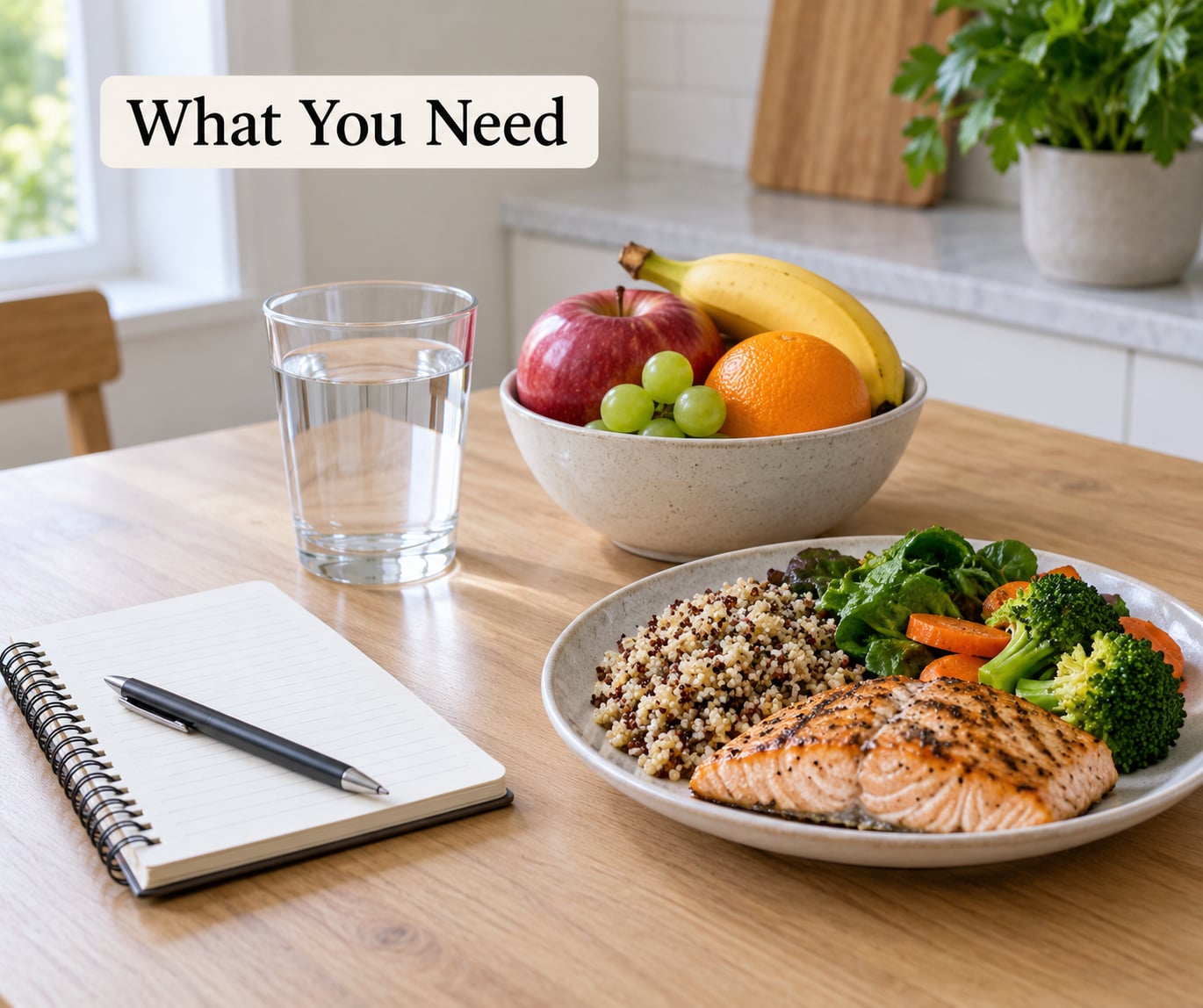
You do not need an app, a journal subscription or a specific food. The method works with what you already have.
A few minutes of quiet helps more than anything else. Most of the confusion happens in the ten seconds between opening the fridge door and putting something in your mouth, so the goal is to slow that gap down. Water within reach matters too, because thirst is easily mistaken for hunger and a glass of water is a cheap way to rule it out.
Have a real meal or a proper snack available, not only the leftovers and the biscuit tin. The check is meant to help you choose the right response, and one of the two responses is eating. It also helps to have somewhere to jot one line about what you noticed, even a note on your phone. Over a week or two, those lines tell you more about your pattern than any single moment of guessing can.
Step-by-Step: A Pause-and-Check Method
Run the steps in order. Each one is a filter, and the filters work best stacked rather than in isolation.
Step 1: Notice Where the Hunger Appears
The fastest filter is location. Physical hunger is felt below the neck: a hollow feeling in the stomach, rumbling, a drop in energy, difficulty concentrating, shakiness, a mild headache. It is a signal about fuel, and the body sends it whether or not you have anything appealing to eat.
Emotional hunger is felt above the neck: restlessness, an urge to chew, a bad mood that food seems to fix, an immediate craving for a particular taste or texture. People on Reddit forums who compare the two often describe it the same way, one putting it as physical hunger being a slow build and emotional hunger being instantaneous.
Ask what is eating you rather than what you want to eat. If the honest answer is that nothing in particular is bothering you and you simply have an appetite, that is the straightforward kind.
Step 2: Check Your Last Meal and Energy Level
Timing gives physical hunger a backstory. Look at when you last ate properly, not when you last picked at something. A genuine, satisfying meal three to five hours ago, followed by low energy, is textbook physical hunger.
Then be honest about the last few days. If you have been restricting, skipping meals, fasting or treating certain foods as off-limits, hunger will arrive louder, later and more urgently than it should, and your ability to read it gets worse. That is not a personal failing. It is why people who restrict describe not trusting their own signals.
Being tired or short on sleep pulls in the same direction, because a depleted body reads hunger more intensely. A mid-afternoon slump after a light lunch is genuinely physical, and no amount of self-control fixes it.
Step 3: Name the Feeling Without Judging It
If the hunger came fast, find the moment just before it. Something happened, or nothing happened and that is the problem. Boredom and loneliness show up far more often as triggers than people expect, and stress usually gets all the attention because it is the easiest word to say.
Use a neutral phrase. Say I am lonely, I am overwhelmed, I am bored, I am irritated, I am tired, not I am being weak. The label matters more than it looks, because shame adds a second uncomfortable feeling to the first one, and that second feeling will not be fixed by food either.
This is the step most often skipped and it is the one that changes the most. On the r/intuitiveeating forum, people repeatedly frame the useful work as building a longer list of things that genuinely care for you, rather than a single forbidden food. Naming the feeling accurately gets you toward that list.
Step 4: Try a Different Need First
If a feeling is driving the urge, food is one way to answer it and rarely the only one. Match the alternative to the actual feeling, because a glass of water does nothing for loneliness.
- Boredom: stand up, change rooms, wash a few dishes, take a ten-minute walk outside.
- Loneliness: message or call one person, or sit somewhere with other people.
- Overwhelm: write down the single smallest next task and do only that.
- Tiredness: a nap, a shower or an early night beats a snack more reliably than people expect.
- Irritability or tension: a few slow breaths, music, a walk, anything that lets the nervous system settle.
- Habit or autopilot: delay the unplanned snack by ten to fifteen minutes. Most cravings lose their edge in that window.
It is fine if none of it works. The delay is not a test you can fail, and eating is a legitimate outcome. You are not required to talk yourself out of every craving.
Step 5: Eat Mindfully If Hunger Remains
If the signal was physical, or still is, eat. Choose something you actually like and that will hold you, and give it enough attention that you notice when you stop being hungry. Fullness is easier to catch when you are not looking at your phone.
Aim to land somewhere neutral. Neutral means not triumphant and not ashamed. One snack eaten at a desk without drama is a good outcome, and it is worth saying plainly because the guilt spiral is what turns one episode into a pattern.
If you ate and the feeling is still sitting there unchanged, that is useful data. It usually means the food was treating a feeling it was never going to fix. Most cravings ease on their own within ten to fifteen minutes anyway, and a soft landing beats a punishing plan every time.
Physical Hunger vs Emotional Hunger: Side by Side
Here is the comparison in one place, because the differences are far more reliable than any single cue.
| Sign | Physical hunger | Emotional hunger |
|---|---|---|
| Onset | Gradual, easy to miss | Sudden and out of nowhere |
| Where you feel it | Below the neck: stomach, energy, focus | Above the neck: mood, restlessness, craving |
| What you want | Food. Almost any food will do | One specific food or texture |
| Urgency | Calm and patient | Intense and urgent |
| Can you stop when full? | Yes, fairly easily | Often no, you eat past comfort |
| Afterwards | Satisfied and neutral | Unsatisfied, or guilty and regretful |
| Typical triggers | Hours since a real meal, low energy, poor sleep | Boredom, loneliness, stress, arguments, habit |
| Does it pass on its own? | No, it needs food | Often yes, within 10 to 15 minutes |
| Effect of food | Eases the signal and stays eased | Brief relief, feeling returns |
Worth adding a third category, because the binary is too tidy. Hedonic hunger is eating for pleasure rather than for fuel or for comfort: the bowl of chips that is genuinely enjoyable, not driven by stress and not driven by an empty stomach. It is a normal part of eating, and it is neither a virtue nor a failure.
Here is what the table means in a real week. Someone who eats at their desk every day at 3pm has a physical signal every time and a habit attached to it. Someone who finishes dinner, feels full, and then wants something specific twenty minutes later while scrolling is looking at an emotional signal. Someone who is genuinely famished after a long run and eats until they stop being hungry has the simplest case of all, and it needs no analysis at all.
Why the Two Get Blurred Together
When the signals are hard to read, the problem is often the signal, not the person. Four things reliably interfere.
Restriction. A history of dieting, fasting or making foods off-limits raises baseline hunger and dulls the ability to notice it. Regained hunger is not evidence of a broken metabolism or a failure of discipline. It is what happens when a system is being run on too little.
Habit. Eating at the same desk, in the car, in front of the same screen turns eating into an automatic response. Once it is automatic, checking in feels like an interruption, so people stop checking.
Chronic stress and poor sleep. Both raise the intensity of every signal and shrink the gap between a feeling and an action. Many people report that tired eating is the hardest kind to catch, because the cue arrives already bundled with the day.
Shame. Judging an episode harshly produces a second craving, this one driven by the need to undo the first. That is how a single episode becomes a restrictive morning, which produces genuine hunger by lunchtime, which produces another episode.
Common Mistakes When Identifying Hunger Signals
Treating every craving as emotional. A craving for one food can be a sign of genuine hunger that has narrowed to a preference, and sometimes it points at something nutrient-poor simply because that is what you ate yesterday. Assume physical until the check says otherwise.
Trusting only the clock. It is 3pm therefore I am hungry, and it is 8pm therefore I am not. Meals drift, appetite shifts, and the clock tells you almost nothing about which kind of hunger is present.
Ignoring the body because of the last bad decision. The most common sentence in these discussions is some version of a promise made and broken. Skipping the next meal as punishment creates real physical hunger within two hours, and you have just built the next episode yourself.
Waiting too long to check. A check-in after you have already eaten has lost most of its value. Ten seconds before is where the information is.
Using guilt as a method. Shame is the only fuel that reliably creates a next episode. Treat noticing the pattern as neutral data; the moment you turn it into a character judgement, you have added a problem you did not have.
Believing a flawless reading exists. The check is a guide, not a test with a passing mark. Most people cannot be certain, and pretending otherwise just produces a new source of self-doubt.
A 1 to 5 rating scale is the cheapest tracking tool there is. Before eating, rate your hunger from 1 (no interest in food) to 5 (urgent). After eating, rate fullness the same way. Seven days of that is enough to show whether your hunger arrives like clockwork, whether the intense urges cluster around certain hours, and whether the physical signals are strengthening. Patterns show up in a week of numbers. They rarely show up in one guess.
And if the two arrive together, which is the case people ask about most often, you do not have to pick one. Being physically hungry while also being upset is ordinary, and the useful question is not which one this is but what I actually need right now. Sometimes the answer is genuinely both: eat something satisfying, and deal with the feeling by a method other than food.
When to Get Professional Support
Emotional eating is a common coping strategy and it is not automatically a disorder. But eating problems sit on a spectrum, and it is worth knowing where the line is.
Speak to a doctor or a registered dietitian if eating is affecting your health, if you avoid meals or social situations because of it, if you feel you cannot stop once you start, if you regularly eat large amounts in one sitting with a loss of control, or if you use vomiting, laxatives or compulsive exercise to compensate. Those are not lifestyle preferences, and support is available for them.
Get prompt help if you notice a persistent low mood, if food has become the main way you cope with everything, or if the pattern is escalating rather than settling. A doctor can rule out physical causes of hunger and refer you on. If you are restricting or fasting at the moment, do not try to sharpen your hunger detection on your own, because that is the one situation where the exercise is most likely to backfire.
This guide is general information about hunger signals and coping, not personal advice. A registered dietitian is the right person for individual guidance on your own pattern.
Frequently Asked Questions
How long should I wait before eating to see if it is emotional hunger?
Wait ten to fifteen minutes for an unplanned craving. That is long enough for the wave of most urges to lose its peak and pass on its own, without it being long enough to become a test you can fail. Delay a snack, drink some water and do something mildly distracting, then check again. If the pull has faded, it was probably emotional. If it is still there and you are genuinely uncomfortable, eat. The delay is a tool for information, not a rule to push through hunger.
Can I be physically hungry and emotionally hungry at the same time?
Yes, and it is more common than most articles on this topic admit. Being physically hungry while stressed, lonely or bored is an ordinary combination rather than a contradiction. The useful question is not which one it is but what you need right now, because sometimes the honest answer is both: eat something satisfying and then deal with the feeling by a method that is not food. Treating the two as opposites is what makes the advice confusing.
What are the four types of hunger?
The common version lists physical, emotional, hedonic and appetite or social hunger. Physical hunger is the fuel signal. Emotional hunger is eating to manage a feeling. Hedonic hunger is eating for pleasure, which is normal and neither good nor bad. Appetite or social hunger is eating because of context, such as a meal with other people or something that simply looks good. Frameworks vary and some list seven, so treat any single list as a conversation starter rather than a rulebook.
Why do I feel hungry soon after I have already eaten?
A few things are going on at once. A large meal that is mostly refined carbohydrate can leave blood sugar moving in a way that brings the signal back quickly, which is one reason protein, fibre and fat tend to hold better. Skipping or restricting earlier in the day makes a genuine hunger arrive early the next day. And if the second hunger keeps arriving regardless of what you ate, check the emotional side too, because a repeated feeling-driven urge can look exactly like a physical one.
When is emotional eating a sign of an eating disorder?
It becomes a clinical concern when it involves loss of control over eating, very large amounts at once, or behaviours used to compensate such as skipping meals, vomiting, laxatives or compulsive exercise. Episodes that are frequent, escalating and interfering with daily life, health or relationships deserve assessment rather than self-management. Speak to a doctor or a registered dietitian, who can rule out physical causes and refer you to specialist support if you need it.
Start with the sixty-second check next time the urge shows up, and write down what you notice. Give it a week before you judge whether it works. Last updated for 2026.