The binge-restrict cycle is a repeating loop: you cut back or skip food, hunger builds until it overrides your fullness signals, you eat a large amount in a short time feeling unable to stop, and then guilt sends you back to cutting back. If you want to know how to stop the binge and restrict cycle, the answer is unglamorous and slow: keep eating regularly, drop the rules that make food feel dangerous, and build a plan for the hard moments.
This is educational information, not medical advice, and it is not a treatment plan. If the pattern includes vomiting or laxative use, fainting, rapid weight changes, chest pain, or an inability to eat safely, stop reading and contact a doctor or a crisis line today.
If you need support right now: in the US, call or text 988 for the Suicide and Crisis Lifeline, 1-888-375-7767 for the ANAD helpline, 1-800-999-7227 for the National Eating Disorders Association helpline, or 1-866-488-7386 for The Trevor Project. Outside the US, your local emergency number or a national eating disorder helpline will do.
Most of what you have read about this cycle tells you to try harder. The opposite tends to work better, and this guide is built on that idea: fewer rules, more regular food, less shame. Most people need weeks, not days, and setbacks are part of the process rather than evidence that you failed.
Table of Contents
- What You Need
- How to Stop the Binge and Restrict Cycle: Step-by-Step
- Step 1: Identify the pattern without judging it
- Step 2: Keep meals and snacks reasonably regular
- Step 3: Build a neutral food safety net
- Step 4: Delay the urge and change the situation
- Step 5: Plan for high-risk moments
- Step 6: Get support and protect recovery
- Common Mistakes
- Frequently Asked Questions
- Should I skip meals after I binge?
- How do I handle hunger when I stop restricting?
- When does the binge-restrict cycle need professional help?
- Can exercise fix a binge-restrict cycle?
- How do I stop the binge-restrict cycle without gaining weight?
- How do I support someone else in this cycle?
- Conclusion
What You Need
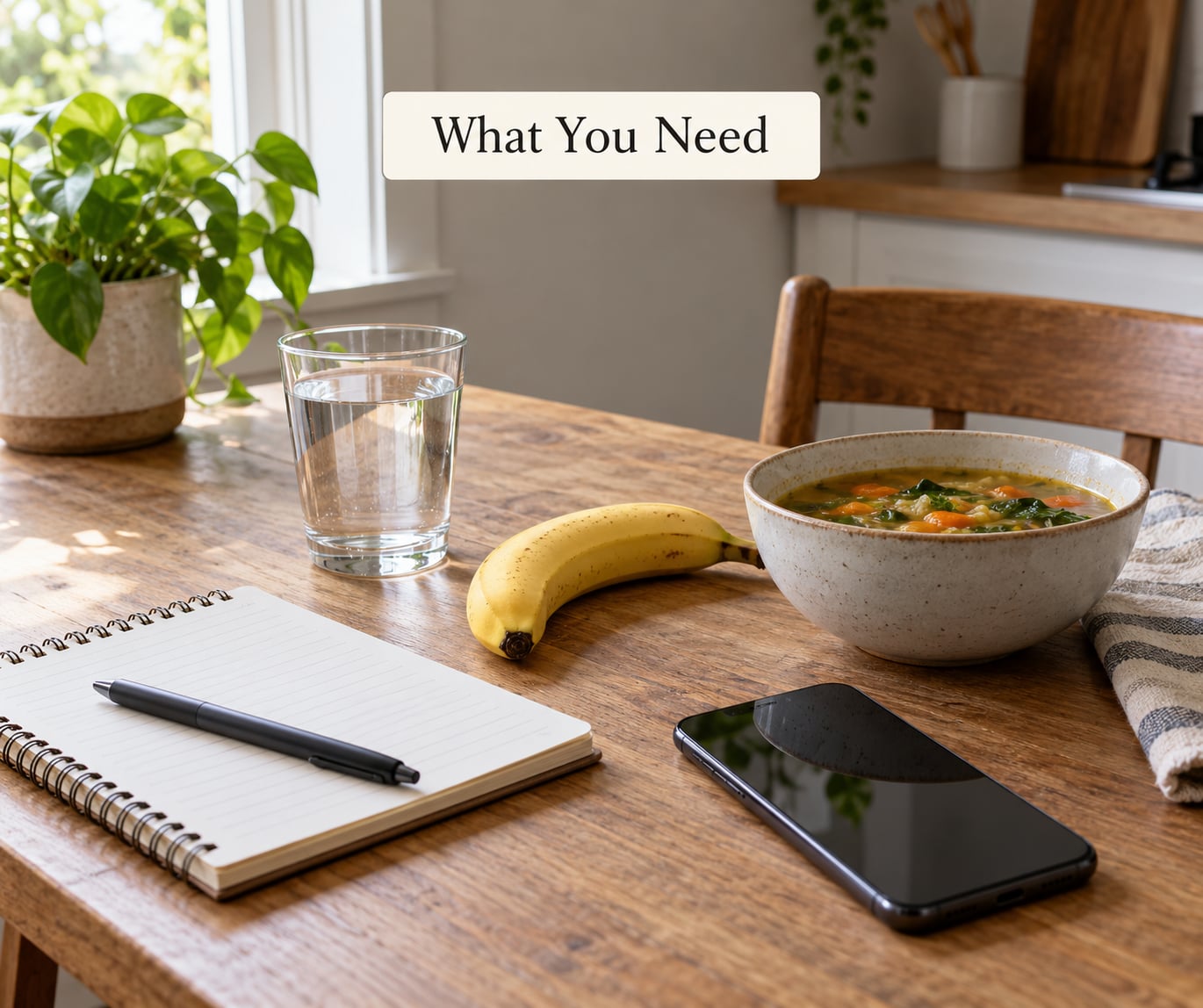
You do not need a detox, a calorie target, an appetite-suppressing product, or a complicated meal plan with prep containers and macros. Those things cost money and attention, and most of them re-create the restriction that drives the cycle in the first place.
What does help is much less interesting. You need somewhere to write things down, either a notebook or a notes app on your phone. You need regular access to nourishing meals, which sometimes means a plan and sometimes means lowering the bar on what counts as a meal.
You also need one person who knows what you are going through. Not a coach, not a narrator on a podcast. A friend, a sibling, a partner or a coworker who will ask how you are doing without asking what you weighed.
Finally, you need a doctor or registered dietitian if the cycle is happening more than once a week, if food makes you afraid, if you avoid meals with other people, or if it is affecting your work, sleep or relationships. That is not the last step of this plan. For many people it is the first one that actually holds.
How to Stop the Binge and Restrict Cycle: Step-by-Step
The six steps below build on each other. Most people get more benefit from doing steps one and two consistently for a month than from working hard on all six at once.
One boundary first: if you are purging, fasting for long stretches, fainting, feeling faint, noticing a fast heart rate, or seeing your weight change quickly in either direction, this is a medical situation and a self-guided plan is not the right tool. A doctor can check bloodwork and a therapist or registered dietitian can build a plan that accounts for what your body is doing right now.
Step 1: Identify the pattern without judging it
Learning how to stop the binge and restrict cycle starts with seeing it clearly rather than with willpower. For two weeks, write down four things each day: when a restrictive episode or an urge hit, what happened in the hour before it, what you ate and when, and what helped afterward. Keep it to a few lines.
Do not track calories, weight, or macros while you do this. Numbers turn a notebook into a scoreboard, and scoreboards are what the cycle feeds on. You are collecting weather data, not grading yourself.
What you are looking for is a pattern in time and place. Most people find something like the same three things: a long gap since the last real meal, a specific emotion such as stress or boredom, and a screen. A trigger journal is the single most repeated thing people say made their cycle visible to them.
Write one sentence at the end of each entry: “I noticed that…” That framing matters, because it keeps you in the position of an observer rather than a defendant.
Step 2: Keep meals and snacks reasonably regular
Long gaps between meals are the fuel of this cycle. When you go hours without eating, hunger hormones rise and fullness signals get weaker, so the eventual urge feels less like hunger and more like an emergency. Eating more often is usually what reduces bingeing.
A useful rhythm for many adults is three meals plus two or three snacks, with no more than three to four hours between them. This is a starting shape, not a rule. If mornings are impossible, shift everything later. If you work nights, build the rhythm around your actual day.
| Time | Meal or snack | Examples that are easy to keep |
|---|---|---|
| Morning | Breakfast or a stand-in | Yogurt with fruit, toast with nut butter, a banana with milk |
| Mid-morning | Snack | Crackers with cheese, a handful of nuts, fruit, a protein bar |
| Lunch | Lunch | A sandwich, leftovers, soup with bread, a takeaway you actually want |
| Afternoon | Snack | Hummus with carrots, a boiled egg, a smoothie |
| Evening | Dinner | Anything you would happily eat, eaten sitting down rather than standing at the counter |
| Evening | Snack if hungry | Cereal, yogurt, a small portion of leftovers, ice cream |
Two details make this stick. First, each eating window should contain something you find genuinely satisfying, not just something nutritionally correct, because a meal you resent is a meal you will think about all afternoon. Second, sitting down matters more than you would expect; eating in front of a screen is the most common setup for the eating that follows.
If a whole day of this feels like too much, start with two anchors: one real meal and one planned snack at roughly the same time each day. Add the third meal when that feels boring rather than impossible.
Step 3: Build a neutral food safety net
Most people who binge do not lack food. They lack food they will allow themselves to eat without a fight. So the practical move is to keep a few options physically available and emotionally neutral.
For a shelf-stable backup, think ready-to-eat fruit, yogurt, frozen sandwiches, crackers with cheese, oatmeal packets, soup from a can, or a frozen meal you have actually tasted before. For a fridge option, keep cut vegetables, eggs, deli meat and a frozen pizza slice where you can see them without deliberating.
The reason this works is that a decision made at 9pm when you are tired and upset is a bad decision. A snack you decided on at lunchtime is a different act. This is not about willpower, it is about moving the decision to a moment when you can actually make one.
Notice what this approach does not include. No food is forbidden, no meal has to be earned, and nothing on this list requires you to feel brave. If a food is currently on your banned list, it belongs in the safety net rather than outside it, because a banned food is a food you think about constantly.
Step 4: Delay the urge and change the situation
When an urge arrives, you are not required to defeat it. You are required to avoid making the next decision in the next ten minutes, which is the window in which most binges are set up.
A ten-minute pause that works looks like this. First, name what is happening out loud or on paper: “This is an urge to eat past comfort, and it usually shows up around this time.” Naming it moves it from something happening to you into something you are noticing.
Second, drink a glass of water and step away from wherever you are. Third, do something with your hands or change your location, even for a few steps, because the urge is partly a cue for a familiar sequence of actions.
Fourth, if you can, contact your support person. A two-minute message asking for company works, and it interrupts the isolation that most binges happen inside. If nobody is available, do not treat that as a failure of the plan; it is just the version of the plan that has one person in it instead of two.
Five, after ten minutes, eat a planned snack if you are still hungry, sitting down. This is the honest part: the urge may not vanish, and promising yourself it will is how people end up at 1am feeling they have failed at something they never had to win.
What this step does is reduce automatic restriction and give you another option. Over weeks, that is usually enough to change the outcome.
Step 5: Plan for high-risk moments
Your journal from step one should already tell you where your risky moments are. Most people find a short list of repeat offenders: a hard day at work, boredom, an argument, late-night scrolling in bed, being alone after a day of barely eating, or alcohol.
For each trigger, write a four-line plan on a card you can actually find. Name the trigger in plain words. Name the meal or snack you will eat before it arrives. Name the person you will text. Name one neutral activity you can do instead, something with your hands or your eyes that is not food.
For example: “After a bad meeting, around 4pm. Before the meeting I eat a snack. I text my sister. I do fifteen minutes of the crossword and shower.” That is a complete plan. It does not require you to feel calm or motivated.
A binge episode is not a personal failure and it is not evidence that your plan failed. It means the trigger ran faster than the plan, usually because the plan did not exist yet or because that particular day was harder than most. Update the card and go again.
Step 6: Get support and protect recovery
Contact a doctor, registered dietitian, psychologist or eating disorder specialist when the cycle happens regularly, when food causes fear or avoidance, when it interferes with daily life, or when it includes vomiting, laxative use, fasting or other unsafe behaviors. Those same behaviors are also the reason a medical appointment matters rather than a self-help book.
The therapies with the strongest evidence for this pattern each target a different part of it. Cognitive behavioral therapy works on the thoughts and food rules that keep the loop running. Dialectical behavior therapy adds skills for managing intense emotion without eating. Interpersonal psychotherapy focuses on relationships and conflict that sit underneath the eating. Nutritional rehabilitation handles the physical side of regular eating.
If access is the problem, say so plainly when you call. Ask about telehealth, sliding-scale fees, community programs and whether your insurance requires a primary care referral before specialist visits. Many people put off treatment over cost or waitlists, and a wrong fit for finances is a poor reason to wait another six months.
Peer support alongside therapy can help some people. The value tends to come from the structure and the sense of not being alone rather than from any particular group’s rules, and mutual-aid groups are a reasonable complement to therapy rather than a substitute for it.
Seeking help is a practical health action. It is what you would do for a broken wrist, and treating it as a character flaw keeps the cycle running longer than it needs to.
Common Mistakes
The most common mistake is making the diet stricter after a binge. Compensation feels logical and it is precisely what feeds the loop, because the next period of restriction rebuilds the hunger that caused the episode. The fix is a single rule: do not change your plan because of what happened yesterday.
Skipping meals the day after a binge is the same mistake with better PR. Hunger after a large meal is normal and physical, and treating it as something to override is how you end up at the next episode earlier. Drink water, eat something with protein and fibre at your next normal mealtime, and expect to feel physically uncomfortable for a while.
Labeling foods good and bad keeps the cycle alive in the background. A forbidden food becomes a craving magnet, which is why the food you banned tends to be the one that appears in the binge. Replace the moral language with neutral language: this is food I enjoy, this is food I eat on weekdays, and the difference is a situation rather than a virtue.
Using exercise as punishment backfires in two ways. It adds physical demand on a body that may already be under-fuelled, and it turns movement into something you have to earn rather than enjoy. Keep moving because you like moving, and drop the sessions that exist to offset last night.
Relying on detoxes, fat burners or appetite-suppressing supplements treats a cycle as a plumbing problem. Some of these products interact with medications or affect heart rhythm, which is a separate reason to leave them alone. A doctor or pharmacist can answer questions about anything you are considering.
Trying to handle it alone is the mistake that keeps people stuck longest. Isolation is part of how the cycle runs, so telling yourself you will fix it privately removes one of the mechanisms that would help you.
Finally, expecting a straight line is what turns an ordinary setback into a collapse. Recovery from disordered eating is not linear, and a week that goes badly is information rather than proof. Weekly wins include eating three meals, eating an evening snack without shame, noticing an urge and pausing, and telling someone how you are doing.
Frequently Asked Questions
Should I skip meals after I binge?
No. Skipping meals after a binge is the single most common way the binge-restrict cycle keeps going. Your body is already running on very little, and the restriction that follows produces stronger hunger and a bigger urge next time. Drink water, and eat your next normal meal even if you feel full, ideally something with protein and fibre. Being uncomfortable for a couple of hours after eating a lot is normal and it passes without you doing anything about it.
How do I handle hunger when I stop restricting?
Expect hunger to feel much stronger at first, and treat that as information rather than a problem. Hunger that feels extreme is often the residue of restriction rather than a sign you need more food than usual. Regular meals and snacks, eaten at roughly the same times each day, do more than any technique for managing the feeling. If you genuinely cannot tell when you are hungry or full, that is a common result of long-term restriction and something a registered dietitian can work through with you.
When does the binge-restrict cycle need professional help?
Get professional support if the cycle happens more than about once a week, if food causes fear or you avoid eating with other people, or if it affects your sleep, work or relationships. Any purging, laxative use, long fasting, fainting or rapid weight change needs a doctor promptly rather than a self-guided plan. A registered dietitian or eating disorder therapist can build a plan around your actual physiology, and reaching out is a practical health step rather than evidence that things are bad.
Can exercise fix a binge-restrict cycle?
No, not on its own. Movement helps mood, sleep and stress, which are all triggers, but using it to offset food creates the same earn-and-burn loop in a different form and can leave an under-fuelled body doing more. Keep exercise because you enjoy it and drop any sessions that exist to cancel out eating. If you are exercising heavily and still restricting, that combination is worth raising with a doctor, because under-fuelled exercise raises the risk of fainting and injury.
How do I stop the binge-restrict cycle without gaining weight?
Understand that the weight gain people fear is usually temporary and mostly fluid, because binge-restrict cycles produce large swings and most of what follows a binge is water and food volume rather than fat. Trying to prevent that weight change is what drives the restriction, which produces the next binge. Work with a doctor or registered dietitian if weight is genuinely the central worry, since they can track changes accurately and explain what is happening. Prioritising safety and flexibility is what actually ends the cycle.
How do I support someone else in this cycle?
Do not comment on their weight, their plate, or what they ate. Do not offer to be a diet coach or a watchdog. What works is telling them you have noticed and that you are available, without an ultimatum, asking what kind of help would be useful, and offering practical support such as company at a meal or a lift to an appointment. If they are restricting or purging, encourage a doctor and offer to help book it. Calm, steady presence beats discussion most of the time.
Conclusion
Pick one thing today and do it: choose a meal or snack you actually want, at a normal time of day, and eat it sitting down. Then drop the all-or-nothing rules, because they are what turns one episode into a whole week of damage.
If the cycle is regular, distressing, or involves purging, fainting or rapid weight changes, book an appointment with a doctor or registered dietitian rather than trying to outrun it on your own.
Recovery here means safety and flexibility, not earning food through perfect behavior. The goal is not to never struggle with food again. It is that when a hard day comes, the recovery is smaller and faster than the last one.