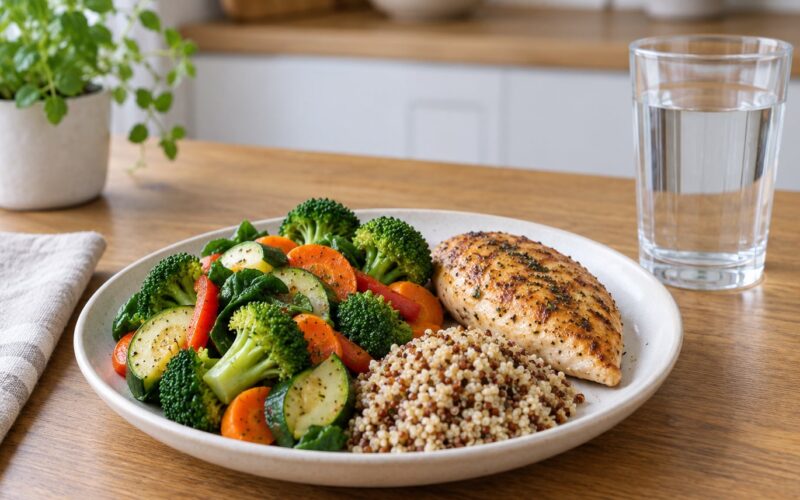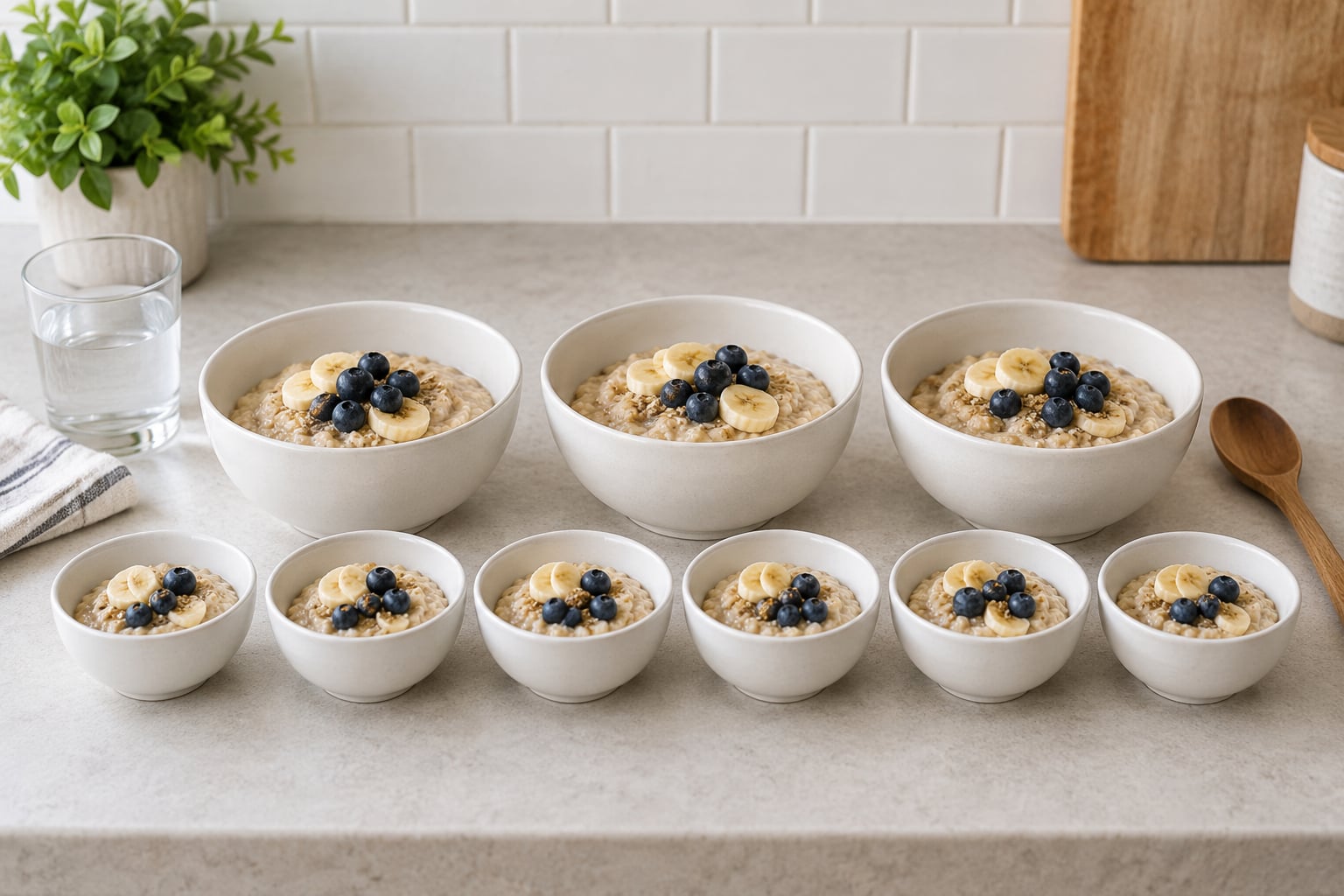
No. Eating six small meals a day does not meaningfully boost your metabolism. The energy your body spends digesting food, called the thermic effect of food, depends on how much you eat in total, not on how many times you sit down to eat it. Split the same 2,000 calories into three meals or six and the metabolic math comes out the same.
That answer has been unpopular for about sixty years. Trainers, magazines and well-meaning doctors kept repeating that frequent eating “stokes the metabolic fire,” and plenty of people ended up prepping six containers a week, skipping the sixth, and feeling like they had failed at something that was never going to work.
A 2023 meta-analysis in the International Journal of Behavioral Nutrition and Physical Activity pooled 16 randomized controlled trials and 279 adults to settle it. Across nine cardiometabolic markers, including weight, body fat, BMI, fasting glucose, insulin and cholesterol, there was no meaningful difference between the frequent-eating groups and the fewer-meal groups.
So let’s get into what metabolism actually is, what changes when you spread food across a day, and who genuinely has a reason to eat more often.
Table of Contents
- Does Eating Six Small Meals Boost Metabolism?
- What Is Metabolism?
- The thermic effect of food, defined
- A worked example of how small TEF really is
- How Does Meal Frequency Affect Your Body?
- Portion distribution and appetite
- Blood sugar swings
- The afternoon crash
- The cost nobody puts in the advice
- What Does the Research Say About Six Small Meals?
- Does eating six small meals boost metabolism in any measurable way?
- Does eating six small meals boost metabolism? The appetite side of the evidence
- Where the six-meal advice came from
- Where researchers disagree
- Why the evidence is weaker than it sounds
- Could Six Meals Help with Weight Loss?
- Myth versus fact
- Six Small Meals vs. Three Larger Meals
- How to Build a Balanced Meal Routine
- Start with protein spread across three or four eating occasions
- Pick a frequency you can repeat on a bad week
- Build each eating occasion around fiber and protein
- When Meal Frequency May Need Professional Advice
- Frequently Asked Questions
- Does eating six small meals increase metabolism?
- Are six small meals better than three big meals for weight loss?
- Does eating every two hours speed up metabolism?
- Can small meals help control blood sugar?
- What should I eat between meals if I choose six meals?
- How many meals per day are best for losing weight?
- The Bottom Line
Does Eating Six Small Meals Boost Metabolism?
No. Splitting your food into more meals changes the rhythm of your day, not your metabolic rate. Here is the short version of why, before the detail.
Your daily energy expenditure has four parts, and meal count touches none of them directly:
- Basal metabolic rate (BMR) — the calories your body burns at rest, keeping organs, brain and temperature going.
- Thermic effect of food (TEF) — the energy spent digesting, absorbing and store food. Roughly 10 percent of what you eat.
- Exercise activity thermogenesis — planned training, from a walk to a heavy session.
- Non-exercise activity thermogenesis (NEAT) — everything else you move. Standing, walking, housework, fidgeting.
Three meals or six, the calories stay the same. BMR does not notice. Your activity does not change. And TEF is calculated as a percentage of total intake, so six smaller plates of food produce the same total as three larger ones.
What Is Metabolism?
Metabolism is the collection of chemical processes that turn food and drink into energy and into building blocks for the body. It is always running, and it runs for everyone.
The confusing part is that “metabolism” gets used for three different things in conversation. People mean calorie burn at rest, they mean the speed at which food is digested, and they mean the rate at which fat is lost. Those overlap, but they are not the same thing.
The thermic effect of food, defined
The thermic effect of food, also called diet-induced thermogenesis, is the energy cost of processing what you have eaten. It is the single largest reason people believe meal frequency works.
Here is the useful part. Protein has the highest thermic effect, roughly 20 to 30 percent of its calories going into digestion and storage. Carbohydrates sit around 5 to 10 percent, and fat is lower still, near 0 to 3 percent. That difference is real, and it is why high-protein diets show higher measured TEF.
What that ranking does not do is change when you eat. If you eat 150 grams of protein in the morning instead of spreading it across the day, you have not added 100 calories of burn to your day. You have moved the same 100 calories of burn to the morning. The daily total is identical.
A worked example of how small TEF really is
Take a 2,000-calorie day. About 200 of those calories go to digestion and storage of food, split across the day however you like. Now split it six ways: each meal costs roughly 33 calories of thermic effect. That is about four minutes of easy walking per sitting.
Nobody has ever felt a metabolic difference from a four-minute walk, which is exactly the point. The effect is real but small enough to be irrelevant next to portion size and food choice.
How Does Meal Frequency Affect Your Body?
Meal frequency changes several things. It just does not change your metabolic rate.
Portion distribution and appetite
Six smaller meals deliver less food at once, which many people find easier to get through. If your usual dinner is a large plate that leaves you uncomfortable, dividing it does not help with weight loss by any metabolic mechanism, but it may make the day more comfortable and therefore more repeatable.
It cuts the other way for plenty of people. People following a grazing pattern describe feeling hungrier, not less hungry. Each small meal resets the appetite signals for another round, and six chances to eat is six chances to take an extra one.
Blood sugar swings
Large, high-carbohydrate meals produce a bigger glucose rise and a bigger insulin response than smaller ones. Spreading the same carbohydrate across more sittings tends to flatten that curve.
This is the strongest real argument for frequent eating, and it is why people managing diabetes often prefer it. It is also why the advice gets flattened into a metabolism claim that the evidence does not support.
The afternoon crash
The 3pm slump is usually a composition problem, not a frequency problem. A lunch heavy on refined carbohydrate and low on protein and fiber gets digested fast, and you crash. Add protein, fiber, fat and water to the same food, or move it earlier, and the crash often eases without changing how many times a day you eat.
Forum discussions on this topic repeat that pattern often. Lifters and everyday readers alike report the same thing: the afternoon dip gets fixed by better meal composition, not by eating the same food more times.
The cost nobody puts in the advice
Six meals a day means six decisions, six containers, six sets of dishes, more food handling and more of your week spent on logistics. One of the most repeated frustrations in discussions on this myth is people describing throwing out prepped containers midweek because the plan had quietly become impossible to keep.
That is not a willpower failure. It is a protocol that never suited the person doing it.
What Does the Research Say About Six Small Meals?
Quite a lot, and it is consistently unfavourable to the myth. Here is what the strongest studies found, including the parts that are less comfortable to read.
Does eating six small meals boost metabolism in any measurable way?
The best answer is no. Blazey and colleagues pooled 16 randomized controlled trials with 279 adults in total and compared frequent eating with restricted eating across nine cardiometabolic markers. Weight, body fat percentage, BMI, waist circumference, fasting glucose, insulin, HbA1c, triglycerides and cholesterol all came back without a meaningful difference.
The average weight difference was 0.62 kilograms, which is smaller than the day-to-day swing from water, salt and bowel movements, and the confidence interval included zero effect. In plain terms: 279 people were fed different meal schedules, and their bodies did not respond differently.
Ohkawara and colleagues in 2013 looked at the same question from the fat oxidation side, moving adults from three meals to six while holding calories constant. Twenty-four-hour fat oxidation did not change. Stote’s 2007 work compared one meal a day with three and found weight, waist circumference and body fat flat too.
Cameron and colleagues in 2010 gave people three meals or three meals plus snacks, again holding energy intake steady. Fullness ratings and appetite hormones came out no different between groups.
Does eating six small meals boost metabolism? The appetite side of the evidence
The hunger results actually run the opposite way from the promise. Perrigue and colleagues published a crossover trial in Appetite in 2015 where adults ate eight meals a day or three meals a day at identical calories.
The eight-meal group reported significantly higher hunger and a stronger desire to eat. Not lower appetite control. More of it. People in the frequent-eating group were not calmer between meals, they were more likely to be thinking about the next one.
A newer trial reported by the Fred Hutchinson Cancer Center, the FRESH study led by Zhang and Neuhouser and published in Obesity in 2025, ran three large meals against six small ones and measured appetite hormones directly. Ghrelin, the hunger hormone, was flat between groups. Peptide YY and leptin, the satiety signals, showed no advantage for frequent eating. Adiponectin and high-sensitivity CRP were flat as well.
The one interesting wrinkle: the dulling of those hunger signals was stronger in participants with a higher body fat percentage and a higher BMI. For people carrying more weight, the frequent-eating pattern may suppress the hormonal signals that tell them to stop eating.
Where the six-meal advice came from
The myth has a specific origin, and knowing it explains a lot. In the 1960s, the Fabry epidemiological studies observed an association between frequent meal patterns and lower body weight among factory workers. It was an observational study. It could not separate meal frequency from the total calories those workers ate.
Correlation got repeated as causation, and 1980s dieting literature turned it into the “nibbling diet,” promoted as a way to keep the metabolism permanently stoked. Bodybuilding culture kept the idea alive through the 1990s as a 6-to-7-meals rule for gaining muscle, which is a separate and much narrower claim.
Those studies were never retracted. They were just read as more than they were.
Where researchers disagree
There is one dissenting analysis worth knowing about, because you will meet it if you dig. Abdollahi and colleagues in 2021 ran a meta-analysis and reported an advantage for frequent eating on at least one cholesterol marker.
The conflict is explained by inclusion criteria. That analysis pooled trials restricted to people with elevated cholesterol risk and metabolic conditions, which is a different population from the general adult trials. The result may hold for people with dyslipidemia. It does not extend to healthy adults, which is who most people reading this are.
Why the evidence is weaker than it sounds
Honesty about certainty builds more trust than a clean verdict does.
- Certainty of evidence was graded very low, using the GRADE framework, for every one of the nine outcomes.
- Fifteen of the sixteen trials carried a high risk of bias.
- 279 participants is below the 400 often treated as a sensible minimum for a meta-analysis of diet interventions.
- Most trials did not monitor physical activity, so a change in movement could hide a real effect on weight.
- Long-term markers such as HbA1c were not consistently measured.
Trials also show something telling. When researchers prescribe three meals versus six and supervise people closely, the prescribed split drifts toward observed. Groups assigned three meals eat closer to four, groups assigned six eat closer to five. Even with support, people converge on what their bodies and schedules actually want.
Could Six Meals Help with Weight Loss?
Yes, but not because of metabolism. Six small meals help with weight loss when they make it easier for one person to hit a calorie target they can hold, and get in the way when they turn into six unplanned snacks.
Weight change follows sustained energy balance over weeks, not the number of eating occasions. If you would naturally eat 2,400 calories in three meals and would rather not, but 2,000 calories across six planned sittings, the second option works. That is a behavioural win, not a metabolic one.
Myth versus fact
| Common claim | What the evidence shows |
|---|---|
| Eating every two hours stokes your metabolism | Total energy expenditure does not change across the day when calories are held constant. Blazey et al. 2023 |
| Skipping meals puts you into starvation mode and tanks metabolism | Meal spacing does not drive this. Sustained under-eating and aggressive deficits are the real variables |
| Small meals keep you full between them | Eight meals produced higher hunger than three at equal calories. Perrigue et al. 2015 |
| Eating often burns more calories from digestion | Thermic effect tracks total intake and macronutrient mix, not meal count |
| Six meals improve blood sugar | Smaller, spaced meals do flatten glucose curves. Blazey et al. 2023 found no meaningful difference in fasting markers |
| Frequent eating protects muscle | Protein spread across three or four meals helps. The mechanism is muscle protein synthesis, not metabolism |
Six Small Meals vs. Three Larger Meals
Neither pattern wins on metabolism. They differ in appetite, convenience and blood sugar behaviour, which is where the choice actually gets made.
| Measure | Three larger meals | Six small meals |
|---|---|---|
| Total daily energy expenditure | No difference | No difference |
| Body weight | No meaningful difference | No meaningful difference |
| Body fat and BMI | No meaningful difference | No meaningful difference |
| 24-hour fat oxidation | No difference | No difference. Ohkawara et al. 2013 |
| Fasting glucose and HbA1c | No difference | No difference. Blazey et al. 2023 |
| Post-meal glucose curve | Larger rise after each meal | Flatter across the day |
| Hunger ratings | Lower reported hunger | Higher reported hunger. Perrigue et al. 2015 |
| Ghrelin, PYY, leptin | No advantage either way. FRESH study, 2025 | No advantage either way. FRESH study, 2025 |
| Practical cost | Fewer decisions, less prep | Six decisions, more prep, more handling |
| Realistic adherence | Simpler to sustain | Harder to sustain for most people |
If you have a job where you cannot leave your desk, three meals may mean three rushed bites. In that case the best version of six meals is three planned meals plus two deliberate snacks you actually have time for.
If you genuinely prefer smaller plates and feel better that way, there is no reason to talk yourself out of it. Just do not expect a metabolic payoff that will not arrive.
How to Build a Balanced Meal Routine
Pick a frequency you can repeat on your worst day of the week, not your best one. Everything below follows from that.
Start with protein spread across three or four eating occasions
This is the one part of the frequent-eating case that holds up, and the reason is muscle protein synthesis rather than metabolism. Muscle protein synthesis rises after you eat protein, peaks, and then falls back. Spreading your protein across the day gives you more chances to trigger it.
The commonly cited practical target is roughly 0.045 to 0.06 grams of protein per kilogram of body weight per meal, with about 25 to 40 grams of high-quality protein per eating occasion for most adults. Three or four protein-containing sittings a day covers that comfortably. You do not need six to get there.
Lifters on forums make this distinction constantly. They report that splitting protein across three or four meals helps them, and they say plainly that it is a muscle argument, not a metabolism argument. That is the correct reading of the evidence.
Pick a frequency you can repeat on a bad week
Ask yourself three practical questions.
- How many eating occasions fit between waking up and going to bed, with real gaps between them?
- Can you realistically shop, prep and store that many meals without food safety problems?
- On a bad day, does this pattern keep you at or under your calorie target, or does it open six chances to overshoot?
Three meals plus one or two snacks is the pattern most people can hold indefinitely. If your work, training or medication schedule genuinely requires six, use six. The number is a logistics decision.
Build each eating occasion around fiber and protein
Whichever frequency you choose, the composition of each eating occasion matters more than the count.
- Protein at each occasion, roughly a palm-sized serving of meat, fish, eggs, dairy, beans or tofu.
- Fiber-rich carbohydrates such as vegetables, legumes, whole grains or fruit, which slow digestion and blunt the glucose curve.
- Some fat, which further slows gastric emptying and adds satiety.
- Water, because mild dehydration gets mistaken for hunger surprisingly often.
Two food safety basics matter if you prep. Refrigerate cooked food within two hours and keep it cold, at 40F or below, for up to three to four days. If you cook poultry, use a minimum internal temperature of 165F, or 74C. Ground meat wants 160F, or 71C, and whole cuts of meat and fish want 145F, or 63C. Anything held longer than that moves to the freezer instead.
When Meal Frequency May Need Professional Advice
Some situations are genuinely clinical, and general advice stops at the edge of them.
If you take insulin or sulfonylureas, meal timing is tied to medication timing and dose. Changing when you eat changes what your blood glucose does. That is a conversation with your prescribing doctor, not a question for a blog.
The same applies to pregnancy, breastfeeding, a history of an eating disorder, and any period when you are eating well below your needs. In recovery from disordered eating, a regular pattern of eating is often used deliberately, and the right pattern is one set with your care team.
Persistent fatigue, dizziness, unintentional weight loss or a heart rate that feels wrong at rest are signs to get checked, not signs to fix with a meal schedule. If you are working around diabetes, thyroid conditions, gastrointestinal problems or weight that has changed unexpectedly, a registered dietitian can map a pattern to your actual numbers in a way no general article can.
Our advice here is general information about healthy adults. It is not a plan for managing a medical condition.
Frequently Asked Questions
Does eating six small meals increase metabolism?
No. Meal frequency does not raise your metabolic rate. The thermic effect of food depends on the total calories and macronutrients you eat, roughly 10 percent of daily intake. A 2023 meta-analysis of 16 randomized trials with 279 adults found no difference in weight, body fat, fasting glucose, insulin or cholesterol between frequent and restricted eating. Split your food however your schedule requires.
Are six small meals better than three big meals for weight loss?
Neither is better. In controlled trials with calories held equal, three meals and six meals produced the same weight, body fat and BMI results. The choice comes down to appetite, schedule and adherence. Choose the pattern that keeps you at your calorie target, because a sustainable pattern beats a theoretically superior one every time.
Does eating every two hours speed up metabolism?
No. Spacing meals two hours apart changes when you feel hungry, not how many calories you burn across the day. Total energy expenditure stays the same when calories are matched. In one crossover trial, people eating eight meals a day actually reported significantly higher hunger than those eating three meals at the same intake.
Can small meals help control blood sugar?
They can flatten the after-meal glucose curve, since less carbohydrate at once means a smaller rise. That is the strongest genuine argument for frequent eating, and it is why some people managing diabetes prefer it. Trials still found no meaningful difference in fasting glucose or HbA1c between frequent and restricted eating. Anyone on blood sugar medication should get individual advice from a doctor.
What should I eat between meals if I choose six meals?
Build each eating occasion the same way you would build a meal: protein of roughly 25 to 40 grams, fiber-rich carbohydrates such as fruit, vegetables or legumes, some fat, and water. The classic example of food that is high in protein and fiber combined is a small bowl of yogurt with berries and nuts. Avoid turning snacks into processed biscuits, which is the most common failure mode of a grazing pattern.
How many meals per day are best for losing weight?
There is no best number. Three meals plus one or two snacks suits most people, and four or five works for others. What matters is that each eating occasion is satisfying enough to prevent grazing, and that you can repeat the pattern on a bad day. Pick the schedule you will still be following in November, not the one that sounds most disciplined on paper.
The Bottom Line
Six small meals do not boost your metabolism. The thermic effect of food scales with what you eat, not how often, and the trial evidence from Blazey’s 2023 meta-analysis through Perrigue’s 2015 hunger work to the 2025 FRESH hormone data all points the same way.
Start with three satisfying meals, add a protein-containing snack or two if that steadies your afternoon, and let the schedule follow your life. If you already eat six times a day and it works for you, keep doing it. You are not breaking anything.
Updated for October 2026. General information only, not medical advice.