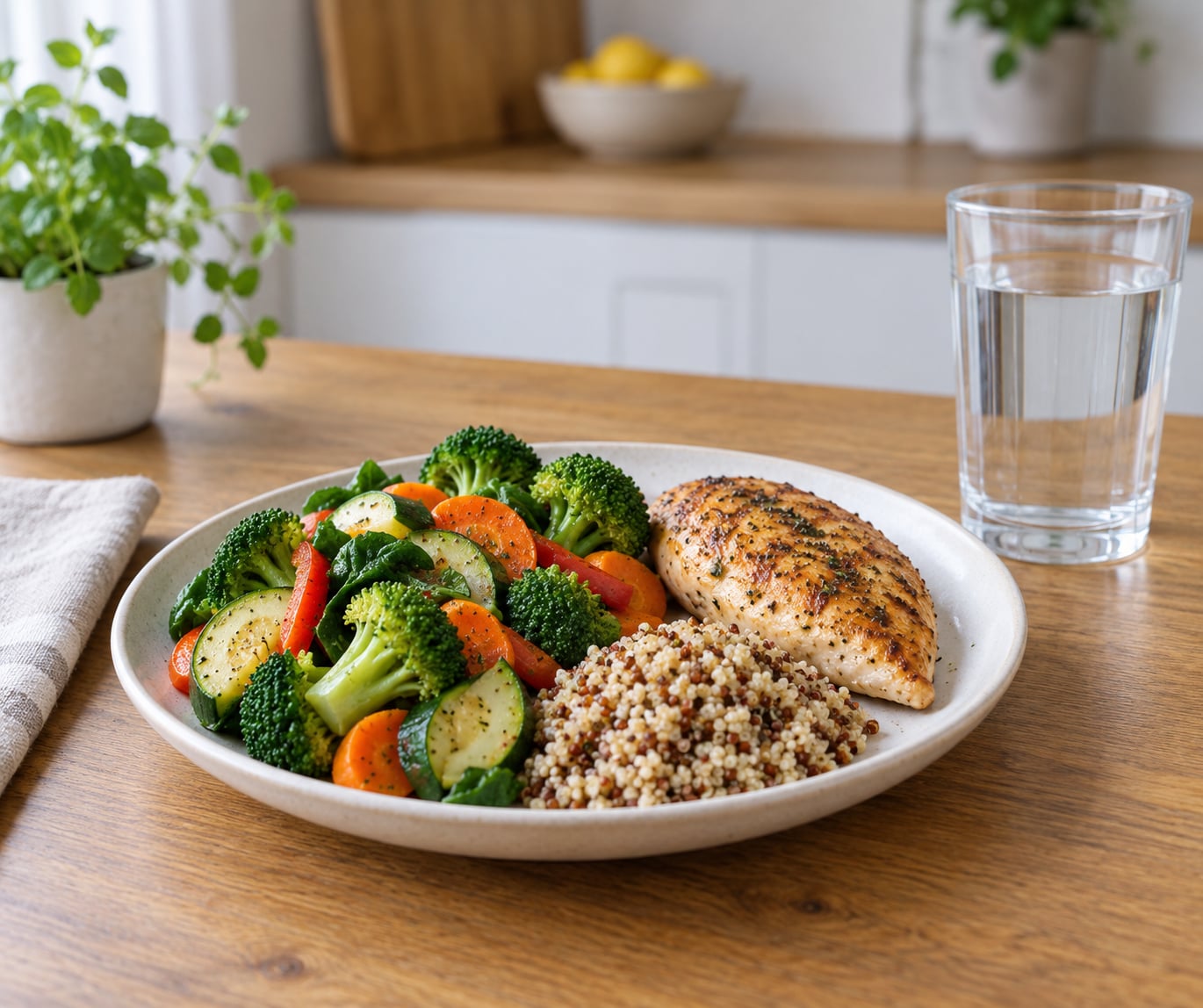
Short version: diets fail because they are built on rules you cannot keep for years, not because you lack willpower. Most weight lost on a strict plan comes back within a few years, and the cycle is well documented. If you’re wondering why diets fail and what to do instead, the answer is a routine you can repeat on a bad week, not a stricter plan.
There’s a reason you can name five diets but not five eating habits you’ve kept for a decade. Diets sell a clean break from your current life. Habits are duller and far more useful.
Table of Contents
- Why Diets Fail and What to Do Instead
- Why Do Most Restrictive Diets Fail?
- The biological reasons your body pushes back
- The psychological reasons people quit
- The Main Reasons People Give Up on Dieting</
- What Makes a Diet Sustainable?
- What to Do Instead of Going on Another Diet
- Eat on a regular schedule
- Build a plate you can actually assemble
- Prioritize protein and fiber
- Drink water and watch liquid calories
- Move in ways that survive a bad week
- Sleep like it’s part of the plan
- Review once a week, not once a day
- How to Reset Your Eating Routine After Repeated Failures
- Small Changes That Usually Work Better Than Extreme Rules
- When You Should Ask a Health Professional for Help
- Frequently Asked Questions
- Is slow progress normal, or is something wrong with me?
- How do I stop regaining weight the moment a diet ends?
- What is the 3-3-3 rule for weight loss?
- How can I mimic the effect of Ozempic naturally?
- What is the hardest age to lose weight?
- What should I do the day after I overeat?
- Conclusion
Why Diets Fail and What to Do Instead
Restrictive diets fail for five recurring reasons: they cut intake too hard, they ban too many foods, they promise a timeline the body cannot deliver, they treat food as a moral scoreboard, and they give you no plan for the week things go wrong. Replace that with regular meals built around protein, fiber and fat, a moderate portion change, movement you actually enjoy, consistent sleep, and a weekly review instead of daily weigh-ins.
That’s the whole idea. Everything below is detail on those two halves.
Why Do Most Restrictive Diets Fail?
Diet failure has a specific pattern. You lose weight quickly in the first few weeks, then progress slows to nothing, then you regain the weight and feel worse than when you started. Research following dieters long-term, including a widely cited University of California Los Angeles review of weight-loss programs, found most people regained all or more of what they’d lost within about five years.
Some of that early drop is water and gut contents, not fat. Carbs hold water in the body, so the first week on a lower-carb plan flatters the scale more than the plan deserves. Fat loss is slower and steadier, which is why a modest weekly change that lasts beats a dramatic one that stops.
The biological reasons your body pushes back
Losing weight triggers a coordinated defense. Leptin, the hormone fat tissue releases to signal fullness, falls when you lose fat. Ghrelin, the hunger hormone, rises. Your resting metabolic rate drops partly because a smaller body needs less energy, and partly because severe restriction teaches it to spend less. Researchers call this metabolic adaptation, and it’s a normal response to a low intake, not a broken metabolism you were born with.
Meanwhile cortisol tends to climb during periods of stress and under-eating, and higher cortisol is associated with abdominal fat storage. Poor sleep makes the whole picture worse: less sleep raises hunger the next day and lowers the appeal of high-fiber foods.
The set point matters too. Your body defends a weight range as familiar and normal, and it fights unfamiliar territory through hunger, reduced energy expenditure, and spontaneous activity. Weight cycling, losing and regaining repeatedly, tends to make each subsequent attempt harder rather than easier.
The psychological reasons people quit
Restriction has a predictable side effect: it makes the restricted thing more mentally loud. That’s the restriction-binge cycle. Cut a food, think about it constantly, eat it in a large episode, feel guilt, then cut it harder. The cycle repeats and the diet gets abandoned.
Food noise, the intrusive thoughts about what and when to eat next, is often harder to live with than hunger itself. People describe it as the single most exhausting part of dieting, and it fades as meals become regular and the rules loosen.
All-or-nothing thinking feeds that cycle. One meal that doesn’t fit the plan gets labeled a failure, and a single failure becomes six weeks of quitting. This is a well-known cognitive pattern in weight management, and it’s the one most worth interrupting.
The Main Reasons People Give Up on Dieting</
| Failure pattern | What it looks like in daily life | The part that ends it |
|---|---|---|
| Extreme calorie cutting | Constant hunger, low energy, poor sleep, irritability | A moderate deficit you can hold for months |
| Eliminating too many foods | Meals with no normal items, social friction, food noise | Plenty of permitted foods, one or two adjusted |
| Relying on quick fixes | A dramatic first month, then a flat scale | Expecting slow progress from the start |
| Moral labels for food | Eating cake feels like a character flaw | Neutral language: some meals are more filling |
| Unrealistic timelines | Aim for 10 pounds in a month, quit on day 12 | Monthly ranges instead of weekly promises |
| Inconsistent support | Starting alone, stopping alone | One person who asks how it’s going |
| Poor self-monitoring | Guessing at intake, no idea what changed | A short weekly note, not daily surveillance |
Read that table and you’ll notice something. Six of the seven patterns are about the plan being too rigid, not too gentle. Almost nobody quits because a routine was too easy.
What Makes a Diet Sustainable?
A sustainable approach has recognizable features. First, it feeds you adequately. Skipping meals to save calories backfires by making the next meal less predictable and harder to enjoy.
Second, the changes are moderate. Two adjustments you will still be doing a year from now beat six you will abandon in a month. Third, there is flexibility. A plan with no room for birthdays, travel, or a late work dinner has no room for your actual life.
Fourth, portions are manageable rather than measured to the gram. You can estimate, and being slightly off is fine. Fifth, meals are enjoyable enough to look forward to, because the point is eating, not eating correctly.
Sixth, progress is allowed to be gradual. Seventh, recovery after a bad day is part of the design, not an exception you have to earn. Eighth, the plan fits work, family, culture and budget, which is where most diet books quietly fail.
What to Do Instead of Going on Another Diet
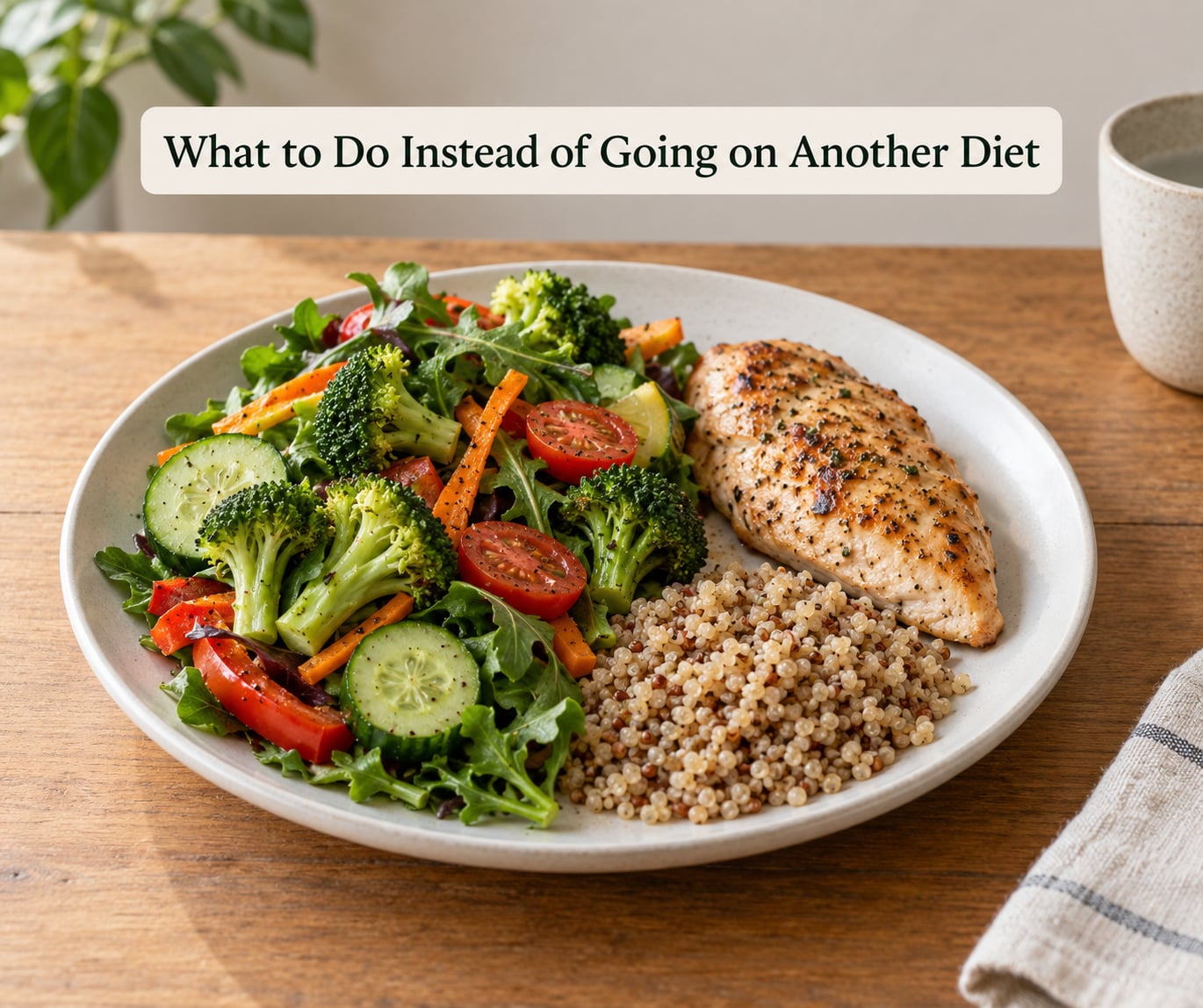
Build a routine instead. Here are the parts, in the order I’d set them up.
Eat on a regular schedule
Three meals a day, roughly the same times, works better than skipping and catching up. Regular meals keep hunger steady and remove the decision fatigue that makes an evening binge feel inevitable. If you prefer breakfast later, that’s fine. Consistency matters more than the specific hour.
Build a plate you can actually assemble
Half the plate vegetables or fruit, a quarter protein, a quarter starch plus fat. This is close to what Mediterranean-style eating looks like in practice, and it’s the pattern behind most of the long-term success in dietary research. The advantage is that it’s a template, not a list of banned ingredients. Add beans to a bowl of grains and you’ve got a complete meal that also gives you fiber.
Prioritize protein and fiber
Protein supports fullness and helps you keep muscle while you lose fat, which matters because muscle is what keeps your metabolism from dropping as hard. Most adults do better with roughly 1.0 to 1.2 grams per kilogram of bodyweight daily, spread across meals. Fiber does quieter work: it feeds gut bacteria, steadies blood sugar, and keeps you full without adding much fuss. Beans, lentils, oats, vegetables, berries and whole grains cover most of it.
Drink water and watch liquid calories
Sweet drinks are the easiest calories to remove, because they rarely register as food. Water, sparkling water, or unsweetened tea for most of the day usually does the work. Milk and coffee still count, and a daily latte is worth an honest look.
Move in ways that survive a bad week
Walking counts. So does lifting weights twice a week, which protects muscle mass. You do not need to hate exercise to benefit from it, and you do not need a program that assumes you have two spare hours. Pick something you’d still do when tired, and do less of it consistently.
Sleep like it’s part of the plan
Most adults need seven to nine hours. Short sleep increases next-day hunger and makes consistent eating genuinely harder, so treating sleep as a weight tactic is fair rather than a distraction.
Review once a week, not once a day
Daily weigh-ins measure water, digestion and salt. A weekly average smooths that out and gives you real information. Note three things: how meals went, what movement looked like, and one thing to adjust. Then stop thinking about it until next week.
How to Reset Your Eating Routine After Repeated Failures
After several failed attempts, the problem is often not knowledge. It’s that the plan was built for a version of your week that doesn’t exist. This reset takes about two weeks per step, and most people only need the first four.
- Drop the all-or-nothing rule first. Decide now, while you are calm, that a single off-plan meal is a normal Tuesday, not a failed diet. This one change removes the spiral that ends most attempts.
- Pick one small change and nothing else. Three regular meals. Or beans at dinner four nights a week. Or a fifteen-minute walk after lunch. One change at a time, because two changes is a plan and plans are what got you here.
- Build two or three repeatable meals you know you will cook on a tired night. Rotation beats inspiration. Write them down so the decision is already made when energy is low.
- Track only what changes decisions. For most people that means protein at meals, vegetables at meals, and movement days. Skip calorie counting unless you genuinely want it; otherwise it adds friction without adding insight.
- Plan for the hard situations in advance. Decide what a restaurant meal looks like, what you’ll do at a family dinner, and what your planned treat is. Regulars on diet forums report that a planned “yes, I’m having that” gets the same result as saying no, without the collapse afterward.
- Plan for maintenance before you reach your goal. This is the step almost everyone skips, and it’s why weight comes straight back. Decide in advance what your eating looks like at maintenance: same meals, adjusted portions, continued walking. A maintenance phase is not a relapse, it’s the finish line.
If weight or appetite changes sharply, or you’ve lost a lot of weight already and it isn’t budging, adjust the plan with a professional rather than cutting harder. That’s a signal, not a failure.
Small Changes That Usually Work Better Than Extreme Rules
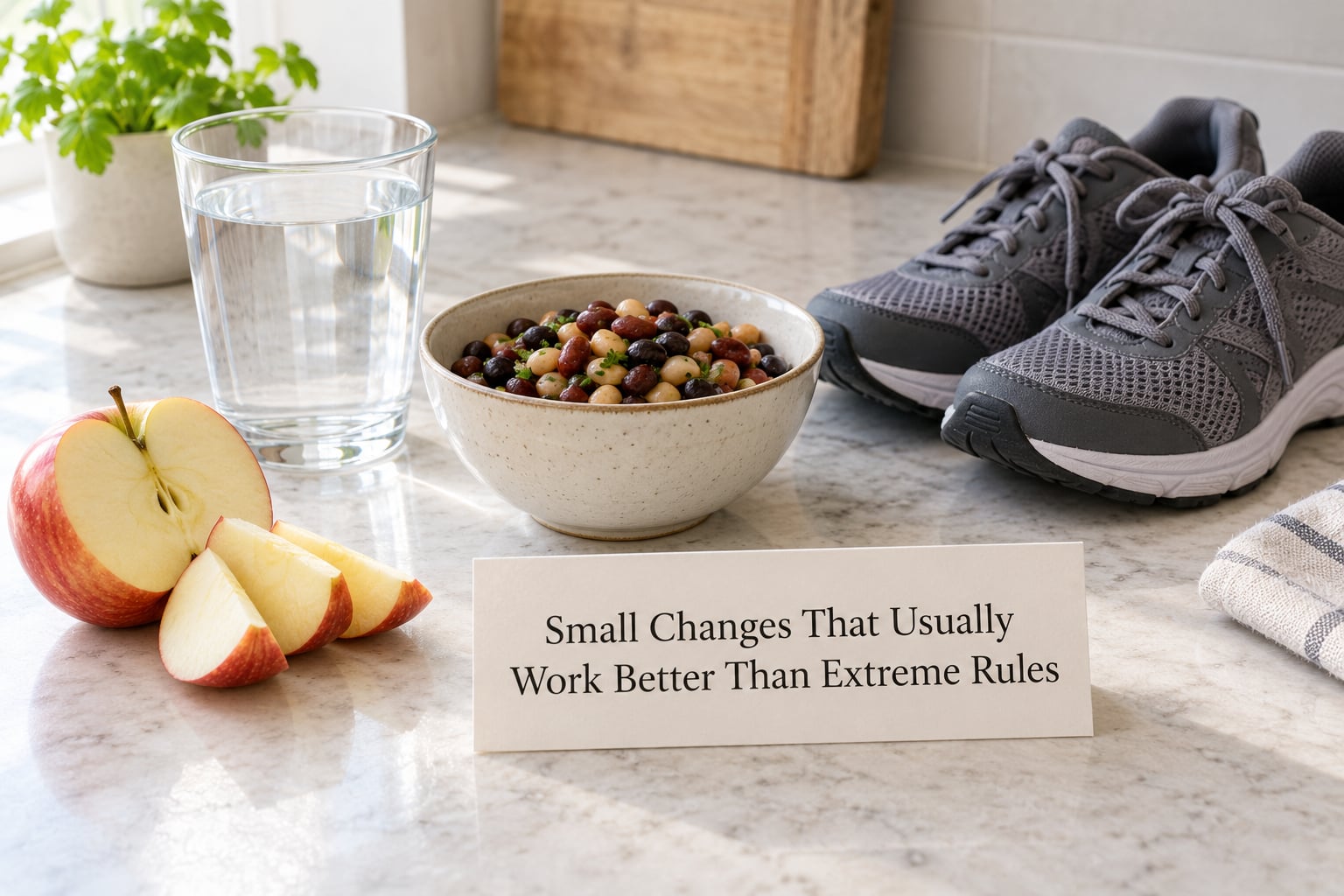
Each of these earns its place because it survives ordinary life.
- Eat three times a day. It removes the decision that starts most overeating episodes, and it costs you no extra cooking.
- Add fiber you already like. A bowl of beans, raspberries, or oats at breakfast adds bulk without adding a chore.
- Cut liquid sugar first. Soda and sweetened coffee are usually the lowest-effort change with the clearest return.
- Choose foods that are less processed when it’s easy. Not always, and not exclusively. It’s a default, not a rule.
- Walk ten to fifteen minutes after a meal. Particularly after dinner. It’s short enough that you’ll do it tired.
- Strength train twice a week if you can. Muscle preservation is the main reason weight lost slowly tends to stay lost.
- Protect seven to nine hours of sleep. Cheaper than any supplement, and it works on hunger regulation.
- Plan your social eating. Know the restaurant, the dish, and the treat in advance. Improvised social eating is where most careful plans quietly end.
Pick two. Not eight.
When You Should Ask a Health Professional for Help
General information has limits, and this one has a clear line. See a doctor or a registered dietitian rather than guessing if any of these apply.
- You have a medical condition affected by diet, including diabetes, kidney disease, hypertension, or a history of disordered eating.
- You’re pregnant, breastfeeding, or planning either.
- You take medication whose effects change with food intake or weight.
- Weight changes without you changing anything, in either direction.
- You feel dizzy, faint, cold all the time, or persistently exhausted while eating less.
- Hunger is severe enough to disrupt sleep or daily functioning.
- You have a history of binge eating, purging, or rigid food rules that leave you unable to eat with other people.
Supplements marketed as natural alternatives to prescription weight-loss medication deserve the same caution. Some interact with medications, and none are a substitute for a routine or for medical care. If you’re considering one, bring it to your doctor first.
Frequently Asked Questions
Is slow progress normal, or is something wrong with me?
Slow progress is the normal pace for fat loss, and steady usually beats fast. Most plans that shed weight in the first month lose a good share of that as water. If you are losing roughly 0.25 to 0.75 percent of your bodyweight per week and your strength and energy hold up, that is a working rate. If progress is zero for several weeks alongside fatigue, dizziness, or constant hunger, the intake is probably too low and worth reviewing with a doctor or registered dietitian.
How do I stop regaining weight the moment a diet ends?
Plan the maintenance phase before you reach your goal. Most regain happens because a diet has an end date and maintenance has none, so your normal habits return all at once. Choose a maintenance approach in advance: the same meals you already eat, slightly adjusted portions, and the movement you want to continue. Treat the last two weeks of a diet as a rehearsal for that, so the changeover feels ordinary rather than like starting over.
What is the 3-3-3 rule for weight loss?
The 3-3-3 rule is a meal-planning shorthand rather than a diet: three meals, roughly three balanced components per meal, eaten across about three hours. In practice it means building each meal from a protein, a vegetable or fruit, and a source of fat or starch, then spacing meals evenly through the day. Some versions use three components per meal with a 3-hour gap between them. Treat it as a simple template that reduces decision fatigue, not a set of medical rules.
How can I mimic the effect of Ozempic naturally?
The honest answer is that nothing you buy over the counter reproduces a prescription medication’s mechanism, and supplements claiming to do so are not regulated the way prescriptions are. What people can do is support the same underlying goals: more protein and fiber for fullness, regular meals instead of grazing, less liquid sugar, consistent movement, and better sleep. If you are considering a supplement such as berberine, discuss it with a doctor first, especially if you take other medications.
What is the hardest age to lose weight?
Many people notice weight loss becoming harder in their forties, and for women often around menopause. The reasons are mostly practical: less physical activity, less lean muscle, changes in sleep, and hormonal shifts that affect fullness and energy. Muscle loss matters most, because muscle drives how much energy your body spends at rest. Adjusting for that means protecting strength training and protein intake rather than cutting harder, and giving it more time than you expected in your twenties.
What should I do the day after I overeat?
Return to your normal meals at your usual time and do nothing else. This is the moment all-or-nothing thinking does the most damage, because the instinct to compensate is what starts the restriction-binge cycle. A single large meal changes nothing meaningful about fat loss over weeks, and compensating with fasting or extreme restriction usually sets up the next episode. If overeating is happening most days rather than occasionally, or it comes with loss of control, that is worth raising with a health professional.
Conclusion
Diets fail because the plan is temporary and the person is not. The biology punishes severe restriction, the psychology punishes rigid rules, and both push you back toward the eating you had before.
So start smaller than feels satisfying. Pick one habit from the list above, keep it for two weeks without changing anything else, then add a second. If a plan stops working, adjust it instead of abandoning it, and bring a doctor or registered dietitian in if weight changes unexpectedly or eating has become distressing.
This piece covers general information rather than personal advice, and it’s not a substitute for care from a qualified health professional.