To calculate your TDEE by hand, find your basal metabolic rate with a formula like Mifflin-St Jeor, then multiply that number by an activity factor: TDEE = BMR x activity multiplier. It takes about ten minutes with a phone calculator and gives you a maintenance calorie target you can adjust week to week.
The catch is that no formula gives you an exact number. Your real TDEE sits somewhere near the result, usually within a few hundred calories either way, which is why the last step below matters as much as the arithmetic.
Calculating your TDEE by hand is worth the effort for a few practical reasons. You end up with a calorie target built from your own measurements rather than a generic 2,000. You can see exactly which input moves the number most. And when a plan stalls, you know which part to change instead of guessing.
What follows is the full working: every sum written out, both the standard and the alternative branches, and the verification routine that tells you whether your answer holds up in real life. Nothing here is medical advice. If you have a health condition, take a medication that affects appetite or metabolism, are pregnant or breastfeeding, or have a history of disordered eating, talk to a doctor or a registered dietitian before you start tracking calories.
Table of Contents
- What You Need
- Step-by-Step: How to Calculate Your TDEE by Hand
- Step 1: Estimate Your Basal Metabolic Rate
- Step 2: Choose the Right Activity Multiplier
- Step 3: Multiply BMR by Your Activity Multiplier
- Step 4: Adjust the Result for Your Goal
- Step 5: Check and Improve Your Estimate
- Common Mistakes
- Frequently Asked Questions
- Can I calculate my TDEE by hand without a calculator?
- Can I use pounds and inches instead of kilograms and centimeters?
- Which BMR formula gives the most accurate result?
- How often should I recalculate my TDEE?
- When should I ask a doctor or registered dietitian instead?
- Conclusion
What You Need
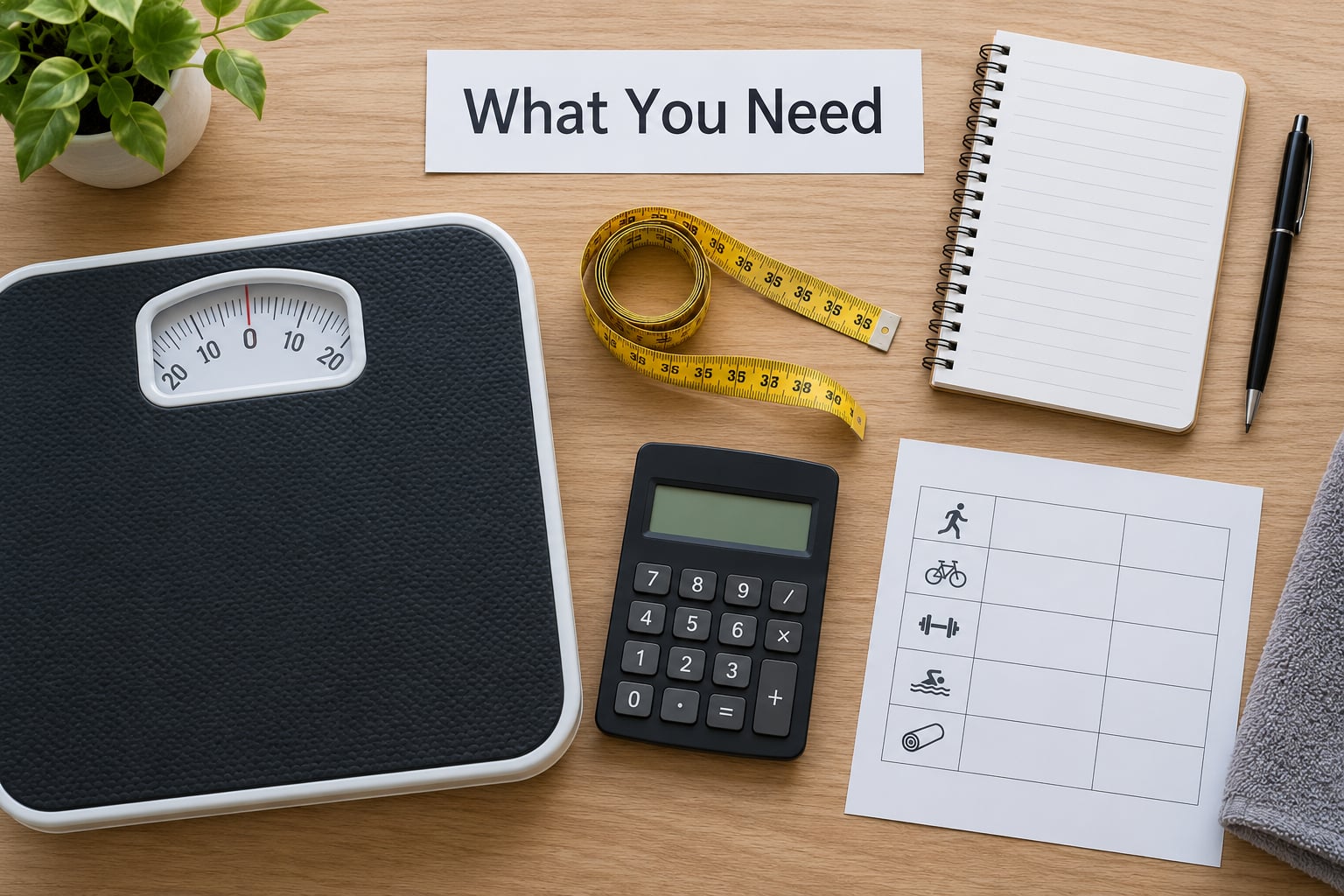
You need five pieces of information and one tool. The tool is any basic calculator, including the one in your phone.
- Current weight in pounds or kilograms. Use a recent average rather than a single weigh-in if you can.
- Height in feet and inches, or in centimeters.
- Age in whole years.
- Sex, because the standard equation uses a different constant for each.
- An honest description of a typical day: your job, your step count, and how often you train.
That last one trips people up more than the arithmetic does. Think about your average Tuesday, not your best week or your intentions for the new year.
One more thing helps a lot: a note of your weight trend over the past month. If you have been dieting hard or gaining quickly, that number changes the right answer.
Step-by-Step: How to Calculate Your TDEE by Hand
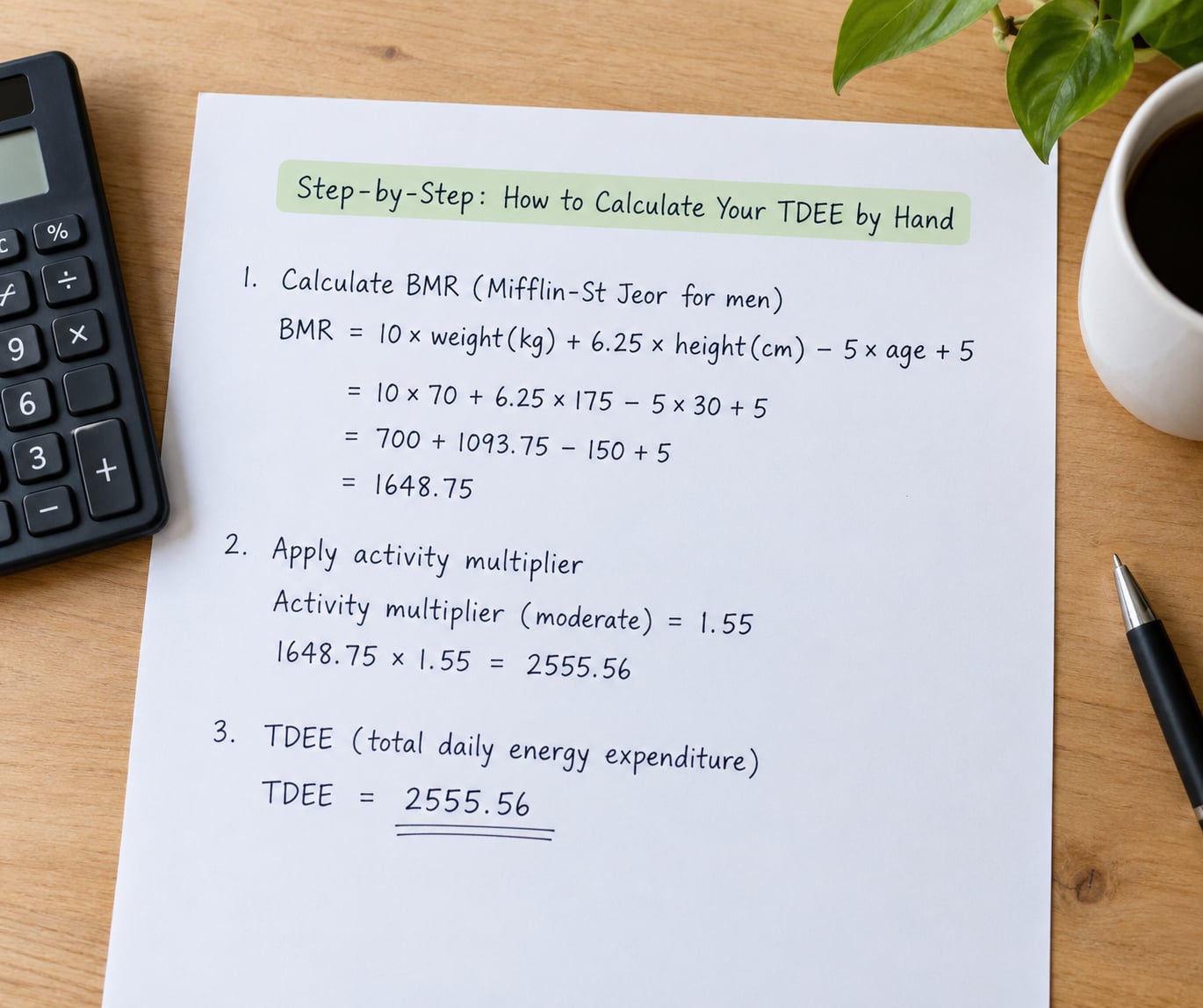
TDEE, short for Total Daily Energy Expenditure, is the number of calories your body burns in a typical day. The whole method rests on two equations: BMR = (10 x weight in kg) + (6.25 x height in cm) – (5 x age) – 161 for women and + 5 for men, and TDEE = BMR x activity multiplier. Five steps get you from your measurements to a usable number.
Step 1: Estimate Your Basal Metabolic Rate
BMR is the energy your body spends at complete rest, keeping organs, breathing and circulation going. It accounts for roughly 60 to 75 percent of your total daily burn, which makes it the foundation of every TDEE estimate.
The Mifflin-St Jeor equation, published in 1990, is the most widely used hand-calculation formula. It reads:
Women: BMR = (10 x kg) + (6.25 x cm) – (5 x age) – 161
Men: BMR = (10 x kg) + (6.25 x cm) – (5 x age) + 5
The +5 and -161 are simply constants fitted to the reference data. Use the men’s version for men and the women’s version for women, and write down which one you used so you stay consistent later.
Here is a woman, 34 years old, 5 feet 5 inches, 150 pounds. Convert first: 150 x 0.4536 = 68.0 kg, and 65 inches x 2.54 = 165.1 cm. Then (10 x 68.0) = 680, (6.25 x 165.1) = 1031.9, (5 x 34) = 170. Add and subtract in order: 680 + 1031.9 = 1711.9, minus 170 gives 1541.9, minus 161 gives 1380.9. Her BMR is about 1,381 calories.
Now a man, 42 years old, 5 feet 8 inches, 185 pounds. 185 x 0.4536 = 83.9 kg, and 68 inches x 2.54 = 172.7 cm. (10 x 83.9) = 839, (6.25 x 172.7) = 1079.4, (5 x 42) = 210. So 839 + 1079.4 = 1918.4, minus 210 gives 1708.4, plus 5 gives 1713.4. His BMR is about 1,713 calories.
Step 2: Choose the Right Activity Multiplier
The multiplier scales your BMR up to a full day of movement, including the calories burned digesting food. Pick the row that matches an ordinary week, not an aspirational one.
| Activity level | Multiplier | What a typical week looks like |
|---|---|---|
| Sedentary | 1.2 | Desk job, under 5,000 steps a day, little or no deliberate exercise |
| Lightly active | 1.375 | Around 7,000 to 8,000 steps, one or two training sessions a week |
| Moderately active | 1.55 | Around 10,000 steps, three to five training sessions, some standing or walking at work |
| Very active | 1.725 | 12,000 steps or more, six sessions a week, physically demanding job |
| Extra active | 1.9 | Manual labour, two-a-day training, or a very large daily step count |
The single most common error is choosing by intention. People who plan to start running pick the row for someone who already runs, then wonder why their weight stalls for weeks. Base it on the last four weeks, not the next four.
If you are genuinely between two rows, take the lower one and let the tracking step correct you. Being slightly low costs you two weeks; being high costs you a stalled month.
Step 3: Multiply BMR by Your Activity Multiplier
This is the part people expect to be complicated. It is one multiplication.
For the woman above: 1,381 x 1.375. Break it into 1,381 + 0.375 x 1,381, and 0.375 x 1,381 is 517.9. Total = 1,898.9, so her TDEE is roughly 1,900 calories a day.
For the man above: 1,713 x 1.55. That is 1,713 + 0.55 x 1,713, and 0.55 x 1,713 is 942.2. Total = 2,655.2, so his TDEE is roughly 2,655 calories a day.
That figure is your maintenance calories: the intake at which your weight holds roughly steady. Write it down with the date and the inputs you used. If you change weight later, the number changes too, and you will want the original to compare against.
Step 4: Adjust the Result for Your Goal
Use your TDEE as the baseline, then move away from it by an amount you can hold for months rather than days.
For fat loss, a deficit of 10 to 20 percent of TDEE is a sensible starting point. On the example above, 1,900 minus 20 percent lands near 1,520 calories. Widely used safety floors sit at 1,200 calories a day for women and 1,500 for men, and going below them without medical supervision is where problems start.
For muscle gain, a surplus of roughly 10 percent keeps weight gain slow enough to control. Anything larger mostly adds fat as well.
Whatever the direction, hold the same number for two to four weeks before changing anything. If weight moves as expected, keep going. If it does not, adjust by 100 to 200 calories rather than rewriting the whole plan.
Step 5: Check and Improve Your Estimate
This step is what separates a useful estimate from a number on a scrap of paper. Eat at your calculated TDEE for two to three weeks, changing nothing else.
Weigh yourself every morning, under the same conditions, and record the number. Look only at weekly averages, never daily figures. Water, salt and bowel movements routinely swing the scale by two to three pounds, and chasing those swings is how people quit the method in four days.
At the end, compare week three with week one. Holding steady means your estimate was close and your maintenance number is now the one to plan from. Dropping by more than about one percent of bodyweight per week means the estimate was too high, so lower it by the same amount. Holding steady when you expected a loss usually means intake was under-reported, and cooking oil, dressings and drinks are the usual culprits rather than a broken formula.
Recalculate whenever your bodyweight moves by 5 kg or 10 lb or more, since the formula is weight-dependent. Also recalculate after a long sedentary stretch or a change in training frequency. Forum advice on this question is consistent: treat the first number as a starting hypothesis and let three weeks of data correct it.
Common Mistakes
These are the errors that show up again and again, each with the fix.
- Using pounds and inches in a metric formula. The equation needs kilograms and centimeters. Multiply pounds by 0.4536 and inches by 2.54 first.
- Treating BMR as your daily calorie target. BMR is only what you burn lying still. Using it as an intake is the most common way people undereat.
- Picking an activity level by intention. Choose from the last four weeks of actual behaviour, and when unsure, drop one row.
- Adding exercise calories on top of the multiplier. The multiplier already covers your training. Eating back workout calories on top of that double counts and stalls progress.
- Judging the result from one weigh-in. A single reading after a salty meal means nothing. Use weekly averages over three weeks.
- Recalculating from the same weight forever. Once you have lost 5 to 10 kg, rerun the formula with your current weight instead of reusing the original.
Frequently Asked Questions
Can I calculate my TDEE by hand without a calculator?
You can, but not reliably. The Mifflin-St Jeor equation has three multiplications and one division by 161, and mental arithmetic on a number that size invites small errors that throw off the final result. Paper is fine if you want to understand the working; a basic phone calculator takes ten seconds and removes the risk of a mistake in the arithmetic itself.
Can I use pounds and inches instead of kilograms and centimeters?
Not without converting first. The formula is built on metric inputs. Multiply your weight in pounds by 0.4536 to get kilograms, and multiply your height in inches by 2.54 to get centimeters. If you skip this and feed pounds into a metric formula, your BMR comes out roughly double the correct value.
Which BMR formula gives the most accurate result?
Mifflin-St Jeor, published in 1990, is the usual choice because it fits most adults better than the older Harris-Benedict equation. If you know your body fat percentage with reasonable confidence, Katch-McArdle is worth running as a cross-check because it uses lean body mass rather than raw weight. Expect both to sit within roughly 200 to 400 calories of your true expenditure.
How often should I recalculate my TDEE?
Every two to four weeks while you are actively changing your weight, and immediately after any change of 5 kg or 10 lb or more. The formula uses current weight, so a number calculated at 90 kg is wrong once you reach 80 kg. Recalculating after a major shift in training or daily activity also matters, since the multiplier moves more than people expect.
When should I ask a doctor or registered dietitian instead?
Get professional guidance if you are pregnant or breastfeeding, under 18, managing diabetes, thyroid disease, kidney disease or a heart condition, or take medication that affects appetite or metabolism. It is also worth asking if you are considering going below about 1,200 calories a day for women or 1,500 for men, or if you have a history of disordered eating.
Conclusion
The sequence is short: convert your measurements to kilograms and centimeters, run Mifflin-St Jeor for your sex, pick an activity multiplier from what your last four weeks actually looked like, multiply, and write the result down with today’s date. That number is your maintenance calories, and everything else is an adjustment in one direction or the other.
Start by doing the arithmetic now, before you change anything, and then do the least interesting part: eat at that number for three weeks and average your weight weekly. The formula gives you a defensible starting point in 2026. Your scale data is what turns it into the right number for you.