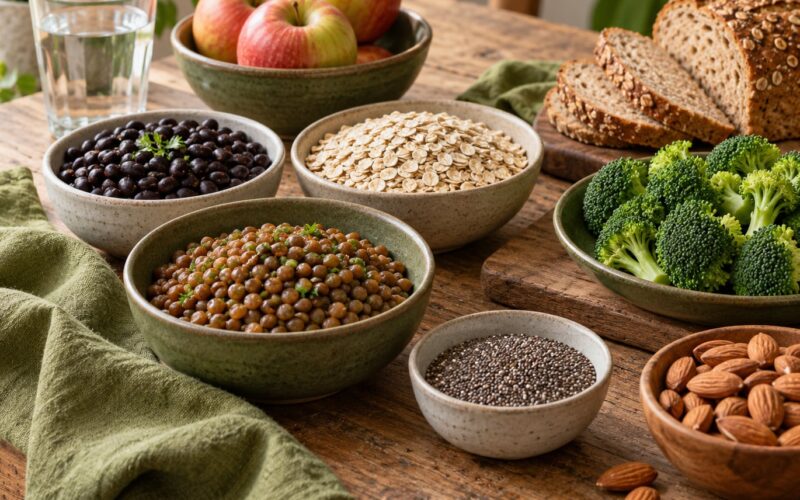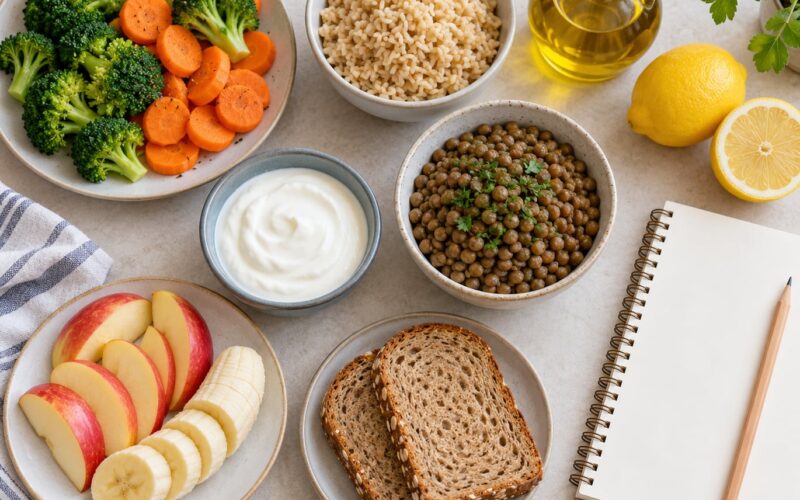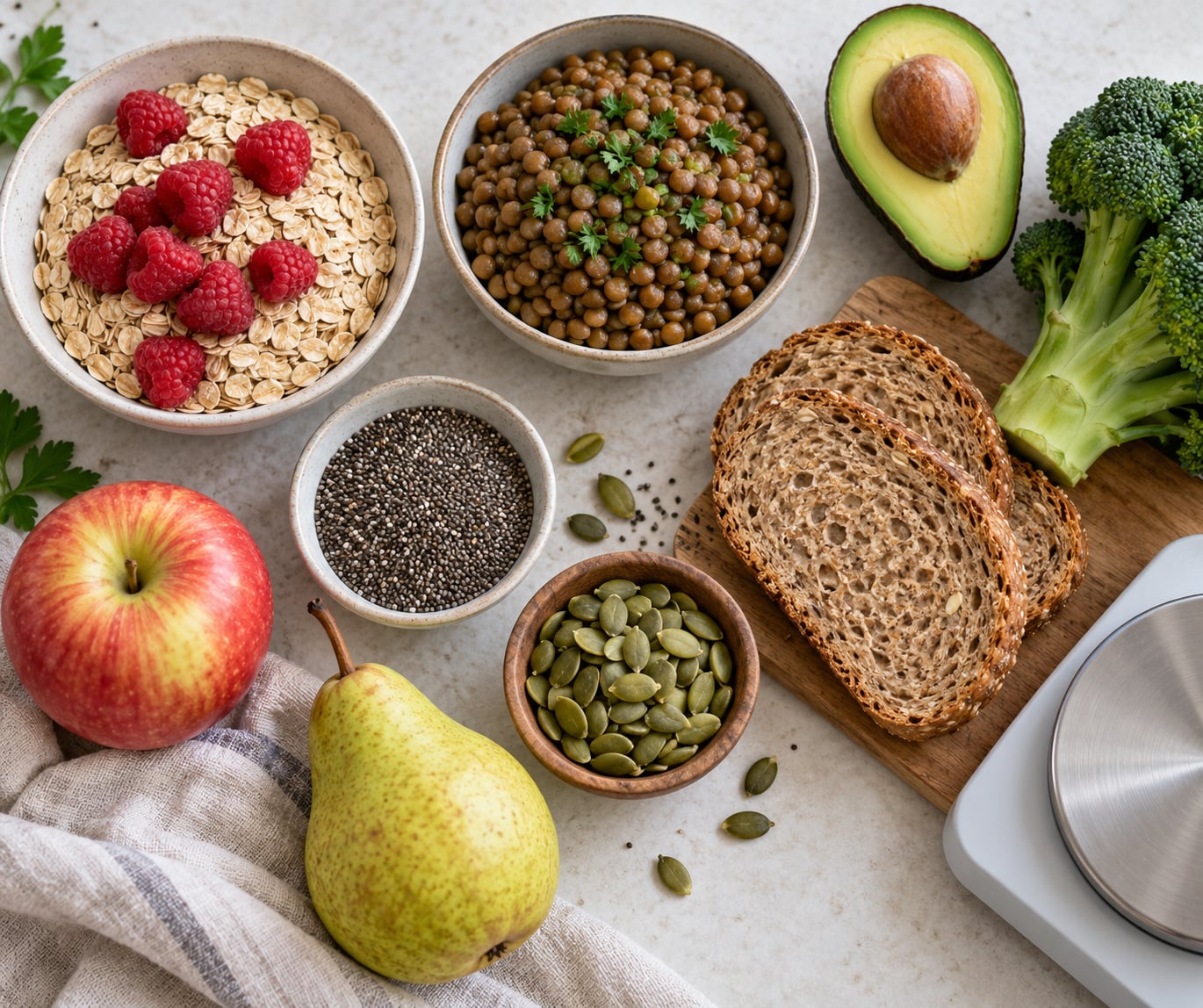
To eat 30 grams of fiber a day, aim for roughly 10 grams at each of three meals plus one or two snacks, built from oats, beans and lentils, whole grains, vegetables, fruit with the skin on, nuts and seeds. Most adults land somewhere between 15 and 20 grams without trying, so the gap is smaller than it sounds.
The trick is not willpower. It is knowing which foods carry the grams, how to spread them across a day, and how to climb toward the target without spending a week feeling like a balloon. That is what the plan below does.
This is general nutrition information, not medical advice. If you have IBS, IBD, celiac disease, an ostomy, or recent abdominal surgery, talk to your doctor or a registered dietitian before increasing fiber, because for some people more is not simply better.
Table of Contents
- What You Need
- Grams versus servings
- Your tolerance is the variable nobody can plan for
- Step-by-Step: How to Eat 30 Grams of Fiber a Day
- 1. Set Your Current Baseline
- 2. Build a 30-Gram Day From Food Groups
- 3. Spread Fiber Across Meals to Hit 30 Grams
- 4. Increase Gradually and Drink Enough Fluid
- 5. Track and Fine-Tune Your Intake
- 6. A Sample 30-Gram Day
- 7. Foods That Help You Get Closer to 30 Grams
- Common Mistakes
- Frequently Asked Questions
- How can I tell if I am getting enough fiber?
- Do I have to eat 30 grams of fiber at every meal?
- What is the best way to increase fiber without bloating?
- Are fiber supplements necessary to reach 30 grams?
- How much water should I drink when eating more fiber?
- Should I follow a 30-gram fiber plan while pregnant or managing a medical condition?
- Conclusion: Where to Start Tomorrow
What You Need
You need four things, and none of them is a special product.
- A way to read a nutrition label. Fiber sits on the Nutrition Facts panel in grams, usually right under total carbohydrate.
- A rough idea of your starting point. A phone notes file, a paper notebook, or a nutrition tracking app all work.
- Fluid. Fiber holds water. Drinking to thirst matters more than any single number.
- Patience for two to four weeks. Your gut bacteria adjust on roughly that timeline, and going faster is the reason most people quit.
Grams versus servings
Serving sizes on a label are marketing as much as nutrition. A “1 cup” of cereal can be 28 grams or 60 grams of product depending on the box, which swings the fiber number with it. Grams are the only unit that matters for this target, so read the serving size and multiply before you trust a number.
One practical shortcut: in the US, 3 grams or more of fiber per serving earns a “good source” label, and 5 grams or more per serving counts as high fiber. In the UK and EU the equivalent rule is 6 grams of fiber per 100 grams of food. If a package meets the second rule, it is a genuinely dense food and will move your total quickly.
Your tolerance is the variable nobody can plan for
Two people eating an identical bowl of lentil soup can have completely different reactions. That is not a failure of the plan, it is normal variation in gut sensitivity and in the bacteria you currently have. Start at the low end of any increase and hold there for several days before adding more.
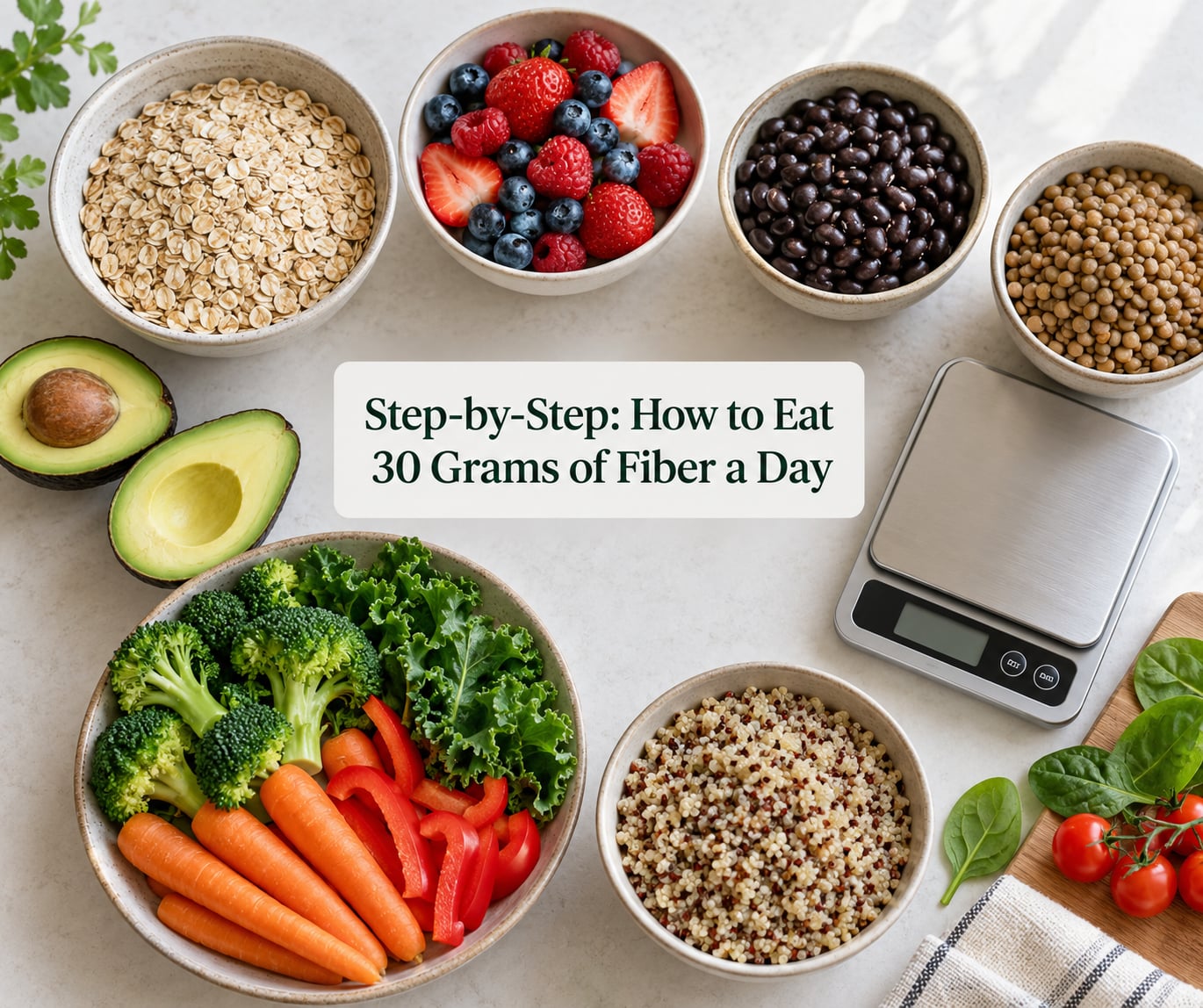
Step-by-Step: How to Eat 30 Grams of Fiber a Day
1. Set Your Current Baseline
For two or three ordinary days, write down everything you eat and check the fiber on the label for anything packaged. Do not change anything during this window. You are collecting data, not grading yourself.
Most people land somewhere between 12 and 20 grams. The interesting part is not the total but the shape of the day. A diet can hit 20 grams almost entirely at dinner, which leaves the rest of the day low and makes the sudden evening load much harder to digest.
Once you have the number, pick one realistic first step. Moving from 15 to 20 grams is more useful than pledging to jump to 30 overnight.
2. Build a 30-Gram Day From Food Groups
You do not need fiber from ten different categories. Four reliable groups cover the whole target.
- Legumes. Half a cup of cooked lentils is about 8 grams, black beans about 7.5 grams, chickpeas about 6 grams. This single category can carry a third of your day.
- Whole grains. Half a cup of dry rolled oats is around 4 grams, one cup of cooked whole wheat pasta about 8 grams, a slice of wholemeal bread about 2 grams.
- Vegetables. A cup of cooked broccoli gives roughly 5 grams. Salad vegetables are lighter, more like 1 to 3 grams per generous bowl.
- Fruit, nuts and seeds. A medium apple with the skin on is about 4.5 grams, half a cup of raspberries about 4 grams, an ounce of pumpkin seeds about 6 grams, a tablespoon of ground flaxseed about 2 grams.
Pick two groups to be generous with and let the others do normal work. A day built on legumes at lunch and dinner plus oats and fruit at breakfast clears 30 grams without any single meal feeling like a challenge.
3. Spread Fiber Across Meals to Hit 30 Grams
Ten grams at breakfast, ten at lunch, ten at dinner, and two to four grams for each snack is a workable frame. Splitting the load means each meal sits in a range your gut can handle on its own.
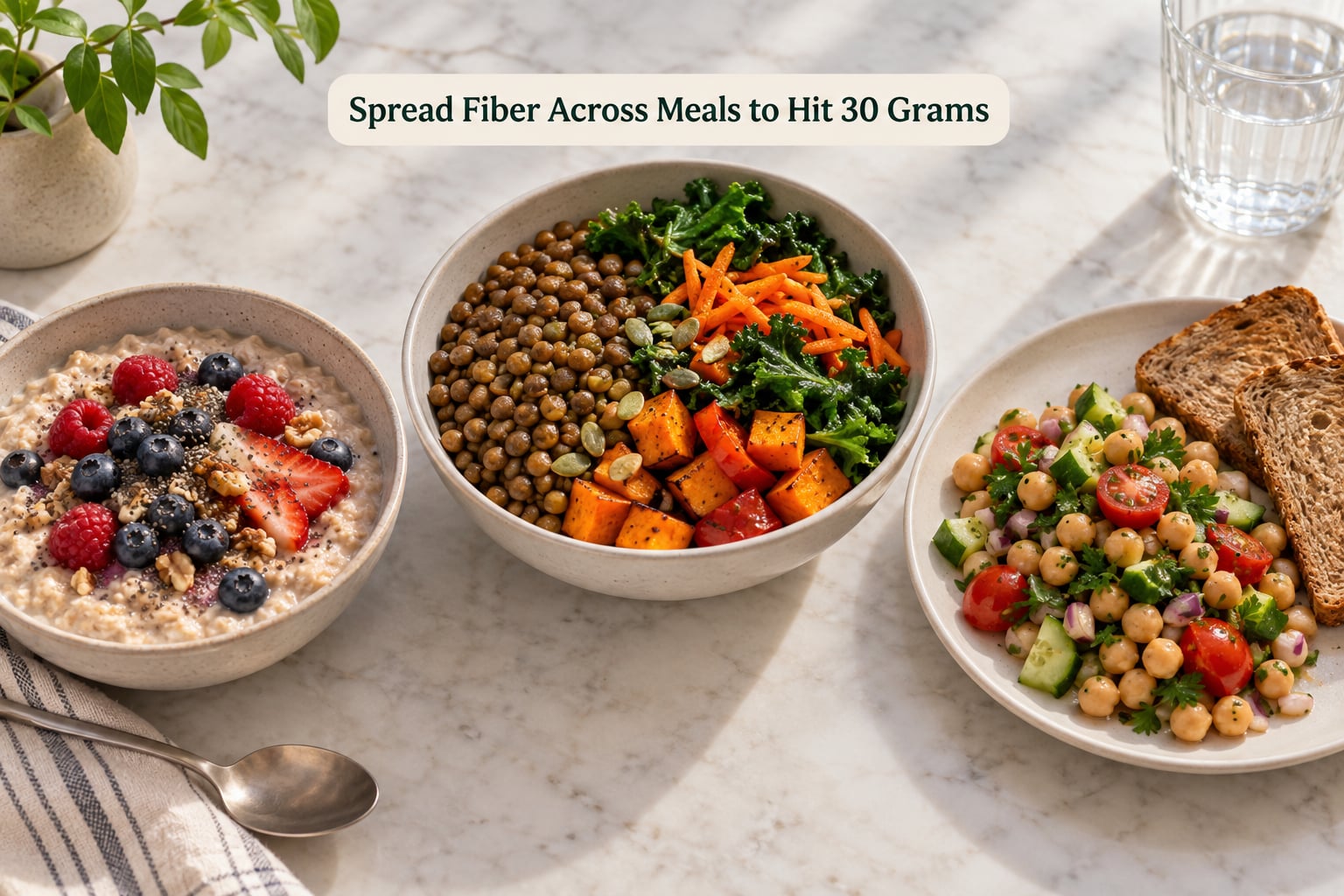
Breakfast is the meal most often skipped on fiber. Oats, whole grain toast, fruit and a spoon of seeds will get you to 8 to 10 grams without effort. Lunch is the easiest place to add a large single hit, because a bean or lentil salad portion does the arithmetic for you. Dinner then needs a vegetable, a whole grain or a legume component rather than a protein and nothing else.
Snacks are where people quietly add four or five grams without noticing, which is often the difference between a 25-gram day and a 30-gram day.
4. Increase Gradually and Drink Enough Fluid
Add fiber in stages rather than all at once. A simple approach is to add roughly 3 to 5 grams every three or four days and hold each stage until digestion feels normal again.
- Week 1. Establish your baseline. Change nothing.
- Week 2. Add one serving of beans or lentils three days a week, and one fruit with the skin on daily.
- Week 3. Swap white bread and white rice for whole grain versions, add two tablespoons of seeds to breakfast.
- Week 4. Add a second legume serving and target roughly 10 grams at each main meal.
Drink fluid with the increase, mostly water, and drink to thirst rather than forcing a fixed volume. Some people feel better with an extra glass alongside the higher fiber meals, particularly at breakfast and dinner.
If you feel bloated or crampy, hold at your current level for a few more days, add more fluid, and reduce the largest single serving rather than abandoning fiber entirely. People with a history of IBS, IBD, celiac disease, or abdominal surgery should ramp up more slowly still and get medical input first. Get prompt medical advice for pain, vomiting, or a sudden change in bowel habits that does not settle.
5. Track and Fine-Tune Your Intake
You need precision for about a week, then you can relax. After that your eye will know roughly what 10 grams looks like on a plate.
Three practical methods: read the label for packaged foods, use a nutrition database for fresh foods, or run a photo through a tracking app that estimates portions. All three have error bars, which is fine. You are trying to land in the high twenties or low thirties, not audit a lab report.
A useful weekly check: total your three biggest fiber sources for the day. If they add up to 20 grams, everything else you ate covered the rest. That is a fast, low-effort sanity check that catches the usual gap, which is breakfast.
6. A Sample 30-Gram Day
Here is one realistic day. The numbers are typical values for the portions listed, and they shift with brand, size and preparation, so treat them as a working estimate rather than a measurement.
| Meal | Food and portion | Approx. fiber | Running total |
|---|---|---|---|
| Breakfast | Half a cup dry rolled oats, cooked with milk | 4 g | 4 g |
| Breakfast | Half a cup raspberries | 4 g | 8 g |
| Breakfast | One tablespoon ground flaxseed | 2 g | 10 g |
| Snack | One medium apple, skin on | 4 g | 14 g |
| Lunch | Half a cup cooked lentils over salad vegetables | 8 g | 22 g |
| Lunch | One slice wholemeal bread | 2 g | 24 g |
| Dinner | Half a cup cooked chickpeas in a curry | 6 g | 30 g |
| Dinner | One medium baked sweet potato with skin | 4 g | 34 g |
Nothing in that day is unusual. Swap the chickpeas for black beans, the sweet potato for whole wheat pasta, or the apple for a pear with the skin, and you land in the same range with different food.
7. Foods That Help You Get Closer to 30 Grams
This is the reference table to keep open while planning. Portions are everyday ones, and the swap column is for readers who need a gentler starting point.
| Food | Practical portion | Approx. fiber | Lower-fiber swap at the start |
|---|---|---|---|
| Lentils, cooked | Half a cup | 8 g | Quarter cup, then build up |
| Black beans, cooked | Half a cup | 7.5 g | Half a cup of white beans, about 3 g |
| Chickpeas, cooked | Half a cup | 6 g | Quarter cup |
| Kidney beans, cooked | Half a cup | 6 g | Quarter cup |
| Lentil soup | One cup | 7 g | Tomato soup, about 1 g |
| Rolled oats, dry | Half a cup | 4 g | Instant oats, about 2 g |
| Oat bran | Quarter cup | 3 g | Wheat bran, about 2 g |
| Whole wheat pasta, cooked | One cup | 8 g | Half cup of white pasta, about 1 g |
| Brown rice, cooked | One cup | 3.5 g | White rice, under 1 g |
| Quinoa, cooked | One cup | 5 g | Half cup white rice |
| Wholemeal bread | One slice | 2 g | One slice white bread, under 1 g |
| Broccoli, cooked | One cup | 5 g | Half a cup, well chopped |
| Brussels sprouts, cooked | One cup | 5 g | Quarter cup, then build |
| Sweet potato with skin | One medium | 4 g | White potato with skin, about 2 g |
| Avocado | Half a medium | 5 g | Quarter of a medium |
| Apple with skin | One medium | 4.5 g | Peeled apple, about 2 g |
| Pear with skin | One medium | 5.5 g | Canned pears in juice, about 2 g |
| Raspberries | One cup | 8 g | Half a cup, about 4 g |
| Blueberries | One cup | 3.5 g | Strawberries, about 3 g |
| Orange, with peel | One medium | 4 g | Juice, under 1 g |
| Prunes | Five | 2.5 g | Four dried apricots, about 2 g |
| Pumpkin seeds | One ounce | 6 g | One tablespoon, about 2 g |
| Chia seeds | One tablespoon | 5 g | Half a tablespoon, about 2.5 g |
| Ground flaxseed | One tablespoon | 2 g | Two teaspoons, about 1 g |
| Almonds | One ounce | 3.5 g | Ten almonds, about 1.5 g |
| Air-popped popcorn | Three cups | 3.5 g | One cup, about 1 g |
| Hummus | Quarter cup | 2 g | Cucumber and tomato, about 1 g |
A few swaps carry more weight than others. Peeling fruit and vegetables throws away a meaningful slice of the fiber, and so does blending fruit into juice. Switching white bread to wholemeal, white pasta to whole wheat, and white rice to brown usually adds 4 to 8 grams across a day without adding meaningful calories.
Common Mistakes
Starting at 30 grams on day one. This is the single biggest reason people quit after four days. The fix is a staged ramp: add 3 to 5 grams every few days and hold each stage until digestion settles.
Treating a supplement as the whole answer. Psyllium, inulin, chicory root fibre and wheat dextrin all add grams, and a supplement is a legitimate tool when food alone will not get you there. Whole food still wins on nutrients, on the vitamins and minerals that travel with fiber, and on how slowly it releases into your system. If you use one, treat it as a top-up of five grams, not as a replacement for meals.
Buying products that only look high fiber. Some breads and cereals are marketed heavily and deliver 1 to 2 grams per slice. Check the panel rather than the front of the pack, and check whether the fiber per slice actually moves your total.
Forgetting fluid. Fiber absorbs water in the gut. Without enough fluid, the same increase that should feel comfortable turns into discomfort. Drink to thirst, and add a glass at the meals where you raised fiber most.
Loading everything into dinner. One 25-gram dinner is hard on any gut, even a healthy one. Moving 8 of those grams to breakfast is usually the easiest fix available.
Assuming every version of a food matches. Rolled oats, steel-cut oats and instant oats are three different products with three different fiber amounts. So are white beans and black beans, and seeded bread versus plain bread. Once a week, check a label. That is enough.
Three practical habits carry the rest. Keep one high-fiber food within reach at all times, because a default you forget is a default you skip. Batch cook a pot of lentils or beans at the start of the week so legume days take two minutes. And aim for 30 grams most days rather than every single one. People tracking long plans report good weeks and flat weeks, and that is a normal pattern rather than a failure.
If you are eating on a calorie budget, fiber is genuinely helpful: high-fiber foods are bulky and low in energy density, so they take up space in the bowl without taking up calories. Legumes, vegetables and fruit are the tools for that, and beans in particular add grams of protein alongside the fiber.
Frequently Asked Questions
How can I tell if I am getting enough fiber?
Track two or three ordinary days with a food diary or nutrition app and add up the grams. Most people land between 12 and 20 grams, and their fiber is often concentrated in one meal. A quicker check: check whether breakfast contains at least 5 grams and whether lunch or dinner includes a legume or whole grain. If both are true you are probably in the high twenties already.
Do I have to eat 30 grams of fiber at every meal?
No. 30 grams is a daily total, not a per-meal requirement. Ten grams at each of three main meals is a convenient way to reach it, but some days breakfast is light and dinner carries more. What matters most is spreading the total across the day rather than eating almost all of it at once, which is much harder to digest.
What is the best way to increase fiber without bloating?
Increase gradually, adding roughly 3 to 5 grams every three or four days, and hold each stage until digestion feels normal. Drink fluid to thirst, and if you feel crampy, reduce the largest single serving instead of stopping fiber altogether. Starting with soluble sources such as oats, psyllium and chia tends to be gentler than jumping straight to large portions of beans.
Are fiber supplements necessary to reach 30 grams?
Usually not. Whole foods carry fiber along with vitamins, minerals and phytonutrients that supplements do not, and they release more slowly, which helps with fullness. Psyllium, inulin and wheat dextrin are reasonable top-ups of a few grams when food alone falls short. Anyone with a medical condition affecting the gut should get advice before starting a supplement.
How much water should I drink when eating more fiber?
Drink to thirst and spread fluid across the day rather than forcing a large fixed amount. Fiber draws water into the gut, so fluid needs rise somewhat as your intake rises. Spacing a glass of water alongside the meals where you added the most fiber is a simple way to keep things comfortable, particularly at breakfast and dinner.
Should I follow a 30-gram fiber plan while pregnant or managing a medical condition?
Pregnancy, and conditions such as IBS, IBD, celiac disease, an ostomy or recent abdominal surgery, all change how fiber should be approached. Some people benefit from a higher intake and others need to restrict or time it carefully. Set your target with your doctor or a registered dietitian rather than following a general plan, and report pain, vomiting or a sudden change in bowel habits straight away.
Conclusion: Where to Start Tomorrow
Tomorrow morning, write down what you ate yesterday and check the fiber on two labels. That is the whole first step, and it costs about five minutes.
Then pick two changes instead of ten. Oats with berries and a spoon of ground flaxseed at breakfast, and half a cup of beans or lentils at one meal, will usually move most people from the high teens into the mid twenties. Add fluid to thirst and increase in stages over two to four weeks.
How to eat 30 grams of fiber a day comes down to repetition rather than perfection. Most days at 28 grams beats a perfect 30 once a month followed by nothing at all.