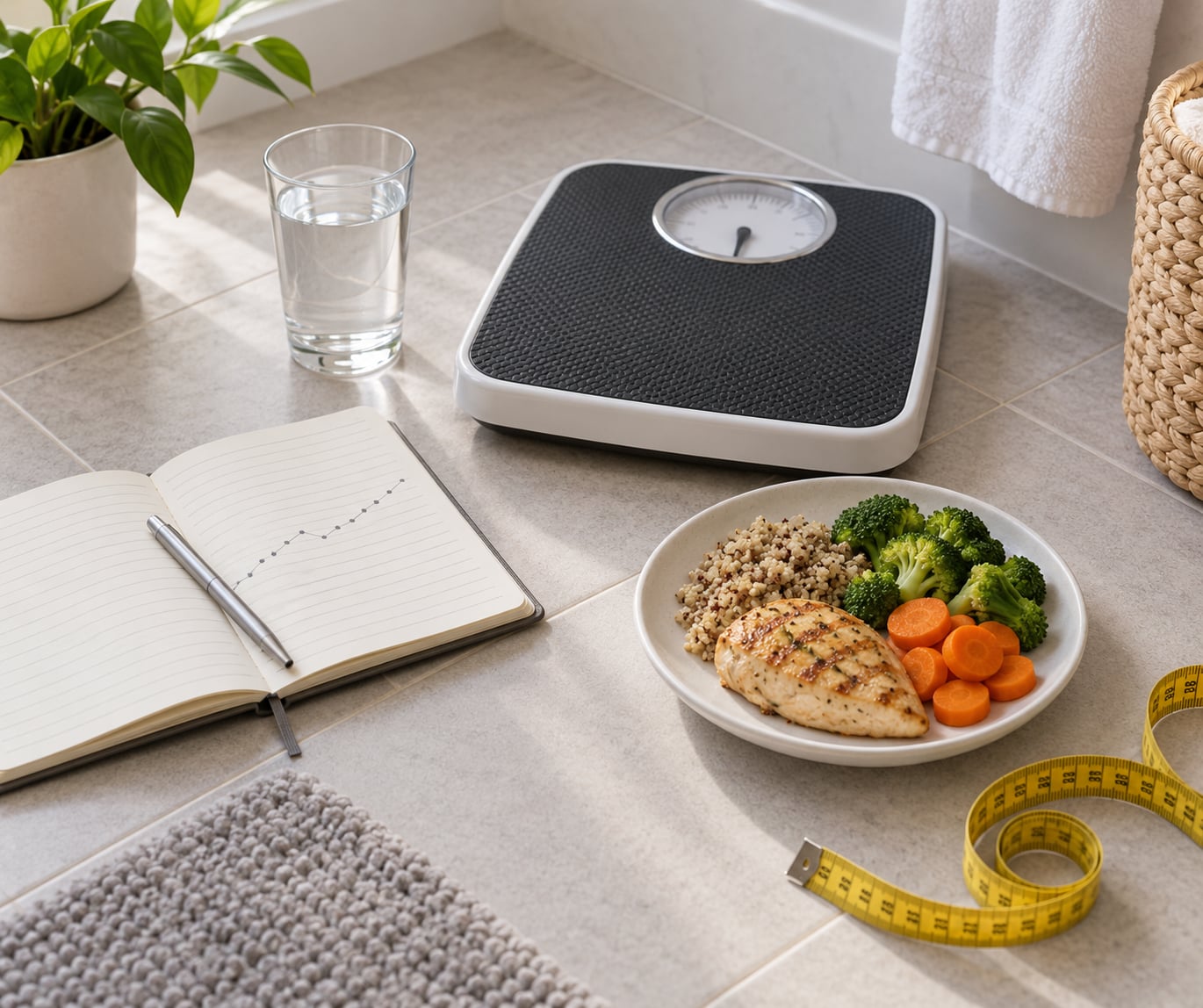
Most people wake up lighter than they went to bed, which is why the morning weigh-in became the standard. On some days it goes the other way, and why do I weigh more in the morning some days comes down to one thing: fluid, not fat. Building even one pound of fat takes a calorie surplus of roughly 3,500 calories, which is not something a single night produces.
So a heavier morning reading is usually water shifting around inside your body, food still sitting in your digestive tract, or a hormone moving fluid for a day or two. Understanding the mechanism is what stops a 2-pound jump from ending a plan that is actually working.
Table of Contents
- Why do I weigh more in the morning some days?
- The 3,500-calorie rule in plain terms
- What causes morning weight to change from one day to the next?
- How much weight can water and digestion change overnight?
- How do hormones and sleep affect your weight in the morning?
- What do meaningful weight changes look like?
- How can you keep your weight readings consistent?
- When should you contact a healthcare professional?
- Frequently Asked Questions
- Why is my weight higher today than yesterday?
- Does a higher morning weight mean I gained body fat overnight?
- Why does my weight fluctuate by a pound or more each morning?
- Is it better to weigh myself every day or once a week?
- Can high-salt or high-carbohydrate meals affect my morning weight?
- When is a sudden weight change a reason to see a doctor?
- What should you do first?
Why do I weigh more in the morning some days?
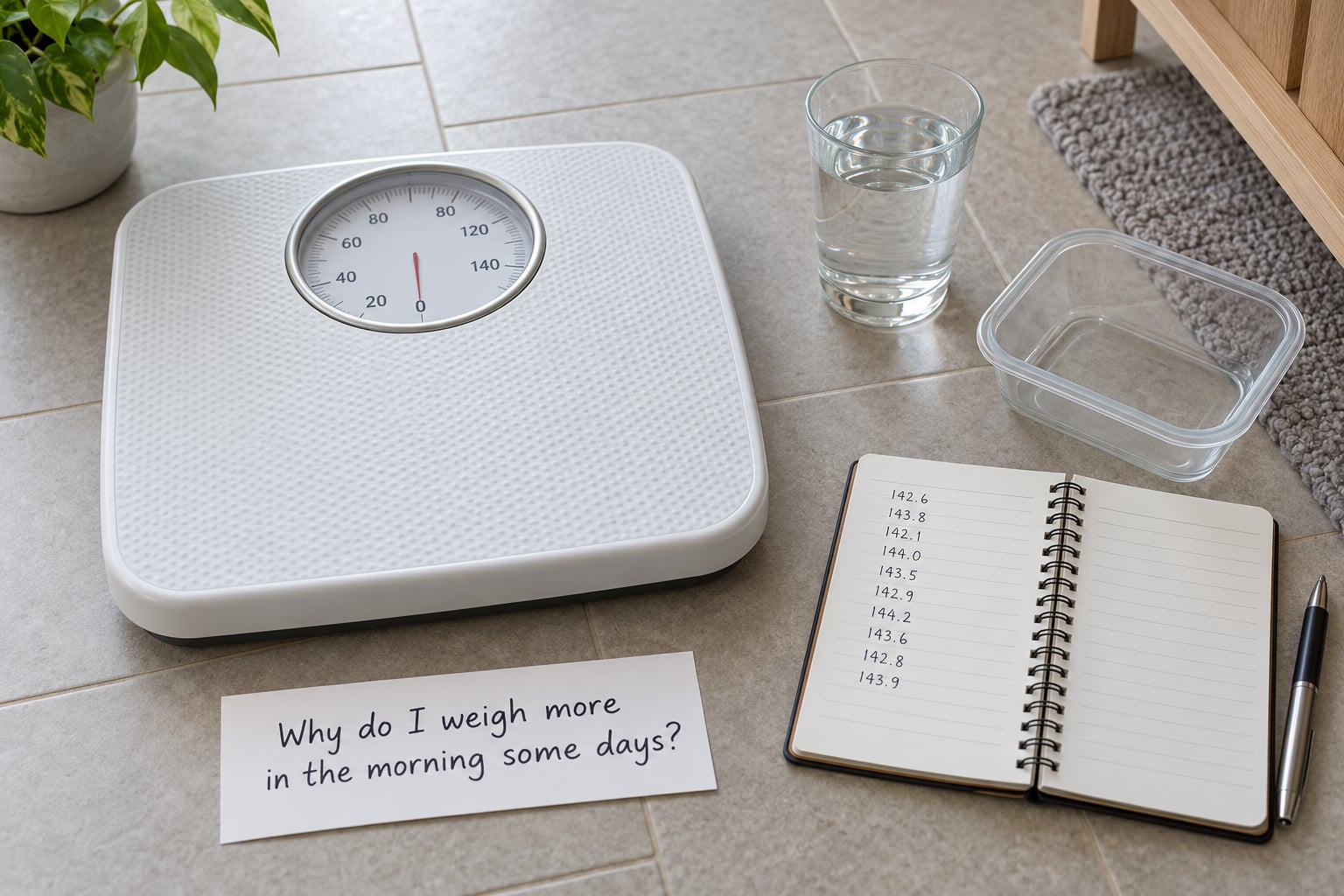
Overnight, your body is still allocating water. The kidneys handle sodium, the liver and muscles hold glycogen with its bound water, hormones shift fluid between compartments, and whatever you ate last night is partly still in your gut. If any one of those inputs sits higher than yesterday, the morning number rises with it.
The interesting part is that this runs in both directions. Most mornings you lose water through your breath and skin and through waking up to an empty bladder, so the scale goes down. On the heavier days something pushed the other direction — a salty dinner, a large carb-heavy meal, alcohol, a workout, a bad night’s sleep, a slow bowel morning — and it outweighed the overnight loss.
The 3,500-calorie rule in plain terms
Fat is not a thing that appears overnight. To gain one pound of body fat, you need to eat about 3,500 calories more than you burn. Even a large 2,000-calorie dinner and a normal day of activity does not produce that gap, so a heavier morning reading is essentially always water, food mass, or both.
Weight-loss coaches call the sudden drop that follows a plateau the whoosh effect. Cells that were holding water release it all at once, the scale plunges several pounds, and it looks like fat melted off overnight. It did not. The fat was already gone, and the water finally moved.
What causes morning weight to change from one day to the next?

Four groups explain nearly all of it: what you ate and drank the night before, how much is still inside you, what your hormones are doing, and how well you slept. Each has a different typical size and a different lifespan, which is why some swings clear by lunchtime and others take three days.
| Cause of a heavier morning reading | Why your weight rises | Typical magnitude | How long it lasts |
|---|---|---|---|
| Salty dinner or processed food | Sodium pulls water into your tissues to balance the concentration in your blood | 1 to 3 lb (0.5 to 1.5 kg) | 1 to 3 days |
| Carbohydrate-heavy meal | Each gram of stored glycogen binds roughly 3 grams of water | 1 to 3 lb (0.5 to 1.5 kg) | 1 to 2 days |
| Alcohol | Fluid balance shifts, sleep fragments, and eating usually drops | 1 to 4 lb (0.5 to 2 kg), sometimes more once eating resumes | 1 to 3 days |
| Constipation or gut contents | Waste and food still inside you add literal physical mass | 1 to 3 lb (0.5 to 1.5 kg) | Until it passes |
| Strength training | Muscle repair pulls fluid into the worked tissue the next day | 1 to 5 lb (0.5 to 2.5 kg) | 24 to 72 hours |
| Cycle-related hormones | Estrogen-driven changes in fluid handling around ovulation and in the premenstrual phase | 2 to 5 lb (1 to 2.5 kg) | Through the cycle phase |
| Short or broken sleep | Stress hormone shifts, late eating, and less overnight water loss | 1 to 3 lb (0.5 to 1.5 kg) | 1 to 2 days |
| Travel, jet lag, shift work | Disrupted meals, sleep and bathroom timing move the baseline | 1 to 4 lb (0.5 to 2 kg) | Until routine returns |
How much weight can water and digestion change overnight?
Water alone can move the scale by several pounds in a day. When the sodium from last night’s dinner is still being handled by your kidneys, your body keeps extra fluid on hand to dilute it, and that fluid sits in your tissues until the load clears.
Carbohydrates work differently but land in the same place. Storing glycogen pulls water with it at roughly a three-to-one ratio, so a pasta-heavy dinner or a large portion of bread the night before can leave you carrying a pound or two of extra fluid by sunrise.
Digestion adds mass that is not fluid at all. A liter of water in your stomach weighs about 2.2 pounds (1 kg), and food in the gut weighs whatever you ate plus its packaging. That is why weighing right after eating or before a bowel movement gives you a number that tells you very little.
So how big is normal? For one person, day to day, the useful reference points are these.
| Type of change | What you might see | Interpretation |
|---|---|---|
| Morning versus evening, same day | 2 to 5 lb (1 to 2.5 kg) lighter in the morning | Completely normal for most adults |
| One morning to the next | 1 to 3 lb (0.5 to 1.5 kg) either direction | Fluid and gut contents, not fat |
| Large single-week spread | 5 to 9 lb (2.5 to 4 kg) | Reported often by people who weigh daily; usually still fluid |
| Week-to-week trend | 10 lb (4.5 kg) of swing but a slow downward average | Plan is working despite the noise |
| Real fat-related change | Steady shift in the weekly average over several weeks | This is the number worth reacting to |
People who track daily often report wider swings than the editorial 2 to 5 pound range suggests. One person in r/keto described waking anywhere from 129 to 138 pounds on a given morning and putting it all on water, and another in r/PetiteFitness described a regular 5-pound fluctuation heaviest the day after heavy lifting. Those reports are consistent with what clinics see.
How do hormones and sleep affect your weight in the morning?
Hormones change how your kidneys handle water, and those changes have a rhythm. Across a menstrual cycle, fluid balance often shifts around ovulation and again in the days before a period, and the same pattern shows up as premenstrual water retention of a few pounds. During menopause, hormone levels move over months and years, and the daily swing can widen.
Stress hormones do something similar in a shorter time frame. Cortisol rises when you are stressed or under-slept, and it pushes the body toward holding sodium and water. One rough night often shows up the next morning as one to three pounds of extra fluid that fades once you sleep normally again.
Alcohol stacks several effects onto one evening. It disrupts sleep, it changes fluid handling, and it usually replaces food and water intake with drinks that do nothing for hydration. The heavier reading typically lands on day two, after a salty or carb-heavy breakfast replaces the skipped calories.
Strength training deserves its own note, because the heaviest morning is often not the morning you lifted. Muscle repair draws fluid into the worked tissue for 24 to 72 hours afterward, which is why people who lift report being heaviest the day after a hard session rather than the day of it.
This is general physiology, not a diagnosis. If your cycle-related swings are new, severe, or come with symptoms you do not recognize, that is a conversation for a doctor.
What do meaningful weight changes look like?
A meaningful change shows up in a weekly average, not in a single morning. Fat tissue takes time to build or shrink, so the honest signal is a trend line moving steadily over two to four weeks while the daily noise bounces around it.
When the daily average shifts by 1 to 2 pounds (0.5 to 1 kg) in a week and keeps that direction for several weeks, that is real change. A 3-pound jump that disappears in two days is fluid, no matter how convincing it felt at 6am.
Waist measurement, how your clothes fit, your strength in the gym and your resting heart rate often move before the scale does. If those are improving while the scale is flat, something is working and you are simply looking at the wrong signal.
How can you keep your weight readings consistent?
Consistency turns the scale from a source of anxiety into a useful instrument. Five habits do most of the work:
- Weigh after the bathroom, before food or drink. An empty bladder removes roughly a pound of noise on its own.
- Use the same scale on the same hard surface. A scale sitting on carpet or a slightly different tile can read differently. Users have reported several pounds of error from a scale that was not level.
- Keep the time within the same narrow window. Even 30 minutes of difference can add a pound before you get on.
- Average a week at a time. Seven mornings averaged gives you a number worth planning with; any single morning is noise.
- Ignore body-fat readings from smart scales. They use bioelectrical impedance, which shifts with hydration and can swing your body-fat percentage several points overnight on a stable weight. Trend the weight, ignore the fat estimate.
If daily weigh-ins make you anxious or trigger compulsive re-weighing, weekly is genuinely better and loses almost no accuracy. One number a week, taken the same way each time, tells you the same trend.
When should you contact a healthcare professional?
Normal fluctuation is gradual, reverses within a few days and comes with no other symptoms. The pattern below is different enough to warrant medical advice rather than more analyzing on the scale:
- Rapid gain of several pounds over a few days that does not come back down.
- Swelling in your ankles, legs, hands or face that stays visible through the day.
- Shortness of breath, chest tightness or reduced exercise tolerance alongside weight gain.
- Unexplained weight loss you did not intend, or a loss that continues for weeks.
- A sudden change that begins after starting or stopping a medication, including prescriptions and over-the-counter products.
- Persistent fatigue, thirst or temperature intolerance that appears alongside weight changes, which can point to thyroid or metabolic causes.
Some of these relate to heart or kidney function and some to thyroid or medication effects. A doctor can sort out which applies to you; the point is not to self-diagnose from a number on a scale.
Frequently Asked Questions
Why is my weight higher today than yesterday?
Because body water, food still in your gut and hormone-driven fluid shifts move independently of fat from one morning to the next. A salty or carb-heavy dinner, alcohol, a workout, constipation or a short night all add mass or fluid overnight. A jump of 1 to 3 pounds (0.5 to 1.5 kg) that fades within a day or two is normal, not fat gain.
Does a higher morning weight mean I gained body fat overnight?
Almost never. Gaining a single pound of fat requires roughly 3,500 calories of surplus, which one night of eating cannot create. What you are seeing on the scale is water, salt-driven fluid retention, glycogen bound to water, or the physical mass of food and waste still inside you. The number usually returns to your trend line within a few days.
Why does my weight fluctuate by a pound or more each morning?
Your body keeps regulating fluid while you sleep, and the inputs change daily. Sodium, carbohydrate intake, alcohol, exercise, bowel contents, stress hormones and sleep quality all shift overnight. Rounding out the picture, digital scales themselves vary by a pound or two depending on placement and surface. Compare weekly averages and the movement stops being dramatic.
Is it better to weigh myself every day or once a week?
Weekly is better for most people who are trying to lose weight. Daily numbers are noisy, and reacting to them leads to cutting calories or quitting plans that are working. If you do weigh daily, use it as raw data for a seven-day average rather than a verdict. Weigh at the same time, after the bathroom and before food, on the same hard surface.
Can high-salt or high-carbohydrate meals affect my morning weight?
Yes, and they are the two most common reasons. Sodium makes your kidneys hold water to dilute it, which can add 1 to 3 pounds (0.5 to 1.5 kg) overnight. Carbohydrates are stored as glycogen, and each gram holds roughly 3 grams of water with it, so a large carb meal the night before carries extra fluid into the morning. Both fade within a couple of days.
When is a sudden weight change a reason to see a doctor?
When it is rapid and does not reverse, or when it comes with other symptoms. Several pounds gained over a few days that stays put, swelling in your legs, ankles or face, shortness of breath, unexplained weight loss, or a sudden change after starting a medication all deserve a doctor’s attention. Heart, kidney and thyroid conditions are among the possibilities, and a clinician can check which applies.
What should you do first?
Step off the scale for a week if the daily number is what makes you anxious, then weigh in once under identical conditions and compare it with the reading from four weeks ago. One comparison, done properly, tells you more than thirty daily ones.
Until then, judge the trend. Your waist, how your clothes fit and your weekly average move together in a way that single mornings never do. If one reading is higher than yesterday, it is water, and it will be gone by Thursday.