Water weight vs fat loss is the difference between two things the scale measures. Water weight is fluid your body holds and releases alongside glycogen and other tissues, and it can swing by several pounds in a few days. Fat loss is a steady reduction of stored body fat at roughly 0.5 to 1 percent of body weight per week.
Water comes off fast and tends to come back. Fat comes off slowly and stays. That single difference explains most of the confusion people hit in the first month of a diet, when the scale drops quickly and then appears to stop moving.
Here is the part worth remembering before any number appears on the display: roughly 60 to 70 percent of an adult’s body weight is water. A bathroom scale cannot separate that water from fat, muscle or bone, so it reports one total and leaves you to guess what changed. This guide gives you a way to make that guess with measurements you can take at home, plus a clear list of signs that point to water rather than fat.
It is general education about how body composition behaves, not medical advice. If fluid changes are sudden, severe, persistent or unexplained, that is a conversation for a doctor rather than a search engine.
Table of Contents
- Water Weight vs Fat Loss at a Glance
- What Is Water Weight?
- Common triggers of sudden water gain or loss
- What Is Fat Loss?
- How to Tell the Difference Over Time
- Signs the loss was mostly water
- Signs the loss was mostly fat
- How to Track Changes Without Getting Confused
- Get your conditions right before you judge the number
- Add at least one measurement the scale cannot fake
- Which Change Should You Choose?
- Frequently Asked Questions
- How do I tell if I lost water weight or fat?
- How much water weight is lost before fat loss starts?
- Is losing 10 pounds in the first week just water weight?
- Can you gain 10 pounds of water weight in a week?
- How do I tell if it is belly fat or water retention?
- Why does the scale stall after the first week?
- Conclusion
Water Weight vs Fat Loss at a Glance
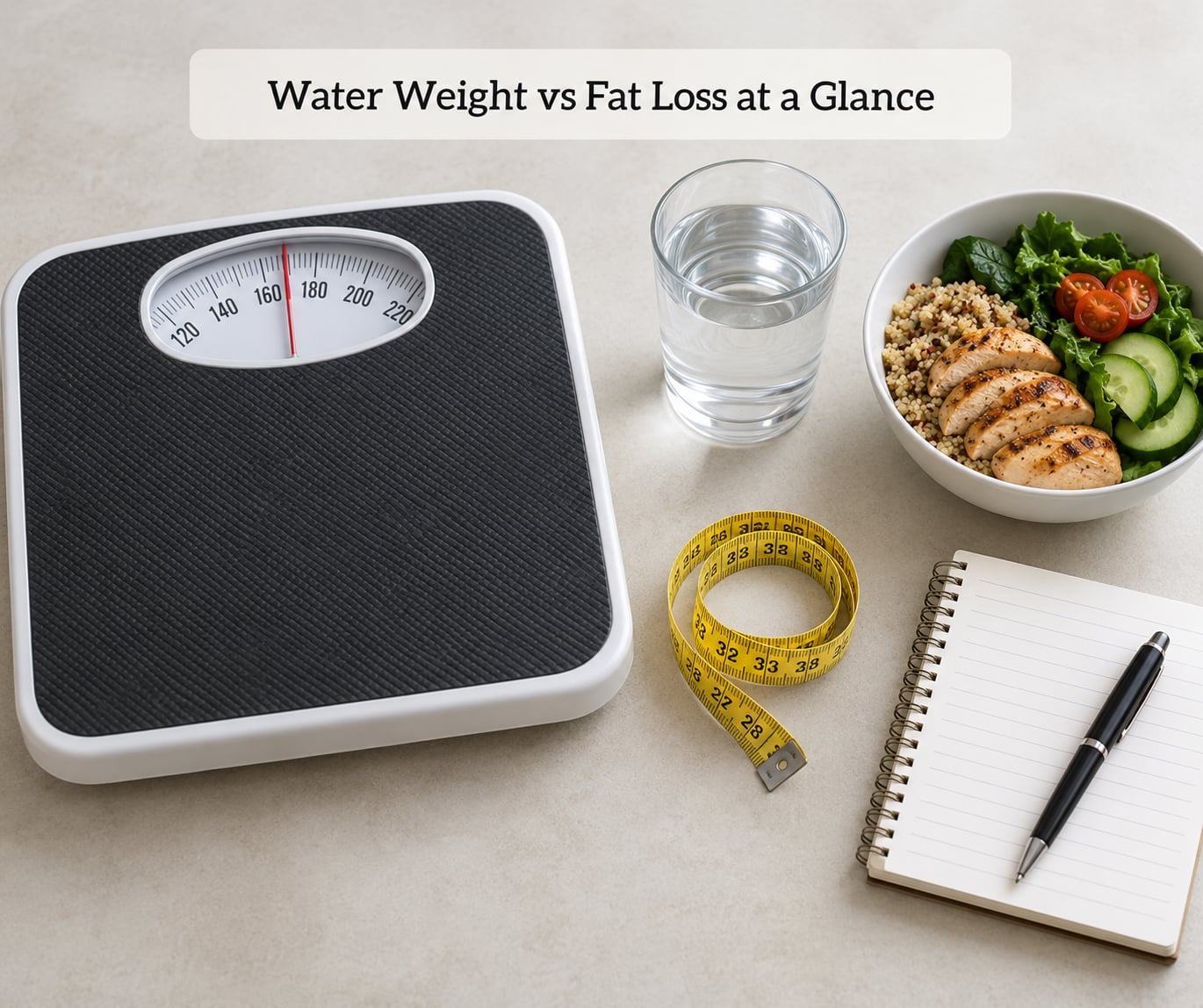
The fastest way to tell them apart is to compare cause, speed, appearance and durability. Water weight arrives and leaves with things you eat, drink, or do that week. Fat loss arrives with a sustained energy deficit and shows up in inches long before it shows up on the scale.
| Factor | Water weight | Fat loss |
|---|---|---|
| What it is | Fluid held by and released with glycogen, plus shifts in sodium and inflammation | Reduction of stored adipose tissue |
| What usually triggers it | Salt, carbohydrate changes, menstrual cycle, illness, medication, travel, new training, alcohol | A sustained calorie deficit over weeks or months |
| Typical speed | 1 to 5 lb within days, sometimes overnight in either direction | 0.5 to 1 percent of body weight per week |
| How it looks | Scale moves, clothes and waist often do not | Waist and hips shrink, clothes fit looser, face and veins sharpen |
| Strength in the gym | Unchanged or slightly reduced | Held steady or improved if protein and training are adequate |
| How long it lasts | Days, often gone the moment you resume your usual eating | Permanent unless weight is regained |
| Best way to detect it | Compare weekly averages after conditions are held constant | Waist measurement, progress photos, clothing fit, performance logs |
What Is Water Weight?
Water weight is simply water your body is holding at a given moment, and your body holds most of it on purpose. Water sits inside cells, sits between cells, cushions your joints, carries nutrients, helps regulate temperature and keeps blood volume working. It is not a malfunction.
The part people care about is glycogen. Every gram of stored glycogen carries roughly 3 to 4 grams of water with it. A typical adult stores about 500 g of glycogen in skeletal muscle and about 100 g in the liver, so the total water bound to glycogen alone can run to several pounds. Body water overall is commonly estimated at about 3 g per kg of body mass, which is another way of saying most of what you weigh is not fat.
Because water is attached to glycogen, changing your carbohydrate intake moves the scale quickly. Cut carbs and glycogen drops, and the water attached to it leaves with it. Add carbs back and both return. That is why the first week of a low-carb or keto approach can produce a drop that feels dramatic and means very little for fat tissue.
Common triggers of sudden water gain or loss
- Sodium. Salt pulls water into the extracellular fluid to help balance the concentration. A salty meal can show up as 2 to 3 lb the next morning and vanish by evening.
- Carbohydrate changes. Each gram of new glycogen brings its own water. A large carb refeed after restriction adds both.
- Menstrual cycle and PMS. Oestrogen changes how the kidneys handle water, and this is one of the most multi-pound swings people track and least understand.
- Perimenopause. Shifting hormone patterns change fluid handling and fat distribution over months, not weeks.
- New strength training or unfamiliar exercise. Muscle repair creates inflammation and holds fluid. Members of r/ScienceBasedLifting describe gaining water weight when they first start lifting, and it is normal.
- Illness and medication. Fever, infection, corticosteroids and some blood pressure medicines all shift fluid. Illness-related gain says nothing about fat.
- Dehydration. The body holds onto water when it senses a shortage, which feels backwards until you look at the numbers.
- Travel, long sitting and alcohol. Flights, hours in a chair and a night of drinking all change fluid balance independently of food intake.
None of these mean body fat rose. A person can add 5 lb in three days and have gained no fat at all, and the reverse is equally true.
What Is Fat Loss?
Fat loss is a reduction in stored body fat, and it happens for one reason only: you take in less energy than you use, consistently, over time. Everything else is noise around that single fact.
Fat is dense energy, roughly 3,500 kcal per pound. It leaves slowly because the body does not have a shortcut for burning it. A common benchmark is 0.5 to 1 percent of body weight per week, which for a 150 lb adult works out to about 0.75 to 1.5 lb per week and comes to 1 to 2 lb per week for someone closer to 200 lb.
Two corrections to widely repeated myths. First, fat loss does not wait for water loss to begin. As one r/keto user put it, fat loss is simply much slower, so it is happening from day one and is just invisible on the scale. Second, fat loss does not stop after the early drop, it becomes steady and predictable. That is the phase where results start to show in your waist and your jeans rather than your weight.
Visible fat loss also lags the arithmetic, which is where the jiggly-fat question comes from. Subcutaneous fat sits under the skin, so as the layer thins, the area can feel softer and looser for a while before it looks different. Anyone who has lost 20 lb over five months and still recognises their own reflection immediately is experiencing this gap.
How to Tell the Difference Over Time
One day’s reading cannot establish either. What separates the two is the pattern across weeks, not the number on a single morning.
| Period | What the scale usually shows | Main cause | How confident you should be |
|---|---|---|---|
| Days 1 to 7 | Fast drop, often 4 to 10 lb | Glycogen depletion and the water bound to it | Treat it as unproven for fat |
| Weeks 2 to 4 | Slower, steadier decline | Mix of remaining water and real fat loss | Start trusting waist and photos |
| Week 4 onward | Slow and predictable | Mostly fat loss, plus normal daily noise | Most reliable phase to judge progress |
The canonical water-then-fat pattern shows up in every weight forum: one r/loseit poster lost 14 lb in the first couple of weeks and then settled into 1 to 2 lb a week, which is the expected shape. Someone nine days into a protein-sparing modified fast weighed 205 lb and then 198 lb, entirely typical for the stage they were at.
Signs the loss was mostly water
- The drop clustered in the first 7 to 14 days and slowed sharply afterwards.
- Returning to your normal carb intake brought the number back within days.
- Waist circumference at the navel did not move.
- Jeans and belt fit exactly as before.
- Lifting numbers stayed flat rather than climbing.
- No new vein definition, no sharper jawline in photos.
- A salty meal made the loss disappear overnight.
- Sleep and resting heart rate looked the same as always.
Signs the loss was mostly fat
- A steady downward weekly average held for three weeks or more, in the 0.5 to 1 percent range.
- Waist and hip measurements came down even while the scale sat still.
- Clothes fit looser, particularly around the waist.
- Progress photos in the same lighting show a difference in the mirror at home.
- Vascularity in the arms and definition along the jawline increased.
- Strength held steady or improved.
- Resting heart rate trended downward and sleep improved.
- The pace stayed even rather than spiking and stopping.
None of these proves anything on its own. Together, four or five of them pointing the same way is a reasonable basis for a conclusion.
That leads to the plateau nobody warns you about. Once glycogen is empty, the water has already gone, so the scale stops dropping fast and reads as stalled. Many people read that as failure and cut calories harder, which is the exact wrong move. On r/MacroFactor the debate is usually about whether to set a lower goal weight to account for water, and the practical answer is that you cannot pre-account for it; you track the trend and let it move.
How to Track Changes Without Getting Confused
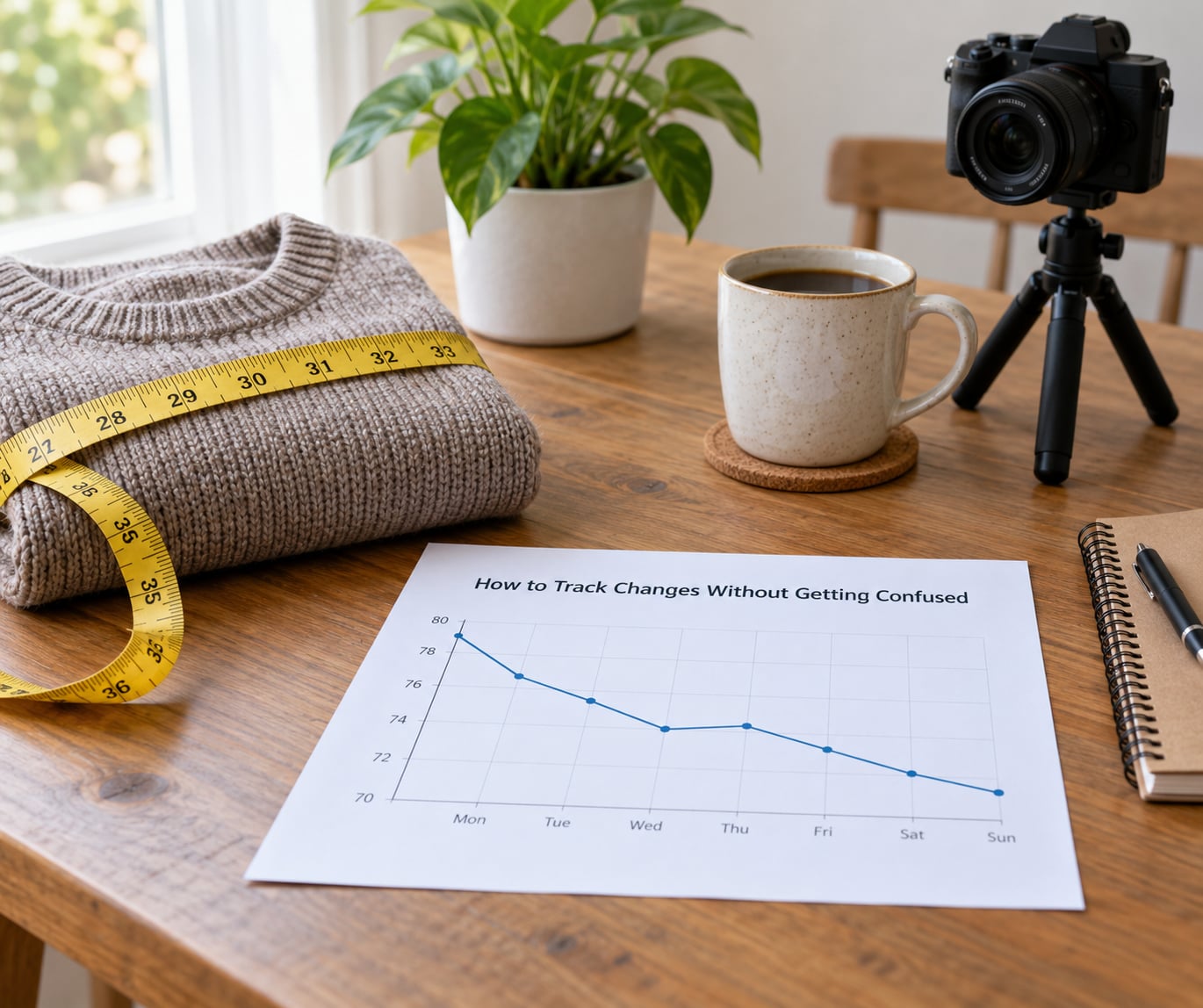
The tracking system that works is boring and repeatable: pick a few signals, measure them the same way, and judge over weeks.
Get your conditions right before you judge the number
- Weigh in the morning, after using the bathroom and before eating or drinking.
- Use the same scale on the same hard floor every time.
- Record every morning, including the days you dislike the number.
- Average seven days, then compare that average to last week’s average.
- Judge only the direction of the averages over three to four weeks.
Daily swings of 2 to 5 lb are normal noise, not change. A single reading tells you almost nothing; a weekly average is a usable measurement.
Add at least one measurement the scale cannot fake
- Tape measure. Waist at the navel, hips at the widest point, plus chest, arm and thigh. Same spot, same time of day, once a week. This is the most trusted home method in self-tracking communities and the one that survives muscle gain.
- Photos. Front, side and back, same lighting, same distance, same time of day. Monthly is enough. Compare with the first, not with yesterday.
- Clothing fit. The most honest signal most people have. A belt needing a new hole means something changed even when the scale disagrees.
- Performance. Record the main lifts in your log. Holding or raising weight while your waist drops is strong evidence of body composition change.
- Sleep, mood and resting heart rate. Often the first things to shift, and free to measure.
Consumer body fat scales deserve a warning label. Self-trackers on forum.quantifiedself.com note that the water loss those scales calculate is nearly identical to the unexplained loss they report, which means they cannot statistically separate the two. Treat the percentage as a rough trend and the direction of change as meaningful, not the decimal.
Which Change Should You Choose?
If your goal is to reduce body fat, fat loss is the only change worth targeting. Water weight is not something to pursue, and the methods that produce fast water loss, such as saunas, laxatives or diuretics, give back every pound within hours while carrying real risks of dehydration and electrolyte problems.
Water retention is not a malfunction to be fixed, either. Lowering sodium, eating more consistently and staying hydrated reduce the swing, but chasing a flat morning number is a losing game that encourages over-restriction.
Two situations do deserve professional input. The first is a change that is fast, large, one-sided, and unexplained by anything you did: several pounds overnight, swelling in the legs or face, breathlessness, or a sustained upward trend lasting more than a few weeks. The second is any plan to lose weight while pregnant, under 18, managing diabetes, heart or kidney conditions, or taking regular medication. A registered dietitian can also set a realistic rate and adjust it as you go.
If fat loss is slowing, check four things before adjusting anything: whether your deficit is still real, whether protein and strength training are holding, whether your measurements have actually flattened or only the scale has, and whether you have hit a plateau or simply a normal week.
Frequently Asked Questions
How do I tell if I lost water weight or fat?
Look at more than the scale. Water loss shows up fast and reverses with a salty meal or a carb refeed, while fat loss shows up in the waist, clothing fit and strength. Weigh yourself under the same conditions each morning and compare weekly averages over three to four weeks. If your weekly average falls steadily and your measurements agree, it was largely fat.
How much water weight is lost before fat loss starts?
Fat loss starts immediately, but you cannot see it while the water dominates. Because each gram of glycogen holds roughly 3 to 4 grams of water, glycogen depletion accounts for most of the first 4 to 10 lb in week one for many people. After that the scale reflects actual fat, which leaves at roughly 0.5 to 1 percent of body weight per week.
Is losing 10 pounds in the first week just water weight?
Mostly, yes. A ten-pound drop in seven days is almost entirely glycogen and the water attached to it, plus reduced gut contents. At 3,500 kcal per pound of fat, a genuine ten pounds of fat would require a deficit far beyond what is healthy in a week. Expect the rate to slow sharply after the first week, and judge progress on the weeks that follow, not the first.
Can you gain 10 pounds of water weight in a week?
Yes, and it is more common than it sounds. Restoring carbohydrates, a salt-heavy eating pattern, premenstrual fluid retention, the onset of strength training and a few days of illness can each add several pounds of water without any fat gain. The pattern to watch for is a sharp rise that tracks with those events and settles back afterwards, which is a very different picture from a steady upward trend.
How do I tell if it is belly fat or water retention?
Belly fat is steady and slow; water retention is sudden and uneven. Water tends to puff the face, hands, ankles and the lower back, often more on one side, and it fluctuates with salt, cycle and sleep. Visceral and subcutaneous fat loss shows as a consistent reduction in waist measurement over weeks. If a hard swollen abdomen develops suddenly, especially with breathlessness, have it checked by a doctor.
Why does the scale stall after the first week?
Because the water has already gone. Once glycogen stores are depleted, the fast early drop is spent, and you are left with the true fat loss rate of about 0.5 to 1 percent of body weight per week, which looks slow next to week one. Muscle gain from lifting can also offset fat loss on the scale. Check your waist measurement, photos and training log before assuming the plan stopped working.
Conclusion
Water weight comes off fast and returns; fat loss comes off slowly and stays. Start by pulling up three or four weeks of weight and measurement data and looking at the trend instead of today’s number.
If the trend is flat but your waist, clothes and strength are improving, you are losing fat. If a change is sudden, severe or unexplained, or you have a medical condition or take regular medication, talk to a doctor or a registered dietitian before trying to change anything.