The most accurate way to measure body fat at home is a skinfold caliper test or a flexible tape measure run through the US Navy circumference formula, repeated under identical conditions. No consumer device matches a laboratory scan, but a repeatable home method tells you far more than an accurate one-off.
That distinction matters more than most guides admit. A body fat percentage separates fat loss from muscle loss in a way that scale weight and BMI never will, and a rough number you trust every week beats a precise number you measure once.
I would start with the tape measure. It costs almost nothing, it has the lowest technique barrier of the four methods, and a five-minute routine in the same spot every morning is easy to keep up. Calipers come second if you want to tighten the error margin.
This guide covers the tools, the four home methods in order of practicality, what each one is honestly good for, and the mistakes that quietly wreck the numbers. For anything medical or specific to your own health, a doctor or registered dietitian is the right person to ask.
Table of Contents
- What You Need
- Step-by-Step: How to Measure Body Fat at Home Accurately
- Use a Consumer Body-Fat Scale
- Take a Skinfold Measurement
- Use a Measuring Tape for a Visual Check
- Check Progress With a Consistent Baseline
- Common Mistakes
- Frequently Asked Questions
- What is the most accurate way to measure body fat at home?
- Are body-fat scales accurate enough to track weight loss?
- What time of day should I measure body fat?
- Can I measure body fat with a measuring tape?
- How often should I check my body-fat percentage?
- When should I get a professional body-composition test?
- Conclusion
What You Need
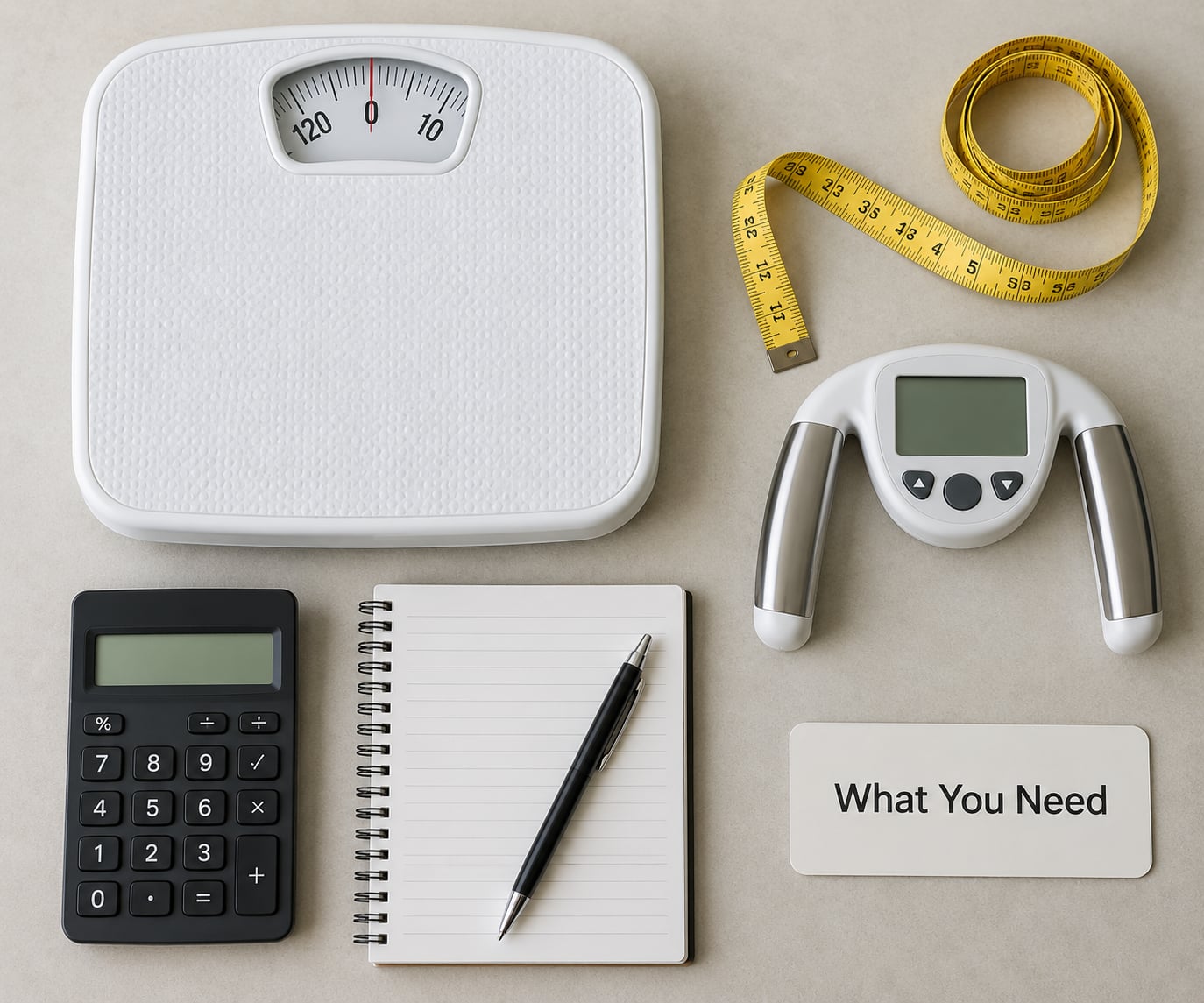
Each method needs something different, and you only need one of them to get started. Buy the tool for the method you will actually repeat, not the one with the longest specification sheet.
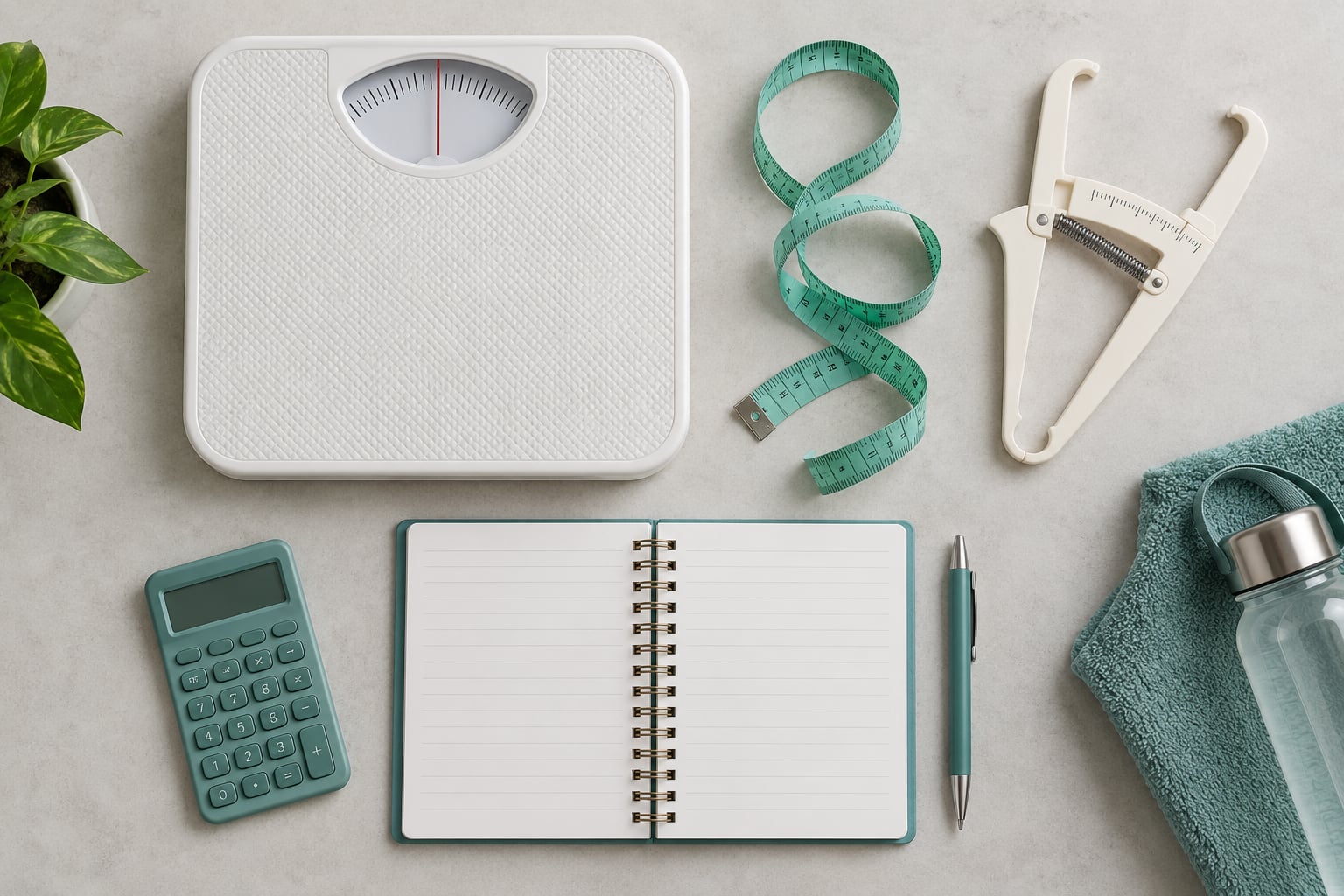
- A flexible measuring tape for the US Navy method. A cheap fabric tape that does not stretch is fine. Measure in centimetres if you can, since the original equations were built on them.
- Skinfold calipers if you want the tightest home error margin. Any accurate pair works; the technique matters far more than the brand.
- A bathroom scale with bioelectrical impedance is optional. It is the least accurate home method and the easiest to misuse, which we cover below.
- A bathroom scale that only weighs you is still worth having. Daily weight is the most sensitive progress signal you will own.
- A notebook or spreadsheet for logging. Every method below only becomes useful once the readings sit next to each other.
- A mirror and a phone, for fortnightly progress photos in the same spot, same lighting, same pose.
One honest note before the methods start. Every home method on this page produces an estimate, not a laboratory measurement. Even the tape method, which is the most accurate of the home options, is derived from a small number of surface measurements plugged into equations built on reference populations from the 1980s.
Step-by-Step: How to Measure Body Fat at Home Accurately
Here is the short version of how each home method compares before you pick one.
| Method | What you need | Realistic accuracy | Repeatable at home | Best for |
|---|---|---|---|---|
| US Navy tape method | Flexible measuring tape | Within roughly 3-4% of DEXA | Very easy | A first method and weekly tracking |
| Skinfold calipers | Caliper pair, sometimes a partner | Within roughly 3.5-5% | Easy with practice | The tightest home error margin |
| BIA smart scale | Impedance bathroom scale | Can swing 5% or more in a day | Only under identical conditions | A daily trend line, not a number |
| Handheld analyzer | Handheld device, bare feet | Moderate, heavily hydration-dependent | Partly | A quick sanity check |
| DEXA scan | A clinic appointment | The reference standard | No | A one-off baseline |
Use a Consumer Body-Fat Scale
Bioelectrical impedance scales send a small electrical current through your body and estimate how much of it is fat, because fat and lean tissue conduct electricity differently. That is the whole idea, and it is why the number moves when nothing about your body has changed.
Step one: dry feet and bare skin. The current travels through the soles, and moisture between them skews the reading. Step two: stand still for the reading to settle, because movement and a shifting stance both interfere.
Step three: repeat the reading two or three times and use the average. A single BIA reading tells you very little. Three readings in the same session start to say something about repeatability.
The bigger problem is not the scale, it is the conditions. Eating, drinking, sweating, a salty meal the night before, a long run that morning, poor sleep and even the time of day can move an impedance estimate by several points. That is the finding behind most of the frustration people post about smart scales: a reading that changes by two or three points overnight without any change in the body.
So use it like a weather vane rather than a thermometer. Same time, fasted, same bathroom floor, same foot position, and only look at the weekly average.
Take a Skinfold Measurement
Skinfold calipers pinch a fold of skin and subcutaneous fat and read its thickness in millimetres. Feed those numbers into a formula such as Jackson-Pollock and you get a body fat estimate. Accuracy depends entirely on technique, which is why a caliper test on yourself is worth less than the same test taken by a trained technician.
That said, self-administered readings are still usable, provided the same person takes every measurement. Popular sites use seven specific locations; the three-site version is enough for most people tracking over time.
Sites for men:
- Chest, taken just below the nipple line at the midpoint between the spine and the nipple
- Abdomen, a vertical fold about two centimetres to the right of the navel
- Thigh, taken at the midpoint between the hip crease and the knee
Sites for women:
- Triceps, at the midpoint of the upper arm between the shoulder and elbow
- Thigh, at the midpoint between the hip crease and the knee
- Suprailiac, just above the hip bone on the side, taken diagonally
Women should not simply copy the men’s sites. Fat distribution differs, and the women’s three-site set was built and validated on women’s data.
How to take the reading. Pinch the fold between thumb and index finger, lift it clear of the muscle underneath, and let the caliper jaws close under their own pressure. Do not squeeze the jaws with your hand, and do not hold the fold while measuring.
Always measure the same side of the body. Take two readings at each site and average them. Write the millimetres down, not the percentage, so you can recalculate later if you want to test a different equation.
Before you trust your numbers, test yourself: take all three readings twice in one session, put the calipers down, go and make a coffee, then repeat. If the second pass is more than a millimetre out at a site, your technique needs work, not a new device.
Use a Measuring Tape for a Visual Check
The tape method is the best value home option and the one most people should learn first. It reads neck, waist and hip circumferences and runs them through the US Navy equation, published by Hodgdon and Beckett in 1984. It typically lands within about 3-4% of a DEXA scan.
Landmarks for the neck: find the hollow just below the larynx, the visible dip between the two collarbones at the base of the throat. Run the tape around that point with a slight downward slope toward the front. Keep the neck relaxed and your chin level, not tipped up.
Landmarks for the waist: for men, take the measurement horizontally at navel level. For women, use the narrowest point of the torso, usually just above the navel. The tape should sit flat and parallel to the floor and touch the skin without digging in.
Landmarks for the hips: women only, at the widest point of the buttocks, roughly level with the top of the thigh crease. Wrap the tape around the whole hip, keeping it level all the way round.
Two rules that people break constantly. First, do not suck in your stomach or push it out. Breathe normally and let the tape land where it lands. Second, measure with a real mirror in front of you so the tape stays level; a slight tilt reads as extra centimetres.
The circumference method needs no waist estimate for men, but some calculators do ask for it, and they ask in centimetres. Check the unit setting before you type anything into a free body fat calculator online, because the equation assumes centimetres and a stray inch conversion quietly wrecks the result.
Check Progress With a Consistent Baseline
This is where most people give up, and it is where the actual answer to accurate home measurement lives. A method that reads three points high every single time still shows you the true direction of travel, because a constant offset cancels out when you compare yourself against yourself.
So the job is not to find a perfect method. It is to pick one, standardize it, and stop switching. Here is the routine that works: wake up, use the bathroom, take the measurement before eating or drinking, stay in the same room, use the same tape, mark the spot with a pen, and log it.
Measure weekly, on the same weekday morning. Daily readings feel good but tell you mostly about water and digestion. Once a week at an identical time of day gives you a usable trend line.
A simple log is enough. Three weeks of entries, filled in the same way, looks like this:
| Week | Date | Weight | Neck | Waist | Hips (women) | Navy result |
|---|---|---|---|---|---|---|
| 1 | Mon 5 Oct | 82.4 kg | 38.0 cm | 88.5 cm | 101.0 cm | 19.8% |
| 2 | Mon 12 Oct | 81.8 kg | 37.7 cm | 87.0 cm | 100.2 cm | 19.1% |
| 3 | Mon 19 Oct | 81.5 kg | 37.6 cm | 86.2 cm | 99.8 cm | 18.7% |
That example is illustrative rather than real data, but the shape is what you are looking for: weight and waist moving in the same direction, tape readings moving in the same direction, and a slow downward trend instead of a jumping number.
If your readings are flat for three weeks while the mirror disagrees, do not reach for a different method. A stuck trend is nearly always an intake or training problem, not an instrument problem.
Common Mistakes
Almost every bad home measurement comes down to one of a handful of avoidable errors.
Measuring at a different time each day. Fix it: pick a fixed window, ideally first thing in the morning, and never move it.
Comparing results from different devices or formulas. A tape result and a BIA result will disagree, and neither is wrong. Fix it: use one method for tracking and treat the others as occasional cross-checks.
Pulling the tape too tight. You compress the tissue and the number reads low. Fix it: the tape should touch the skin without denting it, and you should be able to slide a finger under it.
Practising skinfold technique without testing it. Fix it: run the repeatability check described above, twice in one session with a break in between, before you start trusting any number.
Treating an estimate as an exact result. A reading of 19.8% does not mean your body fat is 19.8%. Fix it: work with changes over weeks, not point estimates.
Waiting for the number to tell you everything. Waist circumference is often a more honest progress marker than a formula output, and forum posters consistently report trusting it more. Fix it: log your waist weekly regardless of what the body fat figure does.
Two more worth naming. Never compare your number to someone else’s on the same day, because the formulas assume reference populations that may not match either of you. And a tape cannot separate lean tissue from fat, or account for bloating or fluid retention, which is a limitation people on glp1forum.com raise for good reason.
A short consistency checklist:
- Morning, after the bathroom, before food or drink
- Same spot in the house, same floor, same device
- Same side of the body every time, marked with a pen if it helps
- Waist measured at navel level for men, narrowest point for women, tape level not tilted
- Neck relaxed, chin level, no shrugging
- Two readings averaged at least, logged in the same notebook line
- Fortnightly photos in the same pose and light as a no-number cross-check
Frequently Asked Questions
What is the most accurate way to measure body fat at home?
Skinfold calipers give the tightest home error margin, typically within about 3.5-5% of a DEXA scan, but technique dominates the result. The US Navy tape method is a close second at roughly 3-4% error and needs far less skill. For most people starting out, the tape method wins because it is repeatable, and a repeatable estimate beats an accurate one you abandon after a month.
Are body-fat scales accurate enough to track weight loss?
Not as a number, yes as a trend. Bioelectrical impedance estimates can move 5% or more within a single day because hydration, meals, salt, sweat and time of day all change how well the current travels through your body. Under identical conditions, averaged across several readings and compared weekly, the scale gives you a usable direction of travel. It will not tell you that you are at 17.4%.
What time of day should I measure body fat?
First thing in the morning, after using the bathroom and before eating or drinking anything. At that point you are closest to your baseline hydration and your stomach is not inflating the waist measurement. Measure at roughly the same hour each week, because a method measured under consistent conditions is far more useful than the most accurate method measured randomly.
Can I measure body fat with a measuring tape?
Yes, and for most home tracking it is the better first choice. You need neck, waist and hip circumferences, then the US Navy or Hodgdon and Beckett formula to turn them into an estimate. It costs almost nothing, takes about five minutes and needs no partner. People startingstrength.com have long recommended pairing a tape, calipers and a scale rather than trusting any single device.
How often should I check my body-fat percentage?
Weekly, at the same time of day, on the same weekday. Daily readings mostly reflect water, sodium and digestion rather than fat. If you are on a calorie deficit, four to eight weeks is a realistic window for a change large enough to see clearly, roughly 1% of your body weight per month. Fortnightly progress photos in the same pose catch what the number misses.
When should I get a professional body-composition test?
Get a DEXA scan when you want a reference point, not a weekly number. It gives you a regional breakdown of fat and lean mass plus bone density, and it takes about ten minutes, so it works well as a one-off baseline to calibrate your home method against. If your waist is growing quickly, you feel unwell while dieting, or you are considering going below essential fat, talk to a doctor instead.
Conclusion
Pick one method, standardize the conditions and record a baseline before you change anything. For most people that means the tape measure on Monday mornings, plus daily weight and a weekly waist reading, because those three together tell you more than any single body fat number ever will.
Judge yourself by the trend across weeks, not by today’s reading. And if your waist is climbing fast, or you are chasing a percentage below what your body needs to function, bring the numbers to a doctor or registered dietitian rather than guessing.