How to keep muscle as you get older comes down to two things: resistance training two to four times a week, and enough protein to rebuild what you use — roughly 1.0 to 1.2 grams per kilogram of body weight, spread across your meals. Two full-body sessions a week and a plate of protein at breakfast will take you most of the way there.
Muscle loss is real and it is gradual. From your thirties onward, people shed an average of 3 to 8 percent of their muscle mass per decade, and the pace picks up after 60. Researchers call this sarcopenia. It is not dramatic week to week, which is exactly why most people only notice it when a heavy grocery bag feels heavier than it used to or a flight of stairs leaves them winded.
Two objections come up more than any other, so let me clear them first. Weight training after 50 does not make you bulky unless you train for years and eat in a surplus — most people add strength, not bulk, and the definition women worry about is slow to arrive if it arrives at all. And the gym floor is not a test. Two sessions at home with a chair, a band and a pair of light dumbbells will move the same needle for a beginner, which matters more right now than anything else.
Below is a five-part plan you can follow this week, roughly 45 minutes on training days and 15 minutes on the rest of the week.
Table of Contents
- What You Need
- Step-by-Step: How to Keep Muscle as You Get Older
- Step 1: Start With Two Full-Body Strength Sessions a Week
- Step 2: Fuel With Enough Protein at Every Meal
- Step 3: Add Daily Movement and Balance Work
- Step 4: Recover and Progress Slowly
- Common Mistakes
- Frequently Asked Questions
- How can I start keeping muscle after age 50 or 60?
- How many strength workouts should older adults do each week?
- Is walking enough to keep muscle as you get older?
- Can I lose weight without losing muscle?
- When should I see a doctor about exercise or muscle loss?
- Conclusion
What You Need
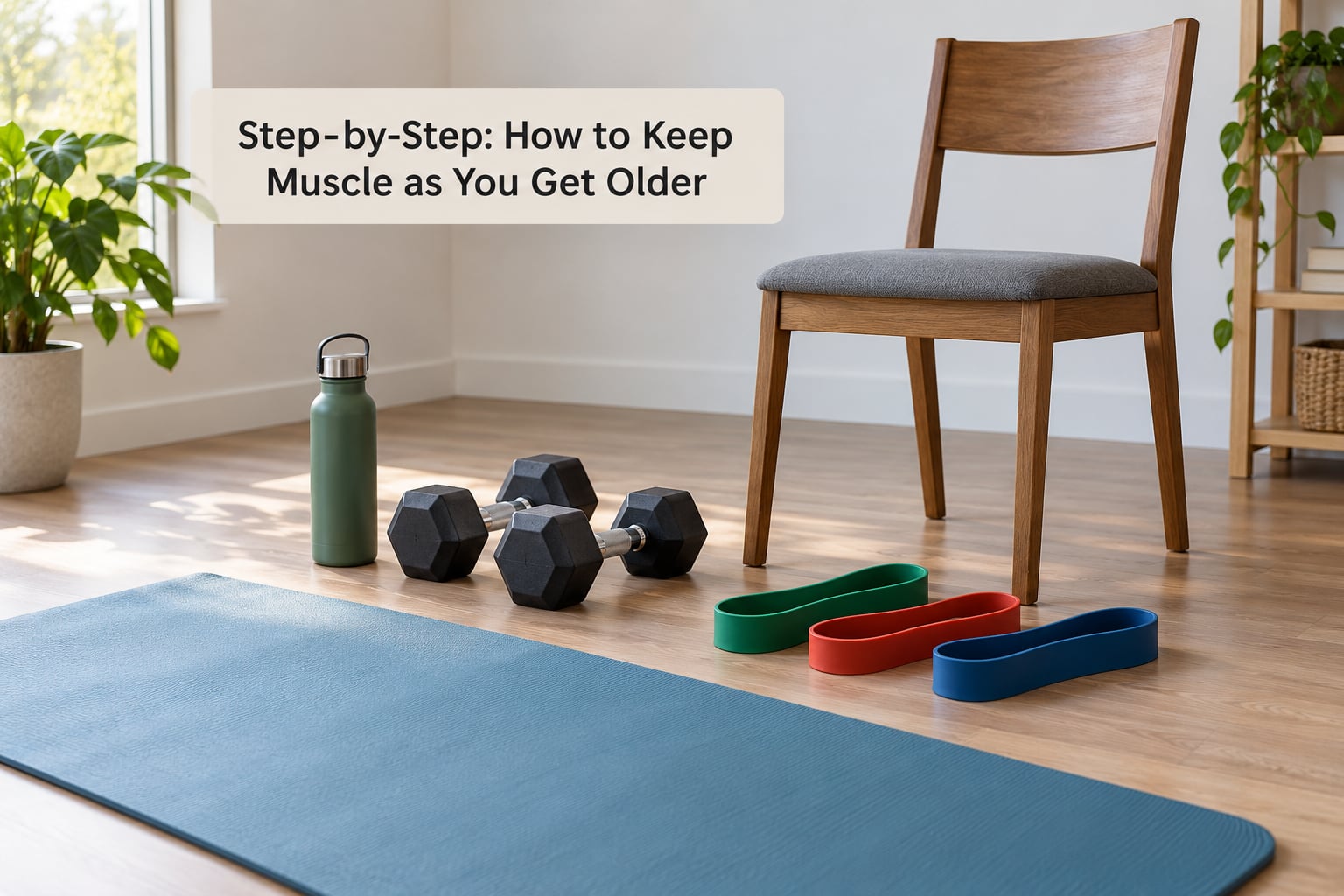
None of the equipment here is expensive, and none of it is optional. The list is short because the plan is about consistency, not gear.
- A safe, clear space. A patch of floor roughly two steps wide, a sturdy chair you would trust to sit on, and a wall or countertop at about chest height for push-ups.
- Something to lift. Resistance bands, light dumbbells, or even cans and jugs of water work to start. Add weight only when the reps feel easy.
- Comfortable clothing and shoes with a flat, grippy sole. You will be standing, squatting and balancing more than you expect.
- A water bottle within reach. Dehydration shows up as early fatigue in the set, and older adults are less likely to feel thirsty before they are already low.
- Protein foods that you actually like and can buy quickly: eggs, Greek yogurt, tofu, beans, fish, poultry, lean meat, milk, or fortified alternatives.
- A way to track. A notebook, a phone note or a calendar. Repetitions per set, sessions completed and how the last set felt tell you far more than the bathroom scale.
If you have joint pain, a recent injury, balance problems, osteoporosis, or any condition that changes how you should exercise, get a clinician’s advice before increasing your training volume. That is general education, not a substitute for a plan built around your own health history.
Step-by-Step: How to Keep Muscle as You Get Older
Five parts, in the order that matters most. The first two do the heavy lifting; the rest make them stick.
Step 1: Start With Two Full-Body Strength Sessions a Week
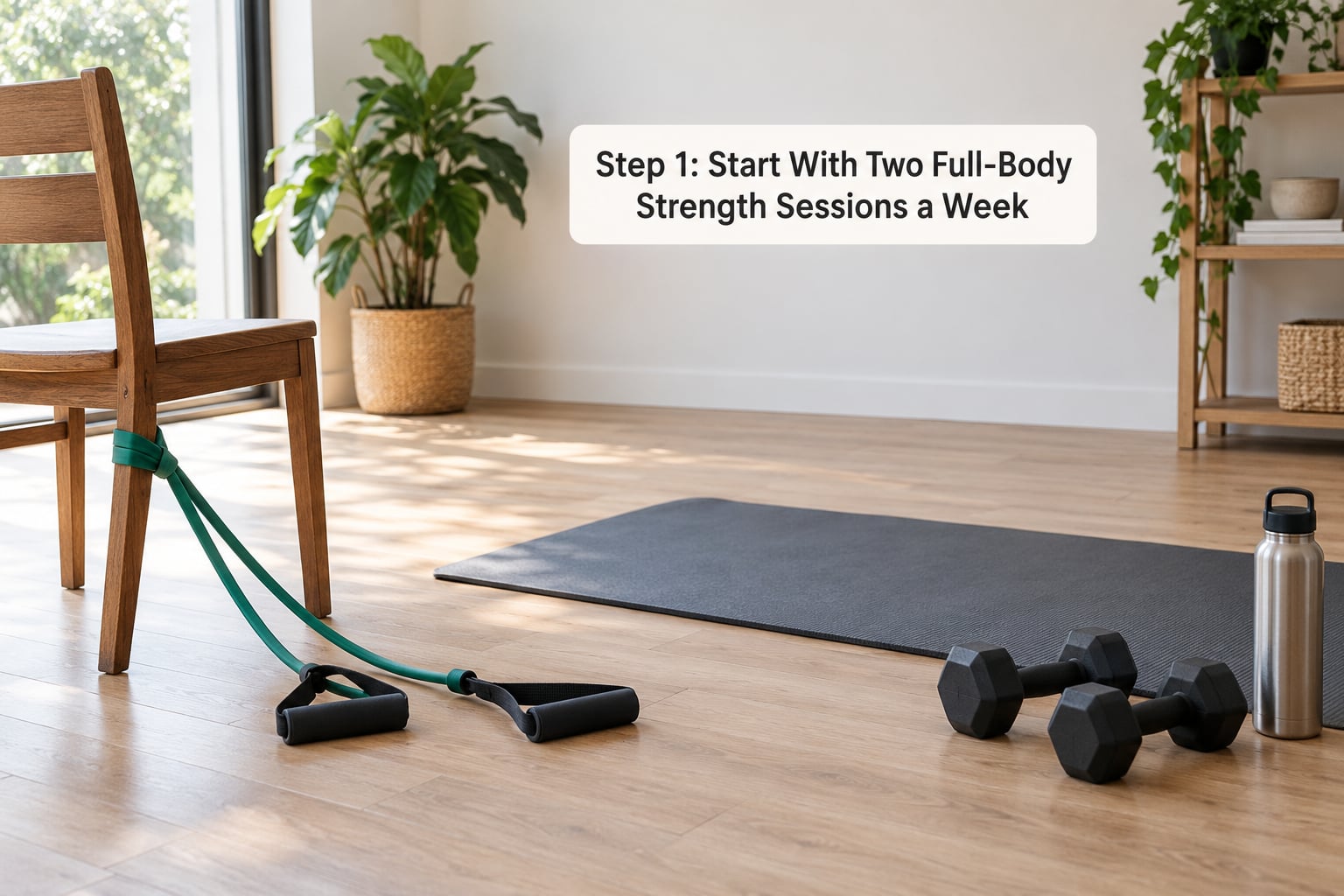
Two sessions, roughly 45 minutes each, on non-consecutive days, is the floor for maintaining muscle. It is also the point where most research shows measurable change, so start there rather than aiming for five days.
Each session covers five patterns, so every major muscle group gets a turn:
- Squat to a chair — stand in front of the seat, sit down slowly, stand back up. Hands in front of your chest if you need help.
- Wall or counter push-ups — hands on the surface, body in one line, lower until your chest comes close. Move the hands lower over time.
- Band row — band anchored to a chair leg, pull the handles toward your ribs and squeeze for a second.
- Hip hinge — hands on your thighs, push your hips back, keep a flat back, come back to standing. This is the movement that protects your back and your posture.
- Carry — a heavy tote or water jug held at your side, walking about 20 to 30 metres each way. This trains grip and grip is a real health marker as you age.
Do 2 to 3 sets of 8 to 12 repetitions of each, and pick an effort that leaves two or three good repetitions in reserve. Good means controlled and smooth, not grinding. Beginners often stop too early here, which is why the first few weeks should feel almost too easy.
Progress on one rule only: when you can finish every set of a movement with all 12 reps and it feels comfortable, add a little load, slow the lowering phase, or add a rep. Change one thing at a time, and give the movement about 48 hours before repeating it hard — connective tissue adapts more slowly than muscle, which is why older bodies need longer rest between sessions.
Stop the set if you feel sharp pain, dizziness, unusual shortness of breath, or anything you would describe as wrong rather than hard. Muscle fatigue is uncomfortable and expected; those four things are not.
Step 2: Fuel With Enough Protein at Every Meal
Resistance training supplies the signal. Protein supplies the building material. Older muscle is also more resistant to that signal — researchers call it anabolic resistance — which is why the general recommendation for adults over 50 sits higher than the basic daily minimum: about 1.0 to 1.2 grams per kilogram of body weight per day.
Work out your own number: your weight in pounds, divided by 2.2, then multiply by 1.0 to 1.2. A 68 kg adult lands somewhere between 68 and 82 grams a day.
The part that trips people up is distribution. Your body cannot use a huge serving all at once, so aim for roughly 25 to 30 grams at three meals, plus a snack if your appetite is small:
- Breakfast: 2 eggs plus a slice of toast, or a bowl of Greek yogurt with a spoon of oats and berries.
- Lunch: a palm-sized portion of chicken, fish or lean meat, or a cup of beans with grains and vegetables.
- Dinner: tofu, fish, poultry, eggs, or a lentil and vegetable stew, with a glass of milk if you tolerate dairy.
- Snack: yogurt, cottage cheese, a boiled egg, edamame, or a small handful of nuts.
Supplements are optional rather than required. Food first keeps the whole thing affordable and easier to stick to, and a powder is only a convenience for days when a meal simply does not happen. This is general nutrition guidance for steady energy and recovery, not a diet or weight-loss plan. If you have kidney disease, gout, diabetes or any condition where protein intake is adjusted, speak with your doctor or a registered dietitian first, because those situations need individual numbers rather than a general target.
Step 3: Add Daily Movement and Balance Work
Walking and other enjoyable movement are not a substitute for lifting, but they handle the rest of the job: circulation, joint mobility, balance and the recovery between strength sessions. Most adults over 50 benefit from some form of movement on most days, built up gradually rather than all at once.
Start with what you already tolerate. A 15-minute walk after one meal is a better foundation than a plan you abandon in week three, and it can grow to 30 or 45 minutes over a few months. Gardening, dancing, swimming, cycling, a class, or pushing a vacuum around twice a day all count.
Balance work deserves its own slot because falls are one of the most common ways older adults lose independence. Practise standing on one foot while you brush your teeth, heel-to-toe walking along a counter or a carpet line, and getting up from a chair without pushing off the arms. Three short sessions a week is plenty.
A simple week looks like this:
| Day | What to do |
|---|---|
| Monday | Full-body strength session, 45 minutes |
| Tuesday | Walk, plus balance practice |
| Wednesday | Full-body strength session, 45 minutes |
| Thursday | Walk, mobility work, or a light activity you enjoy |
| Friday | Balance practice and easy movement |
| Saturday | Longer walk, gardening, or swimming |
| Sunday | Rest |
Step 4: Recover and Progress Slowly
Muscle is built during recovery, not during the session. Seven to nine hours of sleep is the working target, and poor sleep slows down muscle protein synthesis — if you are sleeping five hours a night, that is worth fixing before anything else in this plan. Keep water within reach through your training, and eat enough overall that you are not training in a deficit every day.
Track the boring numbers. Write down your reps, your sets, the sessions you completed, and how the last set felt. Those four things show progress long before your clothes or your weight do. Review them every four to six weeks and adjust one variable: a little more weight, one extra rep, or one extra set.
If you recently lost weight, recovered from illness, or came off GLP-1 weight-loss medication, tell your doctor you are starting strength work. Losing weight quickly can strip lean mass, and muscle rebuilt alongside the loss is the goal. Significant or unexplained loss of strength, weight, or stamina is worth a medical appointment rather than a training log.
Common Mistakes
- Cardio only. Running and cycling burn energy but do not give muscle the tension it needs to hold on to. Fix: keep your two strength sessions non-negotiable and fit the walking around them.
- Cutting calories hard. Aggressive weight loss usually takes lean mass with it, and the muscle is harder to regain than the weight. Fix: lose slowly, or lose no weight and focus on building strength.
- Starting with six unfamiliar exercises. A beginner program borrowed from a 25-year-old’s routine is a recipe for soreness and quitting. Fix: five patterns, two sets, bodyweight.
- Chasing fast progress. Progress in the 50s, 60s and 70s is slower, and that is normal rather than a sign the plan failed. Fix: judge progress on a monthly cycle, not weekly.
- Training through pain. Soreness is expected; sharp pain, joint pain and instability are signals to change the exercise, not push through it. Fix: swap to a pain-free range and check in with a clinician if it persists.
- Skipping meals. Protein at breakfast gets used, protein at 9 pm does not do much for a recovery that already happened. Fix: a protein source at each meal before you worry about powders.
- Expecting one routine to fit everyone. A 62-year-old who lifts and a 68-year-old recovering from surgery are not the same project. Fix: use the plan as a default and adapt it with professional input when your situation calls for it.
Three things make it easier to keep going. Put both sessions in your calendar at a specific time, like Tuesday and Thursday mornings, so you stop deciding each day. Prep food the night before — boiled eggs, portioned yogurt, cooked grains — so protein is the easy choice rather than the decision. And note after each session what felt easy and what felt hard, then raise the easy ones and leave the hard ones alone for another week.
Frequently Asked Questions
How can I start keeping muscle after age 50 or 60?
Start with two full-body strength sessions a week, 45 minutes each, using five patterns: squat to a chair, wall push-ups, a band row, a hip hinge and a weighted carry. Aim for 2 to 3 sets of 8 to 12 repetitions, and add load only when every rep feels comfortable. Add a protein source at each meal, working toward about 1.0 to 1.2 grams per kilogram of body weight daily. Walking on most days and balance practice on three days complete the picture.
How many strength workouts should older adults do each week?
Two sessions a week is the minimum that reliably holds muscle, and three works well if your schedule allows. Keep them on non-consecutive days and give each movement about 48 hours before repeating it hard. Many people in their 60s and beyond do well with two sessions for years. If you are starting from nothing, two is plenty for the first six weeks, and adding a third session comes later, if at all.
Is walking enough to keep muscle as you get older?
Walking is excellent for balance, joints, circulation and mood, but on its own it rarely holds muscle. Walking loads the body in a way muscles adapt to by becoming efficient, not by growing. For steady progress on lean mass, combine your walking with two weekly sessions of resistance work. Think of walking as the base layer and lifting as the part that changes your body composition.
Can I lose weight without losing muscle?
Yes, but slower than a crash diet allows. Most of the weight lost during aggressive dieting comes from lean mass alongside fat, and muscle is harder to rebuild than the weight was to lose. Two strength sessions a week, a protein source at each meal and a moderate calorie deficit over months rather than weeks give you the best odds. If you are on a GLP-1 weight-loss medication, tell your doctor you are starting strength training so they can follow your lean mass too.
When should I see a doctor about exercise or muscle loss?
Ask a clinician first if you have kidney disease, gout, diabetes, osteoporosis, a recent joint replacement, heart or lung conditions, or take medication that affects training. Get checked rather than self-diagnosing if you notice unexplained strength loss, rapid weight loss, repeated falls, dizziness, or difficulty with everyday tasks like stairs and shopping. This article is general information, and your own history may change the right prescription for protein, load and frequency.
Conclusion
The priorities are simple: begin two manageable full-body strength sessions a week, put a protein source at your regular meals, add movement you actually enjoy, protect your sleep and recovery, and adjust one variable at a time. Start with steps one and two this week — put a chair in front of you and book two sessions on the calendar — and talk to your doctor or a registered dietitian if your own health conditions or warning signs make personalized guidance worth having.