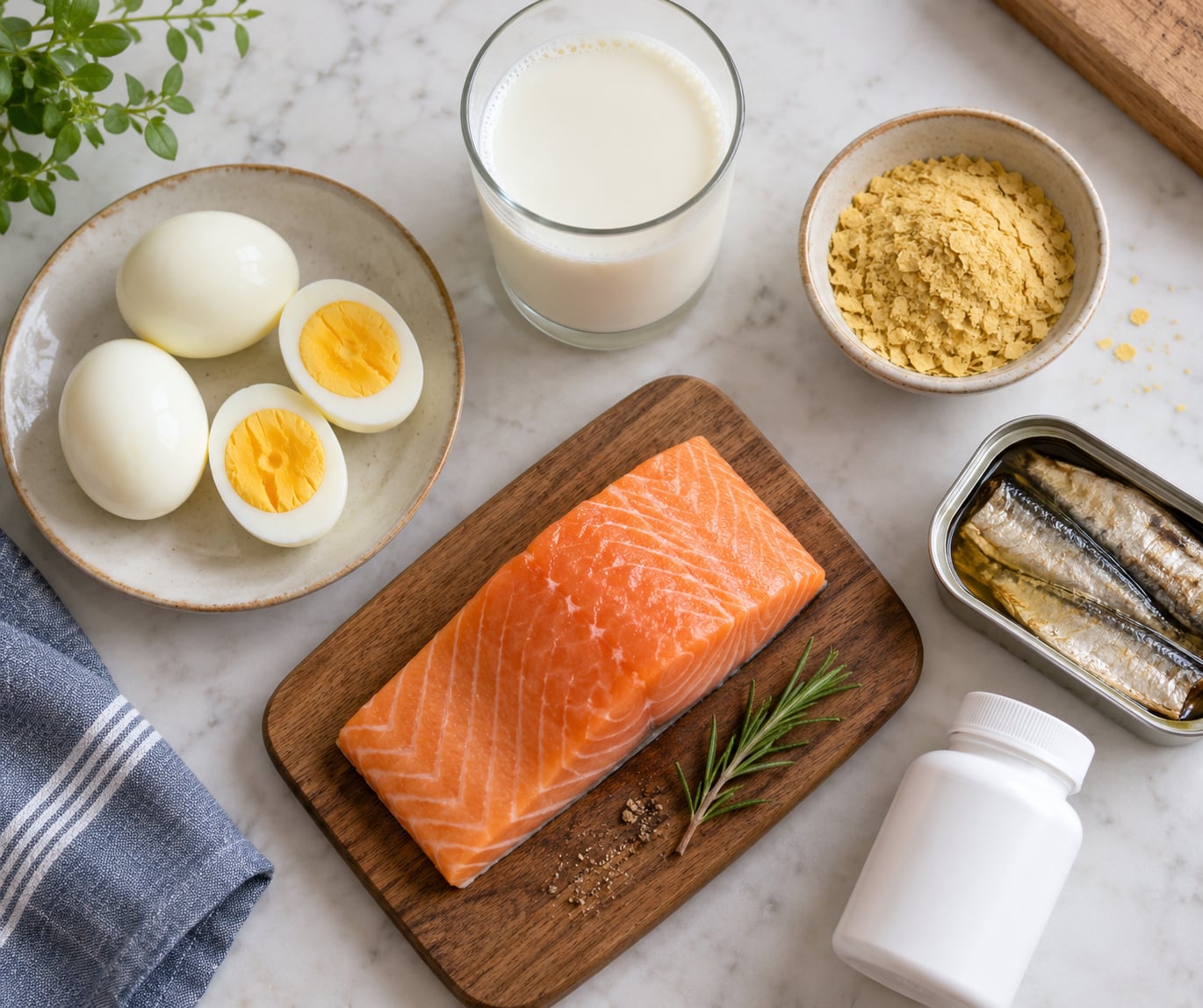
If you are cutting back on meat, vitamin B12 is not automatically a problem. The nutrient occurs naturally only in animal foods, so the practical question is which of those foods you keep, and whether you have a labeled fortified food or supplement covering the gaps. Adults need 2.4 micrograms (mcg) of B12 a day, and most people who still eat eggs, dairy or fish can reach that from food alone.
Plenty of people reduce meat for health, environmental or budget reasons and never think about B12 again. That is often fine. It is worth a short check every few months, though, because B12 is quietly different from other nutrients: your body stores several years’ worth, so a dip in intake does not announce itself right away.
This guide covers the food sources that matter, how to read a label on fortified products, and where supplements fit. It is general information, not medical advice. If you have symptoms, a known deficiency, or take medication that affects absorption, talk to a doctor or registered dietitian rather than acting on a list of foods.
Table of Contents
- Why Vitamin B12 Matters When Meat Intake Drops
- Vitamin B12 Sources for People Who Eat Less Meat at a Glance
- Which Animal-Based Foods Provide the Most B12?
- Vitamin B12 Sources in Eggs and Dairy for Flexible Diets
- Fish and Shellfish as Vitamin B12 Sources
- What Are the Best Plant-Based Vitamin B12 Sources?
- How to Choose Vitamin B12-Fortified Foods
- How to Read Labels for Vitamin B12
- Supplements and Fortified Foods: Which Option Fits?
- How to Build a Practical Low-Meat B12 Routine
- Who Should Ask a Health Professional for Advice?
- Frequently Asked Questions
- What are vitamin B12 sources for people who eat less meat?
- Are eggs a reliable source of vitamin B12?
- Do nutritional yeast and seaweed provide enough vitamin B12?
- How much B12 is in fortified plant milk and cereal?
- Can low vitamin B12 cause symptoms in someone who eats little meat?
- Conclusion
Why Vitamin B12 Matters When Meat Intake Drops
B12, also called cobalamin, does three jobs your body cannot skip. It helps build red blood cells, keeps the myelin sheath that insulates your nerves in good shape, and is required for DNA synthesis in every cell that divides.
Because it works at that structural level, shortfalls show up in two different systems at once: blood and nerves. That is why B12 is discussed more seriously than a purely energy-related vitamin.
Absorption is the part that surprises people. B12 needs a stomach-made protein called intrinsic factor to get through the small intestine, and that active pathway only handles roughly 1.5 to 2 mcg per dose. Larger amounts still raise your levels, but through slow passive diffusion, which is why high-dose tablets and weekly-style dosing work at all.
Dropping meat rarely creates an immediate problem. Your liver holds a reserve that lasts years, and symptoms tend to creep rather than arrive. This delay is exactly why a low-meat eating pattern deserves an occasional label check rather than a panicked change.
This article does not list symptoms for self-diagnosis, and it does not set doses. Your intake needs differ with age, pregnancy and medical history, and a professional can sort that out properly.
Vitamin B12 Sources for People Who Eat Less Meat at a Glance
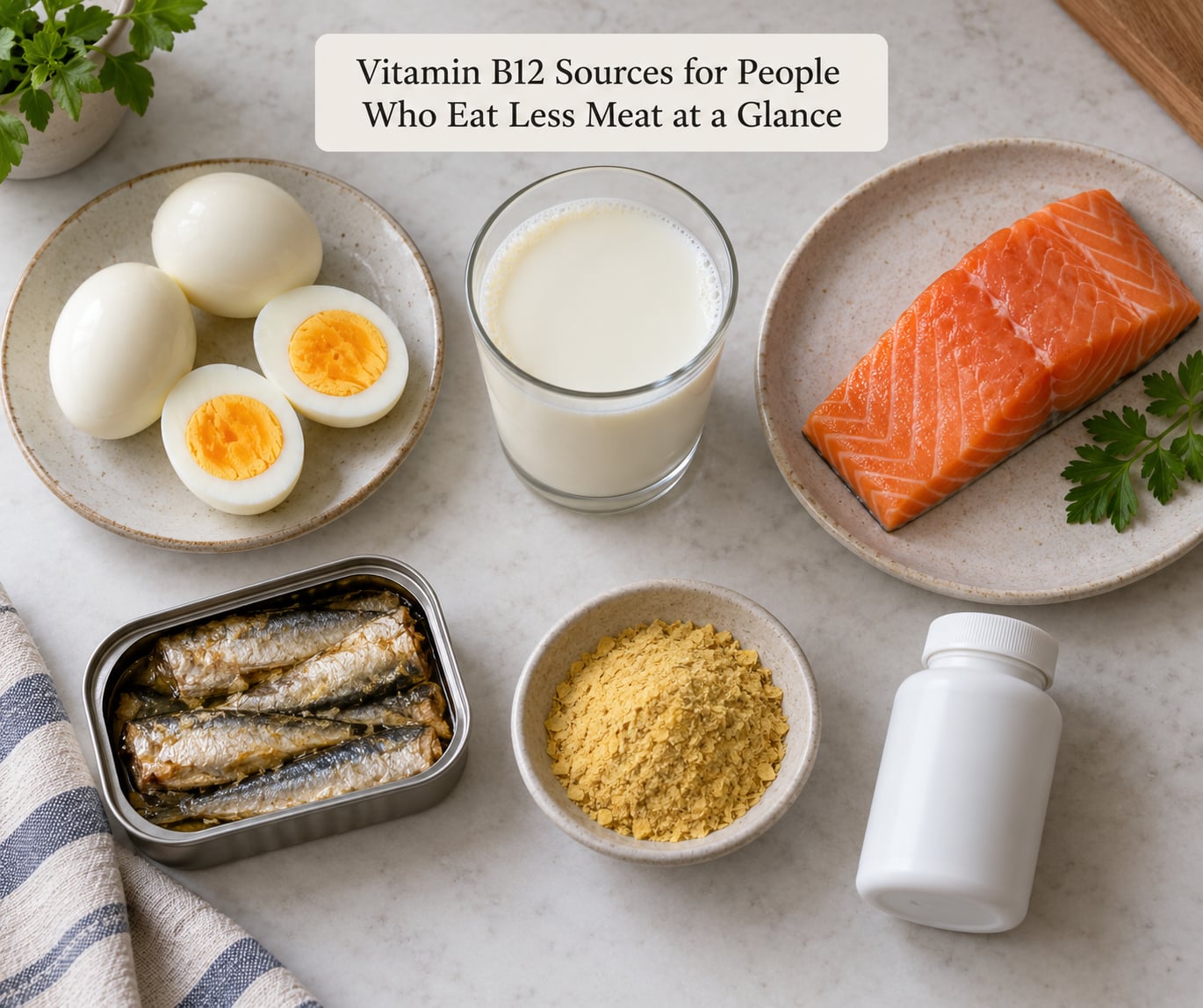
Nothing here is a single magic food. Each row has a different job in a low-meat week, and the reliable approach is combining at least two.
| Source group | What it looks like in a low-meat week | Label consideration | Main limitation |
|---|---|---|---|
| Eggs and dairy | Breakfast eggs, milk, yogurt, cheese in everyday portions | Check serving size, since a large egg is about 0.4 mcg | Amounts per serving are modest; you need several servings to approach the RDA |
| Fish and shellfish | Canned salmon, sardines, trout, mackerel, mussels, clams | Canned products list drained weight, not the total can | Fish is still an animal food, so this suits flexitarians and pescatarians, not strict vegans |
| Meat and liver | Beef and poultry on the days you still eat them | Fresh meat has no B12 line, only a protein and iron line | Reduced by definition in a low-meat pattern; liver is rich but most people eat it rarely |
| Fermented foods | Yogurt, kefir, tempeh, miso, sauerkraut | Fermented foods are not fortified unless the label says so | Bacterial synthesis happens in unpredictable amounts, so these are not counted on |
| Fortified plant foods | Fortified plant milks, breakfast cereals, nutritional yeast, bars, veggie burgers | Compare micrograms per serving and how the serving is defined | Amounts differ between brands and can change between production runs |
| Supplements | Standalone B12 tablets, capsules, gummies, liquid | Look for the specific form, not a proprietary blend | Dose decisions are a conversation with a pharmacist or clinician |
Two things in that table decide most cases. First, whether you still eat some animal foods at all. Second, whether the fortified product you rely on states a B12 amount on its panel.
Which Animal-Based Foods Provide the Most B12?
Animal foods are the only reliable natural sources, but the amounts vary widely, and the phrase most B12 usually points to one family. Shellfish and oily fish sit at the top of the range; eggs and dairy sit much lower per serving.
That gap is worth holding onto, because it explains why two eggs is a real question rather than a rhetorical one.
Vitamin B12 Sources in Eggs and Dairy for Flexible Diets
One large egg holds about 0.4 mcg of B12, so two eggs give you roughly 0.8 mcg, somewhere near a third of the 2.4 mcg adult recommendation. A cup of milk is higher at about 1.2 mcg, and yogurt and cheese sit in a similar middle range depending on the variety.
That is why eggs alone rarely close the gap, even in a family that eats them most mornings. They contribute meaningfully, and they need to be combined with dairy, fish or a fortified food rather than trusted as the whole answer.
The misconception that eggs are optional deserves clearing up. Some readers assume eggs are useless for B12 or that the yolk is a negligible part. Egg is consistently cited as one of the practical animal sources when meat is cut back, and portion size is the real limit, not the food itself.
A flexible week can close a lot of the gap with ordinary portions: an egg or two most days, milk or yogurt daily, and cheese as an easy add-on. The relevant check is the label or a nutrition database, since serving definitions change between products.
Fish and Shellfish as Vitamin B12 Sources
Seafood is where a single serving can realistically carry a large share of the daily target. Mussels come in around 20 mcg per 3 ounces, mackerel about 16 mcg, trout roughly 6.7 mcg, and salmon varies widely depending on whether it is canned, fresh or wild.
Sardines and canned salmon are the practical version of this for many households, since both are shelf-stable, inexpensive relative to fresh fish, and easy to fold into meals people already cook.
Three caveats are fair to mention. Canned products count the drained weight, not the whole tin. Fish is still an animal food, so this route does nothing for strict vegans. And anyone with an allergy, an ongoing pregnancy discussion, or a sustainability preference should factor that into the choice rather than copying a generic list.
For readers who keep fish two or three times a week and eat eggs or dairy the rest of the time, B12 from food alone is realistic. That group rarely needs to think about supplements at all.
What Are the Best Plant-Based Vitamin B12 Sources?
Seaweed is the one widely eaten plant food that contains some vitamin B12, and even there the amounts are small and inconsistent. Fermented foods such as tempeh, miso and sauerkraut are produced by bacteria that can synthesize B12, but the amount that survives and reaches you is unpredictable.
That unpredictability is the whole argument. It is why nutrition guidance treats seaweed and fermented foods as undependable and points plant-based readers at fortified products instead.
Nutritional yeast is a special case, because it can be excellent or useless depending on the brand. It only counts when the label states it is fortified, and plenty of jars on shelves are not. Check the nutrition panel for cobalamin before assuming a spoonful covers you.
How to Choose Vitamin B12-Fortified Foods
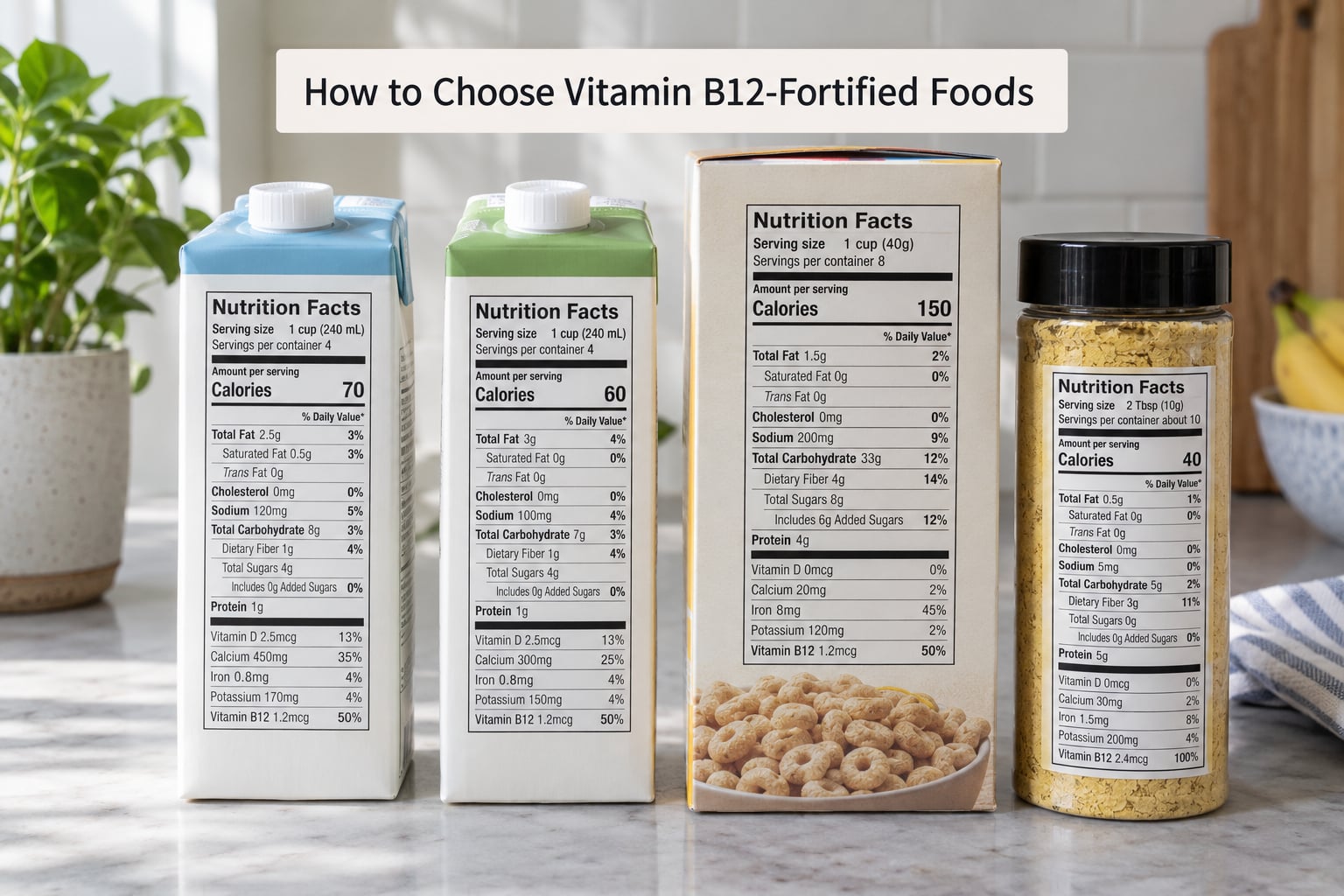
Fortified foods are the backbone of any low-meat or plant-based pattern, and choosing between them gets easier once you compare panels instead of front-of-pack claims. Five things decide which product earns the space in your cart.
- Serving size. A product offering 2.4 mcg per cup and another offering it per two-thirds of a cup are not interchangeable. Work out how much you would actually pour.
- Micrograms per serving. Read the actual amount, not the percentage alone. Percentages are relative to a general adult reference and tell you nothing about your personal needs.
- Ingredient order. B12 added by a manufacturer usually appears in the ingredient list. If nothing is listed and the nutrition panel shows no cobalamin, the product is not a meaningful source.
- Daily value. Percent daily value is a quick shortcut: 100 percent corresponds to 2.4 mcg for adults under the current reference intake.
- What the brand claims. Claims about energy, plant-based nutrition or immunity are marketing. Only the nutrition panel and ingredient list carry B12.
Apply the same checklist to breakfast cereals, energy bars, plant milks, nutritional yeast jars and veggie burgers. Soy and rice beverages have historically carried the most reliable fortification, while oat and almond products vary more by brand, so the panel matters more than the category.
How to Read Labels for Vitamin B12
On most labels in the United States, the vitamin is listed as Vitamin B12, Cobalamin or Vitamin B-12, and it usually appears near the bottom of the nutrition facts panel beside the other B vitamins.
Distinguishing naturally occurring from added B12 takes a little care. In single-ingredient animal foods such as milk or canned fish, the amount is simply what the food contains. On a fortified product, the number reflects B12 that a manufacturer added, and the ingredient list is your confirmation.
Front-of-pack messaging is not a substitute for the panel. Phrases such as good source of B12 or plant powered tell you nothing about the amount, and the same product name can carry different fortification across production runs.
A quick audit works better than a rule of thumb: pick the two or three foods you eat daily, note the micrograms per serving, and add them up across the week.
Supplements and Fortified Foods: Which Option Fits?
For most people eating less meat but still keeping eggs, dairy or fish, a routinely fortified food is enough and a supplement adds nothing you need. The case for a supplement gets stronger the fewer animal foods remain in the pattern, and it becomes a conversation with a professional once symptoms, medications or age are involved.
Forms differ chemically. Cyanocobalamin is the stable, inexpensive form used in most supplements and fortified foods. Methylcobalamin is the form already present in the body and is used in some products. Despite the name, the cyanide group in cyanocobalamin is bound in a way that is not a toxicity concern, which is a persistent source of confusion.
Format matters less than people expect. Tablets, capsules, gummies, liquids and sprays all deliver B12, and delivery method is rarely the deciding factor. What does matter is that the amount per dose is stated plainly rather than hidden inside a proprietary blend.
People who take a general multivitamin often assume B12 is covered. Fortification levels vary between brands and between batches, and the amount on the label may sit far below what the tablet implies at a glance. Reading the panel, as above, settles it.
This section deliberately stops short of recommending a dose. A pharmacist or clinician can take your diet, medications and bloodwork into account. Anything sold with promises of extreme energy or disease treatment deserves a second look.
How to Build a Practical Low-Meat B12 Routine
The routine that works is the one you keep, so aim for the smallest version that covers your pattern. Five steps do it.
- Review your actual week, not your intentions. Count days with eggs or dairy, days with fish, and days with fortified foods. People who reduced meat for months rarely remember their own pattern accurately.
- Find one reliable source. For many households that is a fortified plant milk used daily. One dependable source beats four occasional ones, because you can actually track it.
- Read its label and write down the micrograms per serving and the serving size.
- Check the weak spots. Two or three foods that contribute little add up quickly to nothing. Fortified foods with no stated B12 amount are the most common version of this mistake.
- Ask a professional if you are unsure, and especially if you are over 60, take metformin or acid-blocking medication, have a digestive condition, or have had bariatric surgery.
Reviewing the routine twice a year is plenty. Fortification levels and your habits both change slowly, and a schedule is easier to maintain than a daily calculation.
Who Should Ask a Health Professional for Advice?
Some readers can handle this topic with food knowledge alone. Others are dealing with absorption rather than intake, and food planning will not solve it. If any of the following describe you, book an appointment with a doctor or registered dietitian rather than relying on a general guide.
- Strictly vegan eating, with no reliable fortified food or supplement in the routine.
- Adults over 60, because stomach acid production often declines with age, which affects how B12 is released from food.
- People taking metformin or proton pump inhibitors and acid-reducing medication, both of which are associated with lower B12 status.
- Coeliac disease, Crohn’s disease or a history of gastric bypass surgery, all of which affect B12 absorption.
- Anyone with symptoms or a documented deficiency, including numbness, tingling, balance problems, unexplained fatigue or memory changes. These are reasons to seek care, not things to self-assess against a list.
Professionals can also order the right blood tests. Serum B12 on its own can read borderline, and markers such as methylmalonic acid and homocysteine sometimes clarify what is actually happening in the cells.
Meat-eaters are not exempt either. Low B12 shows up in people who eat meat regularly, usually because of medication or absorption problems rather than diet, so a low reading is worth discussing whatever your eating pattern looks like.
Frequently Asked Questions
What are vitamin B12 sources for people who eat less meat?
The main sources are eggs, milk, yogurt, cheese, fish and shellfish, plus fortified plant milks, breakfast cereals and nutritional yeast. Adults need 2.4 mcg daily, so a low-meat pattern usually works when a couple of animal servings are paired with one reliable fortified food or a supplement.
Are eggs a reliable source of vitamin B12?
Eggs contribute real amounts, but modest ones. A large egg holds roughly 0.4 mcg, so two eggs provide about a third of the adult daily target of 2.4 mcg. Eggs are a useful part of a flexible routine, though not a complete answer on their own.
Do nutritional yeast and seaweed provide enough vitamin B12?
Not reliably. Seaweed contains small and inconsistent amounts, and fermented foods vary by batch. Nutritional yeast is the exception when it is explicitly fortified, in which case it can be a useful daily source. Check that the label states cobalamin before counting it.
How much B12 is in fortified plant milk and cereal?
It varies by brand and by category, with soy and rice beverages historically the most consistently fortified. Some labels show a full daily value per serving, while others show a smaller fraction. Read the micrograms and the stated serving size rather than the front-of-pack wording.
Can low vitamin B12 cause symptoms in someone who eats little meat?
It can, though symptoms usually develop gradually because the body stores several years of B12. Low status is associated with numbness, tingling, balance problems, fatigue and memory changes. If you notice any of these, see a doctor or registered dietitian rather than self-diagnosing.
Conclusion
Start with your real week rather than the worst case. If you still eat eggs, dairy or fish regularly, you are most likely meeting the 2.4 mcg daily target without changing anything, and that reassurance is the accurate one.
If your pattern is thinner, pick one labeled fortified food you will eat daily, note its micrograms per serving, and stop there. When your intake or symptoms are uncertain, a doctor or registered dietitian can settle it faster than another list of foods.