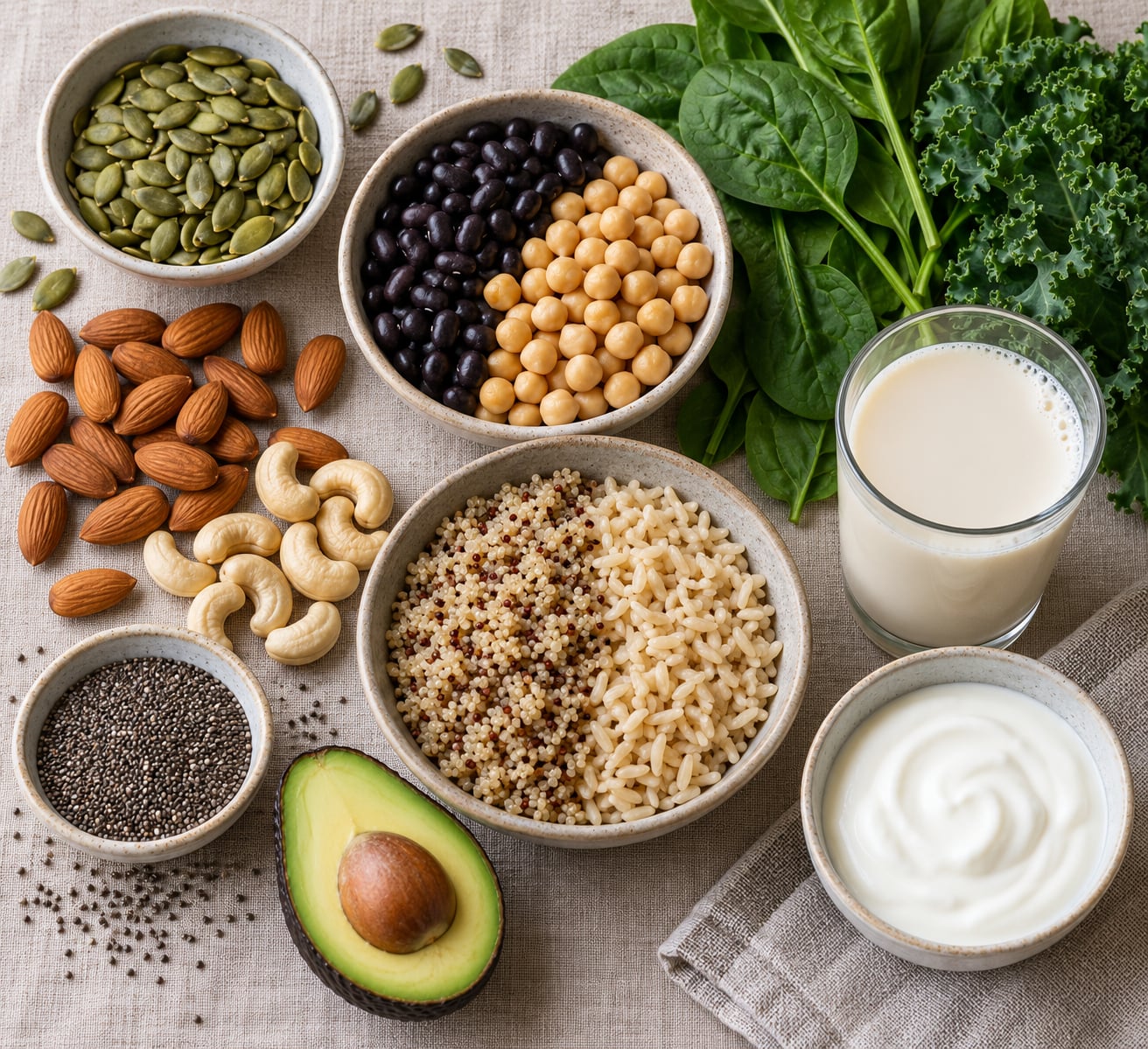
Magnesium rich foods are the everyday edible sources of an essential mineral your body cannot make on its own. Foods high in magnesium, such as pumpkin seeds, leafy greens, beans, nuts, whole grains and fortified soy milk, supply the magnesium that keeps muscles contracting, nerves firing, heart rhythm steady and bones solid. Below is a plain-language guide to the best sources, real milligram numbers, and how to fold them into meals you already eat.
Most nutrition guides hit the same handful of foods and stop there. This one goes further: how much magnesium your body actually absorbs, what quietly blocks it, and how much a normal day of eating adds up to.
Table of Contents
- What Are Magnesium Rich Foods?
- Why Does Magnesium Matter for Everyday Health?
- Which Foods Provide the Most Magnesium?
- What Blocks Magnesium Absorption?
- Plant-Based and Animal-Based Sources
- Easy Ways to Add More Magnesium to Your Diet
- How Much Magnesium Do Adults Need?
- Magnesium Foods vs. Magnesium Supplements
- Who May Need Extra Attention?
- Frequently Asked Questions
- What is the single food highest in magnesium?
- How much magnesium do adults need per day?
- Is one banana a day enough magnesium?
- Which fruit is the highest in magnesium?
- Do certain foods block magnesium absorption?
- When should I ask a doctor instead of changing my diet?
- Conclusion
What Are Magnesium Rich Foods?
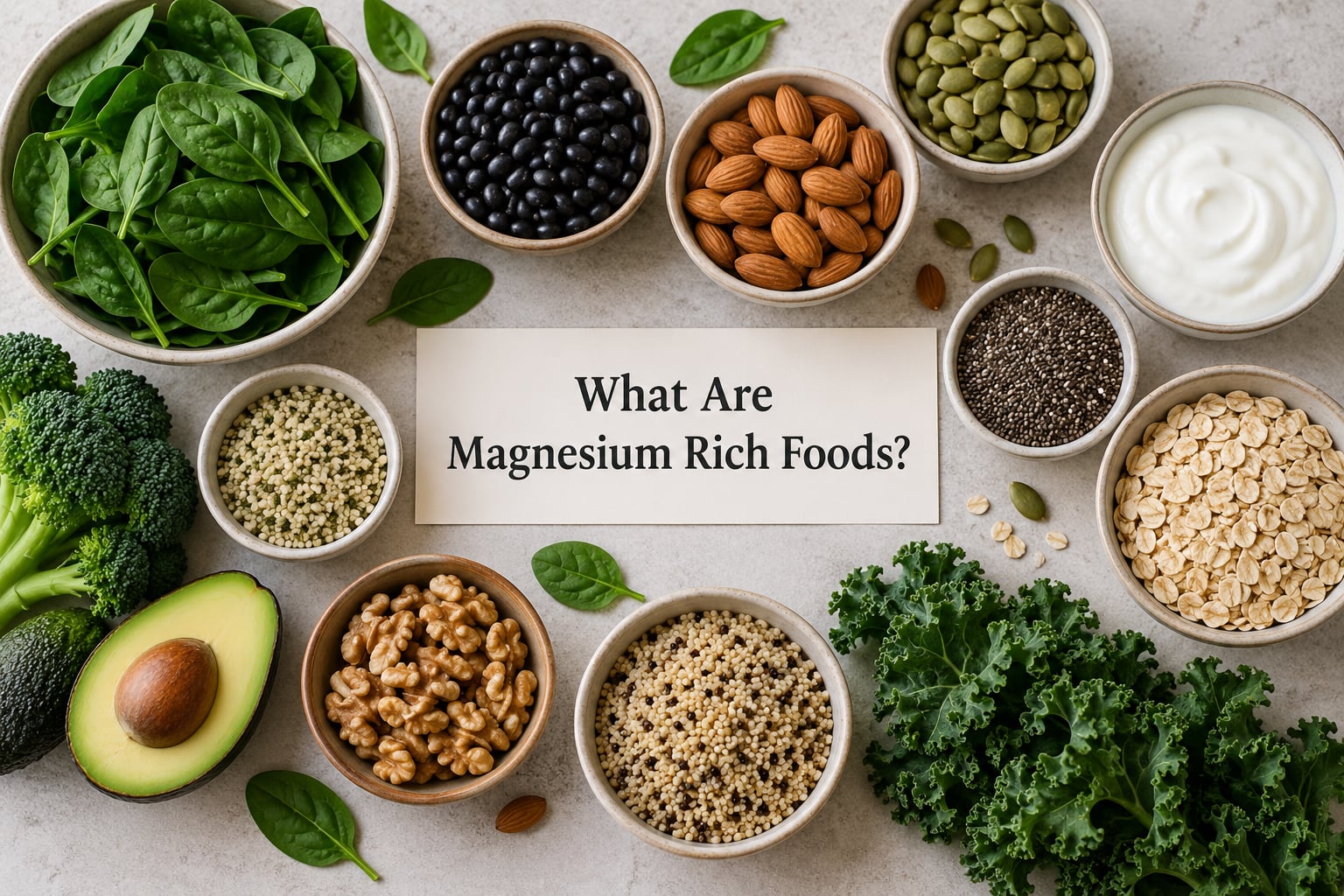
Magnesium is a mineral, not a vitamin, and it sits at the center of hundreds of chemical reactions in the human body. Plants pull it up from soil through their roots, so it ends up concentrated in things like leafy greens, seeds, nuts and legumes. Animals eat those plants, so magnesium carries up the food chain into meat and dairy.
A food earns the magnesium rich label loosely. There is no legal threshold in the United States, so manufacturers use the phrase freely. In practical terms, magnesium rich foods deliver a meaningful share of your daily target in a single ordinary serving, usually 10 percent of daily value or more.
Magnesium arrives from three directions, and each has its own strengths.
| Source type | Typical foods | Best quality | Watch for |
|---|---|---|---|
| Plant sources | Pumpkin seeds, spinach, black beans, cashews, quinoa, almonds | Highest per serving, wide variety, naturally occurring | Phytates can slow absorption; some are calorie-dense |
| Animal sources | Salmon, sardines, yogurt, milk, eggs | Well absorbed, comes packaged with protein and calcium | Lower per serving than seeds; not suitable for plant-based diets |
| Fortified foods | Fortified soy milk, some breakfast cereals, oatmeal | Predictable amounts straight from the label | Amounts vary widely between brands and even between batches |
None of these three groups wins outright. Plant sources dominate by weight, animal sources absorb more efficiently, and fortified foods are the one category where the number is exact and printed.
Why Does Magnesium Matter for Everyday Health?
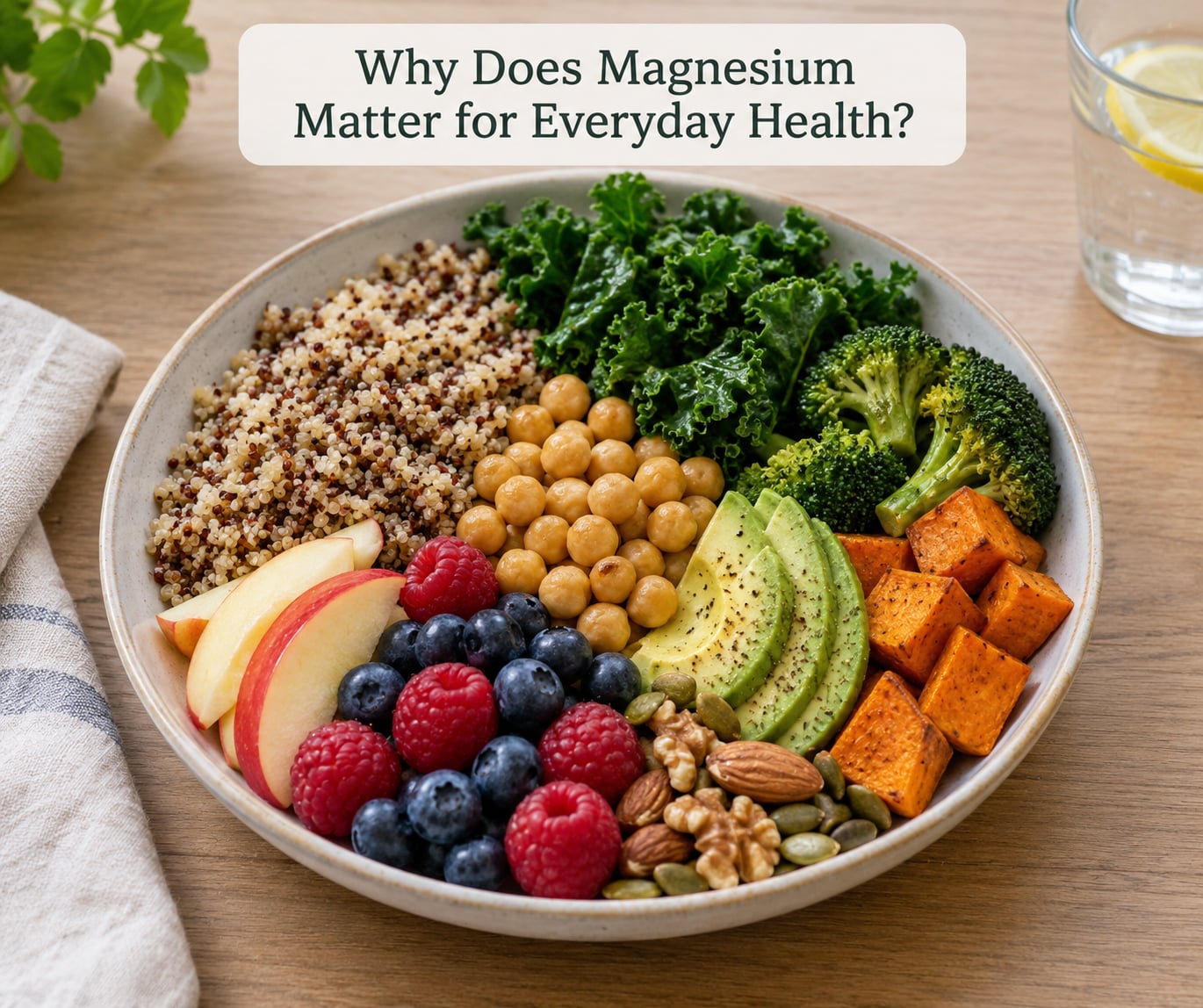
Magnesium acts as a cofactor in more than 300 enzymatic reactions, including the ones that turn food into usable energy. When people describe magnesium as an energy mineral, they mean the machinery, not a stimulant.
The specific roles show up in ordinary body systems:
- Energy production. Magnesium sits inside ATP, the molecule cells use to release energy from food.
- Muscle function. It lets calcium move in and out of muscle cells, which is how muscles contract and then relax.
- Nerve transmission. Magnesium keeps electrical signaling in nerves working properly.
- Heart rhythm. The heart beats partly because of magnesium-dependent electrical signals.
- Bone health. Roughly 60 percent of the body’s magnesium sits in bone, where it supports bone density alongside calcium and vitamin D.
- Blood sugar regulation. It participates in how the body handles glucose and insulin.
- Digestion. Magnesium helps the bowel muscle move, which is why low intake often shows up as constipation.
Shortfalls are common in the United States, and the National Academies estimated that roughly half of adults consume less magnesium than the recommended allowance. Diets heavy in refined grains and processed food, with few nuts, seeds or greens, are the usual reason.
Low intake does not produce one clear symptom. People describe fatigue, muscle cramps or twitching, trouble sleeping, constipation, headaches and cravings for chocolate. Those complaints overlap with dozens of other conditions, which is exactly why self-diagnosis is a bad idea. If something is bothering you, a doctor or registered dietitian can help sort it out.
Which Foods Provide the Most Magnesium?
One ounce of pumpkin seeds delivers roughly 150 milligrams, more than a third of the daily value, which makes them the single most magnesium-dense food most people eat regularly. The table below compares common servings using a 420 milligram daily value, the number printed on US nutrition labels.
| Food | Serving size | Magnesium (mg) | % daily value |
|---|---|---|---|
| Pumpkin seeds, roasted | 1 oz (28 g) | 150 | 36% |
| Chia seeds | 1 oz (28 g) | 140 | 33% |
| Spinach, boiled | 1/2 cup | 63 | 15% |
| Oats, cooked | 1 cup | 63 | 15% |
| Edamame, cooked | 1 cup | 74 | 18% |
| Quinoa, cooked | 1 cup | 64 | 15% |
| Dark chocolate, 70-85% cacao | 1 oz (28 g) | 60 | 14% |
| Black beans, cooked | 1/2 cup | 60 | 14% |
| Avocado | 1 medium | 60 | 14% |
| Almonds | 1 oz (28 g) | 76 | 18% |
| Cashews | 1 oz (28 g) | 48 | 11% |
| Peanut butter | 2 tbsp | 49 | 12% |
| Kale, cooked | 1 cup | 40 | 10% |
| Brown rice, cooked | 1 cup | 42 | 10% |
| Salmon, cooked | 3 oz | 30 | 7% |
| Banana | 1 medium | 27 | 6% |
| Fortified soy milk | 1 cup | 40 | 10% |
| Plain yogurt | 1 cup | 18 | 4% |
Treat these as approximate. Magnesium content varies with soil quality, plant variety, harvest year and processing, so two bags of pumpkin seeds from different batches will not match exactly. Cooking methods matter too, and some magnesium leaches into water.
Ranked by how easy they are to work into a normal week, the practical tiers look like this.
- Easy daily habits: a spoon of chia or pumpkin seeds in breakfast, black beans in tacos or soup, avocado on toast, a square of dark chocolate.
- Easy with a little planning: quinoa or brown rice as a side dish, edamame as a snack, salmon twice a week, fortified soy milk in place of dairy.
- Worth rotating: cashews and almonds as snack food, kale and chard in soups and stir-fries, tofu in place of meat.
One honest correction to a common belief: bananas are famous for potassium, not magnesium. One medium banana gives about 27 milligrams, roughly 6 percent of daily value. Useful, but nowhere near a magnesium rich food.
What Blocks Magnesium Absorption?
Only about 30 to 40 percent of magnesium from food actually makes it into your bloodstream. The rest passes through. That single fact explains why two people can eat identical diets and end up with very different results.
Several ordinary things reduce what gets absorbed:
- Phytates in nuts, seeds, beans and whole grains bind minerals. Soaking, sprouting or fermenting those foods lowers phytate levels somewhat.
- Calcium taken at the same time in a large dose can compete with magnesium absorption, which matters more for supplements than for ordinary meals.
- Tea and coffee tannins reduce magnesium absorption from the same meal. This is a modest effect, not a reason to skip coffee.
- Very high doses of zinc and iron taken together can interfere, another issue that mainly concerns supplements.
- Long-term proton pump inhibitors reduce stomach acid, which lowers absorption of magnesium from both food and supplements.
- Chronic heavy alcohol use increases magnesium loss through urine.
- Gastrointestinal conditions such as Crohn’s disease, celiac disease and ulcerative colitis can limit absorption because the gut lining itself is affected.
Here is the part that confuses people: the foods highest in magnesium, seeds, nuts, beans and whole grains, are also the ones richest in phytates. That is the trade-off, and it is not a reason to skip them.
Two practical habits recover some of the loss. Soak raw nuts and beans overnight and drain them, which reduces phytate content. And separate magnesium-dense meals from strong coffee or tea by an hour or so if that is easy in your day.
Plant-Based and Animal-Based Sources
A varied eating pattern covers magnesium needs whichever side of the aisle you shop on. Plant-only eaters have plenty of options, and they consistently show up in the foods with the highest milligrams per serving.
Plant-based standouts include black beans at about 60 milligrams per half cup, edamame at 74 milligrams per cup, tofu around 40 milligrams per half cup when it is calcium-set, lentils, chickpeas, spinach, kale, Swiss chard, pumpkin seeds, almonds, cashews, peanut butter, quinoa, brown rice and oats.
Animal sources deliver smaller amounts per serving. Cooked salmon gives roughly 30 milligrams per 3 ounces, sardines a bit more, and a cup of plain yogurt about 18 milligrams. The trade-off is that dairy and fish also bring protein, calcium and vitamin D to the same meal.
Fortified foods are the underrated third option for anyone avoiding animal products. Fortified soy milk shows around 40 milligrams per cup and puts the exact number on the carton. Some breakfast cereals are fortified too, and the label tells you.
Two things to check before you commit. Allergies first, since legumes and nuts are common triggers. Then personal constraints such as kidney disease, where magnesium intake needs medical supervision rather than a food-first approach. A registered dietitian can help you build a pattern that fits both.
Easy Ways to Add More Magnesium to Your Diet
Most people do better changing one or two habits than rewriting their whole diet. Here is what actually moves the number, meal by meal.
Breakfast. Stir a tablespoon of chia seeds or a small handful of pumpkin seeds into oatmeal. Soaking raw oats overnight in fortified soy milk does both jobs at once: adds magnesium and cuts phytates.
Lunch. A bowl of black beans and quinoa over spinach gets you close to 150 milligrams in one dish. It also travels well for leftovers.
Snacks. A small portion of almonds or cashews covers roughly a tenth of the daily value. Dark chocolate at 70 percent cacao or higher contributes about 60 milligrams per ounce, and it is the snack people actually reach for.
Dinner. Swap white rice for quinoa or brown rice and add a side of greens. Tofu stir-fries and salmon fillets do the same job with different protein.
Swaps, not additions. Choosing fortified soy milk instead of dairy, whole grain bread instead of white, and beans instead of some of your meat each week adds up without adding much bulk.
Here is what a single day of magnesium-dense eating looks like, using the table values above.
| Meal | Foods | Magnesium (mg) | Running total |
|---|---|---|---|
| Breakfast | 1 cup cooked oats in 1 cup fortified soy milk, plus 1 oz pumpkin seeds | 253 | 253 mg (60%) |
| Lunch | 1/2 cup black beans, 1/2 cup quinoa, 1/2 cup spinach, 1 slice whole wheat bread | 178 | 431 mg (103%) |
| Snack | 1 oz almonds and 1 oz dark chocolate | 136 | 567 mg (135%) |
| Dinner | 3 oz salmon, 1 cup brown rice, 1 cup edamame, 1 cup cooked kale | 186 | 753 mg (179%) |
Nothing exotic, nothing expensive. Four ordinary meals clear the daily target for a woman and comfortably clear it for a man. Magnesium from food does not carry the same upper-limit warning that high-dose supplements do, so there is little reason to force yourself past a comfortable amount.
How Much Magnesium Do Adults Need?
The US Dietary Reference Allowance, set by the National Academies of Sciences, Engineering and Medicine, sets recommended intakes by age and sex. These are population-level figures, not personal targets, and a clinician may recommend a different number for an individual situation.
| Group | Recommended daily allowance |
|---|---|
| Men, 19 to 30 years | 400 mg |
| Men, 31 years and older | 420 mg |
| Women, 19 to 30 years | 310 mg |
| Women, 31 years and older | 320 mg |
| Pregnancy, teens | 335 mg |
| Pregnancy, adults | 350 to 360 mg |
| Lactation, teens | 340 mg |
| Lactation, adults | 310 to 320 mg |
Nutrition labels use a single number instead: 420 milligrams of daily value. That makes labels easy to compare, and it also means a product showing 20 percent daily value gives you about 84 milligrams.
Infants, children and adolescents have their own lower allowances based on age, and the numbers change across life stages. Anyone with a medical condition, who is pregnant, or who takes regular medication should get personalized guidance rather than adjusting their intake on their own.
Magnesium Foods vs. Magnesium Supplements
Food and supplements are not interchangeable, and one is not automatically better. They do different jobs.
Food brings magnesium alongside fiber, protein, healthy fats and dozens of other nutrients, and it is very hard to overdo. Its main limitation is volume. Because absorption runs around 30 to 40 percent, getting 420 milligrams of absorbed magnesium from food alone takes a genuinely magnesium-dense day, as the sample plan shows.
Supplements give a concentrated, predictable dose, which matters when intake is restricted for any reason. The trade-off is that magnesium oxide, the cheapest and most common form, is poorly absorbed and frequently causes loose stools. Glycinate, citrate and malate are absorbed more comfortably. Excess supplemental magnesium can cause diarrhea and, at very high intakes, toxicity, so dose matters.
Some medications interact with supplemental magnesium, including certain antibiotics and thyroid medication. Anyone on prescription drugs, with kidney disease, or pregnant should talk to a doctor or pharmacist before starting one.
Most healthy adults with a varied diet do not need a supplement. Food comes first by default.
Who May Need Extra Attention?
Some groups find it harder to hit their target from food alone.
- People eating processed-food-heavy diets. Refined grains and ready meals are stripped during processing, so the shortfall accumulates quietly.
- Vegetarians and vegans. Plant foods cover magnesium well, but only if meals are planned around beans, seeds and whole grains rather than refined substitutes.
- Adults over 50. Intake tends to drop, kidney function changes how magnesium is handled, and some commonly used medications affect it.
- People with gastrointestinal conditions. Crohn’s disease, celiac disease and ulcerative colitis can limit absorption, and symptoms such as diarrhea add further loss.
- People taking PPIs or diuretics. Both categories alter magnesium levels, and that is a conversation for a prescriber.
- Endurance athletes. Heavy sweat and high training loads increase losses, so daily targets deserve a second look.
- Pregnant and breastfeeding people. Needs rise modestly and deserve individualized advice rather than guesswork.
Persistent symptoms like cramps, twitching eyelids, insomnia or constipation deserve a proper evaluation, because they overlap with many conditions. One important limitation to know: serum magnesium blood tests identify only a small share of total body magnesium, so a blood result can look normal while total stores run low. Your doctor may choose urine testing or assess your diet directly.
Frequently Asked Questions
What is the single food highest in magnesium?
Among foods most people eat regularly, pumpkin seeds rank highest, delivering roughly 150 milligrams of magnesium per 1-ounce serving, about 36 percent of the daily value. Chia seeds are close behind at around 140 milligrams per ounce. By weight, spinach and other leafy greens do well too, though a serving is smaller. Values are approximate and vary with soil, variety and processing.
How much magnesium do adults need per day?
US Dietary Reference Allowances are 400 milligrams for men aged 19 to 30 and 420 milligrams for men 31 and older. Women need 310 milligrams at 19 to 30 and 320 milligrams from 31 onward, with somewhat higher figures during pregnancy and breastfeeding. These are general population guidelines rather than individual targets, so a doctor or registered dietitian can advise on your own circumstances.
Is one banana a day enough magnesium?
A medium banana gives roughly 27 milligrams of magnesium, about 6 percent of the daily value. That is a worthwhile contribution, just not a meaningful one on its own, and bananas are better known for potassium. To approach a full day’s target from fruit alone you would need a very large volume. Pair the banana with oats, chia seeds, beans or nuts and the total climbs quickly.
Which fruit is the highest in magnesium?
Avocado is the fruit most often called the magnesium leader, providing roughly 60 milligrams per medium fruit. Among true fruits, dried figs run about 80 milligrams for ten of them, blackberries around 25 milligrams per cup, and cantaloupe near 27 milligrams per cup. Fruit tends to trail seeds, nuts and legumes for magnesium density, so it works best as a supporting part of the diet.
Do certain foods block magnesium absorption?
Phytates in nuts, seeds, beans and whole grains bind minerals and reduce absorption. Soaking, sprouting or fermenting lowers them somewhat. Tannins in tea and coffee have a smaller effect, and very high supplemental calcium or zinc can interfere when taken at the same time. Ordinary meals with a variety of foods cause no real problem, and the same foods that carry the most magnesium are simply the ones richest in phytates.
When should I ask a doctor instead of changing my diet?
Ask a doctor or pharmacist first if you take prescription medication, since antibiotics, thyroid medicines, diuretics and proton pump inhibitors can interact with magnesium. Anyone pregnant, managing kidney disease, or living with Crohn’s disease, celiac disease or ulcerative colitis should get individualized advice before changing intake. A registered dietitian can also help you build a realistic food plan.
Conclusion
Magnesium rich foods are everyday, affordable and easy to work into meals you already eat, and eating a varied pattern built around seeds, beans, greens, whole grains and fortified foods covers most adults without any extra effort.
Start with one change this week. Put pumpkin seeds or chia in your breakfast oatmeal, add black beans to something you already cook, or swap your milk for fortified soy milk. Add a second change once the first one is boring.
If you have symptoms that worry you, take prescription medication, are pregnant, or follow a restricted diet, book a conversation with a doctor, pharmacist or registered dietitian rather than guessing at the numbers.