
A realistic weight loss goal is one you can hit at roughly 1 to 2 pounds (0.45 to 0.9 kg) a week, which usually means 5 to 10 percent of your starting body weight over three to six months. Turning that target into something you can actually follow takes about half an hour of honest paperwork and a fifteen-minute review every week or two.
Most weight loss goals fail for a boring reason: the number was borrowed from somebody else before anyone checked whether it made sense for your starting point, your schedule, or your history. What works is a sequence. Baseline first, then time frame, then a cautious target, then weekly actions you can tick off, then checkpoints that tell you when to adjust the plan before you start adjusting the goal.
This is general information, not a treatment plan. If you have a health condition, take medication, are pregnant or breastfeeding, or have a history of disordered eating, talk to a doctor or registered dietitian before you set a target.
Table of Contents
- What You Need
- Step-by-Step: How to Set Realistic Weight Loss Goals
- 1. Choose a starting point without judgment
- 2. Set a sustainable time frame
- 3. Choose a cautious target
- 4. Turn the target into weekly actions
- 5. Add checkpoints and an adjustment rule
- 6. Make the goal flexible enough to last
- Common Mistakes
- Frequently Asked Questions
- How much weight can I lose realistically in 1 month?
- How do I know if my weight loss goal is realistic?
- Should I set outcome goals or process goals?
- What is blocking my weight loss at a plateau?
- When should I ask a doctor or registered dietitian about my weight goal?
- How do I restart after breaking the plan?
What You Need
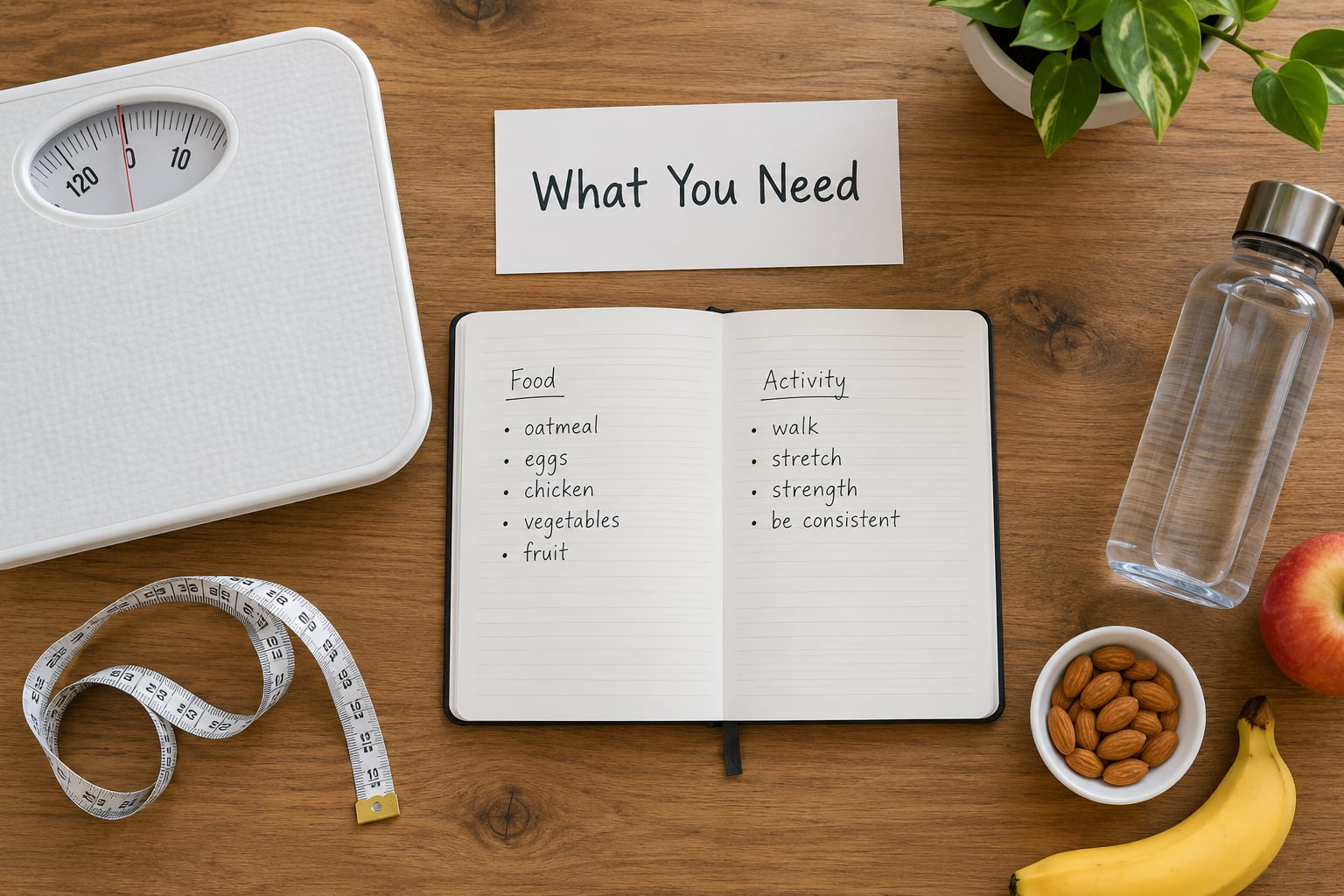
Gather six things before you pick a number. Most of them take ten minutes, and doing them in order saves you from choosing a goal your week cannot hold.
- A starting measurement. Your current weight, if you are comfortable tracking one. If the scale is not for you, use a waist measurement, a photo in the same clothes and lighting, or the size of one specific garment.
- Health conditions and medications. Anything that affects appetite, energy, fluid balance or metabolism changes how fast the number will move.
- Your actual weekly routine. Not your best week. Shift work, a commute, three kids, a desk job — write down where the hours really go.
- What happened last time. Past attempts tell you which approach failed you and which part you could not sustain.
- How many weeks you genuinely have. Before an event, a holiday, a photo shoot, or simply how much patience you have left.
- One repeatable measurement method. One scale or one tape, same conditions each time, so your numbers stay comparable.
A phone note is enough for all of this. A food and activity record for three ordinary days is plenty to start with; it tells you what a normal day looks like before you start changing it.
Note warning signs while you are writing. Persistent fatigue, dizziness, constant hunger, hair thinning, missed periods, snoring that is new, or chest pain are not weight loss targets to work through. Those belong in a doctor’s office.
Step-by-Step: How to Set Realistic Weight Loss Goals
Six steps, in order. Each one feeds the next, and skipping the early ones is how people end up with a target that was never realistic to begin with.
1. Choose a starting point without judgment
Take one or two measurements and write them down with the date. Repeat after seven days if you want a steadier number, because a single reading tells you about water, salt, timing and digestion rather than about you.
Your starting weight is information, not a verdict. Treat it the way you would treat a bank balance at the start of a budget: a figure to plan from, not a thing to be ashamed of. People who can do that tend to keep going longer, because they are adjusting a plan instead of prosecuting themselves.
2. Set a sustainable time frame
Pick a planning window, not a deadline. Twelve weeks for a first block, or six months if you want one honest target, works better than a date-driven sprint because the window absorbs holidays, illness and bad weeks without turning them into failure.
Community conversations about weight loss repeat the same lesson: goals attached to a single event produce a fast crash and a rebound, while goals attached to a block of weeks survive contact with real life. A deadline you set is still useful for planning, just not for judging yourself.
3. Choose a cautious target
Use 5 percent of your starting weight as the first target and 10 percent as the stretch target. Both are well supported numbers, and both tend to bring measurable health benefits such as lower blood pressure and steadier blood sugar before you reach anything dramatic.
| Starting weight | 5% first target | 10% stretch target | Approximate weeks at 1-2 lb per week |
|---|---|---|---|
| 140 lb | 7 lb | 14 lb | 7-14 weeks |
| 160 lb | 8 lb | 16 lb | 8-16 weeks |
| 180 lb | 9 lb | 18 lb | 9-18 weeks |
| 200 lb | 10 lb | 20 lb | 10-20 weeks |
| 220 lb | 11 lb | 22 lb | 11-22 weeks |
| 240 lb | 12 lb | 24 lb | 12-24 weeks |
| 260 lb | 13 lb | 26 lb | 13-26 weeks |
| 280 lb | 14 lb | 28 lb | 14-28 weeks |
Body mass index is a rough screen and nothing more, so do not treat a number as a verdict either. Waist circumference and waist-to-hip ratio tell you more about risk than BMI does, and at the end of a long loss the waist usually moves while the scale sits still.
Talk to a clinician before setting a target if you have diabetes, hypertension, kidney disease, a thyroid condition, a pregnancy or postpartum goal, a history of eating disorders, or you are taking weight loss medication. A weekly rate that works without medication is not the rate that applies on it.
4. Turn the target into weekly actions
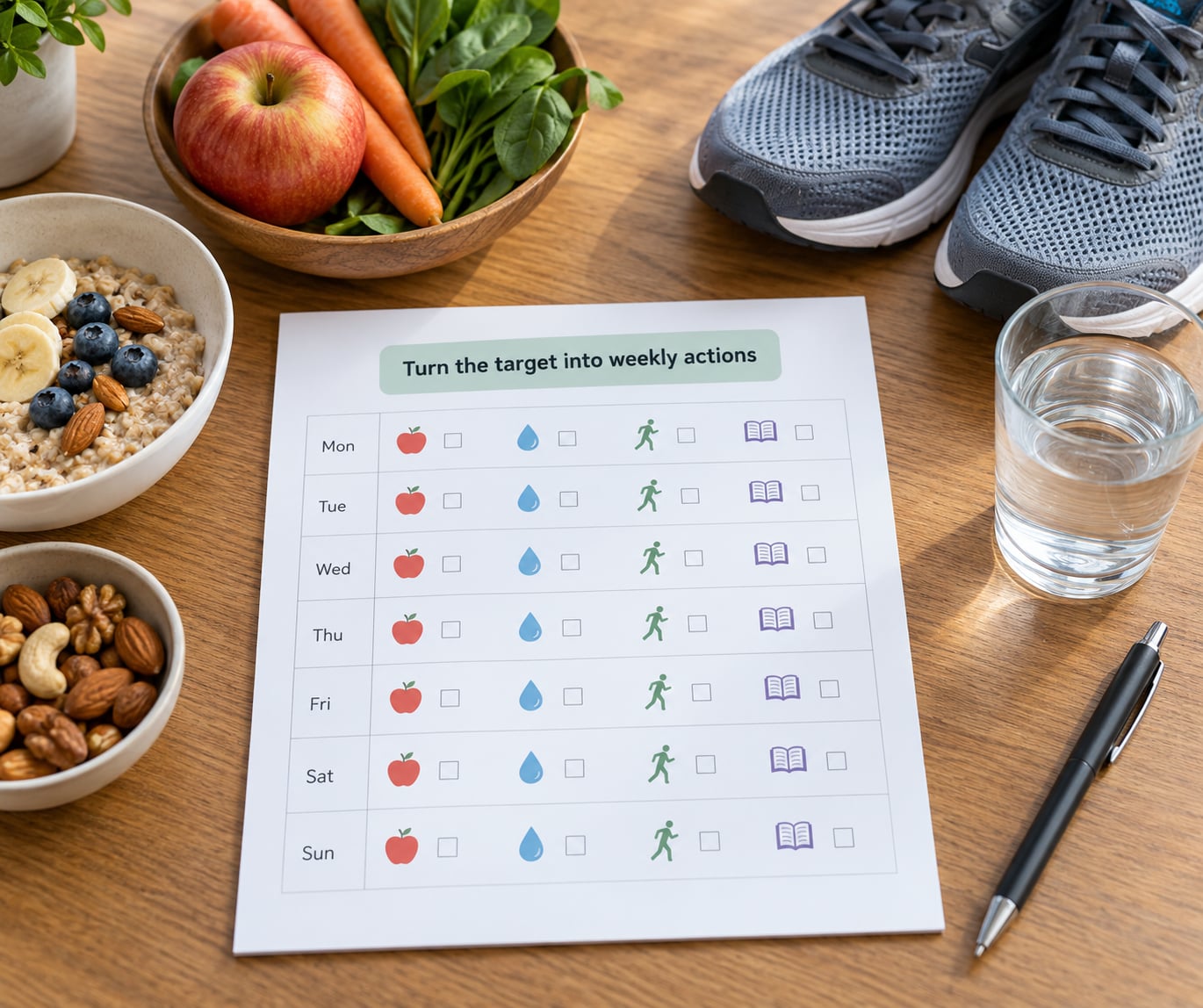
An outcome goal is the number on the scale. A process goal is what you actually do on a Tuesday: walk ten minutes after two meals, put a protein source in every meal, swap one snack for fruit, train twice this week. Process goals carry the weight, because they are the only part you control on any given day.
Keep them small enough to survive a bad schedule. A ten-minute walk beats a cancelled gym session. Water at the table before coffee does more than any rule written on a fridge.
Here is a vague goal converted into a usable one. “Lose 20 pounds” becomes: reach 5 percent of starting weight by week 12, measured as a weekly average, by walking 30 minutes on five days, eating a protein source at breakfast and dinner, and walking after dinner on Sunday.
The same target looks different for different lives. On a tight budget the actions lean on beans, eggs, frozen vegetables and walking. With a bad knee they lean on upper-body resistance work and cycling. With a night shift they lean on batch cooking and a plan that does not depend on dinner happening at a certain hour.
5. Add checkpoints and an adjustment rule
Weigh in once a week at the same time and average the readings over two to four weeks. Daily weigh-ins mostly measure salt, water and bowel movements, and plenty of people report that daily stepping made motivation worse rather than better.
At each checkpoint look at more than the scale: waist measurement, energy through the afternoon, sleep, strength in a few exercises you repeat, and how many of the process goals you actually hit.
Here is the adjustment rule: if three checkpoints in a row show no downward trend, change the plan, not the goal. Adjust one variable at a time — portion size, a food you eat automatically, daily steps, sleep hours — and give it two more weeks. A goal you rewrite every time the week goes badly is not a plan, it is a mood.
On plateaus, change the plan first and the goal last. A planned diet break or a few days at maintenance intake is what many people use to move a stalled number, and cutting intake further is the step that most often backfires with fatigue and regain.
6. Make the goal flexible enough to last
Build the disruptions in now. Travel, birthdays, illness, a heavy work week — decide in advance what the minimum version of each habit looks like, such as a five-minute walk or one simple meal, so a bad day stays a bad day instead of becoming a ruined week.
Recovery counts as part of the plan, not a break from it. Sleep, days off and an activity you enjoy are what let the plan continue through month seven, when willpower is no longer doing the work.
Finally, write the maintenance goal while you are still in the losing phase. Name the intake you will hold, the weekly activity minimum, and the weight band above which you will act rather than wait. Regain is common because almost nobody sets that goal at the moment they reach the target.
Common Mistakes
- Starting from someone else’s number. A target borrowed from an influencer has no relationship to your starting weight, your age or your build. Fix: convert every target into a percentage of your own starting weight.
- Using only the scale. Weight moves daily for reasons that have nothing to do with fat. Fix: pair it with a waist measurement and a strength or stamina check you repeat.
- Wanting a deadline. Fixed dates push people into intake levels they cannot hold. Fix: use a twelve-week window with a review at the end.
- Making every goal about restriction. Goals phrased as foods you may not eat fail faster than goals phrased as additions. Fix: aim most process goals at things you add, like steps, protein, vegetables or sleep.
- Checking too often. Daily readings average out over the week, and reacting to a single number is reacting to noise. Fix: one fixed weigh-in day, averaged over a month.
- Treating a plateau as a character flaw. Stalls are normal and usually mean the plan needs a small adjustment. Fix: after three flat checkpoints, change one variable and hold the goal steady.
- Setting a goal with no recovery plan. A plan with no rest, no flexibility and no maintenance phase has a short shelf life. Fix: name the minimum version of each habit and your maintenance target now.
- Going further on an empty tank. Cutting intake harder usually costs muscle, energy and consistency. Fix: if a target has not moved in three weeks, restore intake to maintenance and reassess before going lower.
Three habits carry most of the weight for most people who keep it off: weekly weigh-ins averaged rather than daily, about 150 minutes of moderate activity spread through the week, and a process goal short enough to keep on a bad day.
Frequently Asked Questions
How much weight can I lose realistically in 1 month?
For most adults, 4 to 8 pounds in the first month, then 1 to 2 pounds a week after that. The first month often looks faster because water and stored glycogen move first. Going much faster than that early usually means eating too little, which costs muscle, energy and consistency. To pick your own figure, take 5 percent of your starting weight and see what date it lands on.
How do I know if my weight loss goal is realistic?
Test it three ways. Does it sit within 1 to 2 pounds a week? Is it 5 to 10 percent of your own starting weight rather than a number from someone else? And can you name the weekly actions that produce it? A goal that fails any of the three is worth rewriting. A useful extra check is whether you can still do those actions on your worst week of the year.
Should I set outcome goals or process goals?
Set both, but let the process goals do the work. An outcome goal gives you a direction, such as 5 percent of starting weight in twelve weeks. Process goals describe the actions that get you there, such as walking 30 minutes on five days. Outcome goals are partly out of your control week to week, so process goals are the ones you can tick off and adjust.
What is blocking my weight loss at a plateau?
Weight usually stalls for ordinary reasons: intake creeping back up, less daily movement than you think, poor sleep, high stress, or water retention masking real progress. Check your waist measurement and strength before touching the plan. After three flat checkpoints, change one variable at a time and hold the goal steady. Cutting intake harder is the step most likely to cost you muscle and energy.
When should I ask a doctor or registered dietitian about my weight goal?
Ask before you start if you have diabetes, hypertension, kidney or thyroid conditions, are pregnant or postpartum, have a history of disordered eating, or take weight loss medication. Ask during if you hit persistent fatigue, dizziness, constant hunger, hair thinning or missed periods. A registered dietitian can also help when you need a plan that fits a budget, a shift schedule or a physical limitation.
How do I restart after breaking the plan?
Restart at the next ordinary checkpoint, not on Monday with a clean slate and a harder target. Go back to your process goals one at a time rather than to the calorie target, and drop the two that were hardest. Expect your weight to bounce for a few days as water shifts, and judge yourself on the next four-week trend instead of that first reading.
Start with one number this week: 5 percent of your starting weight, measured as a weekly average, over twelve weeks. Write the two or three actions that will get you there, book a checkpoint for two weeks from now, and treat every week before that as just the plan running.