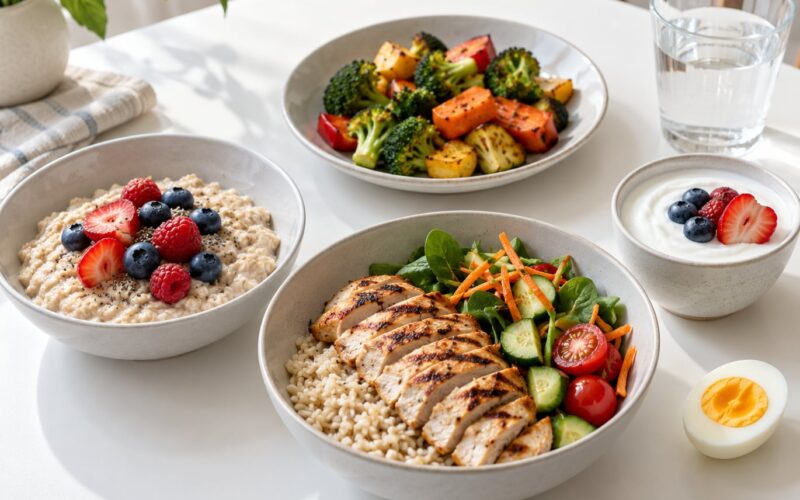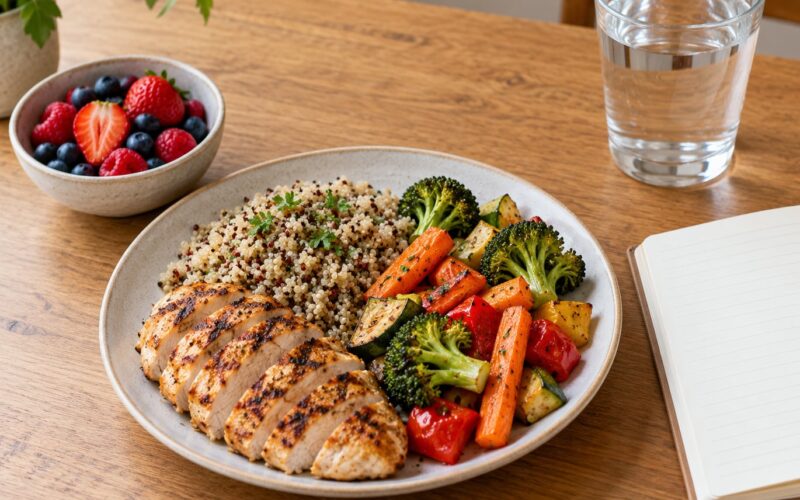
All or nothing thinking is a cognitive distortion, also called black-and-white thinking, where food and progress are judged as either perfect or ruined with nothing in between. One slice of pizza is treated as proof the whole plan failed. That verdict turns a small slip into permission to stop caring, which is why all or nothing thinking ruins diets far more often than the food itself does.
If you have eaten one thing you did not plan and immediately started planning how to compensate, you are in the middle of a very common cycle. It is not a character flaw, and it is not a lack of information. You have plenty of advice already.
Table of Contents
- Why All or Nothing Thinking Ruins Diets
- What all or nothing thinking actually is
- Where the pattern comes from
- How All or Nothing Thinking Creates a Restrict-Binge Cycle
- What Makes Flexible Eating Different
- Common Triggers of All or Nothing Dieting
- How to Stop the All or Nothing Cycle
- Simple Scripts for Flexible Eating Decisions
- When Dieting Thoughts Need Professional Support
- Frequently Asked Questions
- What is all or nothing thinking?
- What to do if I ruined my diet?
- Will 2 days of bad eating ruin my diet?
- Why do I want to start over on Monday?
- Is all or nothing thinking a sign of an eating disorder?
- Conclusion: Choose the Next Flexible Choice
Why All or Nothing Thinking Ruins Diets
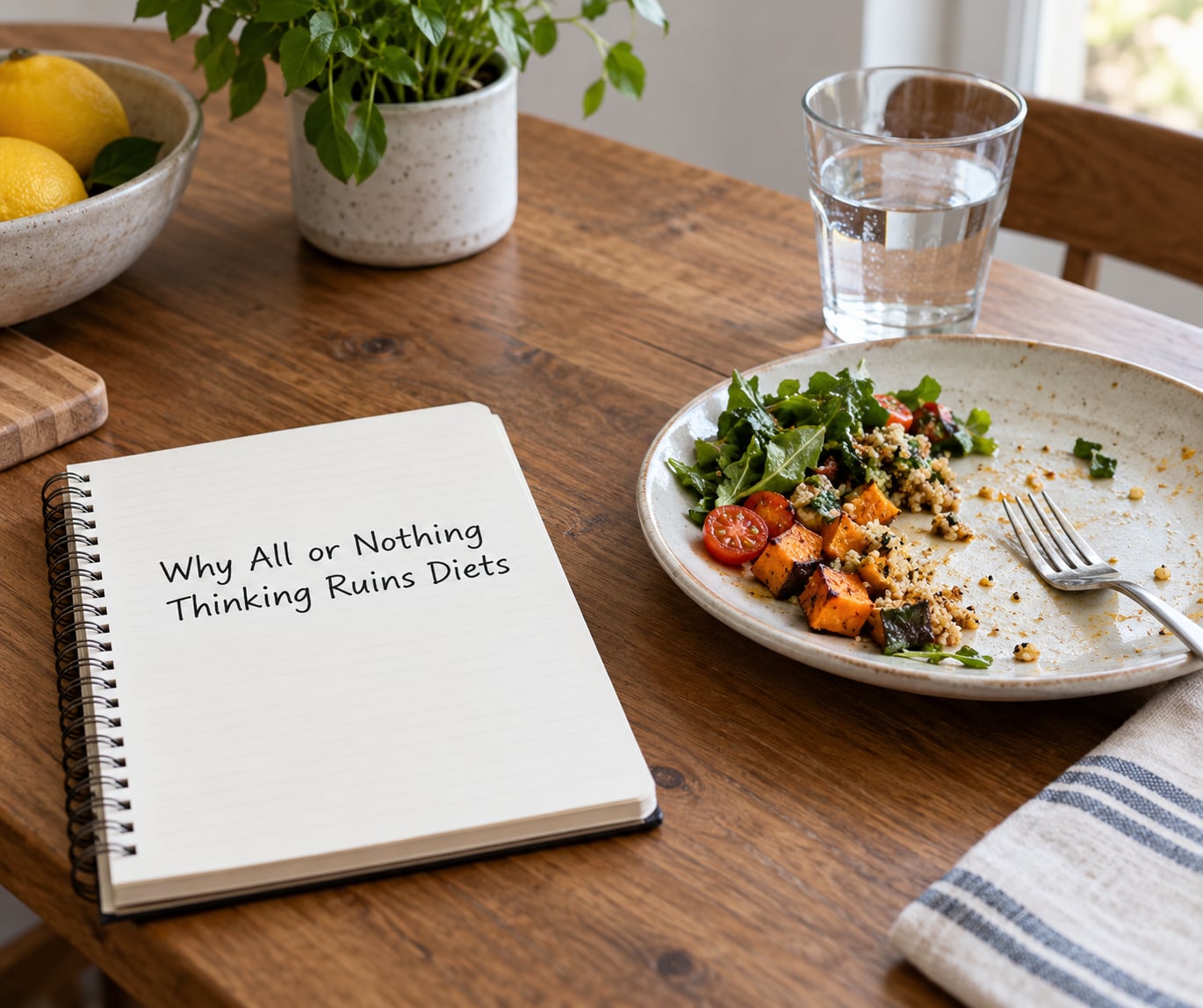
Rigid rules turn ordinary eating into a pass-or-fail test. The test has no grey area, so a single unplanned snack reads as a total loss rather than a normal Tuesday.
Once the day is declared over, the pressure that was keeping choices in check lifts. Most people describe the same thing: a calm morning, one off-plan item, and then sitting in front of the fridge at 10pm wondering how it went that fast. The slip functioned as permission, not as information.
What all or nothing thinking actually is
Psychologists describe it as dichotomous thinking. Your brain sorts an entire day, meal or week into two bins: on the right side of the plan, or ruined. There is no third bin for a mixed day, so any deviation gets promoted into evidence that you cannot do this.
A useful test is to hear your own rules out loud. “Nothing after 8pm.” “No carbs in the evening.” “I only earned lunch if I trained.” “Calories never go over 1,200 on a weekday.” These are not nutrition rules. They are pass marks, and a pass mark you can fail is a recipe for the day ending early.
Where the pattern comes from
Most rigid rules were never chosen deliberately. They are absorbed from parents and partners, from diet culture and moralised food language, from past crash diets, and from feeds full of other people’s perfect weeks.
Many people can trace the origin to a single childhood moment of being told a treat had ruined something. That story becomes a lifelong belief about food rather than a single memory about one dessert. Diet culture keeps reinforcing it by treating food as good or bad, so the label sticks.
How All or Nothing Thinking Creates a Restrict-Binge Cycle
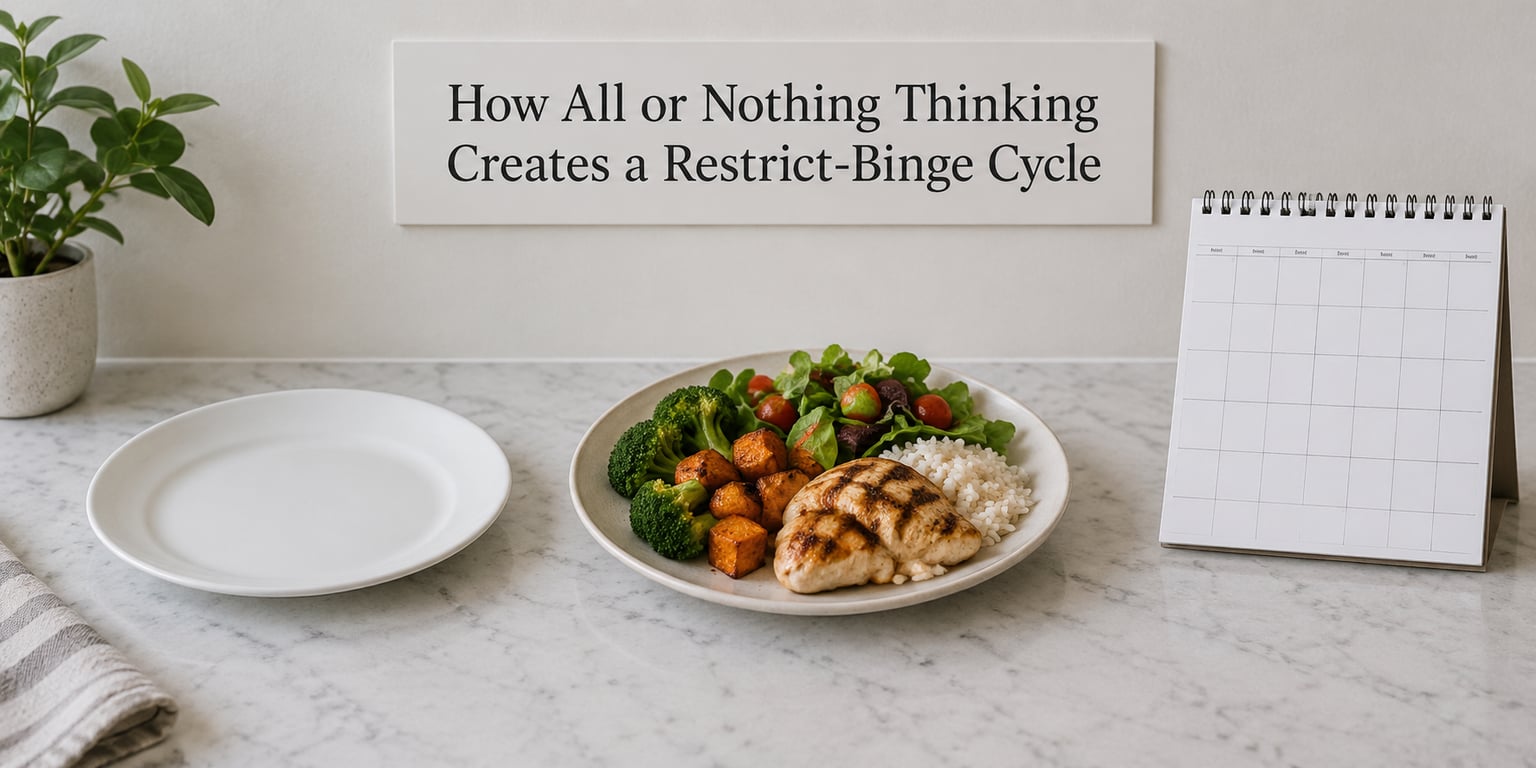
The cycle is repeatable, and once you can see the steps you can catch yourself earlier. It usually runs like this.
- The rule. You set a hard standard, often stricter than what you actually need. For a few days it works, sometimes because the enthusiasm is new.
- The slip. A meal out, a missed session, a bad night, a friend baking. Something small and ordinary that the rule did not allow.
- The verdict. “I already blew it.” This is the hinge of the whole cycle. The goal stops feeling worth protecting, self-monitoring stops, and the rest of the day stops counting.
- Rebound eating. You eat past physical hunger, usually for comfort, distraction or a feeling of relief rather than because you are starving. People often report the second day as worse than the first.
- Guilt and overcorrection. You compensate with fasting, punishing workouts or near-total restriction. On r/loseit, posters repeatedly name this overcorrection as the actual trigger for the rebound that follows.
- Restart on Monday. A new plan, a fresh start, strict again. Delay discounting makes Monday feel completely rational, because the payoff feels closer than it is.
Step three is where the damage is done. The thought “I already failed” removes the reason to keep going, and everything after it is regulation of a feeling rather than a response to hunger.
On Reddit, r/BorderlinePDisorder describes the escalation cleanly: for me if I eat two bad things I go over board and eat everything. People on r/stopdrinking describe the identical structure around alcohol, which is a useful clue. This is a general thinking pattern, not a food-only problem.
What Makes Flexible Eating Different
Flexible eating does not mean doing anything you want. It means making decisions without a verdict attached, and judging a week by its pattern rather than by its worst meal.
| Area | Rigid dietary restraint | Flexible dietary restraint |
|---|---|---|
| Inner voice | Judges each choice as good or bad | Curious about each choice |
| Rules | Many hard rules, any breach ends the day | A few anchors, room to adjust |
| After a slip | Abandons the plan or overcorrects | Returns to the next meal unchanged |
| Standard of success | Perfect compliance | Repeatable actions over time |
| Long-term result | Weight tends to creep back | Better maintenance and less distress |
Three differences do most of the work. The first is that a slip becomes information rather than proof. The second is that a mixed day still counts as a day you fed yourself. The third is that flexible plans survive contact with real life, because they were built to bend.
People who work on this with therapists often use cognitive behavioural therapy, which treats the thought pattern as the target rather than the plan. The goal is psychological flexibility: holding a goal and holding your humanity at the same time.
Common Triggers of All or Nothing Dieting
Triggers are predictable once you name them. Most people recognise themselves in at least four.
- A missed number. Hitting a calorie, step or weigh-in target marks the whole day as broken.
- Social pressure. Someone comments on what you are eating, or the only options at an event are things your plan excludes.
- Travel and disruption. Flights, shift work, hotels and eating out turn a careful plan impossible within a day.
- Stress, poor sleep and PMS. Fatigue and stress reduce your capacity for decisions, and the rigid plan collapses first because it was never built to be flexible.
- Boredom. With no hunger and no plan, eating becomes the default activity.
- Good and bad labels. Once food carries a moral weight, eating becomes an argument you are having with yourself.
- Misreading a plateau. A couple of weeks without movement on the scale gets treated as proof the approach failed, rather than as ordinary variation.
- Restarting rituals. Waiting for Monday or the first of the month makes the start feel clean, and the waiting itself becomes the pattern.
That last one matters more than people expect. Delay discounting describes how heavily we discount a reward that sits far in the future. A diet that starts next Monday feels free, which is exactly why it gets started repeatedly and abandoned repeatedly.
The pattern also spreads. The same black-and-white logic tends to drive spending, sleep, screen time and exercise, and forums often mention this as oddly validating. If you quit a diet entirely after one mistake, you probably do the same with a savings goal or a training streak.
How to Stop the All or Nothing Cycle
Breaking the cycle means removing the decision from the moment of greatest pressure. These steps work because each one is mechanical rather than motivational.
- Find the rule underneath the slip. Write down the rule that was broken. Then ask where it came from and who wrote it. Rules you did not choose are the easiest ones to renegotiate.
- Lower the stakes. Swap the daily target for a weekly one. Four days that look like your plan out of seven is a good week, not a failed one.
- Use a neutral response after a slip. Say something factual: that happened, this is what happens next, the next meal is at seven. Nothing about character, nothing about the week.
- Protect the next meal. Not a punishment meal, not a compensation meal, just the next ordinary meal. That single rule stops the slip from becoming a whole day.
- Build anchors instead of rules. A few repeatable things, such as a protein source at each meal, a planned snack before the hungry evening, and a short list of low-effort dinners, hold better than a long list of prohibitions.
- Track repeatable actions, not daily perfection. A tick for each anchor you hit builds a record of reliability rather than a record of failure.
- Skip the compensation plan. No punishing workouts, no fasting to make up for a meal. Overcorrection is what turns one slip into two.
- Ask what the food was doing. Comfort, stimulation, transition, avoidance, boredom. Naming the job usually reveals a different solution, and one that does not involve earning or deserving food.
The version of this that people find most useful is often the smallest: not having to be perfect, just doing your better. Forum posters describe that reframe as the single most repeated breakthrough in recovery threads.
Simple Scripts for Flexible Eating Decisions
Have the sentence ready in advance. People who keep a short phrase written somewhere report fewer rebound evenings than people who plan to think of something clever at 10pm.
After overeating: “I ate more than I planned, and I am still going to eat tomorrow. Nothing is ruined.” Then stop talking about it for the evening.
After missing a meal: “One missed meal is a scheduling problem, not a character flaw. I eat at the next opportunity and I do not make it up by skipping food.”
At a social event: “I can enjoy this and still eat normally tomorrow.” Pick the thing you actually want, sit down, take your time, and stop negotiating with yourself mid-plate.
When the plan does not fit: “The plan is wrong, not me. I adjust the plan.” This is the reframe that carries the most weight, because it moves the blame onto the thing that can change.
When someone comments on your eating: “I am fine, thanks.” Most comments are noise, and explaining your plan only invites a debate you did not ask for.
When you want to restart on Monday: “I start at the next meal, not on a future date.” Starting soon is easier to sustain than starting perfectly.
When Dieting Thoughts Need Professional Support
Occasional slip guilt is common and usually manageable on your own. Some patterns are a different matter and deserve a real conversation with someone qualified.
Consider contacting a doctor or a registered dietitian if eating thoughts take up most of the day, if you restrict to the point of fainting, dizziness or feeling cold all the time, if you experience episodes of eating large amounts with a loss of control, if your weight changes rapidly in either direction, if food rules are becoming increasingly strict, or if eating causes intense distress or fear.
Binge eating disorder and other eating disorders are treatable conditions, not failures of willpower. Resources from national eating disorder organisations offer confidential information and referral routes, and in the UK, beat can point you to local services.
This article is general information about thinking patterns, not medical or dietetic advice. If any of the above sounds familiar, book an appointment and mention the cycle by name, because naming it is often the moment it starts to change.
Frequently Asked Questions
What is all or nothing thinking?
All or nothing thinking is a cognitive distortion, also called black-and-white or dichotomous thinking, where food, meals or progress are judged as either perfect or ruined with nothing in between. It shows up as rigid food rules, all-or-nothing self-talk and the belief that a single slip has already made the whole effort pointless.
What to do if I ruined my diet?
Say something neutral out loud, such as that happened and the next meal is at seven, then eat the next ordinary meal without compensation. Do not fast, skip meals or punish yourself afterwards, because overcorrection is what usually turns one slip into a rebound. Most importantly, do not end the day: a slip is one meal, not a failed plan.
Will 2 days of bad eating ruin my diet?
No. Two off-plan days do not erase the rest of the week, and they have far less effect on progress than people fear at the time. What does real damage is what follows: skipping meals to compensate, punishing workouts, and quitting entirely. The most common reason a diet fails is the response to a bad patch, not the bad patch itself.
Why do I want to start over on Monday?
Delay discounting describes how heavily we discount a reward that sits far in the future, so starting next Monday feels free while its true cost is invisible. Waiting for a clean date also lets the restart carry moral weight, which makes the first slip feel like the end of something. Starting at the next meal is harder psychologically but far more reliable.
Is all or nothing thinking a sign of an eating disorder?
It is not a diagnosis on its own, and it appears in many people who are not unwell. But when it comes with rigid food rules, increasing restriction, fainting or dizziness, loss-of-control eating episodes, or intense distress about food, it is worth raising with a doctor or registered dietitian. Binge eating disorder and other conditions are treatable when they are identified early.
Conclusion: Choose the Next Flexible Choice
All or nothing thinking ruins diets because it makes eating a test, and a test you can fail is one you will eventually abandon. Flexibility is not a softer version of discipline. It is the version that survives an ordinary week.
Start with one thing. Notice the rule you are breaking most often, decide where it came from, and drop the good and bad label on it. Then pick a single anchor for the next meal, eat it, and leave the rest of the day open.
Progress, not perfection, updated for 2026.