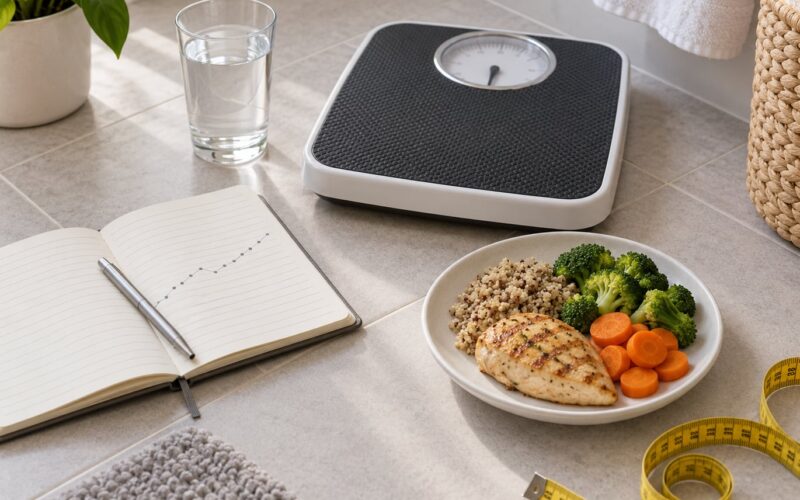
To maintain weight loss long term, keep three things steady: a consistent eating pattern with enough protein, a daily movement habit you would keep even on a bad week, and a regular weigh-in that shows you the weekly trend instead of one noisy morning reading. That is the short version. The rest is detail, and the detail matters because maintenance is where most regain actually happens.
Here is the uncomfortable part first. Losing weight is the easier half. People who shed a meaningful amount tend to give back roughly a third to half of it inside a year unless something changes after the last pound comes off, and the six months after reaching a goal weight is usually when the habits quietly fall apart. People call it a plateau. Most of the time it is simply the diet ending while the appetite stays.
What follows is a maintenance plan you can run without a coach standing over you. It is built around boring consistency rather than intensity, which is also what the research on long-term success keeps pointing at.
Table of Contents
- What You Need
- Step-by-Step: How to Maintain Weight Loss Long Term
- 1. Set a realistic maintenance range
- 2. Keep your eating routine consistent, not perfect
- 3. Protect protein, fiber, and satisfying meals
- 4. Continue regular movement
- 5. Monitor trends instead of daily numbers
- 6. Plan for setbacks before they happen
- Common Mistakes
- Frequently Asked Questions
- How long does it take to stabilize weight after losing weight?
- How many calories should I eat to maintain my weight after a diet?
- Do I need to count calories forever to keep weight off?
- Should I weigh myself every day or once a week?
- How much exercise do I need per week to maintain weight loss?
- When should I see a doctor or dietitian about weight regain?
- Conclusion
What You Need

Six things make maintenance workable. None of them are expensive and none require a membership.
- A routine that survives an ordinary Tuesday. A plan built around 5:30am workouts and Sunday meal prep fails the first week someone works late.
- An honest way to track. A scale you step on, a weekly average, or a measuring tape. Pick one you will still use in month eight.
- Food you actually like. Maintenance is a years-long project, so the meal plan has to include foods you would eat even if nobody was watching.
- Somewhere to move. Walking counts. It is the cheapest activity that reliably burns calories without triggering an injury.
- A written setback plan. Decide now what you will do during a holiday week, a business trip or a month of poor sleep, because you will not decide well in the moment.
- Support from a healthcare professional when you need it. A registered dietitian is useful for individual plans, and a doctor matters if you have a medical condition, take weight-affecting medication, or are pregnant or breastfeeding.
You do not need all six perfectly. You need the first two and a version of the rest.
Step-by-Step: How to Maintain Weight Loss Long Term
Six steps, in order. The sequence matters because the early ones protect your muscle and your patience, which are the two things that cause most early regains.
1. Set a realistic maintenance range
Maintenance does not mean the same number every morning. A body that has just lost weight will swing by a few pounds across a week from water, salt, bowel habits and sleep, and none of that is fat. Decide on a band instead of a single figure, and base it on your own history rather than on a number from a chart.
A practical way to set it: look back at the weeks you were already eating at maintenance intake and moving regularly. Take the average of those weeks. Add five pounds on either side and call that your zone. If your weekly average sits inside it, nothing is happening, regardless of what the scale said on Tuesday.
How to tell it is working: three consecutive weekly averages inside your zone.
2. Keep your eating routine consistent, not perfect
The meal pattern that got you down is the one most likely to keep you there. If you ate breakfast every day, kept protein high and stopped eating straight out of the pantry, keep those three things. Perfection is not the target; repetition is.
Consistency means weekends look roughly like weekdays. The most common failure pattern I hear about is a restrained week followed by a loose weekend, which averages out to no deficit at all and a lot of frustration. One indulgent meal is a meal. Two days of it is a pattern.
Travel and celebrations get a plan in advance, not a decision in the moment. Eat normally before you go out, pick one thing you actually enjoy at the meal, and go back to your normal pattern the next morning without commentary.
How to tell it is working: your weekly average holds steady through social weeks, not just quiet ones.
3. Protect protein, fiber, and satisfying meals
Appetite is the reason most maintenance plans collapse, and appetite is mostly a protein and volume problem. Aim for a serving of protein at each meal, and for roughly 25 to 30 grams of fiber a day from vegetables, fruit, beans, oats and whole grains.
Fiber does quiet work: it adds bulk to a meal, slows digestion and feeds the gut bacteria that influence fullness. Whole foods also travel better than pastries when your day goes sideways, which is not a small thing at month nine.
Watch liquid calories. Beverages are the easiest hundreds in a day to lose track of because they arrive without a plate, and a large latte or a weeknight glass or two can quietly undo a careful meal. Not every week. Enough weeks.
If you tracked calories during the loss phase, most people need to add some back as they transition, and doing it gradually rather than all at once keeps the adjustment uneventful. If you never counted, portion-based habits do the same job: protein first, vegetables second, measured starch last.
How to tell it is working: three hours after a meal you are not thinking about food.
4. Continue regular movement
Mainstream guidance puts adults at 150 to 250 minutes of moderate activity a week, with muscle-strengthening work on two or three days. For maintenance that is a floor, not a ceiling, and the people who hold their weight down tend to sit well above it.
Strength training earns its place because muscle is what burns calories while you sleep. It is also the strongest lever against the slow metabolic decline that comes with weight loss. Walking earns its place because it adds up quietly, needs no recovery window and survives an injury elsewhere.
Steps are the easiest thing to add. Most maintenance advice lands somewhere between 10,000 and 15,000 a day for people who lost a large amount, and the honest version is that your personal baseline depends on your size and how much you lost. If you lost 80 pounds, your current step count probably needs to be higher than it was when you weighed 200. That is non-exercise activity thermogenesis doing its job, and it declines as you get smaller unless you replace it.
How to tell it is working: your walking volume and your two strength sessions are still happening in an average week, not a perfect one.
5. Monitor trends instead of daily numbers
Weigh in the morning, after using the bathroom, before eating, on the same scale. Write the number down. Then stop looking at it until next week.
At the end of the week, add the seven numbers and divide by seven. That average is your real weight. A single reading is mostly noise, and treating noise as information is how people end up cutting carbs on a Tuesday because of water they gained overnight.
One number worth knowing: a fasted morning weight that is 3 to 5 percent above your goal, or above your range for more than a week, is the usual trigger to act. Changes inside that band get watched, not fought.
Some people get obsessive with the scale, and that is its own problem. If daily weighing makes you anxious or sends you into restriction spirals, weigh monthly and put the focus on how your clothes fit, your strength in the gym, and your walking volume.
How to tell it is working: you have a trend line, not a mood.
6. Plan for setbacks before they happen
Setbacks are not failures, they are inputs. Decide in advance, while you are calm, what each common scenario gets.
- Travel. Keep one anchor meal a day. Walk instead of calling a ride. Eat protein at the first available opportunity rather than saving it for a restaurant at 9pm.
- Illness. Weight drops during illness is not fat loss. Eat, hydrate, wait until you are well, and do not step on the scale for two weeks.
- Stress. Cortisol and poor sleep both raise appetite and cravings for quick energy. Protect sleep first; a short walk and a consistent wake time do more than an hour of willpower at 10pm.
- Holidays. Plan one meal you enjoy and two you keep normal. Skip the “start Monday” language.
- Gradual regain. One to two pounds above your range over a couple of weeks is normal variance. Three to five is a signal to tighten portions and add activity. More than that, sustained, means something structural changed and needs a plan rather than a push.
Know when to ask for help. If you regained a substantial amount, feel out of breath climbing stairs, or notice your weight drifting steadily for months with no explanation, see a doctor. A registered dietitian can build a plan around your actual meals, your schedule and your history, which is worth more than anything general.
How to tell it is working: you can describe what you will do in any of those scenarios without improvising.
Common Mistakes
Going back to your old eating pattern the day you hit goal weight. Maintenance is a different phase with its own intake, and treating it as a reward reopens the deficit. Add calories gradually and treat the new level as the real starting point.
Crash dieting after a regain. A sharp cut usually produces another sharp rebound, and the cycle is what creates yo-yo dieting. A modest, sustained adjustment beats an aggressive reset every time.
Skipping meals to “save” calories. It works on paper and fails in practice, because the next meal is larger and the pattern reads as failure in your own head. Three regular meals, each with protein, is easier to repeat.
Overcompensating after a week that went badly. The fix for one bad week is the next normal week, not a punishment week. This is where most all-or-nothing cycles start.
Relying on exercise alone. Movement matters, but it burns fewer calories than people expect and it does not offset a food surplus unless it is genuinely large. Eating has to be part of it.
Treating one fluctuation as a collapse. A 1.5 pound jump overnight means water. Acting on it is how a stable week turns into a bad month.
Waiting for motivation. Motivation runs out in weeks. Maintenance is built from habits small enough that you do them tired, on purpose, without a good mood.
Letting the maintenance phase run indefinitely without a check-in. Every three months, look at your trend, your strength and your sleep. Small corrections early are cheap.
Frequently Asked Questions
How long does it take to stabilize weight after losing weight?
Most people find their weight settles into a stable range within about six months of reaching their goal. The first few weeks are the least stable, because water and glycogen are still shifting. Treat the first month as adjustment rather than judgment, and judge progress on weekly averages over a quarter rather than on daily readings.
How many calories should I eat to maintain my weight after a diet?
There is no single number, because your expenditure depends on your size, your muscle mass and how active you are. Most people need more calories than they ate while losing, but fewer than they ate before, and the transition works best when it is gradual rather than sudden. A registered dietitian can estimate this from your own data far more accurately than a calculator.
Do I need to count calories forever to keep weight off?
No. Lifelong calorie counting is one option and it works, but it is not required. Plenty of people maintain using protein at each meal, regular meals, limit on liquid calories, and a weekly weigh-in that catches a few-pound drift early. The people who keep counting tend to be the ones who like the certainty it gives them, which is a perfectly good reason.
Should I weigh myself every day or once a week?
Daily weighing works well for some people, but only if you average the numbers and look at the weekly line rather than the individual readings. Once a week on the same morning, under the same conditions, is enough for almost everyone and causes far less anxiety. If weighing daily makes you restrict or feel worse, weigh monthly and track other markers instead.
How much exercise do I need per week to maintain weight loss?
Start from mainstream guidance of 150 to 250 minutes of moderate activity weekly plus muscle-strengthening work two or three days a week. Most people who maintain a large loss need more than that, because a smaller body burns fewer calories at rest. Strength training matters most for keeping muscle, and daily walking is the easiest activity to keep doing for years.
When should I see a doctor or dietitian about weight regain?
See a doctor if regain is rapid and unexplained, if you feel short of breath or unusually tired climbing stairs, or if you have a medical condition or take medication that affects weight. A registered dietitian is worthwhile whenever the generic advice stops fitting, including during the transition away from weight loss medication. Both can be far more useful than another round of restriction.
Conclusion
Keeping weight off is less about willpower and more about a handful of habits you repeat while tired: protein at each meal, a realistic movement routine that includes strength work, a weekly average instead of a daily verdict, and a plan for the weeks when everything goes sideways. Appetite rises and calorie burn falls after you lose weight, so maintenance is an active response to that, not a passive state.
Pick one thing to start this week. I would pick the weekly average, because it costs nothing and it tells you everything the rest of the plan depends on. Weigh in the same morning seven times, average the numbers, and see where you actually are in 2026. Once you have that line, the other five steps get much easier to judge.