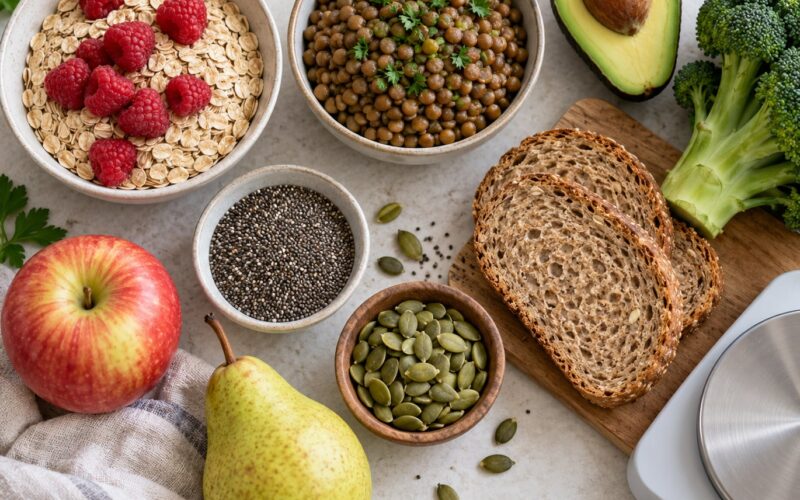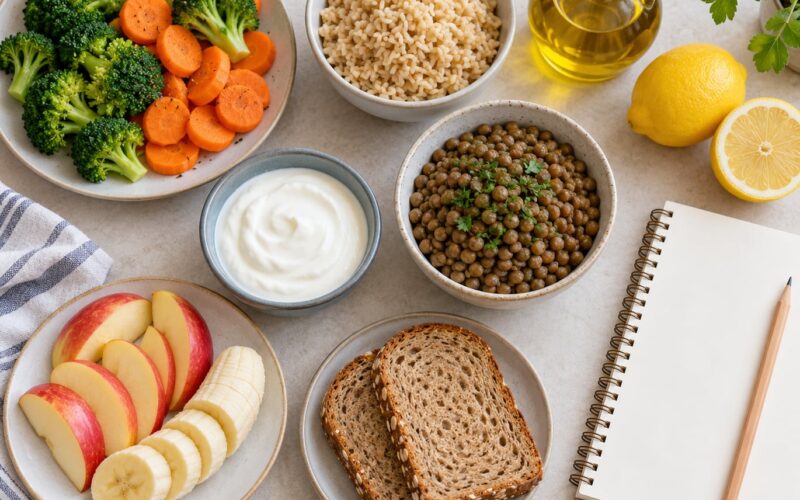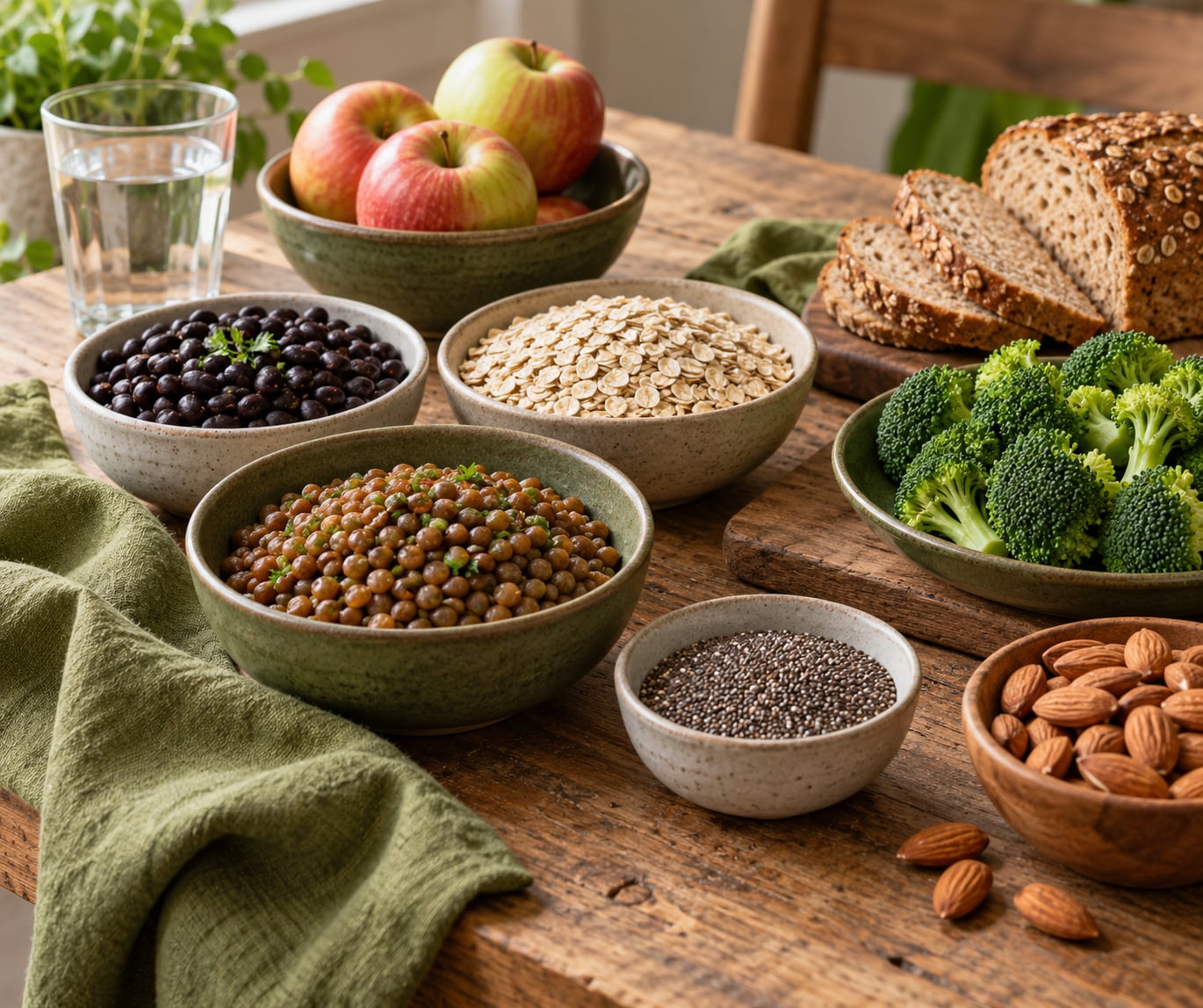
Adults need roughly 25 to 38 grams of dietary fiber a day, and the easiest way to hit that number is to add one high-fiber food to each meal rather than overhaul everything at once. If you want to know how to eat more fiber every day without wrecking your digestion, the method is simple: swap refined staples for whole versions, add beans or seeds where they fit, and ramp up slowly over two weeks.
Updated for 2026. This is general nutrition information, not medical advice.
It helps to know why you’re doing it. Fiber adds bulk and holds water in the intestine, which keeps things regular, and some types ferment into short-chain fatty acids that feed gut bacteria and help steady blood sugar and cholesterol. The American Institute for Cancer Research links each extra 10 grams of daily fiber to about 7% lower colorectal cancer risk.
Table of Contents
- What You Need
- Step-by-Step
- Check Your Current Fiber Intake
- Choose High-Fiber Foods You Already Enjoy
- Build a How to Eat More Fiber Every Day Routine
- Increase Gradually and Drink Enough Fluids
- Read Labels and Watch Added Sugars
- Make Fiber-Friendly Substitutions
- Common Mistakes
- Frequently Asked Questions
- How much fiber should an adult eat each day?
- Should I take a fiber supplement or get fiber from food?
- Can eating more fiber help with constipation?
- Does a high-fiber diet help with weight loss?
- Why does eating more fiber cause gas or bloating?
- Start With One Small Change
What You Need
Nothing special. No special equipment, no expensive powders, no meal-prep containers. What you need is a working idea of which four food groups carry fiber, and about fifteen minutes of attention a week.
Those four groups do nearly all the work: beans and lentils, whole grains, vegetables and fruit with their skins on, and nuts and seeds. Animal products contain no fiber at all, so the change is really about shifting the share of your plate toward plant foods.
Two optional tools help. First, get in the habit of glancing at the fiber line on a nutrition label; the shortcuts are covered in step five. Second, a rough intake note in your phone is useful for a fortnight, whether that’s a notes app or a paper list, just to see the running total.
That’s the whole kit. Skip tracking apps unless you enjoy tracking.
Step-by-Step
Check Your Current Fiber Intake
Most people start somewhere between 12 and 18 grams a day, which is why the target feels impossible when you first see the number. Roughly 95% of US adults fall short of recommended intake, and the UK average sits near 20 grams against a 30 gram guideline.
You don’t need a precise figure, so skip the calorie counting mindset entirely. Pick three things you ate yesterday, look up the fiber per serving on the box or the brand’s site, and multiply by how much you actually ate. That gives you a rough baseline in about five minutes.
Write the number down. It’s the only time you really need it, and it makes the next step measurable.
Choose High-Fiber Foods You Already Enjoy
Work with foods you already buy, not an idealized list of foods you’ve never cooked. Fiber is dense in a few places, and those are the places to spend your attention.
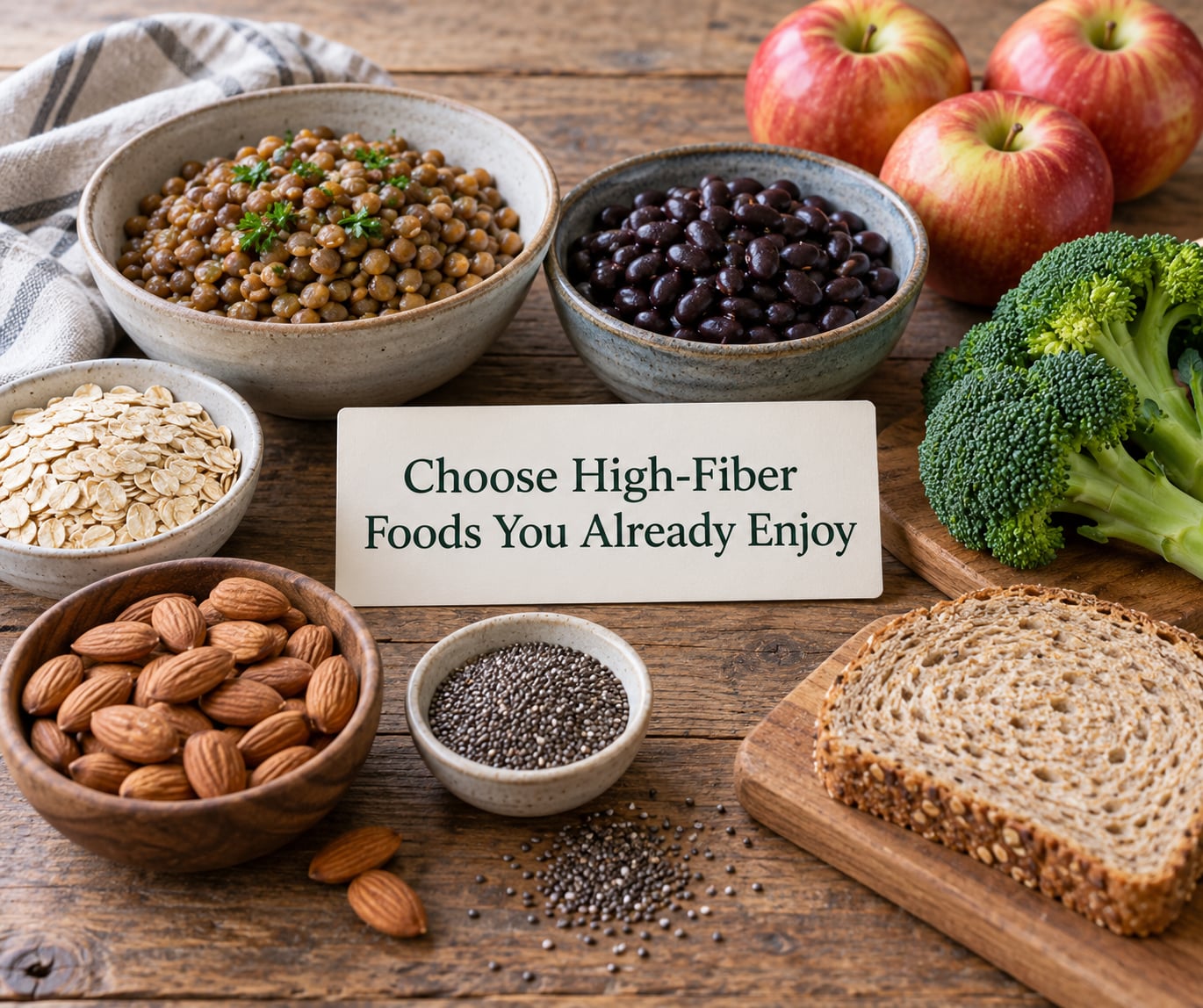
Here is a realistic serving list. The numbers are typical values for a normal portion, not laboratory measurements, so treat them as close enough to plan with.
| Food | Typical serving | Fiber |
|---|---|---|
| Chickpeas, cooked | 1 cup | 12 g |
| Lentils, cooked | 1 cup | 16 g |
| Black beans, cooked | 1 cup | 15 g |
| Kidney beans, cooked | 1 cup | 13 g |
| White beans, cooked | 1 cup | 11 g |
| Split pea soup | 1 cup | 10 g |
| Oats, rolled, dry | half cup | 4 g |
| Wheat bran | quarter cup | 3 g |
| Whole wheat bread | 2 slices | 4 g |
| Brown rice, cooked | 1 cup | 3.5 g |
| Quinoa, cooked | 1 cup | 5 g |
| Barley, cooked | 1 cup | 6 g |
| Raspberries | 1 cup | 8 g |
| Pear with skin | 1 medium | 6 g |
| Apple with skin | 1 medium | 4 g |
| Kiwi | 2 medium | 6 g |
| Avocado | 1 whole | 10 g |
| Broccoli, cooked | 1 cup | 5 g |
| Artichoke hearts | 1 cup | 7 g |
| Almonds | 1 ounce | 3.5 g |
| Chia seeds | 2 tablespoons | 5 g |
| Ground flaxseed | 2 tablespoons | 4 g |
| Popcorn, air popped | 3 cups | 3.5 g |
| Whole grain toast | 2 slices | 4 g |
Two patterns jump out. Pulses are the fastest route by a wide margin, and fruit and vegetables are the trap, because most standard servings deliver only 3 to 5 grams. That’s the reason people get stuck: they do everything “right” and still land at 20 grams.
Build a How to Eat More Fiber Every Day Routine
One fiber source at each meal is enough to move the needle. Breakfast gets oats, bran, chia or whole-grain toast. Lunch and dinner get a bean or lentil component, a whole grain, or both. The snack gets fruit, nuts or roasted chickpeas.
Here is a full day that lands around 30 grams without anything exotic.
| Meal | What you eat | Fiber | Running total |
|---|---|---|---|
| Breakfast | Half cup rolled oats with 2 tablespoons chia, 1 sliced pear and a handful of almonds | 14 g | 14 g |
| Lunch | Two slices whole wheat toast, half a cup of chickpeas, tomato and lettuce | 11 g | 25 g |
| Snack | One apple with skin | 4 g | 29 g |
| Dinner | One cup of lentil soup, one cup of broccoli, half a cup of brown rice | 13 g | 42 g |
A day like that overshoots, which is fine for an early demonstration. Trim the chia or drop the rice and you land in the 30 to 35 gram range, right in the middle of the recommendation.
Repeatability matters more than variety at the start. The same four meals every day for two weeks will do more for you than a varied plan you abandon by Thursday.
Increase Gradually and Drink Enough Fluids
This is the step that decides whether you keep the habit. Fiber works by absorbing water, so more fiber means more fluid moving through the gut. Add fiber and liquid together, or you’ll feel worse than before you started.
A simple ramp looks like this. In week one, swap one refined item for a whole version and add one serving of fruit or vegetables. In week two, add one bean serving and one whole grain. In week three, add nuts, seeds or a second snack.
Aim for water spread through the day rather than one large glass, and add a bit more than usual while you ramp up. Activity helps too, since fiber plus movement is what keeps things moving.
If you bloat, back off by one serving for three or four days and hold there. Then try again from the same level. Gas and cramping usually come from going too fast, not from fiber being bad for you.
Read Labels and Watch Added Sugars
Two shortcuts make shopping fast. A product with 5 grams or more of fiber per serving is a reasonable US target, and in the UK a food with 6 grams or more per 100 grams counts as high fiber. Also read the ingredients list: if the first grain is whole, the product is doing what you think.
Then check two more lines. A high-fiber granola bar can carry 8 grams of fiber and a short list of added sugars with it, and some bran cereals do the same. Fiber plus a lot of added sugar is a trade, not a win.
Watch saturated fat too, since some high-fiber crackers and granola products bring a fair amount along. You have to eat the whole package to get the label’s fiber number, so check the servings too.
Make Fiber-Friendly Substitutions
Swaps do most of the work because they don’t add any extra cooking or planning. Most of these land between 2 and 5 extra grams each.
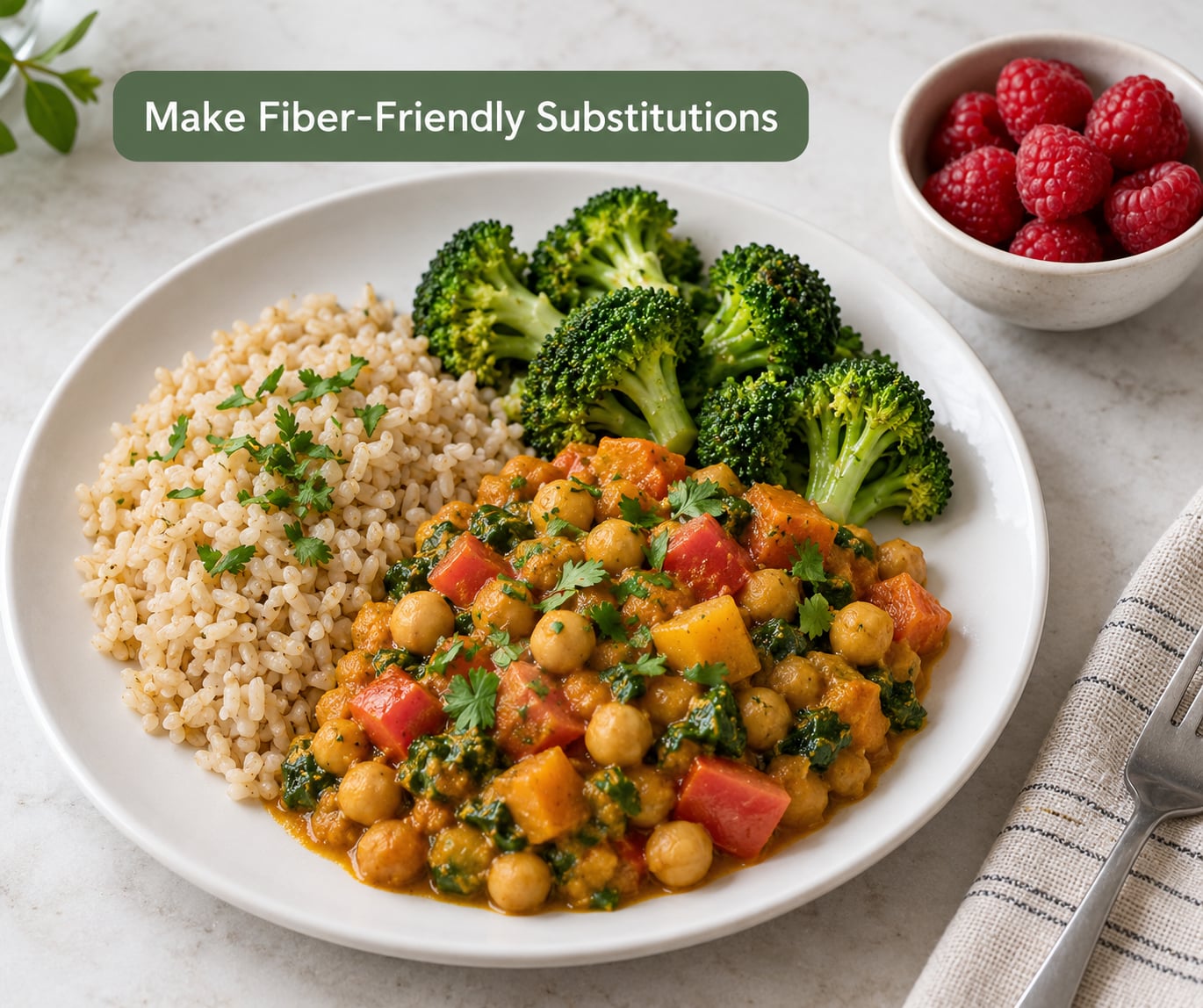
- White bread to whole wheat bread, adding about 2 grams per two slices.
- White rice to brown rice, quinoa or barley, adding about 2 grams per cup.
- Refined breakfast cereal to bran or oat cereal, adding 3 to 4 grams per bowl.
- Salted crackers to whole-grain crackers or oatcakes with hummus.
- Peeled apple or potato to the same item with the skin on.
- Butter-based pastry to a whole-grain muffin or a slice of bran bread.
- Chips to air-popped popcorn, adding about 3.5 grams per three cups.
- Candy to a handful of nuts, or roasted chickpeas for a portable option.
- Smoothie with juice to a smoothie blended with whole fruit and a tablespoon of ground flaxseed.
- Half the vegetables on the plate to a full cup, and add beans as the protein.
- Salad with no dressing to salad with chickpeas or lentils folded through.
- Rice cakes with butter to whole-grain toast with nut butter.
One clarification for beginners: fiber comes in two main types. Soluble fiber dissolves in water and sits in oats, beans, apples and citrus; it tends to help with cholesterol and blood sugar. Insoluble fiber does not dissolve and sits in whole grains, nuts, seeds and vegetable skins; it adds bulk and supports regularity. Most foods contain both, and you do not need to track them separately.
If you’re eating low-carb or high-protein, fiber still fits. Chia and flax, broccoli, asparagus, nuts, seeds and berries are low in net carbs and high in fiber, and beans work well alongside eggs, fish or poultry instead of bread or rice. On keto specifically, the vegetable and nut sources carry most of the load.
Common Mistakes
Starting at the finished target. Going from 15 grams to 35 grams on day one is the single most common reason people quit within a week. The fix is one extra serving a week.
Treating supplements as the answer. Psyllium and similar powders are a reasonable bridge for a few weeks, but they don’t carry the vitamins, minerals and phytochemicals that come with food. Use them to hold you over, not to replace the plan.
Adding fiber without adding fluid. This is where good intentions turn into cramping. Fix: an extra glass of water with each increase, spread across the day.
Picking portions you can’t sustain. A cup of dry bran is technically more fiber and practically impossible. Fix: choose portions you’d eat twice a week, then keep them there.
Assuming a high-fiber label means automatically healthy. It doesn’t. Check added sugars, saturated fat and serving size before you commit.
Two more worth naming. Don’t measure your success in days of perfection; the goal is a change you’re still making in a month. And on low-fiber days, whether that’s travel, a shift or a restaurant, just return to the next normal meal instead of writing the day off.
Frequently Asked Questions
How much fiber should an adult eat each day?
Adult women generally need about 25 grams of fiber a day and adult men about 38 grams, based on the US dietary reference intakes. The NHS uses a single 30 gram target for adults. Children’s needs are lower: roughly 15 grams for ages 2 to 5, 20 grams for ages 5 to 11 and 25 grams for ages 11 to 16. Most adults eat about half of what they should, so the gap is usually a matter of adding a few servings rather than changing everything.
Should I take a fiber supplement or get fiber from food?
Food comes first. Whole foods bring fiber along with vitamins, minerals and plant compounds a supplement does not have, and they fill you up because you have to chew them. Psyllium or methylcellulose products are useful as a short-term bridge when eating is difficult, or when a clinician has recommended them. Always drink plenty of water with them. Talk to a doctor or registered dietitian before starting a supplement, especially if you have gut symptoms.
Can eating more fiber help with constipation?
Usually yes, because fiber holds water in the bowel and adds bulk, which makes stools softer and easier to pass. Oats, beans, pears, kiwi and prunes are commonly recommended. It works best alongside fluids and regular movement, and it takes a few days of consistent intake to notice a difference. Raise it gradually rather than jumping. If constipation comes with pain, bleeding, weight loss or lasts more than a few weeks, speak to your doctor.
Does a high-fiber diet help with weight loss?
Fiber supports weight management mainly through fullness. Foods high in fiber take longer to chew and eat, and viscous types slow stomach emptying, so meals feel more satisfying on fewer calories. Many people find that higher fiber plus adequate protein makes spontaneous calorie reduction easier without counting anything. Fiber on its own is not a weight loss plan, and it works best alongside a balanced diet and regular activity rather than instead of them.
Why does eating more fiber cause gas or bloating?
Your gut bacteria ferment fiber to get energy, and the gas that produces is normal, especially when a food is new to you. Large amounts of insoluble fiber also pass through undigested and can feel uncomfortable on their own. Most of it settles within two to three weeks at a steady dose. Going slower, adding one serving every few days, drinking enough water and cooking dried beans rather than using canned ones all help.
Start With One Small Change
Pick one meal you already eat without thinking, and add a moderate portion of a fiber-rich food to it: oats instead of refined cereal, chickpeas on your usual lunch, brown rice in place of white, or a tablespoon of chia in whatever you already have for breakfast.
Drink a bit more water that day, give it four or five days, then decide whether to hold steady or add the next serving. Repeat for two weeks before stacking anything else. That is the whole method behind how to eat more fiber every day, and it works because you can keep doing it.
If you have IBS, inflammatory bowel disease, a recent surgery on your digestive tract, or ongoing pain, gas or changes in bowel habits, check with your doctor or a registered dietitian before increasing fiber. For everyone else, add the one serving.