Yes, you can usually work out when you are sore, as long as you adjust it. The short answer to how to work out when you are sore: ordinary post-exercise ache is a reason to lower the load and train something else, not a reason to skip the week. What changes the answer is the type of soreness, not the fact of it. Most people can make the call in about two minutes once they know what to look for.
Delayed onset muscle soreness, or DOMS, is the deep ache that shows up 12 to 72 hours after a session. It comes from microscopic damage to muscle fibres, mostly during the lowering phase of a movement, and it fades as the tissue repairs. That process is normal, and your body adapts to it faster the more consistently you train.
Table of Contents
- What You Need
- Step-by-Step: How to Work Out When You Are Sore
- Step 1: Identify the Type of Sore You Have
- Step 2: Check Your Symptoms and Warning Signs
- Step 3: Choose a Low-Intensity Session
- Step 4: Adjust the Workout Instead of Forcing It
- Step 5: Warm Up, Train, and Cool Down Gradually
- Step 6: Plan Your Next Workout
- Common Mistakes
- Frequently Asked Questions
- Is it a good idea to work out while sore?
- Am I weaker when I am sore?
- How long does muscle soreness last?
- Is it normal to still be sore 4 days after a workout?
- Does stretching help muscle soreness go away faster?
- What is the 3-3-3 rule for working out?
What You Need
None of this needs a gym membership or a gadget. It needs a few honest answers before you pick your session.
- Timing. When did the soreness start, and how long after the session? The gap tells you a lot.
- Your recent load. What did you do in the last three days, and was any of it new, heavier than usual, or unfamiliar?
- A way to rate it. A simple 1 to 10 scale, the one forum lifters use to decide whether to train. Ten minutes of honest rating beats a bad session.
- Somewhere to move. A flat surface, comfortable clothes, and a water bottle. A foam roller or a tennis ball helps but is optional.
- Clear stop signs. Know in advance what makes today a rest day, so the decision is made before you are mid-workout and tempted.
If you are logging your sessions anyway, a one-line note on soreness and how the next day felt is the cheapest training data you will ever keep.
Step-by-Step: How to Work Out When You Are Sore
Step 1: Identify the Type of Sore You Have
Ordinary exercise soreness is dull, spread across the belly of a muscle, and usually shows up on both sides. Sharp pain, swelling, bruising, weakness, tingling, or anything centred in a joint is a different animal and needs a different decision.
| Signal | DOMS | Strain or injury |
|---|---|---|
| Timing | 12 to 72 hours after the session | During the session, or within a few hours |
| Character | Dull, heavy, achy | Sharp, stabbing, electric |
| Location | In the muscle belly, often both sides | One spot, often a tendon, joint or the pull of a single movement |
| Swelling or bruising | No | Possible |
| Response to movement | Eases as you move, stiff at first | Worse with the movement, or it keeps you off it |
| Trajectory | Improving day by day | Plateauing or getting worse |
This is the fork in the road. If the answer is DOMS, movement is fine and usually helpful. If it looks like a strain, the movement is the problem.
Step 2: Check Your Symptoms and Warning Signs
Now rate the soreness 1 to 10 and test your range of motion. Can you get into a full squat, reach your arms overhead, or walk normally without a limp? Full movement with mild stiffness is the green light that the r/beginnerfitness crowd keeps coming back to: go train.
| Rating | What it feels like | What to do |
|---|---|---|
| 1 to 3 | Noticeable but not distracting | Train as planned |
| 4 to 6 | Stiff, movement feels heavier than normal | Drop the load 10 to 20 percent, keep your sets and reps |
| 7 to 10 | Movement hurts, or form breaks down | Do not train that group. Walk, mobility, or a full rest day |
Stop and contact a healthcare professional if you have sharp pain, swelling, a hot or bruised area, noticeably reduced range of motion, weakness you cannot explain, numbness or tingling, or pain that sits in a joint. So do the obvious one: pain that is still ramping up after several days, or that wakes you at night. Nobody can diagnose you through a screen, and I am not going to pretend otherwise.
Step 3: Choose a Low-Intensity Session
On a sore day, active recovery is the default. Twenty to thirty minutes of easy walking, a relaxed cycle, a slow swim, or gentle yoga keeps blood moving through the tissue without asking much of it.
Use the talk test: you should be able to speak in full sentences without pausing for breath. On a 1 to 10 effort scale, you are aiming for a 2 or 3. If you are gasping, you have quietly turned recovery into a second workout.
Skip anything that spikes the pain, loads the sore area heavily, or bounces you. If mobility work is your thing, keep it slow and unhurried rather than pushing into end ranges.
Step 4: Adjust the Workout Instead of Forcing It
A session does not have to be all or nothing. There are five levers, and you usually only need one or two of them.
- Lower the load by 10 to 20 percent and keep your sets and reps. Volume is what builds progress, intensity is just the tool.
- Trim the range of motion to the part of the lift that feels normal.
- Slow the tempo, especially on the way down.
- Add rest between sets, often 30 to 60 seconds more than usual.
- Switch muscle groups and come back to the sore one later.
That last one answers the question people ask most on fitness forums: I planned arms one day, legs the next, then cardio. Keep the split. Just move the sore group down the line rather than deleting the session.
| What is sore | Train this instead |
|---|---|
| Quads, glutes, hamstrings | Upper body or push day: press, row, pulldown, arms |
| Chest, shoulders, triceps | Lower body or pull day: squat, hinge, lunge, rows are fine if shoulders allow |
| Back and biceps from a heavy pull session | Legs, core, low-impact cardio |
| Everything after a hard full-body or new-exercise day | Walking, swimming, mobility, rest |
If you lift on the sore group anyway, a common protocol from experienced lifters is to run your warm-up sets and judge from there. More often than not, the ache settles once the muscle is warm and the session turns out to be fine.
Step 5: Warm Up, Train, and Cool Down Gradually
Give yourself five to ten minutes more warm-up than usual. Five to ten minutes of brisk walking or cycling, then dynamic mobility: leg swings, hip openers, arm circles, controlled squats at low weight. You are trying to raise tissue temperature and check in with the sore area before loading it.
Then train in what I would call a comfortable band. Not a test, not a hero set, just work that looks unremarkable in a training log. Pause mid-session and ask whether the soreness is stable, easing, or climbing. Stable or easing means carry on. Climbing means cut the session short.
Cool down with five to ten minutes of easy movement rather than long static holds. Finish with water, and eat normally rather than trying to repair everything in one meal.
Step 6: Plan Your Next Workout
Use today’s response as the data. If you trained sore muscles and felt the same or better afterwards, the schedule you planned is fine. If everything felt worse, that group gets a longer gap next time.
Beginners get hit hardest, and that is normal rather than a sign they picked the wrong programme. The repeated bout effect, as researchers call it, means the same session produces markedly less soreness after two to four weeks of consistent work. The first leg day is famously brutal. The fourth one usually is not.
Two habits help more than anything else. Log the soreness rating next to each session, and build in a deload week every six to eight weeks, where you cut volume roughly in half. Chronic soreness that never quite settles is usually a sign the plan outpaces your recovery, not that you need to train harder.
Common Mistakes
Training through sharp or worsening pain. The mistake is treating all pain as a challenge. The fix is the Step 1 table: if it does not look like DOMS, it is not a training day for that body part.
Confusing soreness with proof of a good workout. Soreness measures how unfamiliar the stimulus was, not how well you trained. A session can build you and leave you flat, and chasing the ache is how people end up adding volume they cannot recover from.
Starting at full intensity. Dropping to 80 percent of your usual load for the first two working sets costs you almost nothing and tells you quickly how the muscle responds.
Skipping the warm-up because you are tired. The extended warm-up is doing the diagnostic work here. Five extra minutes is cheaper than a wasted set of squats.
Doing more training than the body can tolerate. A rest day is not a wasted week. Myfitnesspal community users say it plainly: an extra day off is part of the programme, and frequency you cannot sustain is not frequency.
Stretching hard into soreness. Gentle movement helps. Forcing a range of position the tissue is protecting does not, and static stretching will not prevent next week’s DOMS.
On recovery between sessions, the basics do most of the work: seven to nine hours of sleep, steady hydration, and enough protein in your day, commonly around 1.6 to 2 grams per kilogram of bodyweight. Foam rolling helps you feel less stiff rather than curing anything. Use ice for a hot, swollen, newly injured area and heat for multi-day stiffness.
Frequently Asked Questions
Is it a good idea to work out while sore?
Usually yes, if the soreness is ordinary DOMS rather than an injury. Trim your load by 10 to 20 percent, keep your sets and reps, extend the warm-up, and train a different muscle group. Skip the session if the pain is sharp, swollen, centred in a joint, or comes with weakness or numbness.
Am I weaker when I am sore?
Expect a small drop, mostly in explosive and heavy efforts, because sore muscles produce less force at the same load. Sets of moderate weight usually come out close to normal, and many people feel the gap close once they are warm. That is why a reduced-load session still counts as training rather than a wasted day.
How long does muscle soreness last?
DOMS typically starts 12 to 72 hours after a session, peaks around one to three days in, and fades within three to five days. Anything beyond that is worth a closer look at your training load, sleep, and recovery, and a word with a physiotherapist if it is not settling.
Is it normal to still be sore 4 days after a workout?
It is on the long side but not automatically a problem, especially after a new exercise, a big jump in load, or a first week of training. Check whether it is easing day to day, spread across the muscle, and improving with movement. One-sided sharp pain, swelling, or stiffness that is not improving deserves a professional assessment.
Does stretching help muscle soreness go away faster?
Not by much. Gentle movement, easy cycling, and massage-style work give modest short-term relief by increasing blood flow, but stretching does not shorten the soreness window. Hard static stretching before training can slightly reduce power output, so keep it light and skip the pre-session version.
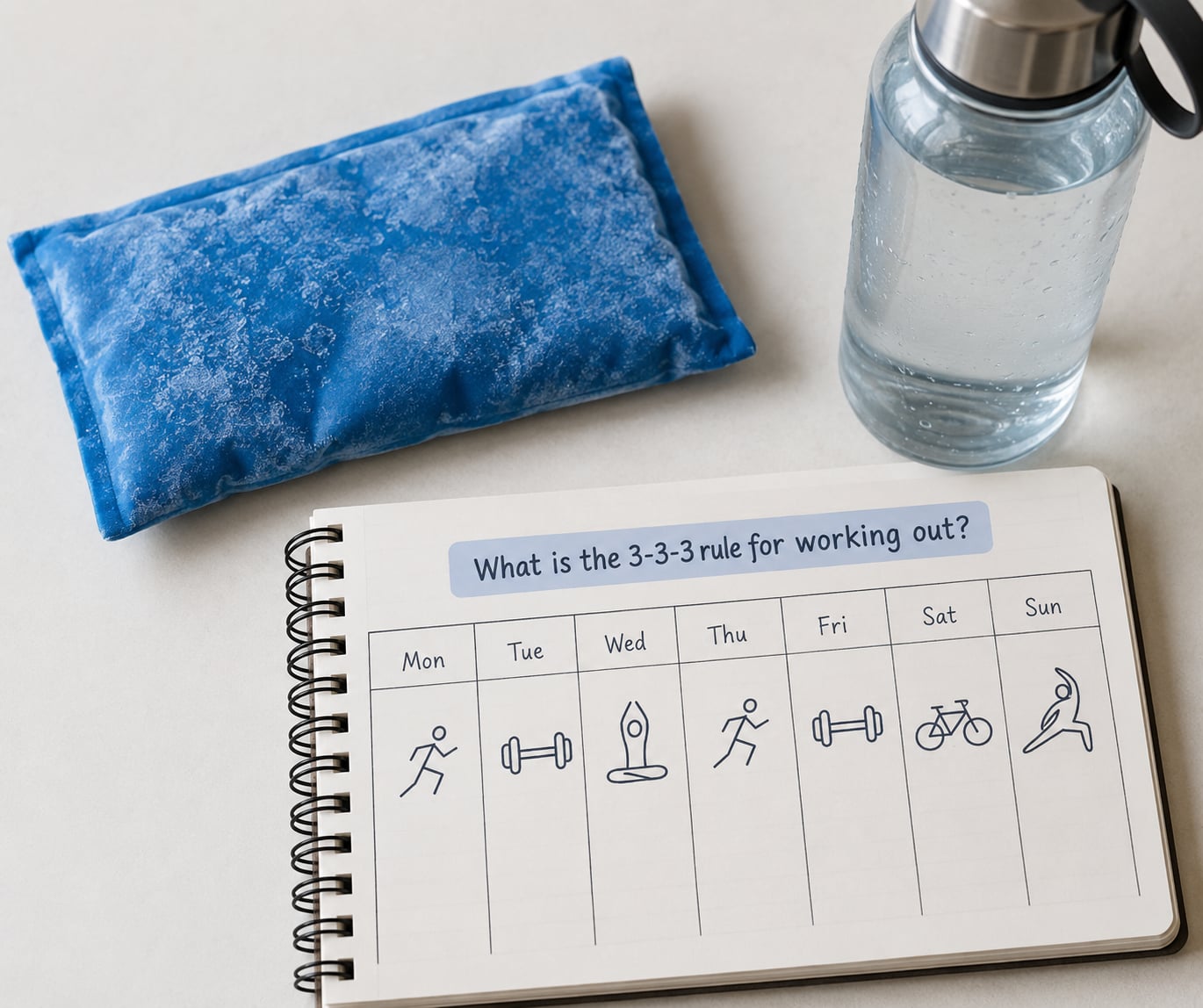
What is the 3-3-3 rule for working out?
It is a simple layout rather than a law: three sets per exercise, three reps or a short time under tension, and roughly three sessions a week, often across an upper and lower split. With soreness, keep the three-by-three structure and lower the load. Spacing sessions three days apart also gives sore muscles more time to settle.
So here is the short version. Rate the soreness out of 10, test whether the movement is fully available, and then choose: under 4 and you train, 4 to 6 and you drop the load, 7 or above and you rest or switch groups. Sort ordinary ache from anything sharp, swollen, or numb, and when you are not sure, ask a doctor or physiotherapist rather than guessing. That is the whole method behind how to work out when you are sore, and it fits into a week far better than most people expect.