If your heaviest dumbbell is already too heavy to lift with clean form, you can still progress. Keep the weight where it is and add repetitions until you reach the top of your range on every set, then increase load, add a set, or make the movement harder by slowing the lowering phase, pausing at the bottom, or shortening your rest. That repeatable method is how to progress with dumbbells at home, and the whole thing takes 20 to 40 minutes, three days a week, and a pen.
Most beginners stall because they treat the dumbbells as the only variable. Once the same weight produces the same twelve reps week after week, the muscle has nothing new to adapt to, and the session becomes a formality. Progression is what turns a list of exercises into an actual training plan.
This guide is written for someone picking up dumbbells for the first time, and it was updated for 2026. It follows the general strength and conditioning principles mainstream bodies recommend: two to three sessions per week, at least a day of rest between hard sessions for the same muscle group, and a warm-up before lifting.
Table of Contents
- What You Need
- How to Progress With Dumbbells at Home: Step by Step
- How to Progress With Dumbbells at Home Without Jumping Loads
- 1. Learn the Range of Each Exercise
- 2. Know When a Set Is Ready to Progress
- 3. Increase Repetitions Before Load
- 4. Increase the Dumbbell Load Gradually
- 5. Progress Sets or Exercise Difficulty
- 6. Deload and Repeat the Cycle
- Common Mistakes
- Frequently Asked Questions
- What weight dumbbells should a beginner use?
- How many times per week should I use dumbbells at home?
- Should muscle soreness stop me from progressing?
- How many reps should I do with light dumbbells?
- Should I increase weight or reps first?
- How do I progress if my dumbbells are too light?
- Conclusion: Start With Two Reps in Reserve
What You Need
You need very little. Beginners get most of their results from consistency and technique, not from equipment variety.
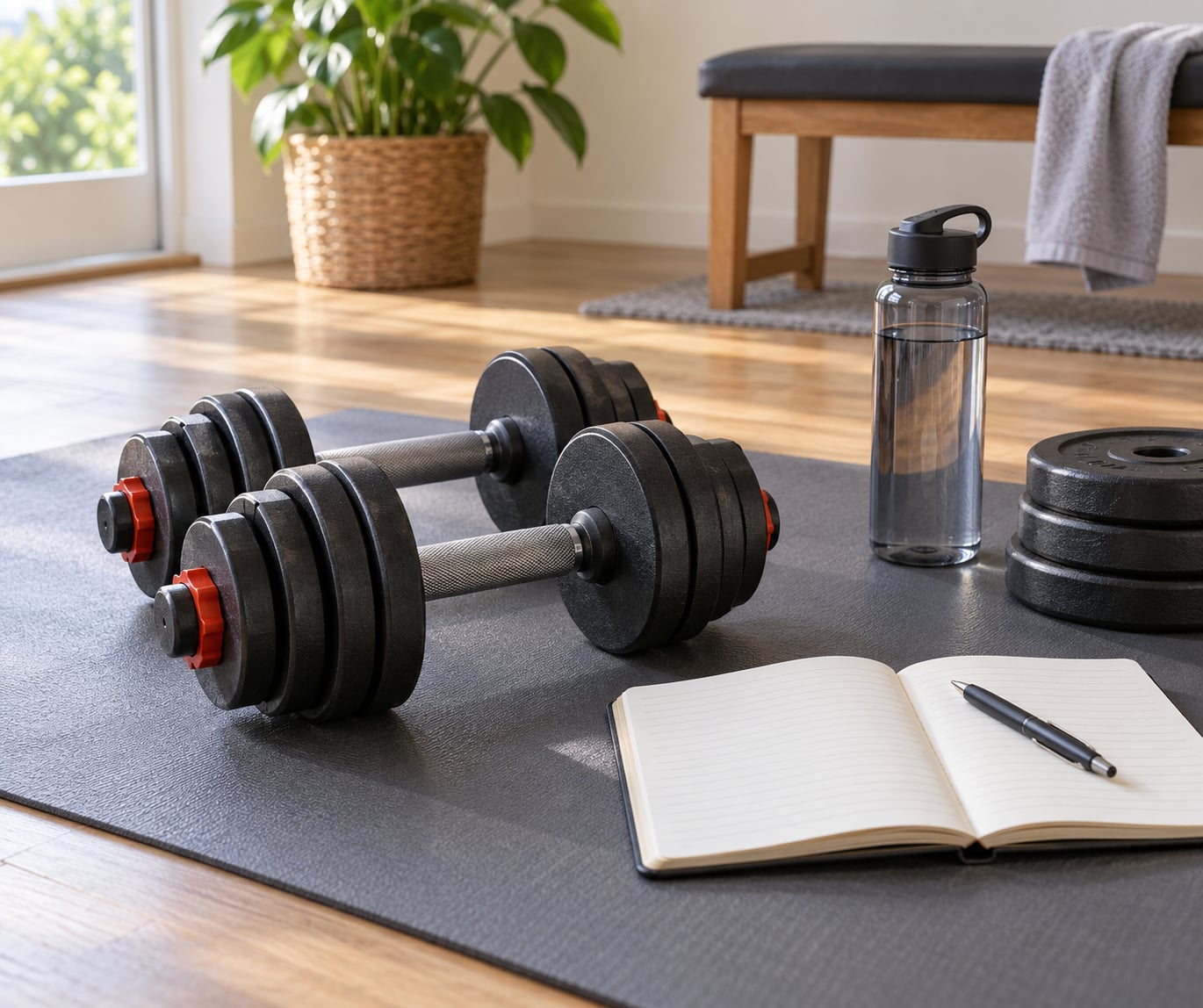
- Dumbbells. A single pair of fixed dumbbells is enough to run this plan for months. Adjustable dumbbells help when the gap between fixed weights is too large, since they often move in smaller steps.
- A clear floor space. Enough room to lie flat with your arms out and to move through a full overhead press without hitting a wall.
- A notebook or workout app. You need a place to record the weight, the repetitions, the set count, and how the last set felt. Progression you cannot see is progression you cannot repeat.
- A timer. Useful for rest intervals and for slow lowering phases, which is one of your main non-weight levers.
- Two to six exercises. A squat pattern, a push, a pull, a hinge, and a core movement covers a beginner’s week. You do not need more.
One note on equipment gaps. Fixed dumbbell sets usually step in 5 lb jumps, which is why a lot of home lifters get stuck: the jump either does nothing or breaks their form. Test the step before you plan around it. If 10 lb makes lateral raises easy but 15 lb drags your shoulder up toward your ear, the gap is too wide for a beginner, and you need a non-weight lever rather than a bigger pair.
Before you start, sort out whether this kind of training suits you. If you have an existing injury, a recent surgery, joint pain, osteoporosis, a heart condition, or any medical advice restricting your exercise, speak to a doctor or a qualified fitness professional first. This article is general information, not personal medical advice.
How to Progress With Dumbbells at Home: Step by Step
The system below has six parts, and the order matters. Reps come before load, and load comes before difficulty changes. Here is how to progress with dumbbells at home without the jumps that derail beginners.
How to Progress With Dumbbells at Home Without Jumping Loads
Your first session is a measurement, not a workout. Pick a load that lets you complete one to three sets of 8 to 12 controlled repetitions with approximately two to three repetitions left in reserve.
Two reps in reserve means you could have squeezed out two more clean reps, but you stopped. That is the effort level beginners should work at, and it is the level at which you can add something each week without wrecking your form.
Write down four things for every exercise: the dumbbells you used, the repetitions per set, the number of sets, and anything you felt, such as an achy elbow or a shoulder that pinched on the last set. This record is the starting point every later session is compared against. If you skip it, you are guessing, and guessing is how people end up lifting the same weight for a year.
1. Learn the Range of Each Exercise
Before you add meaningful load, learn where the movement starts and ends. For every exercise, practice the bottom and top position slowly, and know which joints control the range.
On a squat, that means your hips crease below the top of the knee with your heels down and your chest tall. On a press, your elbow travels down toward the floor without flaring out at the bottom. On a row, your shoulder blade reaches back and down instead of your arm swinging wide. On a hinge, your hips move back and your torso stays braced. The specifics change with each lift, but the rule does not: your hip, knee, elbow, and wrist positions are set before the weight matters.
A set counts as a success when you finished the planned repetitions with stable technique, not when the final repetition looked easy. The tenth rep of a set usually looks uglier than the third, and that is the rep your muscle actually learns from.
2. Know When a Set Is Ready to Progress
A set is ready to progress when three things are true at once: you completed every planned repetition without pain, your technique held up through the whole set, and you still had roughly two more clean repetitions left in you.
Repetition speed is a useful third signal. If your last four reps are noticeably slower than your first four, you are near the limit. That is fine when you are testing, but it is not the moment to add something. Bring the weight back down, keep the reps clean, and revisit it next week.
Pain is the exception to every rule here. Sharp pain, joint pain, numbness, and dizziness all mean stop, not push through. Talk to a doctor or a qualified professional about anything that keeps coming back.
3. Increase Repetitions Before Load
Double progression means you add repetitions first and weight second. Keep the same dumbbells and add one or two reps per set each week until you hit the top of your chosen range on every set. Only then do you move up.
For example, you might start a dumbbell row at 3 sets of 8 with 10 lb, adding two reps per set each week. Weeks one through four take you from 8 to 10, 10 to 12, 12 to 14, then back to 3 sets of 8 but with the next available weight up.
This method is the beginner default because the jump is already built into the step. It also keeps the decision simple, which matters more than cleverness when you are training alone at home with no spotter and no coach.
4. Increase the Dumbbell Load Gradually
When you hit the top of your rep range on every set, move up to the next available weight and drop back to the bottom of the range. The cycle starts again.
The important part is returning to the bottom. A heavier weight almost always costs you repetitions, and starting again at the top of the range means your next increase arrives sooner, not later.
Small jumps are the whole trick. If your set only steps up by 5 lb, treat that as a large jump and expect your reps to fall. If a weight makes good repetitions turn into partial, shaky, or painful ones, it is too heavy for now. Step down and progress reps or tempo instead.
That is the answer to the most common home dumbbell question: when the lighter pair gives fifteen to twenty easy reps and the heavier one ruins your form, stay with the lighter pair and make the set harder. The heavier dumbbell is not going anywhere.
5. Progress Sets or Exercise Difficulty
When the reps are maxed out and the next weight is too big a jump, progress something other than load. The levers below are roughly ordered by how little they disturb your technique, so work down the list rather than jumping to the hardest one.
| Progression lever | What it changes | Example |
|---|---|---|
| Add repetitions | Total reps per set | Move from 3 sets of 10 to 3 sets of 15 |
| Slow the eccentric | Time under tension | Lower for 3 to 4 seconds instead of 1 |
| Add a pause | Time under tension at the hardest point | Hold for 2 seconds at the bottom of a row |
| Add a set | Training volume | Go from 2 sets to 3 sets of the same exercise |
| Shorten rest | Density | Rest 90 seconds instead of 2 minutes between sets |
| Unilateral work | Per-arm load | Hold two dumbbells for one arm, halving the jump |
| External resistance | Added load without new weights | A resistance band, or books in a backpack |
Change one thing at a time. If you add reps, slow the tempo, and add a set in the same week, you will not know which change worked or which one broke you. Pick a lever, run it for two to three weeks, then decide.
Range of motion counts too, in both directions. Moving through a deeper, controlled range makes an exercise harder, as long as you can hold the position. Shortening the range with the same weight makes it easier, which is useful as a deload.
6. Deload and Repeat the Cycle
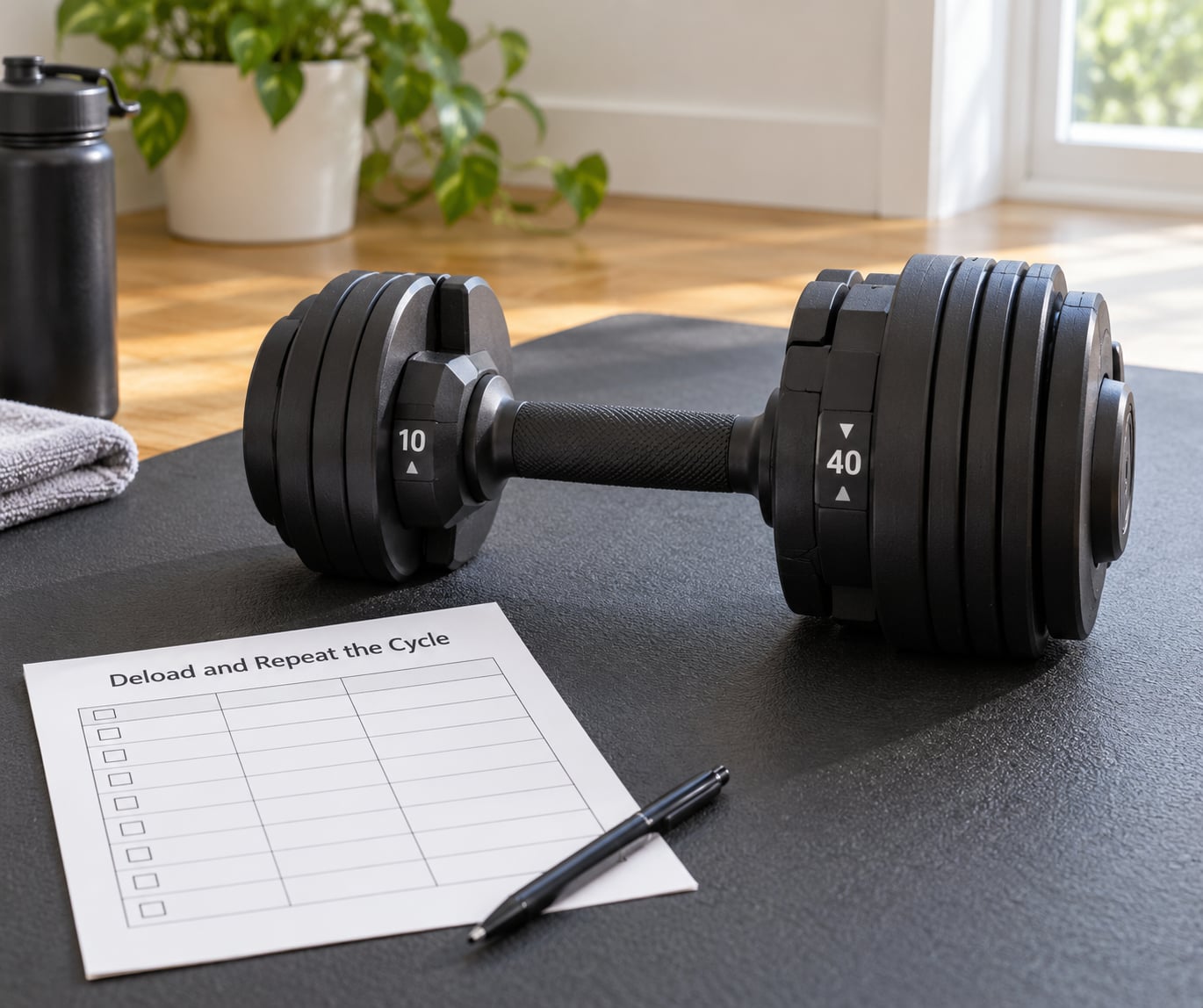
After three or four challenging weeks, take a lighter week. Cut your sets in half, drop back to the bottom of your rep range, and skip the levers you added recently. Most beginners feel stronger in the week after a deload rather than the week before it.
Here is a simple eight-week structure. Two full-body sessions alternating across three days each week, with a deload built in rather than reached by accident.
| Week | What you do | Milestone |
|---|---|---|
| 1 | 2 sets of 8 to 12, light load, two reps in reserve | Baseline written down |
| 2 | Add 1 to 2 reps per set | First progression step |
| 3 | Add 1 to 2 reps per set | Near the top of the range |
| 4 | Deload: cut sets in half, drop reps | Recover and reassess |
| 5 | Same reps as week 3, next weight up | Load progression starts |
| 6 | Add a third set to two exercises | Volume progression |
| 7 | Add a pause or slow the lowering phase | Non-weight lever |
| 8 | Repeat the week 3 set, or deload if effort felt high | Second cycle begins |
If two or three weeks pass with no change in any direction, do not add more exercises. Look at recovery first: sleep, food, stress, and how much time you are giving each muscle group. Then reduce volume by a third and rebuild the cycle from a slightly easier starting point. A deload is progress management, not a failure.
Common Mistakes
Almost every stalled home routine comes down to one of a handful of avoidable habits.
- Jumping to heavy weights too early. Add weight only after you hit the top of your rep range with clean form. The fix is patience, not effort.
- Progressing while technique deteriorates. If your last reps are shorter than your first, or your back rounds on a set, drop the weight and rebuild reps. Bad reps teach the movement nothing.
- Changing reps, load, sets, and difficulty at once. You lose all feedback. Fix: one variable per week, written in your log.
- Chasing soreness as a progress marker. Soreness tells you a muscle was challenged, not that you got stronger. Judge the workout by your numbers in the log.
- Using the same weight forever. If you have not changed anything for four weeks, add reps, then slow the tempo, then add a set.
- Hopping programs every few weeks. Progress takes longer than enthusiasm. Give one plan eight weeks before you judge it.
Three habits protect everything above. Keep a neutral spine and controlled joints on every rep. Breathe on the way up, and hold your breath for as little time as possible. Leave at least one rest day between hard sessions for the same muscle group, and get to sleep, because most of the adaptation happens while you are not training.
Frequently Asked Questions
What weight dumbbells should a beginner use?
Pick a pair where you can finish 8 to 12 controlled repetitions with about two clean reps left in reserve. For most beginners that lands somewhere between 5 and 15 lb per dumbbell, and it depends on the exercise more than your age or sex. Lateral raises and isolation work need lighter loads than squats and presses. Test a pair on a squat pattern and on a row: if either one breaks down, step down.
How many times per week should I use dumbbells at home?
Two or three full-body sessions per week is the standard recommendation for beginners, with at least one rest day between hard sessions for the same muscle group. Two alternating workouts across three days is a structure that works and keeps recovery realistic. Progress comes from repeating the same movements with more load over weeks, not from training daily. If you are sore for more than a day or two, you have spaced it too tightly.
Should muscle soreness stop me from progressing?
Mild soreness after a new exercise is normal and fades as your body adapts. It is not a signal to add weight immediately, though, because soreness does not tell you whether the last reps were technically sound. Judge the session by your log, not by how your shoulders feel the next morning. Sharp pain, swelling, joint pain, numbness, or dizziness mean stop and speak to a doctor or qualified fitness professional.
How many reps should I do with light dumbbells?
For muscle growth, 8 to 15 controlled repetitions per set is a workable range with light dumbbells, as long as the last repetitions are genuinely hard. The weight matters less than whether the target muscle is loaded through a full range and whether the set approaches failure. Light dumbbells can absolutely build muscle when sets, progression, and nutrition are handled properly. Aim to be two reps short of failure in most sets.
Should I increase weight or reps first?
Reps first, every time. Add one or two repetitions per set until you reach the top of your range on every set, then move up to the next weight and return to the bottom of the range. This is called double progression, and it is the simplest reliable method for a home lifter. Loading up first is the most common reason beginners stall, because the jump in difficulty is far larger than the jump in weight.
How do I progress if my dumbbells are too light?
Use the non-weight levers in order: more reps, a slower lowering phase, a pause at the hardest point, an extra set, shorter rest, unilateral work, then external resistance such as a band or a backpack. Most people need only the first three. You are not wasting the session: time under tension and training volume both drive adaptation. If pain, dizziness, or an injury changes what you can do, ask a doctor or qualified professional first.
Conclusion: Start With Two Reps in Reserve
Do one short baseline session this week. Choose a load you can handle for two reps more than you think you need, complete your sets, and write the numbers down.
From there, add reps only while your technique and effort stay the same. When the reps stop moving, change one thing: a heavier pair, a slower lowering phase, or an extra set. That is how to progress with dumbbells at home, and it does not require a single new weight to get started.