
If you train regularly and something has felt off for a few weeks, you are probably searching for a short answer. Here it is: the signs you are overtraining are fatigue, soreness and falling performance that persist even when you reduce or stop training. Normal tiredness clears with a night or two of sleep. Overtraining does not.
This guide walks through the twelve most common warning signs, how to tell overtraining apart from ordinary training fatigue, how long recovery usually takes, and when a doctor should get involved. It is educational information, not a diagnosis. If any of this sounds familiar, the most useful thing you can do is look at the pattern rather than one bad workout.
Table of Contents
- What Are the Signs You Are Overtraining?
- Physical and Performance Warning Signs
- Sleep, Mood, and Motivation Changes
- Common Causes of Overtraining
- Overtraining vs. Ordinary Fatigue
- How to Check Whether You Are Recovering
- What to Do If You Think You Are Overtraining
- How to Prevent Overtraining in Your Routine
- Frequently Asked Questions
- Does muscle soreness mean I am overtraining?
- How long does it take to recover from overtraining?
- Is 4 hours of working out a week too much?
- Do I need a rest day after every workout?
- Can overtraining make you get sick?
- When should I see a doctor about fatigue and training?
- Conclusion
What Are the Signs You Are Overtraining?
Overtraining happens when your training load stays higher than what your body can recover from, week after week. Muscles get micro-damage they cannot finish repairing, inflammation lingers, immune function drops and your nervous system stops fully winding down. The result shows up everywhere: in the gym, in bed, at work and in your mood.
It helps to think of it as three stages on a spectrum. In functional overreaching, you train hard on purpose for a short period, feel worse for a few days, then come back stronger. In non-functional overreaching, the extra fatigue lingers for weeks and your performance stays flat or drops. Overtraining syndrome is the far end, where symptoms persist for months and simple rest no longer clears them.
The signs you are overtraining usually appear across four areas at once: how your body feels, how you perform, how you think and sleep, and how quickly you recover. One clue on its own means very little. Three or four of them, persisting together, are worth taking seriously.
Physical and Performance Warning Signs
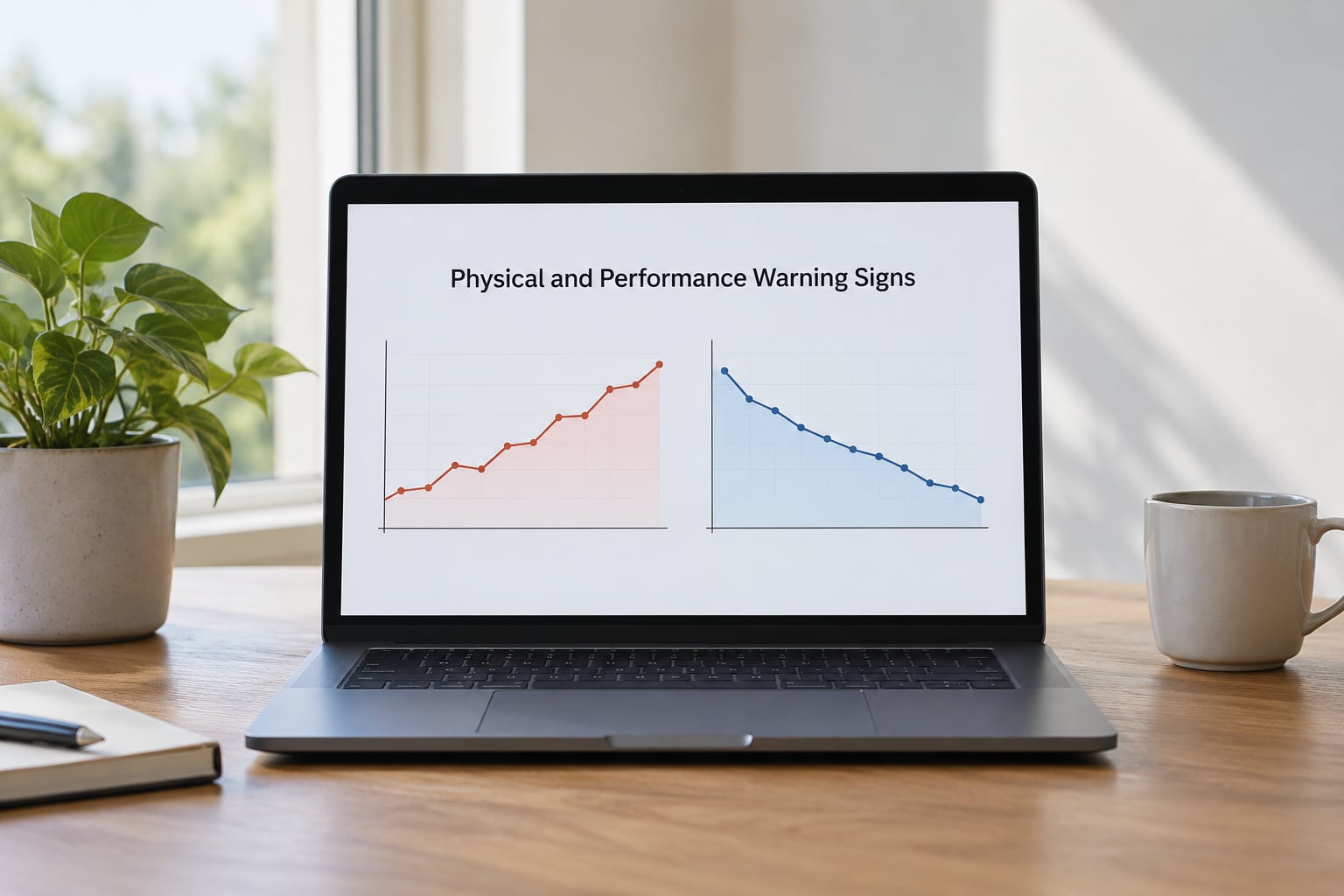
These are the twelve signs that come up most often in sports medicine clinics and in the training forums where runners and lifters ask the same question over and over. They are grouped roughly by what they affect.
1. Fatigue that rest does not fix. You feel tired on waking and a walk to the car feels like more than it should. A day off helps a little, then it comes straight back.
2. Performance stalls or reverses. Your times get slower, your weights stop moving, or rep quality drops, even though your effort has not changed. Progress normally has small dips; a multi-week slide is different.
3. Soreness that never resolves. You are still sore from a session several days later, and new sessions add soreness instead of removing it. Ordinary delayed onset muscle soreness settles within about 48 to 72 hours.
4. Your resting heart rate sits higher. Runners and cyclists tracking morning numbers often report a rise of roughly 5 to 10 beats per minute from their usual baseline, along with less variation day to day.
5. Getting sick more often. Colds, sore throats and stomach bugs arrive one after another. Training temporarily suppresses immune function, and a heavy block can leave it suppressed for weeks.
6. Niggles that keep coming back. Small aches in an elbow, a knee or an Achilles tendon settle, then return on the same movement. Overuse injuries grow gradually from repeated irritation that never fully heals.
7. Recovery between sessions gets slower. Sessions that once left you recovered in a day now need two or three. Heart rate during the warm-up creeps up even at the same pace.
8. Your coordination feels off. Slipping plates, missing a jump, clipping a kerb. Fine motor control and balance are among the first things to degrade when fatigue accumulates.
9. Heavier legs, lower endurance. Muscles feel dense and slow rather than springy, and intervals that used to be manageable now end early.
10. Appetite or weight shifts. Losing your appetite, eating noticeably more, or dropping weight quickly during a training block often points to underfueling, which pushes the whole system toward the same symptoms.
11. Small injuries take longer to heal. A grazed knee that stays open for days, a bruise that lingers, a niggle that never quite settles. Slow healing is easy to dismiss and one of the quietest signs that your recovery system is running behind.
12. Hormonal changes and a low libido. Irregular periods, reduced sex drive or changes in bone health show up in some people who train hard while under-eating. That combination points to low energy availability, and it is a reason to see a doctor rather than to adjust your training plan.
None of these proves anything on its own. A cold will give you signs 1, 5 and 6, and a stressful week at work will happily produce 2 and 7. What matters is whether several of them arrive together and refuse to shift after a few easier days.
Sleep, Mood, and Motivation Changes
Persistent tiredness is the clue people notice last, even though it is often the loudest. You lie down tired and still wake up tired. Sleep becomes restless, you wake during the night, and eight hours no longer leaves you refreshed.
Alongside that comes a drop in concentration. You reread the same paragraph, forget names, and make small mistakes at work you would not normally make. Many people describe this as brain fog, and it clears once recovery does.
Motivation usually goes first. Sessions you used to look forward to start feeling heavy and pointless. You begin to dread the alarm, negotiate with yourself about whether to go, and sometimes skip without much guilt, which is unusual for you.
Irritability and mood swings follow close behind. Small frustrations land harder, and you feel on edge or down for reasons that do not seem proportional. Sustained exercise helps mood for most people, so a genuine mood dip alongside the physical signs is a reason to talk to a professional rather than push harder.
The distinction that matters is duration. Feeling flattened the evening after a hard session is ordinary. Feeling flattened for two weeks despite going easier is the pattern that points to overtraining.
Common Causes of Overtraining
Overtraining rarely has one cause. It is usually a stack of things, and identifying the stack is what makes it fixable.
- Increases that come too fast. Adding volume or intensity every week with no adjustment weeks is the single most common trigger. A beginner who doubles their program in month two is a textbook case.
- Too few genuine rest days. Training six days a week is fine for some people. Training six days with no day off and every session hard is a different setup, and it is where problems cluster.
- Not enough sleep. Seven hours or less during a heavy block means you are also carrying a sleep debt into every session, and the two stack.
- Underfueling. Eating too little for the work you are doing reduces recovery capacity and can produce the whole fatigue-and-performance pattern on its own. This overlaps with low energy availability, where hormonal and bone health are affected too.
- Life stress. A demanding week at work or poor sleep at home is extra load. Your body does not keep training stress in a separate account from everything else.
- Training through pain or a niggle. Compensating for one area shifts stress onto another, and compensation patterns hide the original problem.
An 18-year-old lifter once described a week of two lower-body sessions, two upper-body sessions, two incline walks and two ab sessions, and asked whether that was too much. Volume alone rarely is. Doing all of it hard, without a genuine off day, usually is.
Overtraining vs. Ordinary Fatigue
Most anxious training threads come down to one question: is this real, or am I just tired? This table is the clearest way to tell them apart.
| Factor | Ordinary training fatigue | Overtraining |
|---|---|---|
| Onset | Within a day or two of a hard session | Builds gradually across several weeks |
| Duration | Clears with one or two days off | Persists through reduced or no training |
| Performance | Returns to normal after rest | Stays flat or declines despite easier sessions |
| Soreness | Gone within about 48 to 72 hours | Present before the next session, or lingers for weeks |
| Sleep | Tired after effort, sleeps well, wakes restored | Restless sleep, waking unrefreshed after enough hours |
| Mood and motivation | Motivated once rested | Dreading sessions, irritable, flat, uninterested |
| Heart rate | Morning resting heart rate near your baseline | Roughly 5 to 10 beats per minute above baseline for a sustained stretch |
| What resolves it | A normal rest day | A structured deload or longer break, sometimes professional input |
One nuance from rehabilitation specialists is worth keeping. Fatigue often feels light. Overtraining carries a heaviness, in the legs or the chest, and it shows up as reluctance that survives a genuine break.
How to Check Whether You Are Recovering
Rather than guessing, run a two-week check. It takes about five minutes a morning.
Track your morning resting heart rate. Take it lying down before you get up, every day, under the same conditions. Look at the trend across two weeks rather than a single reading. A sustained rise of about 5 to 10 beats per minute is the number most self-tracking athletes report as meaningful.
Write down the session. After each workout, record the load or distance, how it felt, and roughly what percentage you could have given. Two or three sessions in a row where you finish far below your normal is worth noticing.
Rate three things out of ten. Sleep quality, soreness and motivation. Do it at the same time each day. Numbers that drop and stay dropped tell you more than a single bad morning.
Check your resting heart rate variability if you have a watch. A declining trend across several days alongside a rising resting heart rate is a stronger signal than either alone. Consumer wearables are noisy, so look at direction over a week or two.
Look for a sustained pattern. One bad week after a hard race or a bad night is normal fatigue. The same picture across four weeks while you have eased your training is not.
What to Do If You Think You Are Overtraining
If the pattern holds, the response is to reduce stress, not to add more effort to compensate. General recovery steps look like this.
- Take one to three full days off. Not active recovery, not easy cycling. Actual rest, and it works more often than people expect.
- Cut volume by roughly half for a week. Keep the movements, drop the sets or the distance. Keep intensity easy.
- Sleep on purpose. Aim for a consistent window of seven to nine hours. This is the one lever with the widest effect on everything else.
- Eat regularly and raise protein a little. Do not go to bed hungry after a hard week. Most underfueling in training blocks is accidental.
- Return at around half effort. Rebuild over two to four weeks rather than jumping back to where you were.
- Adjust the plan, not just today. If the same thing happens every fourth week, your program has too little variation built in.
There is no single recovery timeline, and the range is wide. Functional overreaching resolves in days. Non-functional overreaching takes a few weeks. Overtraining syndrome can take weeks to months, and one poster described systemic fatigue that resolved after a single week off, which sits at the far quicker end.
A break does not undo your fitness. Aerobic conditioning declines slowly over several weeks of complete rest, and strength returns faster than most people expect once training resumes.
See a doctor or a qualified sports medicine clinician if symptoms last beyond two or three weeks of reduced training, or sooner if something feels plainly wrong. Fatigue can also come from anaemia, thyroid problems, an infection, a vitamin deficiency or a mood disorder, and those need testing rather than a training plan.
How to Prevent Overtraining in Your Routine
Prevention is mostly structure. Progress in steps you can hold for several weeks rather than jumps you make on a Monday.
Build genuine rest days into the week as planned sessions, not whatever space is spare after everything else fills up. Vary intensity, because the same effort every week is harder on the body than alternating hard and easy days. Keep an eye on the numbers from your two-week check so a drift shows up before it becomes obvious.
Watch the inputs too, because load and recovery travel together. When work stress rises, sleep drops or you get ill, pull the training back by choice rather than by symptom. Most of the people who end up stuck for months are the ones who kept pushing through a bad fortnight.
Frequently Asked Questions
Does muscle soreness mean I am overtraining?
No. Delayed onset muscle soreness usually peaks within 24 to 72 hours after a session and then fades, and it is a normal part of training hard. It becomes a warning sign when it never fades: you are still sore several days later, you are sore before the next session, and each new session adds soreness instead of clearing it. That pattern, especially alongside stalled progress and poor sleep, points to accumulated fatigue rather than an ordinary hard workout.
How long does it take to recover from overtraining?
It depends on how far past the line you went and how quickly you caught it. Functional overreaching resolves within days of easing off. Non-functional overreaching usually needs a couple of weeks of reduced training. Overtraining syndrome can take several weeks to a few months, and some people report feeling themselves back within a week of a full break. Expect slower recovery if you were underfueling or sleeping poorly while pushing through.
Is 4 hours of working out a week too much?
Four hours on its own is not a warning sign. What matters is intensity, how the sessions are mixed, and whether you recover. Four hours of varied training with easy days between them is a sustainable week for a lot of people. Four hours of near-maximal work with little sleep, no rest days and under-eating is a common route to overtraining. Judge by whether your performance recovers and your symptoms clear, not by the clock.
Do I need a rest day after every workout?
Not necessarily, but most people need a mix. Training on consecutive days is fine when the sessions are light or target different systems, such as an easy run one day and upper-body work the next. It becomes a problem when every session is hard and nothing truly recovers in between. A simple approach is to plan at least one or two days a week with no training at all, and to keep a genuine deload in your cycle every four to eight weeks.
Can overtraining make you get sick?
Yes, it can raise your chances of picking up infections. Hard training temporarily lowers immune function, and if that stress repeats without enough recovery, the effect carries over. People in heavy blocks often notice a run of minor bugs, or one illness that seems to drag on. Getting sick once does not prove overtraining, but frequent infections alongside fatigue, poor sleep and stalled progress together are a reason to reduce your load and mention it to your doctor.
When should I see a doctor about fatigue and training?
See a clinician if fatigue persists for more than two or three weeks even after you reduce or stop training, or if it comes with a racing or irregular heartbeat, chest pain, unexplained weight change, ongoing fever, or a niggle that will not settle. Some of those point to anaemia, thyroid problems, infection, a vitamin deficiency or a mood disorder, none of which a change of training plan will fix. A doctor can run simple blood tests to rule those out.
Conclusion
Start with the pattern, not the single workout. If fatigue, soreness, stalled progress and unrefreshing sleep are all showing up together and have not moved after a few easier days, cut the load now: a few full rest days, more sleep, regular meals, then return at half effort. If it does not settle within two or three weeks, or if you have chest pain, a racing heart or unexplained weight change, talk to a doctor. Recognising the signs you are overtraining early is far cheaper than working them out months later.