If you have knee pain, you can still lose weight, and you do not need a gym membership, a pool pass or a single piece of exercise equipment to start. The approach that works is a modest calorie deficit built from ordinary food changes plus low-impact movement and gentle strengthening that your knee can tolerate this week, not next month. Most people who follow it see the scale move slowly, and that is the point: every pound lost takes real pressure off a joint that was already working too hard.
What follows is a general information guide, not a diagnosis or a treatment plan. If your pain is sudden, severe, hot, swollen, or you cannot put weight on the leg, see a doctor before you change anything about your activity or eating. A doctor or physical therapist can tell you what your particular knee can handle, and that answer changes the plan more than any food trick ever will.
Table of Contents
- What You Need
- How to Lose Weight When You Have Knee Pain: Step-by-Step
- 1. Establish a Comfortable Baseline and Check for Red Flags
- 2. Build a Small, Balanced Eating Routine
- 3. Use Low-Impact Movement You Can Tolerate
- 4. Strengthen the Muscles Around the Knee Gradually
- 5. Add Recovery and Mobility Between Activity Days
- 6. Progress One Variable at a Time
- 7. Review Results and Adjust the Plan
- Common Mistakes
- Frequently Asked Questions
- Is walking good for weight loss if my knee hurts?
- How quickly can I lose weight with knee pain?
- What exercises are safest with painful knees?
- Does knee arthritis change how I should lose weight?
- Should I exercise when my knee pain is flaring?
- When does knee pain during weight loss need medical attention?
- Conclusion
What You Need
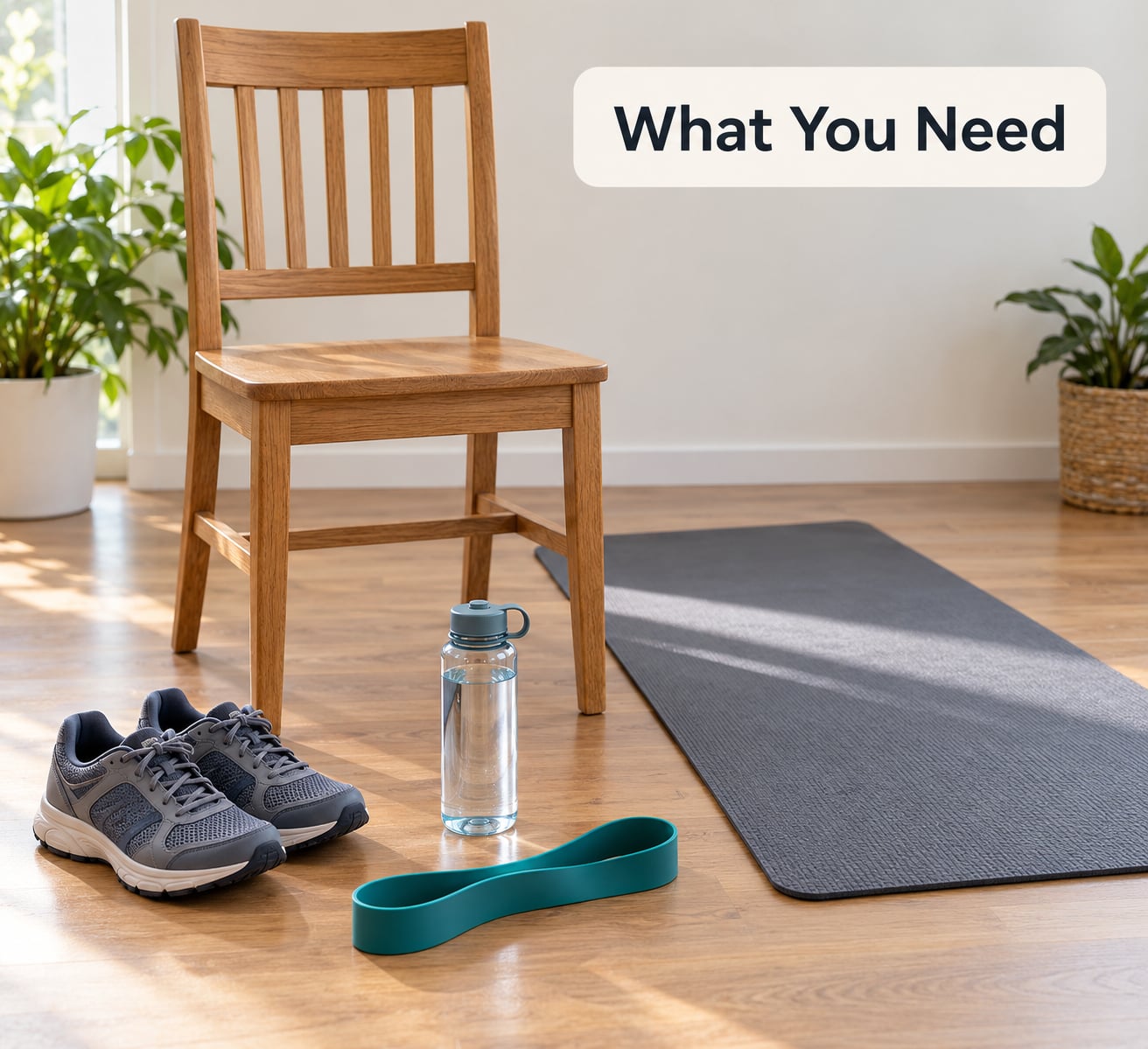
The list is short on purpose. You need comfortable, supportive footwear with a roomy toe box, because loose-fitting shoes stop your toes from gripping while you walk. A stable chair with a back and no wheels gives you something to hold onto for balance work, and a countertop or sturdy railing works just as well if a chair is not handy.
A water bottle matters more than it sounds. Many people cut calories by skipping meals and then mistake dehydration headaches and fatigue for hunger, then eat more than they would have. Ordinary foods from your regular grocery store cover everything else. No specialty items, no meal replacements, no supplements you have to buy to make this work.
What you do need is a healthcare professional when the pain is persistent, severe, or simply unexplained. That is not a formality. A physical therapist in particular can watch you move once and tell you which of the movements below are appropriate, which your knee is not ready for, and how to modify the rest.
None of this requires a home exercise machine. If you own nothing else, the chair, the floor and your own bodyweight give you a complete first month of work.
How to Lose Weight When You Have Knee Pain: Step-by-Step
Learning how to lose weight when you have knee pain works best as a sequence, not a pile of separate tips. Each step depends on the one before it, and the order matters more than speed. Start at the lowest level that feels comfortable, hold it long enough to settle into a habit, then add one thing at a time.
1. Establish a Comfortable Baseline and Check for Red Flags
Before changing anything, spend five honest minutes describing where you are. Note whether your knee aches, catches, swells, or feels unstable, and note what you can currently do without a follow-up ache later that day. If you want to track weight at all, record it once, in the morning, and treat it as a reference point rather than a scoreboard.
Then look for warning signs that need a professional rather than a plan of your own. Sudden severe pain, a knee that feels hot or very swollen, an inability to bear weight, fever alongside joint pain, a recent injury, or pain that persists with no obvious cause all belong in a doctor’s office.
Weight loss can reduce knee pressure substantially, but it does not repair cartilage that is already worn or reverse an existing diagnosis. People who expect it to do both tend to lose faith in week three. Knowing that going in saves a lot of frustration.
2. Build a Small, Balanced Eating Routine
Losing weight when you have knee pain requires eating less than you burn, and the way to do that without wrecking your energy is to change three or four things and leave the rest of your diet alone. Skipping meals backfires fast, because fatigue and dizziness cut your activity level before they cut your weight.
Start with portions rather than restrictions. Put your meal on a smaller plate, serve vegetables first, and fill the remaining space with a protein you actually like and a whole grain. Protein and fiber are what keep you full, and fullness is what makes the next portion decision easy instead of a daily argument.
- Protein at each meal. Eggs, beans, lentils, fish, chicken, tofu, Greek yogurt. It holds hunger steady while you cut elsewhere.
- Fiber from vegetables, fruit and whole grains. Volume without calories, which matters more when your activity budget is small.
- Drinks counted honestly. Sweet coffee, juice and alcohol are easier to reduce than food, and cutting them often does more work than any single food change.
- Regular meals. Three meals a day, or smaller meals if that suits you, beats skipping and overeating at night.
A modest deficit, roughly 500 calories a day for most adults, is enough to produce steady progress without draining you. A registered dietitian can help you set a number that fits your actual needs if you are unsure, especially if you take medication or manage other conditions. If you feel fatigued, dizzy, or lose weight without trying, stop and get professional guidance rather than pushing harder.
3. Use Low-Impact Movement You Can Tolerate
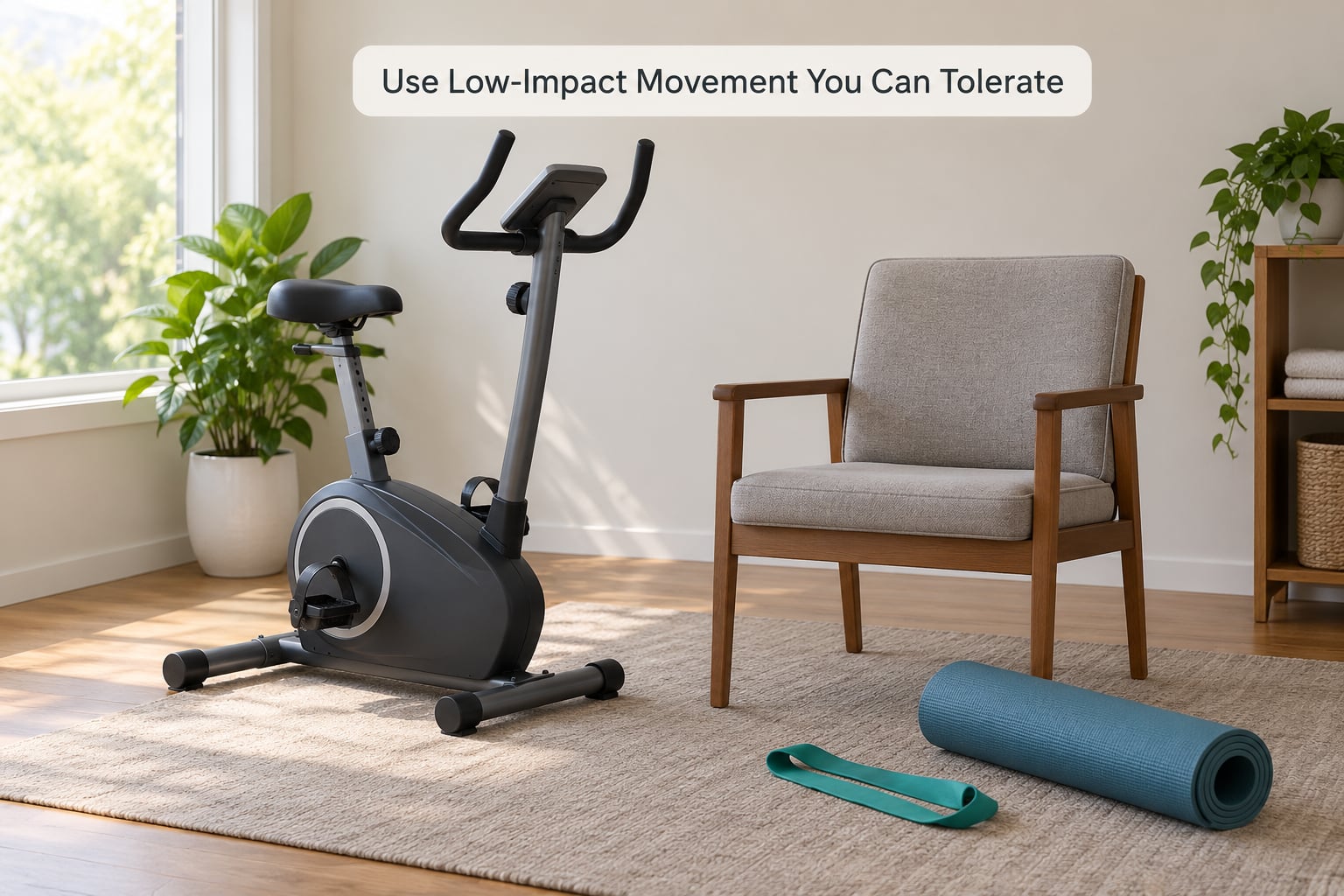
This is where most weight loss plans fail people with knee pain, because they hand over a running or burpee schedule and call it done. Low-impact movement still burns calories and still protects the joint, as long as it does not spike impact. Your menu runs from gentlest to most demanding, and the right one for you is the gentlest one you can do consistently.
- Water exercise or water walking. Body weight stops mattering when you are in water, which makes this the classic starting point for arthritic knees.
- Stationary cycling. A recumbent bike usually suits painful knees better than an upright one, and the seat needs raising high enough that your knee stays almost straight at the bottom of the stroke.
- Flat-ground walking in short blocks. Ten minutes on a flat, even path costs far less than one long walk on a slope. Use a walking pole or a cart if that helps.
- Elliptical trainer. Available at most gyms, kinder than walking because both feet stay on the machine.
- Chair-based movement. Seated marching, heel lifts and side leg lifts burn more than you would expect and put almost nothing through the knee.
Set duration by the talk test. If you can speak in full sentences, you are in a range you can repeat often, which matters far more than intensity. Use a simple discomfort scale from zero to ten to track how the knee feels during and the morning after, and treat a number that keeps climbing as information rather than failure.
Pain that rises during activity and settles within an hour or two is common. Pain that stays elevated for a day or two, or that keeps getting worse across sessions, means the movement or the volume needs to change, or stop. Modify first, quit second, and take it to a professional if modification does not settle it.
4. Strengthen the Muscles Around the Knee Gradually
The thigh muscle in front of the knee takes a beating every time you stand up, climb stairs, or get out of a chair, and a weak one makes the joint work harder. Strengthening the quadriceps, hips, and glutes usually does more for daily knee comfort than any amount of rest. It also protects the knee during the cardio work from step three.
Begin with movements that do not push the knee through a deep range. Chair stands, where you sit down and stand up from a firm chair, build exactly the strength you need for stairs. Supported heel raises, with your fingertips on a counter, work the calf that helps absorb each step. Tightening the front of the thigh while it lies straight on the bed, and glute bridges from the floor, fill out the rest.
Two sets of ten repetitions, twice a week, is a realistic starting dose. Add a resistance band around the thigh for leg presses and extensions, and keep the movement smooth. Stop any exercise that sharpens symptoms rather than leaving you mildly worked. Readers with a confirmed diagnosis should get individualized guidance from a physical therapist rather than following a list from the internet, including mine.
5. Add Recovery and Mobility Between Activity Days
Progress comes from the days between sessions, not the sessions themselves. Build at least one full rest day into every week and use the quieter days for gentle range of motion: a slow knee bend and straighten while lying down, ankle pumps, and a few relaxed stretches held for about twenty seconds each.
Heat before and cold after are the two tools people ask about most. Neither is a treatment and neither works for everyone, but plenty of people find a warm pack makes a stiff knee easier to move and a cold pack settles an ache afterwards. Use whichever feels better on your own knee and drop whichever does nothing.
Two habits quietly protect the joint: supportive footwear you actually wear indoors as well as out, and avoiding sudden jumps in weekly volume. A knee that handled twenty minutes of walking easily is still not ready for an hour. The jump is what provokes pain, not the walking itself.
6. Progress One Variable at a Time
Once a few sessions have felt manageable, increase one thing and only one. Add five minutes to your walk, or five minutes to your cycling session, or a little more resistance to your band work, and leave everything else alone for another week. Changing time, intensity, and food at the same time means you cannot tell what helped when a symptom flares.
Use a short weekly check-in rather than daily weighing: how was your energy, how hungry were you, could you manage stairs, and what did the knee say this week? A five-minute Friday note is plenty. Most people find that the knee tolerates more movement over time than they expected in week one, and that confidence is what keeps the plan going.
Realistic pace is about one pound a week for many adults, sometimes less when activity is limited. Chasing faster usually means eating too little and moving too little, which is the pattern that stalls progress and hurts the joint at the same time.
7. Review Results and Adjust the Plan
After several weeks, look at more than the scale. Notice how stairs feel, how far you can walk before the ache arrives, whether your clothing fits differently, and whether your energy is steady. Those are the signals that tell you the plan is working, and they often show up before the number does.
Adjust one variable at a time in response. If hunger is the problem, revisit portions and protein before cutting activity. If the knee is the problem, shorten sessions or swap in gentler movement. If nothing changes for several weeks, that is normal and not a failure, and it is a good moment to bring a doctor or physical therapist in rather than escalate on your own.
Get medical help if your weight changes unexpectedly in either direction, if symptoms worsen steadily over two to three weeks despite modification, or if the knee swells and stays swollen. Unexpected weight loss in particular is not a weight loss success, and it deserves an explanation.
Common Mistakes
Almost every stalled plan I have seen with this problem shares one of a handful of mistakes, and each one has a simple fix.
- Trying to lose weight fast. The fix is a smaller deficit with more consistency. A pound a week that lasts a year beats a fast drop that ends in two months of eating back everything.
- Treating all knee pain as safe to push through. Sharp pain, swelling, instability and giving-way are stop signals, not challenges. The fix is to get those symptoms assessed instead of training around them.
- Starting with long walks or heavy squats. The fix is to start at ten minutes and build from there. Squats with bodyweight are useful later; deep squatting under load is not a place to begin.
- Eliminating whole food groups. Cutting carbs, dairy or fat to near zero is hard to sustain and rarely needed. The fix is portion and drink adjustments first, restriction only if a professional advises it.
- Chasing soreness as proof of progress. Muscle effort and joint pain feel similar but are not the same. The fix is to judge sessions by how you move the next morning.
- Changing food and exercise all at once. When everything shifts at the same time, you have no idea which change caused a flare. The fix is one variable per change, held long enough to judge.
Two smaller habits help more than people expect: protecting your sleep, because short sleep makes hunger harder to manage the next day, and drinking water before meals, which sometimes removes the feeling that is actually thirst.
Frequently Asked Questions
Is walking good for weight loss if my knee hurts?
Walking burns meaningful calories without impact, so it can be part of your plan, provided the walking stays short, flat and pain-tolerant. Start with five to ten minutes and build slowly rather than committing to a long distance. If your knee aches during the walk, swells afterwards, or is more painful the next morning, shorten the session and discuss it with a physical therapist.
How quickly can I lose weight with knee pain?
Most adults lose roughly one pound a week at a moderate deficit, and limited activity can make that slower. Rapid loss usually means eating too little, which drains energy and cuts activity, the opposite of what your knee needs. Judge progress over several weeks using energy, walking tolerance and how stairs feel, not daily scale readings. A registered dietitian can set a target that fits your needs.
What exercises are safest with painful knees?
Water exercise, stationary cycling with the seat raised high, short flat-ground walks, chair-based movement, and gentle strengthening such as chair stands, supported heel raises and straight-leg quadriceps sets. These keep load low or remove body weight from the equation entirely. Add them one at a time and stop any movement that produces sharp pain, swelling, or instability.
Does knee arthritis change how I should lose weight?
It changes the emphasis rather than the goal. Because excess weight adds load to an already affected joint, gradual weight loss and ongoing low-impact activity are commonly recommended. Progress is usually slower and consistency matters more, since joint-friendly strength work protects function over time. Existing cartilage damage is not reversed by losing weight, so a doctor should confirm your diagnosis and guide medication or treatment decisions.
Should I exercise when my knee pain is flaring?
During a flare, resting from aggravating activity is sensible, but complete inactivity for long stretches can weaken the muscles that support the joint. Gentle motion, such as a slow bend and straighten while lying down or a short walk on flat ground, often feels better than stillness. If pain is severe, hot, very swollen, or you cannot bear weight, skip exercising and contact a doctor.
When does knee pain during weight loss need medical attention?
See a doctor promptly for sudden severe pain, a hot or very swollen knee, an inability to put weight on the leg, fever with joint pain, or pain following an injury. Pain that keeps worsening across several weeks despite modification, or unexpected weight changes in either direction, also deserves an explanation. A physical therapist can assess your movement and set individualized guidance between appointments.
Conclusion
Start smaller than feels impressive. Adjust one portion habit, for example, and add one ten-minute pain-tolerable movement session this week, then hold both until they feel ordinary before changing anything. The goal is not to force a number through a painful knee; it is to make everyday movement easier over the coming months, and that is the version of how to lose weight when you have knee pain that actually lasts. If any of the red flags above apply to you, book the appointment first.