If you’re wondering how to get your partner on board with healthy eating, the short answer is this: you can’t control another adult’s plate, but you can change what the household makes easy. Start with your own reason out loud, ask what they’d like to change first, pick one shared goal, and cook one dish for both of you. Everything below builds from that.
Most attempts fail for the same reason. Someone announces they’re eating differently, the other person hears a verdict on their character, and the kitchen turns into a negotiation. The partner who wasn’t interested in a diet now has something to defend.
What works instead is quieter. You change what you buy, what you cook, and how you talk about it, and you let your partner opt in at their own speed. Most of the time they notice before you tell them anything.
This is general information about household eating habits, not medical advice. If either of you has a diagnosed condition such as diabetes, high blood pressure or high cholesterol, talk with a doctor or a registered dietitian about the changes that actually matter for your situation.
Table of Contents
- What You Need Before You Get Your Partner on Board With Healthy Eating
- One reason that belongs to both of you
- A calm hour with no audience
- An honest look at the household
- A starting point small enough to be boring
- Step-by-Step: How to Get Your Partner on Board With Healthy Eating
- 1. Say what you want to change, then stop talking
- 2. Ask what they’d like to change, if anything
- 3. Choose one shared goal for the month
- 4. Make the healthier option the more convenient option
- 5. Cook one dish and adjust only the sides
- 6. Support the change without policing it
- 7. Review after a month and keep only what felt sustainable
- Common Mistakes That Backfire (and what to do instead)
- Treating it as a willpower problem
- Forgetting that food is personal
- Expecting the same pace from both of you
- Skipping the boring safety basics
- Frequently Asked Questions
- What if my partner refuses to discuss healthy eating?
- How do I bring up weight loss without making my partner feel criticized?
- What if we want different diets?
- How can we make healthy eating easier when one person cooks?
- Should I make healthier meals for my partner without telling them?
- How long does it take for a partner to change eating habits?
- Start With One Dinner This Week
What You Need Before You Get Your Partner on Board With Healthy Eating
You need very little to start, but you need to arrive at the conversation with something other than a complaint.
One reason that belongs to both of you
“I want to look better” lands as criticism when your partner is the one hearing it. Energy for the weekend hike, sleeping better, keeping up with a kid on a bicycle, having a doctor visit in six months you actually want to attend — those are shared reasons. Pick one and keep returning to it.
A calm hour with no audience
Not in the middle of an argument, not while they’re carrying groceries through the door, and not in front of the kids. Ten quiet minutes on a walk or at the end of the day is usually better than a scheduled “talk about our eating” meeting, which sounds like a performance review.
An honest look at the household
Before you ask them to change anything, know the facts. Who actually cooks on weeknights, and how long does it take? What’s the real grocery budget for the week? What equipment do you have — an oven, an air fryer, a decent knife? Is there a night each week when one of you already eats alone for work?
Most failed attempts are logistics failures dressed up as motivation problems. Someone wants to eat more vegetables and also works until seven four nights a week with a fifteen-minute kitchen.
A starting point small enough to be boring
One change, one month. Maybe it’s a vegetable on the table at dinner four nights a week. Maybe it’s replacing the weekday delivery order with a home-cooked version of the same dish. A goal you could fail on a bad week and still keep going beats an ambitious one that dies in nine days.
Step-by-Step: How to Get Your Partner on Board With Healthy Eating
1. Say what you want to change, then stop talking
Keep it to about thirty seconds and make it about you. “I’ve been feeling sluggish and I want to cook more at home for a while” is a statement about your own life. “You’ve been ordering out every night” is a statement about theirs, and it starts a fight you’ll lose.
Then be quiet. The silence is uncomfortable, and it is doing the work. Most people fill it themselves, often with a reason you hadn’t thought of — a medical scare, a bad number at a checkup, a parent who wasn’t well.
2. Ask what they’d like to change, if anything
An invitation beats an instruction almost every time. “Is there anything about how we eat that you’d want to do differently?” gives them room to say yes, no, or “not right now,” and all three are workable answers. A request to change their behaviour gives them only two, and one of them is a fight.
If they say nothing is wrong, believe them and move to the next step anyway. You’re allowed to change your own habits without their permission.
3. Choose one shared goal for the month
Write it down somewhere visible and make it small enough that a bad week doesn’t end it. “Cook at home four nights a week together” works. “Eat a perfect diet every day” doesn’t, because it treats one skipped meal as a failure rather than a Tuesday.
Agree in advance on how you’ll decide whether it worked. Energy levels, sleep, whether the week felt manageable — anything except the scale and the mirror.
4. Make the healthier option the more convenient option
This is the tactic with the best track record and the least romance to it. Put the fruit where the cookies were. Keep washed vegetables in the front of the fridge, not the crisper. Buy the frozen vegetables you’ll actually cook and skip the fresh ones you’ll let wilt. When you cook more often, you eat more home-cooked meals, and home-cooked meals carry more vegetables and fiber than delivery.
Batch cooking helps more households than any other single trick. Cook one pot of beans or a tray of roasted vegetables on Sunday, freeze in single portions, and dinner becomes reheating rather than starting from an onion.
5. Cook one dish and adjust only the sides
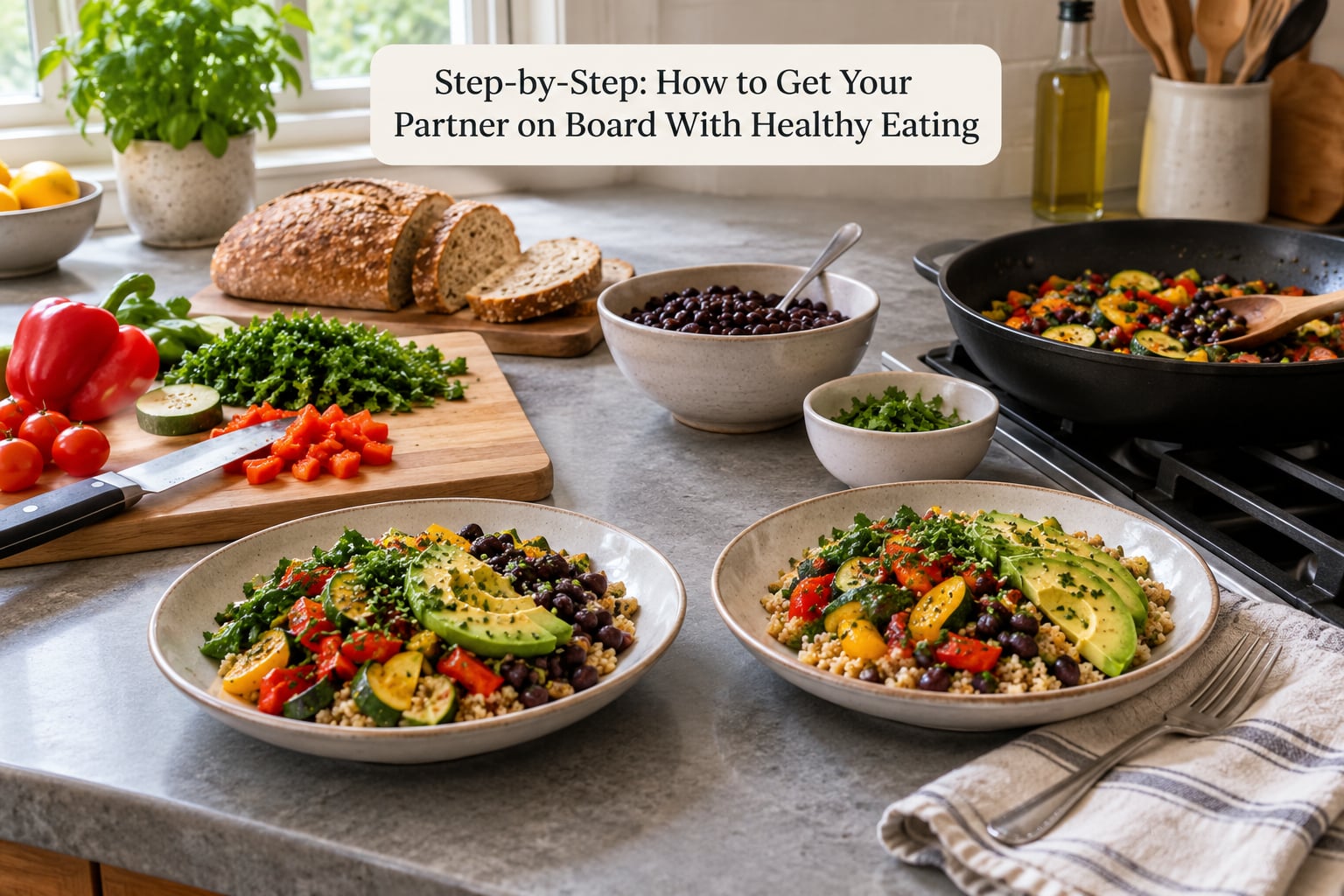
This is the compromise that survives months. Make a single meal — a stir-fry, a sheet-pan of chicken and vegetables, a pot of chili — and change the components each person adds. More vegetables and brown rice for you, extra rice and cheese for them. One cook, one sink, one meal, two plates.
Keep the seasoning and the base identical. When the food is basically the same food, people don’t feel like they’re being fed something different, and you haven’t cooked two dinners every night.
6. Support the change without policing it
Notice what’s working out loud. “That lentil thing on Tuesday was really good, I’m making it again” lands better than any lecture, and it gives them an easy way to agree without agreeing to anything. Praise the dish, not the body. Nobody wants to hear they’re “doing so well” when the real message is that you were watching their plate.
Then stop. The fastest way to turn a supportive partner into a controlling one is to keep scoring the effort.
7. Review after a month and keep only what felt sustainable
At the end of the month, ask two questions: what made this easier, and what was annoying? Keep the first list, drop the second. If the only thing that happened was that you ate better alone while they were annoyed, that’s still a win, and next month you try something gentler.
Most change shows up in two to three months, not two weeks, and taste usually shifts before habits do. Set the horizon at three months and judge the experiment at the end, not the first Tuesday.
Common Mistakes That Backfire (and what to do instead)
Setting an all-or-nothing rule — “you can’t ever have cake again.” One treat becomes a moral failure, and resentment shows up fast. Try a schedule you both chose instead: cake on Saturday, broccoli on Thursday. Nothing gets banned, so nothing has to be defended.
Commenting on their weight, body or appearance. Nothing shuts a conversation down faster than feeling judged, and nothing makes change less likely. Talk about your own health goals and let them decide whether their own come up.
Quietly swapping their food for “better” versions. It reads as control, and once they notice, every plate becomes a suspicion. Make the change in your own plate and let them ask if they want some.
Saying “you just need more willpower.” That ignores time, money, cooking skill and access, which are usually the real constraints. Ask what’s in the way and fix one of those things.
Moralising about food — “that stuff is poison.” Food becomes something to argue about rather than something to enjoy together. Describe what you like about your meals, not what’s wrong with theirs.
Doing all the work, then monitoring their plate. The workload imbalance becomes the argument, not the food. Share the cooking, and keep your own portions to yourself.
Treating it as a willpower problem
Willpower is the least interesting variable and the one people reach for first. Before you assume motivation is missing, check the boring explanations: the shift starts at 6 a.m., the commute is 45 minutes each way, the produce in this grocery store goes bad before anyone cooks it, the gym is a 20-minute round trip. Fix one of those and behaviour usually moves without a single motivational speech.
Forgetting that food is personal
What someone eats is tied to memory, money, identity and sometimes a long history of being told what to put on a plate. A partner who won’t eat your vegetables may not be refusing vegetables. Ask once, gently, why. Sometimes the answer is a comment from a parent twenty years ago, and suddenly the strategy is completely different.
Expecting the same pace from both of you
One of you might be ready for a big shift and the other might be in the “not interested, thanks” phase for months. That’s ordinary and it isn’t a verdict on the relationship. Decide in advance which parts of your routine are yours alone, and keep them small enough that maintaining them doesn’t feel like a second job.
Skipping the boring safety basics
Cooking more at home is one of the best things you can do for your household, and it comes with ordinary food-safety rules. Refrigerate perishables within two hours, use refrigerated leftovers within three to four days, and reheat them to 165°F until steaming hot. Whole cuts of meat and fish cook to 145°F, ground meat to 160°F, poultry to 165°F. Nobody in the household needs to get sick for the experiment to work.
Frequently Asked Questions
What if my partner refuses to discuss healthy eating?
Then don’t push the discussion. Ask once, calmly, and if the answer is no, leave it. Change what you buy and what you cook for yourself, keep it unannounced and unjudged, and let the shift speak for itself. Pushing past a refusal rarely changes minds; it usually only confirms to them that you are in charge of their plate.
How do I bring up weight loss without making my partner feel criticized?
Lead with your own reason rather than theirs. Say what you want to do and how you would feel about doing it together, and let them respond. Never reference their body, their plate or a number on a chart as the motivation. Shared reasons such as energy, sleep or a future goal travel much better than appearance-based ones.
What if we want different diets?
Cook one dish and change only the sides. A stir-fry, sheet-pan meal or pot of chili becomes two plates by adjusting what each person adds: more vegetables and brown rice on one side, extra rice, cheese or a different sauce on the other. When the base dish and seasoning are identical, two diets cost one dinner instead of two.
How can we make healthy eating easier when one person cooks?
Batch cook on one weekend day and freeze single portions, so most weeknights are reheating rather than starting. Then share the actual cooking rather than expecting gratitude. A second person chopping vegetables for twenty minutes on Sunday removes a real bottleneck, and it keeps the change from feeling like a favour one person is doing for the other.
Should I make healthier meals for my partner without telling them?
No. Quietly swapping someone’s food is control that they haven’t consented to, and once they notice, every plate becomes a subject of suspicion. Change your own meals openly, explain the reason once, and keep making enough for two in case they want some. Eating well next to someone relaxed about food is more persuasive than any substitution.
How long does it take for a partner to change eating habits?
Judge it in months, not weeks. Taste usually shifts within a few weeks of consistently eating a new way, but habits settle over two to three months of repeat meals. Some people lean in within a month; others take longer or decide they are content where they are. Set a three-month trial and decide together at the end.
Start With One Dinner This Week
Pick a night, cook a single dish that both of you can eat, and say nothing about it being a step in any direction. Do that twice before you have a conversation about it. If your partner never joins in, you have still changed your own habits, which was the part you could control anyway — and if they do join in, it happened without a single argument, which is the only way it tends to last.