Packing a work lunch that is not boring comes down to one thing: variety built from the same few components, not a new recipe every morning. Pick a filling base, add a protein, add produce, then finish with something crunchy and a sauce you pack separately. Rotate five of those combinations across the week and the 8am decision disappears.
That is the whole method. It takes about 30 minutes on a Sunday and five minutes a day to assemble, and it works whether you have a microwave, a fridge, or neither.
Table of Contents
- What You Need to Build Lunches That Are Not Boring
- The five food categories
- The gear that actually matters
- Two tiers of effort
- Step-by-Step: How to Pack a Work Lunch That Is Not Boring
- Step 1: Choose a Filling Base
- Step 2: Add Protein and Colorful Produce
- Step 3: Create Contrasting Flavors and Textures So Lunch Is Not Boring
- Step 4: Keep It Fresh and Enjoyable
- Common Mistakes That Make Work Lunches Boring or Bad
- Frequently Asked Questions
- What foods are best for a work lunch that stays satisfying?
- How can I pack a work lunch that is not boring when I only have a few minutes?
- How long can I safely keep a packed lunch in the refrigerator?
- Should I pack salad dressing separately, and what other foods should stay separate?
- How can I keep a packed lunch from getting soggy or wilted?
- Conclusion
What You Need to Build Lunches That Are Not Boring
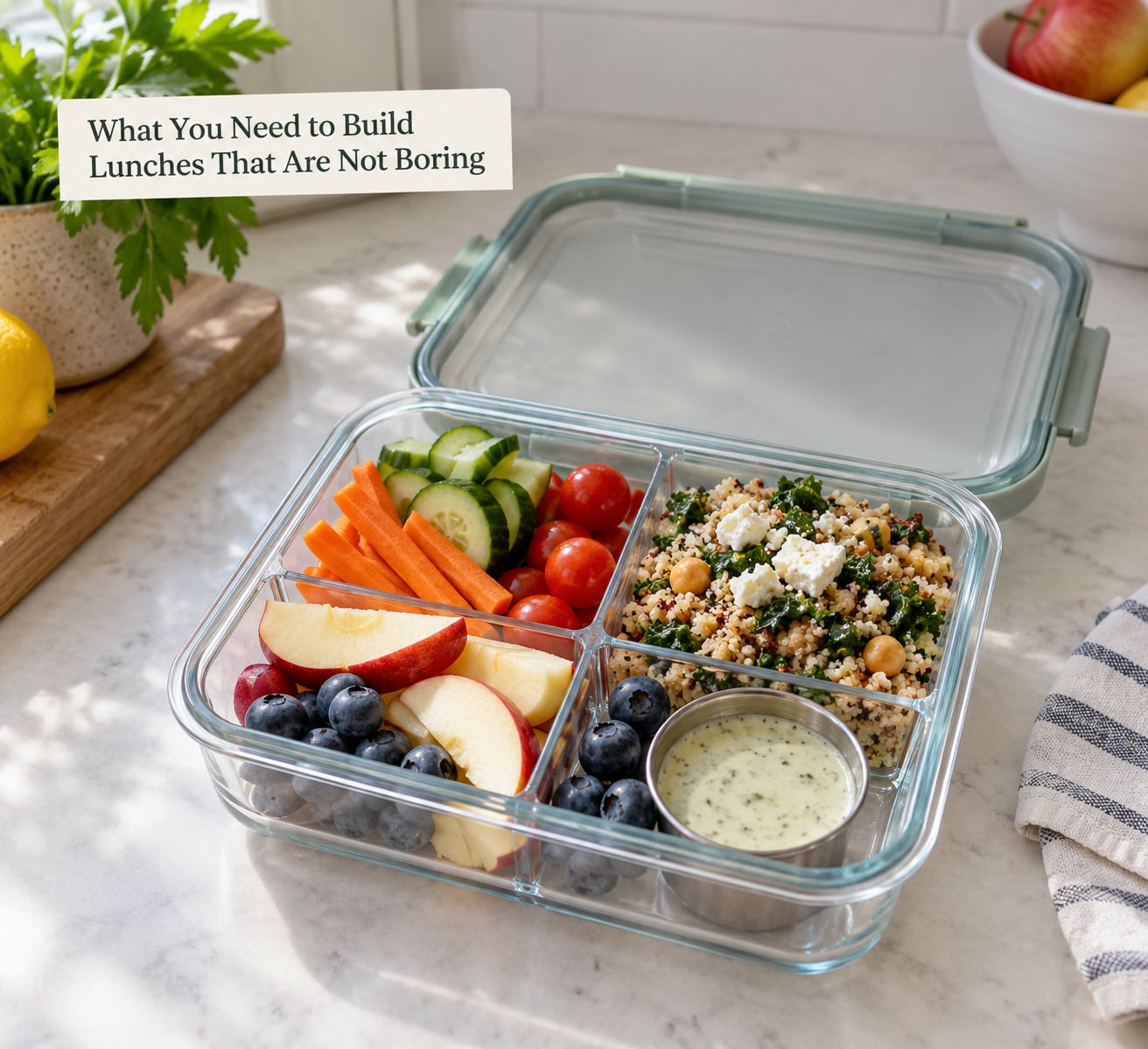
You do not need a pantry full of ingredients. You need five food categories you can swap, and four small pieces of gear that stop a good lunch turning into a bad one.
The five food categories
- A base. Something with weight and staying power: cooked grains, pasta, potatoes, rice, couscous, a tortilla, or a bed of greens.
- A protein. Eggs, chicken, tuna, salmon, chickpeas, beans, tofu, edamame, leftover meat, cheese, or a mix of nuts and seeds.
- Produce. At least two, ideally three: raw vegetables, roasted vegetables, fruit, pickles, or a quick-pickled batch made on Sunday.
- Something crunchy. Toasted seeds, nuts, roasted chickpeas, crisp cabbage or lettuce, sliced radish, tortilla strips, or a rye cracker.
- A sauce or dressing. Poured on at the last minute from a small jar, so nothing goes soggy at 12:30.
Every packed lunch is a combination of those five. Change one slot and the meal changes completely, which is how five lunches come out of one grocery shop without five separate recipes.
The gear that actually matters
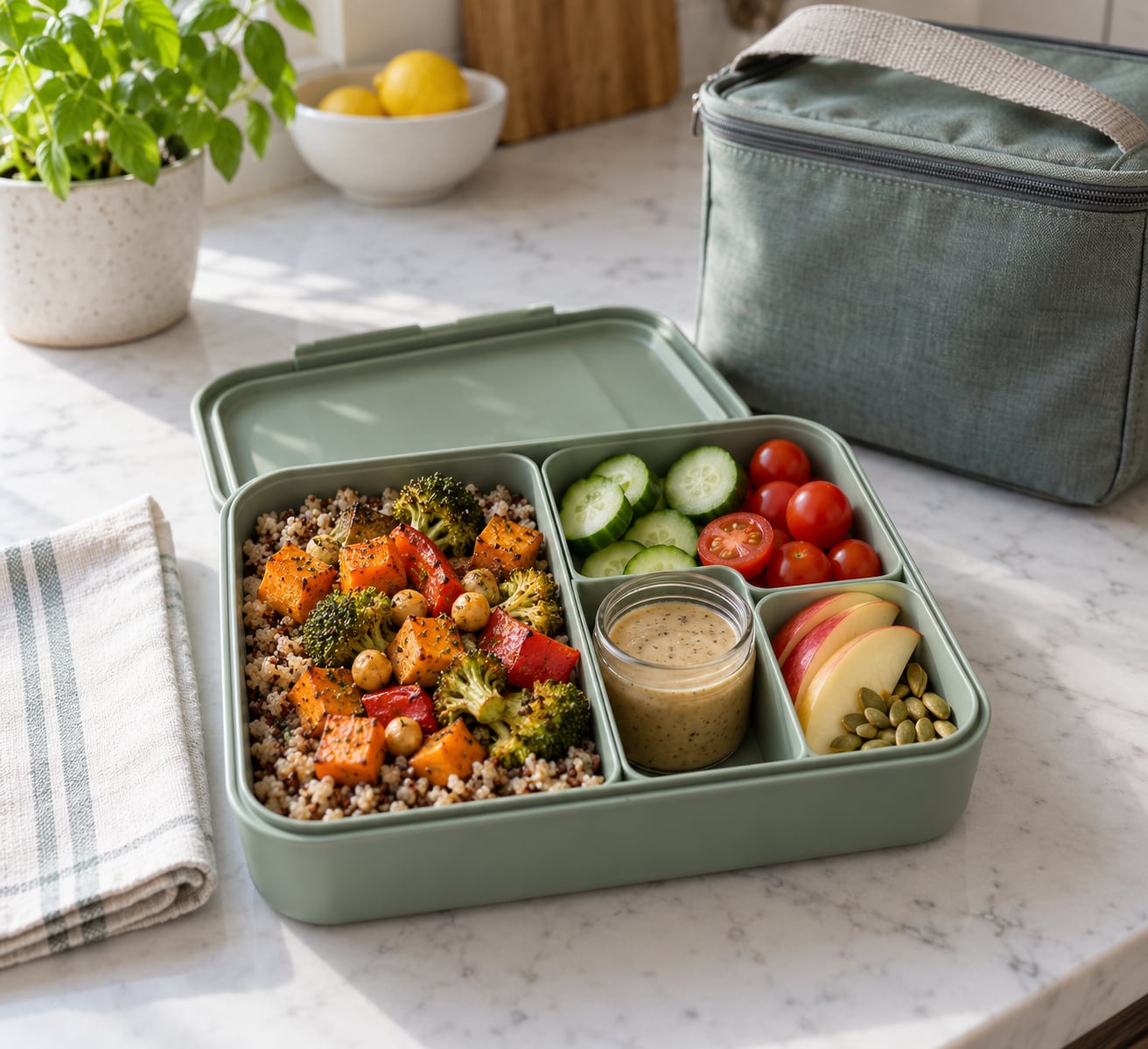
- A compartmented container. A leak-proof box with at least two sections is the single biggest upgrade. Wet items sit in the small section; the rest stays dry.
- A small sauce jar. Any leak-proof pot with a lid works. Dressing poured over everything at 7am is a soggy lunch by noon.
- An insulated lunch bag. Plus at least one ice pack if there is no fridge at work. Cold food keeps for a few hours in a cool bag.
- Cutlery, a small fork or spoon, salt, pepper and a squeeze of lemon. Eating chicken and rice with a plastic spoon, unwashed, is a fast route to quitting.
If you buy one thing, buy the compartmented container. Everything else can be improvised with what you already own.
Two tiers of effort
Some days you have five minutes. Some days you have thirty. Plan for both, or the system collapses the first busy Tuesday.
| Tier | When | What it looks like | Keeps |
|---|---|---|---|
| Five-minute assembly | Weeknights, no cooking | Pre-cooked base, tinned protein, raw vegetables, jarred dressing, crackers | 2 to 3 days in the fridge |
| Thirty-minute Sunday prep | Once or twice a week | Cook a grain, roast a tray of vegetables, boil eggs, mix one dressing, slice fruit | 3 to 4 days in the fridge |
| Freezer stash | Cooking anyway | Soups, curries, chili, muffin-style egg cups, portioned lasagne | 2 to 3 months frozen |
Freezing a couple of extra portions while you cook dinner on Sunday costs you nothing and gives you two lunches you did not have to think about.
Step-by-Step: How to Pack a Work Lunch That Is Not Boring
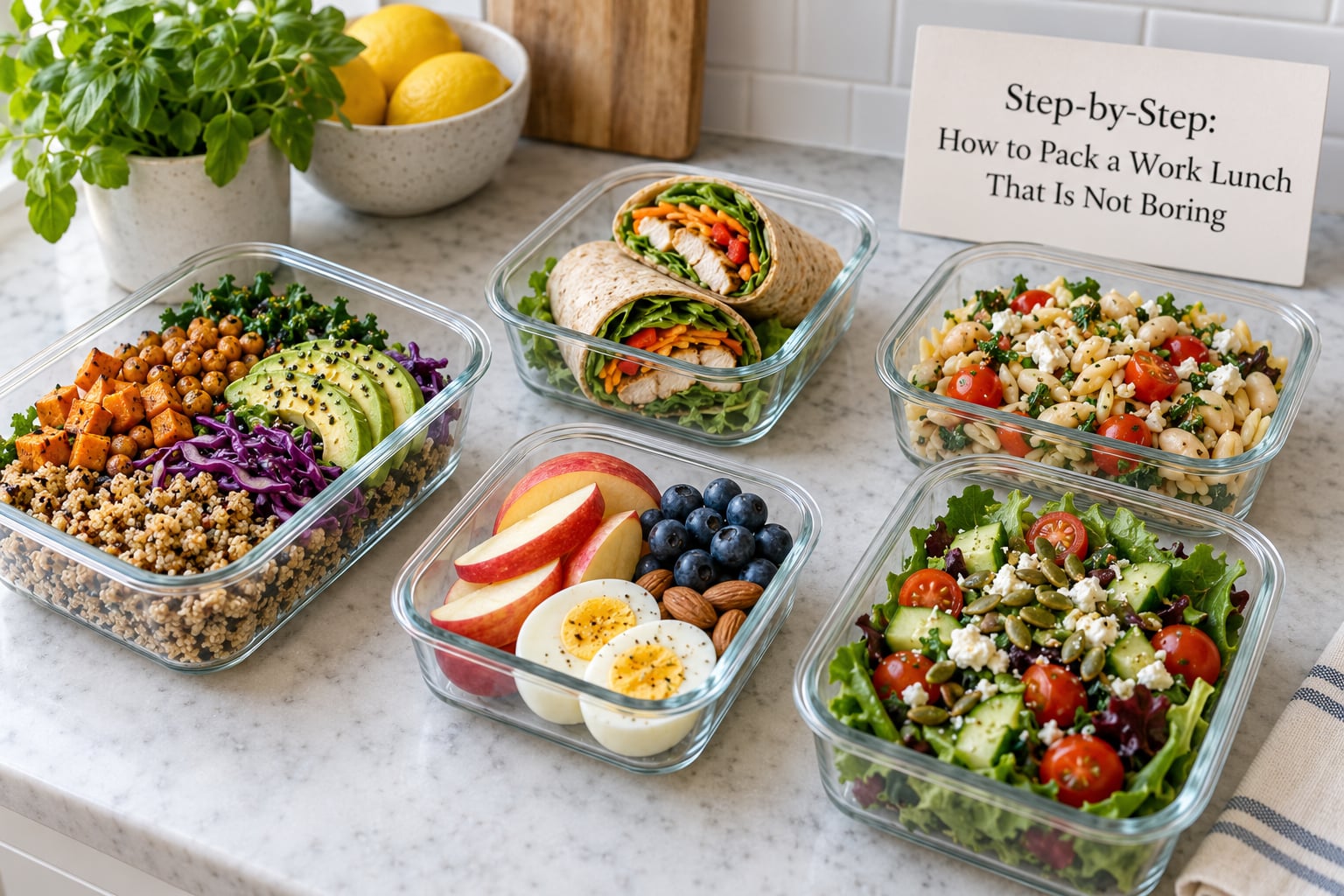
Follow the same four steps every time. The order matters, because each step fixes a specific reason lunches go flat.
Step 1: Choose a Filling Base
Start with something that stays satisfying at 1pm, when you are hungry but not starving. A base should hold together, taste fine plain, and not turn to mush by lunchtime.
- Grains. Rice, quinoa, couscous, farro or buckwheat. Cook a batch on Sunday and portion it out; grains are the cheapest way to get five different lunches from one pot.
- Pasta. Cook it a minute underdone and it holds its shape. Toss with a little oil and salt in the morning, sauce at lunch.
- Potatoes and roots. Roast a tray on Sunday. They are good hot or cold, travel well, and tolerate strong flavours.
- Tortillas and flatbreads. The fastest route to a different-feeling lunch, and they need no reheating at all.
- Leafy greens. Use sturdy varieties like romaine, kale or little gem as a base, not soft-leaf iceberg, which turns to water by noon.
You will know the base works if you are still full an hour later. If lunch leaves you hungry, the base is too light, and adding more dressing will not fix that.
Step 2: Add Protein and Colorful Produce
A base on its own is a side dish, not a meal. Add protein, then add two or three things with colour. That combination is what turns a pile of grains into something you look forward to opening.
Protein options that need almost no prep: tinned tuna or salmon, boiled eggs, jarred olives, jarred artichokes, chickpeas straight from the can, edamame, frozen edamame thawed in the morning, cubed cheese, leftover roast chicken, tofu, and nut butter rolled into a small log.
Produce is where most people give up. Cut it the night before, not at 6am. Carrot and cucumber sticks, cherry tomatoes, bell pepper strips, snap peas, radishes, grapes, orange segments, apple slices tossed in a little lemon juice so they do not brown.
Roasted vegetables are worth the ten minutes on Sunday. Squash, sweet potato, peppers, broccoli and cauliflower come out of the oven sweet and slightly chewy, and they hold up for four days in the fridge, which is longer than most raw vegetables.
Then add something sharp. Pickled onions, capers, a spoon of salsa, a wedge of lime, a few olives, or quick-pickled sliced radish. Sharp food wakes up a plain bowl faster than any amount of dressing, and it is the difference people notice most but rarely name.
Vegetarian and dairy-free versions follow the same shape: chickpeas or tofu for protein, roasted vegetables and raw crunchy vegetables for colour, tahini or a yogurt-based dressing on the side, pumpkin seeds for crunch.
Step 3: Create Contrasting Flavors and Textures So Lunch Is Not Boring
Most boring packed lunches are not bland in flavour. They are boring because everything in the box has the same texture. Soft, soft, soft, and a wet piece of lettuce on top.
Fix it by pairing opposites in at least two ways:
- Soft with crisp. A grain bowl with cucumber, radish or toasted seeds. Pasta with a rye cracker or a handful of roasted chickpeas on the side.
- Mild with bold. Plain rice next to a strongly flavoured protein: chilli tuna, curry-spiced chickpeas, pesto tuna, or a forkful of something salty.
- Sweet with savoury. Apple or pear with cheese, dried fruit with nuts, honey on a wrap with sliced turkey, roasted squash with a sharp dressing.
- Warm with cold. A warm grain or leftover alongside something straight from the fridge, which also keeps the meal from tasting flat at room temperature.
Then rotate. Here is a five-day version built from one Sunday prep session, where the base changes three times and the protein changes four:
- Monday, grain bowl. Rice, roast chicken, roasted squash, cucumber, pumpkin seeds, a lemon dressing in a jar.
- Tuesday, wrap. Wholegrain tortilla, hummus, sliced turkey or baked falafel, shredded cabbage, sweet chilli sauce packed separately.
- Wednesday, cold pasta. Pesto pasta with cherry tomatoes, mozzarella or edamame, a handful of arugula and a few crushed crisps in a separate pot so they stay crisp.
- Thursday, plate. Chopped salad built on romaine, tuna or three boiled eggs, olives, corn, radish, and a mustard dressing on the side.
- Friday, leftovers remix. Last night’s dinner turned into lunch: cold noodles with leftover stir-fried vegetables and a fried egg, or a leftover curry with fresh cucumber and lime.
Notice that Wednesday and Thursday use the same components as Monday in a different shape. That is the trick that makes variety cheap: you are not cooking five meals, you are assembling the same meal five ways.
One dinner can also become two different lunches. Roast a whole chicken on Sunday: eat it hot on Sunday, pack the sliced breast into a wrap on Monday, and turn the carcass and leftover bones into a pot of stock on Monday night that becomes Tuesday’s soup.
Leave one lunch slot a week open for buying lunch or eating with a colleague. Packing every single day is the fastest way to turn lunch into a chore, and the habit tends to last longer when one day is deliberately left open.
Step 4: Keep It Fresh and Enjoyable
Pack it well and the lunch survives. The packing order is simple: dressing and wet ingredients in the small compartment, protein and base in the large one, crunchy toppings on top, fruit in whatever section is left.
Choose sturdy vegetables over delicate ones. Carrot, cucumber, snap peas, peppers and broccoli hold their texture; soft lettuce, tomato and cucumber in a watery dressing do not. Pat produce dry before it goes in, and do not wash it and leave it wet.
Use the ice pack, and put the ice pack on top. Cold sinks. A leak-proof bag or a small container is worth ten minutes of your morning even on a mild day.
For food safety, the numbers are short and clear. Cooked leftovers stay safe in the refrigerator for three to four days, so prep Sunday and eat Wednesday at the latest. Perishable food should not sit at room temperature for more than two hours, and one hour if the day is above 90F. Reheat leftovers to 165F, and cook poultry to 165F, ground meat to 160F, and whole cuts of meat and fish to 145F.
Reheat only what you will eat. Food reheated twice goes dry, and half a container left on the desk until evening is a lunch you will not want, which defeats the point.
No microwave? Most cold packed lunches need none. Grain bowls, wraps, pasta, plates of chopped salad, sushi, fruit with cheese and nuts, overnight oats in a jar, and crackers with spreads all work at room temperature for a few hours in a cool bag with an ice pack.
No fridge either? The rule gets tighter. Pack food that is safe unrefrigerated: whole fruit, nuts, sealed crackers, shelf-stable bread, dried or roasted snacks, canned items opened into a sealed pot, and nut butter. Keep anything with meat, dairy, eggs or cooked rice on an ice pack and out for no more than two hours.
Hot-smelling food in a shared office is worth avoiding too. On a long shift, a thermos of soup or a wide-mouth flask for noodles solves both the microwave problem and the smell problem at once.
Common Mistakes That Make Work Lunches Boring or Bad
Packing only salad. A lettuce salad without a protein or a grain leaves you hungry by 3pm. Fix it by treating greens as the base and adding a protein, a grain and a crunchy element.
Pouring dressing on in the morning. Everything softens overnight, and by lunchtime the bowl is a swamp. Fix it by packing every sauce in a separate jar and letting the person eating decide how much goes in.
Forgetting protein. This is the most common reason a packed lunch is unsatisfying. Fix it by picking the protein first, before the vegetables, so the meal is designed around it.
Packing wet foods together. Rice stored in the same compartment as a marinade, or tomatoes on top of everything, wets the whole box. Fix it with the compartmented container and by packing wet items in the small section.
Eating the same combination every day. This is the boredom problem itself. Fix it with a rotation of five, and rotate the sauce first, because the sauce is the cheapest slot to change.
Packing food you already do not want. Packing it and then not wanting it is the complaint that ends most packing habits. Fix it by packing components rather than one finished dish, so the last ten minutes of assembly still gives you a choice.
Using soft produce. Soft lettuce, unripe tomato and wet cucumber slices turn limp by midday. Fix it by using sturdy vegetables, patting them dry, and keeping dressing sealed.
Frequently Asked Questions
What foods are best for a work lunch that stays satisfying?
Foods with protein, fibre and some fat stay satisfying longest, so a work lunch that is not boring needs all three. A grain or potato base, a protein such as eggs, chicken, tuna or chickpeas, and a raw or roasted vegetable will carry you to dinner. Whole wheat wraps and pasta work the same way. Very low-carb lunches, plain salads and anything made only of raw vegetables tend to leave people hungry within two hours, and that hunger is often mistaken for boredom the next day.
How can I pack a work lunch that is not boring when I only have a few minutes?
With five minutes, you are assembling, not cooking. Start from something already cooked, such as rice, pasta, leftover roast vegetables or boiled eggs, then add three components: a protein, a crunchy vegetable, and one jarred sauce. A wrap with hummus, sliced veg and crackers takes about two minutes. The key is changing the sauce and the base rather than trying to build something elaborate, since a new sauce makes the same lunch feel like a different meal.
How long can I safely keep a packed lunch in the refrigerator?
Cooked leftovers are generally safe in the refrigerator for three to four days, so a Sunday prep covers Monday through Wednesday comfortably, and Thursday with freezing. Perishable food should not sit at room temperature for more than two hours, or one hour above 90F. If a lunch has been in a cooler bag all morning, treat it as perishable and eat it the same day. Reheating to 165F makes it safe to eat.
Should I pack salad dressing separately, and what other foods should stay separate?
Yes, pack dressing in a leak-proof pot every time. Dressing is the main reason salads and grain bowls go soft and watery, and the person eating can add as much or as little as they want. Keep wet items like olives, pickles and marinated vegetables in the small compartment. Keep crunchy toppings like crackers, seeds and tortilla chips dry, and add them just before eating rather than on top of a moist dish.
How can I keep a packed lunch from getting soggy or wilted?
Separate wet from dry, use the smallest compartment for anything moist, and put fragile things where nothing sits on top of them. Choose sturdy vegetables such as carrots, cucumber, snap peas and peppers over soft lettuce, and store any leafy greens in a paper towel inside the fridge until the morning you pack them. Pat produce dry before packing it, and drain tinned ingredients properly, because the thin film of brine left behind is what wilts everything it touches.
Conclusion
Start with one base, one protein, two produce options and one contrasting flavor, then rotate them across the workweek. Pick three sauces rather than one, because the sauce changes the meal for almost no extra work, and pack it separately so nothing goes soggy.
Once that rotation is running, deciding what to pack takes five minutes, and the packed lunch stops being the thing you quietly resent about your working day.