
The calmest way to get back on track after a diet break is to stop treating the break as damage to repair, then rebuild one ordinary habit at a time. Most people lose ground in the first week back because they overcorrect, not because the break itself undid anything.
If you have eaten at maintenance for a fortnight, come home from a holiday heavier on the scale, or simply fell out of a plan, this takes about two weeks of ordinary effort. You will feel hungry for the first few days. That is normal, and it passes.
You did not reset your metabolism, you did not destroy your progress, and you do not owe your body a punishment week. Research supports the idea of planned breaks in dieting. The MATADOR trial (Byrne and colleagues, published in the International Journal of Obesity) put people on cycles of weight loss followed by two-week maintenance periods and found the drop in resting metabolic rate was no worse than with continuous dieting. A recent systematic review in Nutrition Reviews reached a similar conclusion about intermittent dieting with planned breaks.
This guide is written for adults, last reviewed in 2026, and covers eating, movement, sleep and how you measure progress. It is general information, not medical advice.
Table of Contents
- What You Need
- Step-by-Step: How to Get Back on Track After a Diet Break
- 1. Pause the Compensation Mindset
- 2. Check In With Your Body and Routine
- 3. Rebuild a Normal Meal Pattern
- 4. Add Flexible, Sustainable Movement
- 5. Use Portion Awareness, Not a New Rulebook
- 6. Set One Small Habit to Repeat
- 7. Plan for Future Breaks
- Common Mistakes
- Frequently Asked Questions
- When should I restart a calorie deficit after a diet break?
- How many calories should I eat in the first week back?
- Why is my weight higher after a diet break?
- How long does water weight take to come off?
- Why am I so hungry when I return to structured eating?
- When should I see a doctor or registered dietitian instead of adjusting my own plan?
- A Calm Return to Healthy Habits
What You Need
You need four things, and all of them are free.
A food and activity journal, even a notes app. Write down what you eat for a week. Most people are guessing at their intake by a factor of two, and the guessing is what makes restarting feel hopeless.
A regular meal pattern. Three meals and one or two snacks, at roughly the same times each day. Structure does more work than any single food rule.
Comfortable activity options. Shoes, a mat, whatever you actually used before the break. Restoring what you already have is easier than building something new.
A realistic definition of progress. Energy, sleep and clothes fitting the way you want beat a single number on a scale any day of the week.
Step-by-Step: How to Get Back on Track After a Diet Break
1. Pause the Compensation Mindset
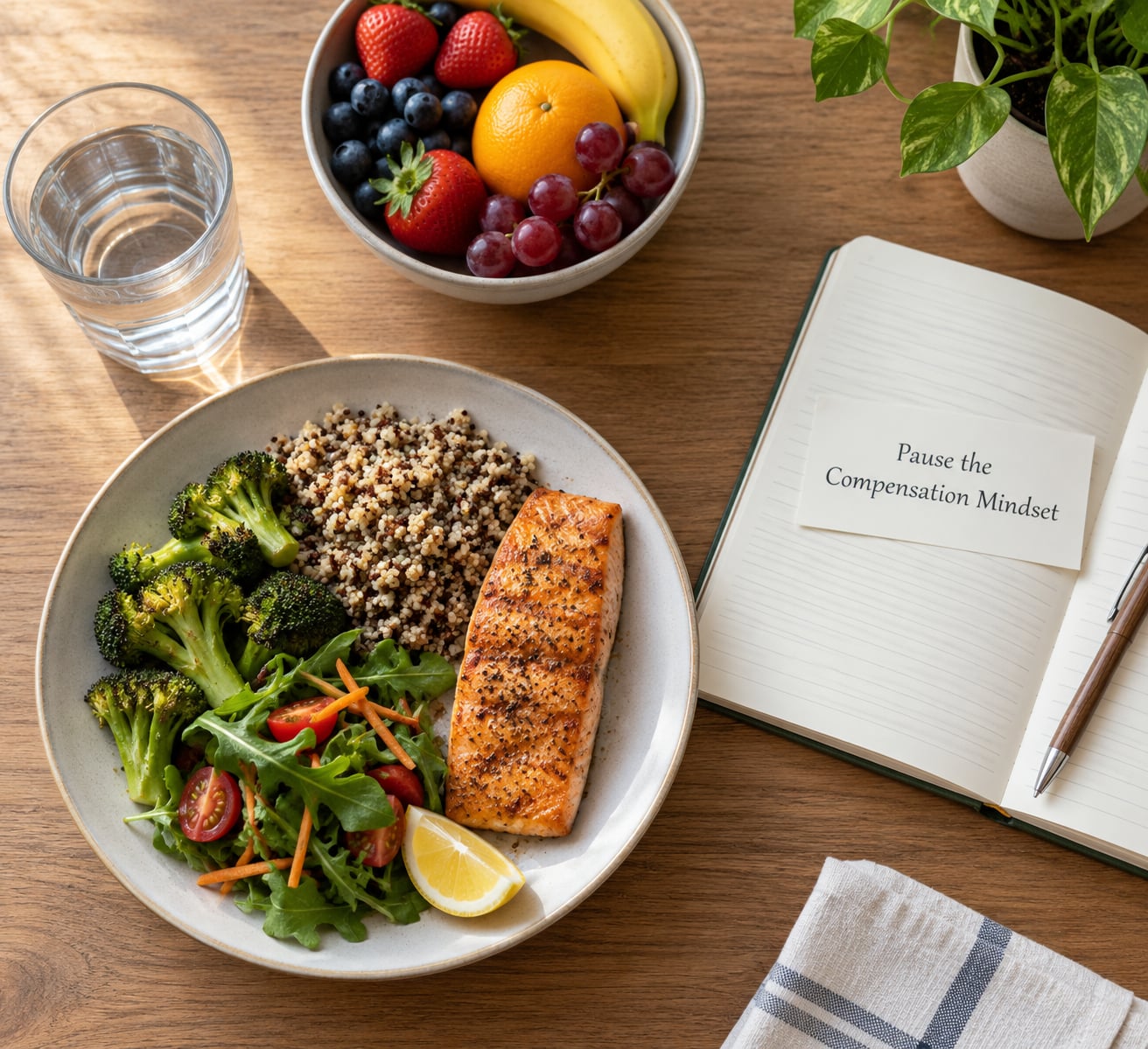
The first step is to do nothing aggressive for about three days. No fasting, no punishing sessions at the gym, no skipping breakfast to make up for dinner.
Skipping meals after overeating is the single most reliable way to end up hungrier two days later. On the r/loseit threads where people ask this question, the most common pattern is exactly that: determined in the morning, unable to stop snacking by nightfall.
Eat normal meals during these three days. Write down one or two things you noticed during the break, such as which meals you actually looked forward to or which evening habits broke down first. That is useful information. Treat it as data, not as a verdict.
2. Check In With Your Body and Routine
Before touching any number, check in with five things: energy through the afternoon, hunger between meals, sleep quality, digestion, and how your clothes fit.
These tell you far more than a weigh-in. Fat-free mass moves slowly, while sleep, stress and gut contents move overnight. A two-pound swing between mornings is usually water, sodium and gut contents rather than anything you ate.
One caution: if you have been weighing daily and reacting to each number, stop for these three days. Weighing is a tool, not a mood check. You can restart it once your eating has a rhythm again.
3. Rebuild a Normal Meal Pattern
Build each meal from four components: a protein source, a fiber-rich carbohydrate, vegetables or fruit, and a fat that makes the meal satisfying. Portions stay flexible.
Breakfast could be eggs, toast and fruit. Lunch is a grain bowl with chicken, chickpeas or tuna and plenty of vegetables. Dinner is the same template with a different protein. A snack is fruit with yogurt, or nuts with cheese.
Protein deserves particular attention. It keeps you full at a portion size you can actually maintain and protects lean mass while you are eating less overall. If your breakfast usually has none, that is often the first gap to close.
Do not set a calorie target in this section. Get the pattern stable first, then decide on numbers in week two.
4. Add Flexible, Sustainable Movement

Put movement back in the way you can repeat. Walking after dinner, two strength sessions a week, or a few minutes of stretching on the days you feel stiff all count.
A simple ramp: add ten to fifteen minutes of walking daily for the first week, then add a second or third session where you want it. Non-exercise activity, sometimes called NEAT, tends to matter more than people expect, because it happens without recovery cost.
If your weight, fatigue or schedule changes, adjust volume rather than intensity. Drop a set, shorten a walk, keep the frequency. The habit survives; the workout plan does not have to.
5. Use Portion Awareness, Not a New Rulebook
Another strict plan is the thing that just failed you. Replace it with awareness instead. Before eating, rate your hunger from one to ten. Eat at a pace where you notice fullness around seven, rather than eating to ten.
A practical method: fill half the plate with vegetables or fruit, a quarter with protein, a quarter with a carbohydrate, then add a small amount of fat. No weighing, no measuring cups, no banned foods on a list.
Favorite foods stay in. What you do on holiday is not a moral event, it is a fortnight of eating. The plan that leaves room for pizza is the one you will still be running months later.
6. Set One Small Habit to Repeat
Pick one behavior with the highest ratio of effect to effort. Eating a protein-rich breakfast. Walking for ten minutes after dinner. Planning tomorrow’s first meal the night before.
Track it as a simple yes or no for two weeks. That is enough, and it is the piece most people skip.
When you miss a day, restart the next scheduled instance rather than doubling up or starting over on Monday. One missed walk is not a broken streak. Nothing in this plan requires perfection, only repetition.
7. Plan for Future Breaks
Decide now what happens next time. A planned break has an end date written down in advance. An unplanned break, such as illness, a work trip or a rough month, gets a different rule: return to your normal meals at your next real meal, with no repayment.
For travel and holidays, keep two anchors. Eat a protein-rich meal once a day and walk twenty minutes. Two anchors survive a bad week in ways a full tracking system does not.
For emotional eating or a disrupted routine, plan for the aftercare rather than the streak. Decide in advance what a normal next day looks like, and treat relapse as a scheduled event rather than a personal failing.
Common Mistakes
Trying to erase the break. The fix is a forward-looking start rather than a look-back. What does lunch look like today?
Restarting an intense diet. Going straight back to your lowest previous number is the most common error, and it usually fails within a fortnight. Build back up gradually instead, letting appetite settle before restricting again.
Making weight loss the only measure. If the only thing being tracked is the scale, a normal water fluctuation reads as failure. Add at least two non-scale measures: energy, sleep, waist measurement, or how your workout feels.
Exercising through pain or exhaustion. Fatigue, poor recovery and persistent hunger are signs the plan is too aggressive, not signs to push harder. Ease the volume down and keep the habit.
Demanding immediate results. Weight after a break moves for reasons that have little to do with fat, then settles. Judge the plan on two to four weeks of trend data, not on Monday morning.
Assuming hunger means the plan is broken. Appetite rising after restriction is physiological and predictable. A slower rate of loss that you can sustain beats a fast one that ends in week three.
One tip that helps more than the rest: decide your first meal the night before. Restarting gets easier when the next decision is already made.
Frequently Asked Questions
When should I restart a calorie deficit after a diet break?
Most people wait three to seven days after the break ends, then return to structured eating at roughly maintenance for a week before trimming anything. That settling week lets water weight, digestion and appetite normalize, so your starting number is based on real data rather than a bloated reading. If the break turned into unplanned overeating, give it slightly longer and skip the calorie math entirely until regular meals feel normal again.
How many calories should I eat in the first week back?
For a planned break, return to approximately your maintenance calories first, then ease down toward your target over the following one to two weeks rather than dropping straight to your old number. If your weight changed during the break, recalculate maintenance based on your current weight, since a lighter body burns less and a heavier one burns more. Eating below maintenance from day one is the most common reason restarts collapse within a fortnight.
Why is my weight higher after a diet break?
Most of it is not fat. Refilling glycogen stores after eating more carbohydrates brings water with it, and higher sodium and larger meals add gut contents and fluid on top. Real fat gain would require a meaningful calorie surplus sustained over weeks, not a fortnight of normal eating. Expect the scale to look worse in week one than in week two, and read a weekly average rather than a single reading.
How long does water weight take to come off?
Most of the post-break increase clears within three to seven days once your carbohydrate intake and salt levels return to your usual range. Some of it lingers longer if sodium intake has been high, if you are new to strength training, or if you are retaining fluid for other reasons. If the number has not moved at all after two weeks of consistent eating and weighing, the cause is probably not water and your calorie estimate is worth revisiting.
Why am I so hungry when I return to structured eating?
Hunger rises during any extended deficit because hormones that regulate appetite move with the restriction itself, and after two weeks of maintenance those signals take a few days to reset. Hunger hormones are not broken, and this sensation does not mean your metabolism has crashed. Add protein, volume and fiber at each meal, keep meals regular rather than skipping, and give it one to two weeks before changing the plan.
When should I see a doctor or registered dietitian instead of adjusting my own plan?
Speak with a doctor or registered dietitian if you have a medical condition, are pregnant or breastfeeding, take regular medication, have a history of disordered eating, or want to make a large calorie change at once. Get prompt medical advice for fainting, dizziness, palpitations, persistent fatigue, hair loss, loss of menstrual periods, or any rapid unexplained weight change. These are not dieting problems to solve by adjusting macros.
A Calm Return to Healthy Habits
How to get back on track after a diet break is mostly about removing the drama. Three ordinary days of normal meals, one habit you can repeat, and movement you would happily do on a tired Tuesday will carry you further than a hard restart that lasts nine days.
Pick one thing to do today. Choose a regular meal time, a ten-minute walk, or a page of notes on what you ate yesterday. That is the whole assignment.
If you have a medical condition, are pregnant or breastfeeding, take regular medication, or have a history of disordered eating, talk to a doctor or registered dietitian before changing what you eat. Warning signs such as dizziness, fainting, persistent fatigue, hair loss or any rapid unexplained weight change deserve medical attention rather than a diet tweak.