One planned cheat meal will not ruin your weight loss progress. Weight change runs on weeks of averages, not single meals, so one higher-calorie meal shifts your week by a few hundred calories rather than undoing months of work. To learn how to plan a cheat meal without ruining progress, pick one meal in advance, budget for the extra calories across the rest of the week, build a plate that still has protein and vegetables in it, then go back to your normal meals at the very next sitting. Ten minutes of planning does most of the damage control.
The part that actually costs people progress is not the meal. It is the guilt spiral afterwards: a skipped breakfast, a punishing run on the treadmill, then another blowout on Friday. Plan the meal and the spiral never gets a foothold.
This guide is general nutrition information, not personal medical advice. If you have a history of disordered eating or binge eating, talk to a doctor or a registered dietitian before using any structured flexibility approach.
Last reviewed for 2026.
Table of Contents
- What You Need to Plan a Cheat Meal Without Ruining Progress
- The weekly calorie math, with real numbers
- Step-by-Step: How to Plan a Cheat Meal Without Ruining Progress
- 1. Choose One Planned Indulgence
- 2. Build a Balanced Plate Around It
- 3. Eat Mindfully and Stop When Satisfied
- 4. Return to Your Usual Routine the Next Meal
- If the cheat meal was unplanned
- Common Mistakes
- Frequently Asked Questions
- Can one cheat meal ruin my progress?
- How often should I have a cheat meal?
- Is eating 3000 calories on a cheat day bad?
- Can a cheat day help break a plateau?
- What should I do the day after an unplanned cheat meal?
- Does one higher-calorie meal slow down my metabolism?
- Conclusion
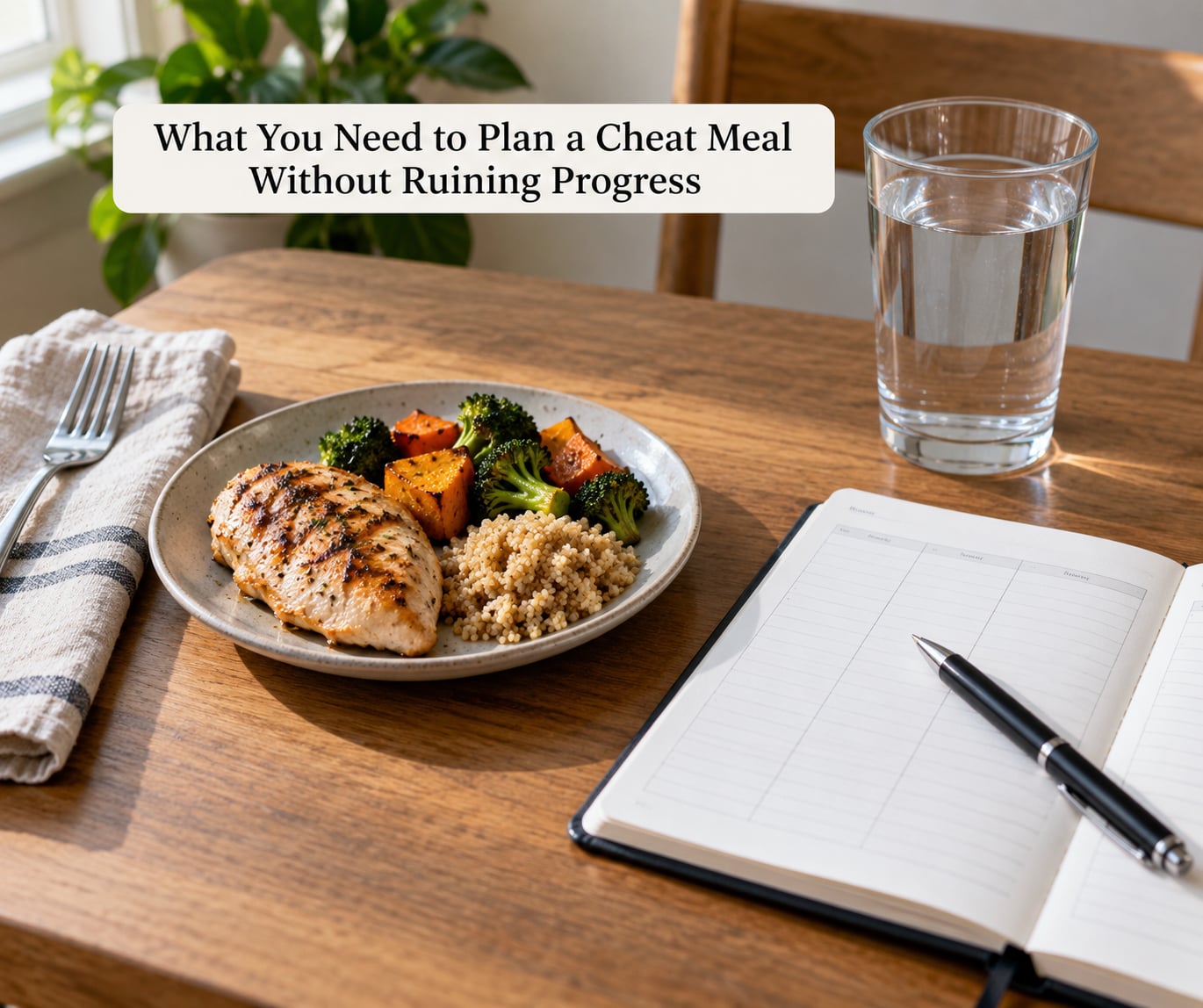
What You Need to Plan a Cheat Meal Without Ruining Progress
Start by retiring the word cheat. It frames food as something you are breaking rules about, and rules are exactly what you break when you are tired, hungry or at a birthday party. Dietitians more often talk about nutritional flexibility: eating planned amounts of what you actually like, on purpose, inside a weekly calorie budget.
The terms get mixed up constantly, so here is what each one means in practice.
Cheat meal — one planned meal that departs from your usual pattern. It is usually one to two hours long, decided beforehand, and roughly 300 to 1,000 calories above what you would normally eat for that sitting.
Cheat day — an entire day off-plan. The calorie swing is typically far larger, often 2,000 to 3,000 extra calories, and a large share of people who start there report it sliding into two or three days.
Refeed — a deliberately carb-forward meal or day used most often during a fat-loss phase to top up glycogen stores and appetite signals. It is smaller and more targeted than a cheat day, and it is timed rather than spontaneous.
Diet break — one to two weeks eating at maintenance calories instead of a deficit. Longer than a meal, structured rather than chaotic, and most often recommended every 6 to 12 weeks on a long diet.
Maintenance calories — the intake where your weight stays roughly steady. Working out this number is the part that makes everything else on this list easier, because a budget you can see is far easier to plan around than a vague sense of portion size.
So what do you need before you pick a meal? Five things.
First, your approximate maintenance calories. For a lot of adults this lands somewhere between 1,800 and 2,500, and it changes with your size, age and activity level. A rough starting point is your current weight in pounds multiplied by 14 for women or 16 for men, then adjust based on what actually happens to your weight over a couple of weeks.
Second, your weekly deficit. A common sustainable target is 300 to 500 calories a day below maintenance, which is roughly 2,100 to 3,500 calories a week. Bigger deficits lose faster on paper and end sooner in practice.
Third, a rough sense of your normal meals, so you know what your baseline for that time of day looks like.
Fourth, the occasion, if there is one. A birthday, a wedding, a holiday, a restaurant you have been meaning to try. Cheat meals attached to social events are far easier to keep to one meal than ones attached to a Tuesday.
Fifth, permission. Not permission to eat anything, but permission to enjoy one meal without earning it through hours of exercise. You are not paying a fine with cardio.
One more piece of context helps, and it is the framing most coaches land on eventually. The 80/20 rule treats a week as 80 percent on-plan eating and 20 percent flexibility. A single cheat meal sits comfortably inside that 20 percent, which is exactly why it does less damage than it feels like it should. A cheat day eats the whole week’s margin in one go. The research on flexible eating patterns has grown rather than shrunk, and the general direction of it supports the planned 20 percent over the daily one.
The weekly calorie math, with real numbers
Here is a worked example, illustrative rather than a prescription. Take an adult whose maintenance sits near 2,200 calories, eating in a 500-calorie daily deficit at roughly 1,700 calories a day. That is a weekly total of about 11,900 calories, or roughly 3,500 calories of deficit across the week.
A dinner out that comes in near 900 calories, when the equivalent home-cooked version would have been about 500, adds roughly 400 calories. To land the week back on target, you trim about 65 calories a day across the remaining six days. In practice that is a slightly smaller portion at dinner, a coffee without the pastry, or one skipped snack — tiny, ordinary adjustments rather than anything drastic.
For a bigger cheat meal, say one that runs about 1,200 calories above a normal version, the math gets less comfortable. Spreading 1,200 over six days means cutting 200 calories a day, which is a real adjustment and often makes the plan worse rather than better. That is the signal to scale the meal back or spread it across two lighter days instead.
The standard advice you will find on forums like r/loseit and r/WeightLossAdvice follows the same logic: budget 500 to 1,000 extra calories for the meal, then trim roughly 130 to 170 calories a day for the rest of that week. Plenty of long-term dieters there dropped all-or-nothing cheat days entirely and just budgeted the indulgence into the weekly allowance.
Step-by-Step: How to Plan a Cheat Meal Without Ruining Progress
This is the procedure. Work through it roughly a week ahead for social events, or the evening before for an ordinary weeknight.
1. Choose One Planned Indulgence
Pick the specific meal before you pick the food. A planned meal has a start and an end, which is what keeps it from expanding into a whole day of grazing. Decide the day, roughly the time, and the place.
Tie it to something if you can. Family dinner out, a birthday, the meal you always order on holiday. Scheduled indulgence is far easier to protect than the “I will just see what I feel like tonight” version.
Choose the food with a portion in mind. If the goal is a slice of pizza, one slice is a portion. If the goal is a whole personal pizza, that is the plan and the calorie estimate should reflect it. Vague intentions reliably turn into vague outcomes.
How you will know it worked: the decision took five minutes, not five hours of negotiation with yourself, and the meal had a defined start and end.
When should the meal land in the week? Later in the day works better than earlier, because an indulgence at breakfast tends to set an expectation for the rest of the day. Midweek suits people whose weekends are already busy with social eating. And if you train in the morning, putting the meal after training rather than before it makes the whole day easier to arrange.
2. Build a Balanced Plate Around It
An indulgence eaten on its own tends to pull in more around it. Start the meal with protein and vegetables, then move to the part you actually planned to enjoy. Order a protein-heavy starter, get the vegetables or salad first, and let the main event sit in the middle of the meal rather than at the front of it.
At restaurants: sauces and dressings on the side, one shared dish rather than three individual ones, and a decision made before the food arrives about whether you want dessert, a drink, or both. Two desserts planned is a planned cheat meal. Two desserts because they appeared is a different thing.
Protein matters here. A meal with a decent protein anchor alongside the indulgent part tends to land better and settle faster than the same indulgence on its own.
How you will know it worked: you finished the meal feeling satisfied rather than stuffed, and you did not need a second, unplanned meal afterwards.
3. Eat Mindfully and Stop When Satisfied
Pace is the practical lever. Most people eating a restaurant meal in under fifteen minutes comfortably finish the whole thing and then add more on top. Slowing down gives your fullness signals time to catch up, which is the whole mechanism.
Use a simple internal check rather than a food rule. Is the meal enjoyable right now? Would I enjoy a second bite as much as the first? Am I eating because the plate is there, or because I want to?
Satisfied is the target. Stuffed is overeating, and overeating is what triggers the next day’s regret. One plate to comfortable, then stop.
How you will know it worked: you stopped at a point you would happily repeat, and nothing automatic crept in afterwards.
4. Return to Your Usual Routine the Next Meal
This is the step that protects everything above it. At your next scheduled meal, eat what you normally eat, in roughly your normal amount. That is the entire protocol.
Do not skip the meal to make up for it. Skipping produces a hunger spike later in the day that usually ends in the thing you were trying to avoid. Do not add punishing exercise. A hard session the morning after a big meal is a punishment, and punishment is a poor long-term strategy because it reliably leads to another compensatory cycle. Researchers have looked at this directly: in the Biggest Loser study (Fothergill and colleagues, 2016), the participants who lost the most weight had the highest resting metabolic rates, and metabolism did not simply reset on demand afterwards.
Then look at your week as a total. One 800-calorie meal spread across seven days is roughly 115 calories a day, which is noise on top of a structured diet.
How you will know it worked: the meal after your cheat meal looked like every other meal that week.
If the cheat meal was unplanned
It already happened, and you are reading this with a heavy feeling in your stomach. Here is the recovery protocol people on r/loseit ask for most often and rarely get a straight answer to.
Eat your next scheduled meal as planned. Then the one after that. Nothing else. No fasting, no juice cleans, no doubling your workouts for a week, no dropping to the bare minimum of what you consider acceptable intake.
Notice the difference between a planned blowout and an unplanned slip. A planned blowout has a finish line. An unplanned slip is usually followed by guilt, which creates restriction, which creates the next uncontrolled meal. Recognising the slip as a single event, rather than evidence that the whole plan has failed, is what stops the chain.
If the unplanned eating was driven by stress, boredom or low mood rather than hunger, that is worth taking seriously. If it happens most days, speak to a doctor or a registered dietitian rather than trying to out-plan it with more rules.
Common Mistakes
Planning too much into one meal. The more food you put on a single cheat plate, the higher the chance of overshooting and the harder the recovery. If you genuinely want three things, split them across two lighter days rather than stacking them into one sitting.
Treating it as a cheat day when you meant a cheat meal. A day is a much larger calorie swing, usually 2,000 to 3,000 extra, and it is where the slide into day two starts. Pick the meal version unless your diet is short and you have a reason.
Using shame as the planning tool. Guilt after eating is the single most common complaint in weight-loss forums, and all-or-nothing thinking is the reason people lose weeks after one meal. Shame makes the next decision worse rather than better. The correction is boring: treat the meal as a planned event you can repeat.
Skipping meals to compensate. The panic about the day after is usually worse than the meal itself. Skipping leads to hunger-driven eating later, and the average of the week ends up less predictable than if you had simply eaten normally.
Trying to erase it with training. Exercise cannot reliably outrun a large meal in the direction people hope, and using it that way turns exercise into penance. The MATADOR trial (Byrne and colleagues, 2018) looked at alternating periods of a low-calorie diet and maintenance over a year and found sustained weight loss with better hormonal markers, which is a very different model from earning back food with workouts.
Doing it constantly. If a cheat meal feels like the only thing that makes food tolerable, the plan underneath is too restrictive. The fix is more structure and more flexibility at once, which sounds contradictory but works better than a rigid week punctuated by blowouts.
Using cheat meals to treat a plateau. They are not a reliable fix. A short diet break at maintenance, or a controlled carb-focused refeed, is the better-supported option if your intake has drifted far below maintenance. Research on metabolic adaptation, including the hormone signal work around leptin and appetite (Dirlewanger and colleagues, 2000), suggests that prolonged severe restriction changes hunger and satiety signalling rather than needing a single high-calorie day to reset it.
Using this approach with an eating disorder history. If you have a history of disordered eating, binge eating, or if eating plans trigger distress, skip this entirely and work with a doctor or registered dietitian. Flexible approaches can help some people, but they are not for everyone.
Frequently Asked Questions
Can one cheat meal ruin my progress?
No. Weight change follows weekly and monthly averages, not single meals. An 800-calorie meal spread across seven days works out to roughly 115 calories a day, which is small against a structured deficit. What damages progress is the pattern afterwards: guilt, skipped meals, punishing workouts and repeat blowouts. Plan the meal, keep the surrounding days roughly normal, and resume at the next meal.
How often should I have a cheat meal?
For most people, once a week is a reasonable upper limit, and once every one to two weeks works well for an ordinary routine. Social events get planned as they come up rather than added on top of a weekly quota. On longer diets, a structured diet break of one to two weeks at maintenance every 6 to 12 weeks is a better tool than frequent cheat meals.
Is eating 3000 calories on a cheat day bad?
A day at 3000 calories on top of a normal intake can add 2000 or more calories in a single sitting, which is more than a week of deficit for many people and takes real effort to absorb. It is not forbidden, but it is a poor tool for weekly control. A meal of 500 to 1000 extra calories fits a normal week far more comfortably.
Can a cheat day help break a plateau?
Occasionally it appears to work, but the mechanism is not a metabolism reset. Most of the benefit comes from breaking routine and from lifting mood, which can help you get back on plan. The better-supported options are a diet break of one to two weeks at maintenance or a controlled carb-focused refeed. If your intake has fallen well below maintenance, that is the problem to fix first.
What should I do the day after an unplanned cheat meal?
Eat your next scheduled meal as usual, in a normal amount, then carry on normally. Do not skip, fast, or add punishing workouts. Overcorrecting creates hunger that ends in a second uncontrolled meal, which is how one slip becomes a week. Notice whether the slip was driven by hunger or by stress, since the second one usually needs a different response.
Does one higher-calorie meal slow down my metabolism?
No. A single higher-calorie meal does not meaningfully change resting metabolic rate. Metabolic adaptation develops over weeks or months of prolonged severe restriction, not over one sitting. The Biggest Loser study found metabolism tracking body size rather than resetting on demand, which is why maintenance calories fall as you lose weight and an intake that was right months ago may no longer be the right target now.
Conclusion
If you do one thing, plan the next meal: choose the day and the food, decide the portion, and eat a normal plate around it. Then return to your usual meals at the next sitting and let the rest of the week stay ordinary. That single habit, applied consistently, is how to plan a cheat meal without ruining progress — because the progress was never at risk in the first place.
For anything medical, or if past eating has been difficult in a way that worries you, talk to a doctor or a registered dietitian before making changes.