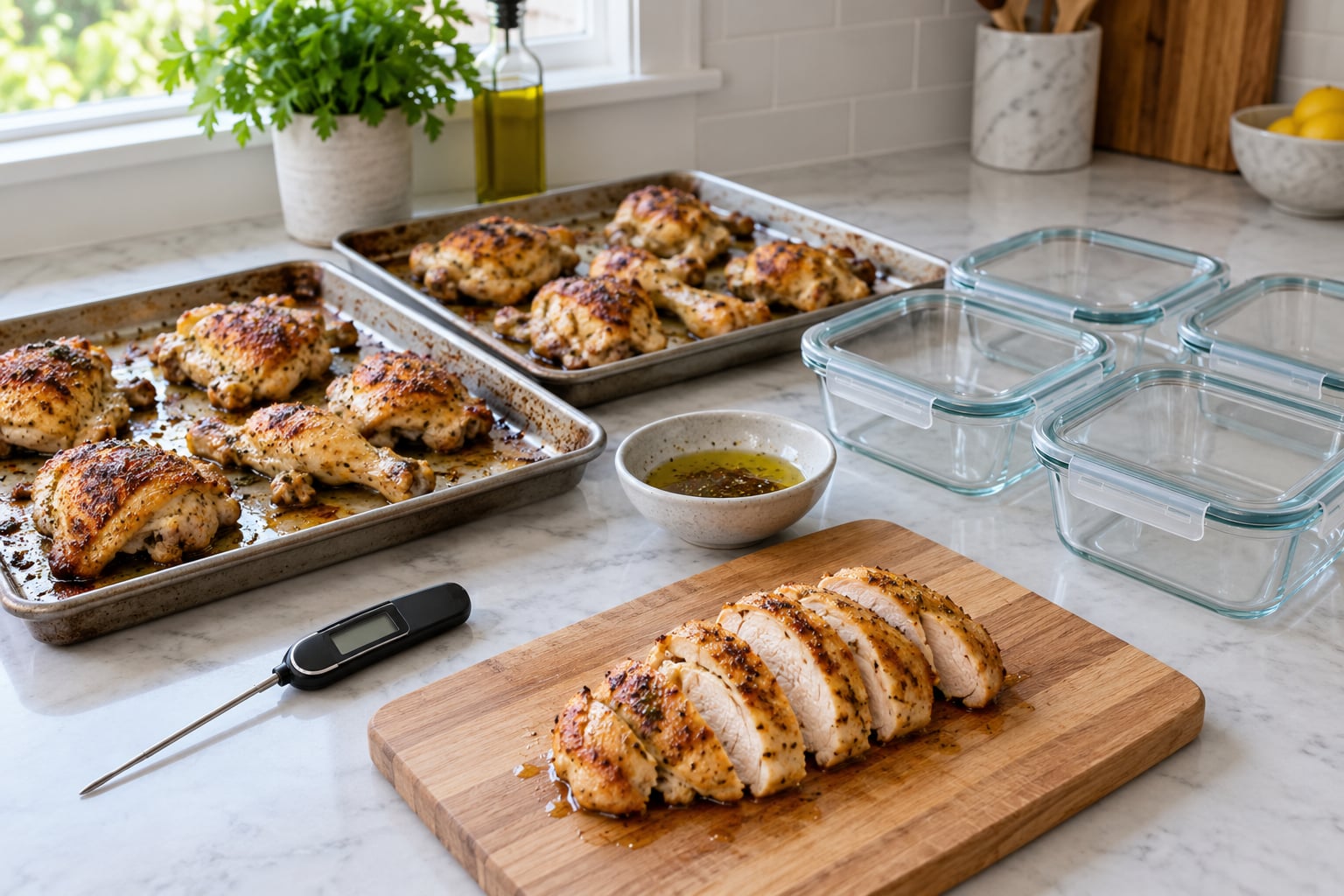
How to batch cook chicken for the week comes down to one cooking session, a thermometer, and about forty minutes of portioning. You cook 4 to 10 pounds of chicken in a single oven or slow-cooker run, let it cool quickly, then divide it into containers sized for the meals ahead. Doing it this way means you are not deciding what to cook at 6pm on a Tuesday.
The part that trips people up is not the cooking. It is the math before it, the cooling after it, and reheating that does not turn everything rubbery. Get those three right and the week is basically handled.
Table of Contents
- What You Need
- Step-by-Step: How to Batch Cook Chicken for the Week
- 1. How to Figure Out Portion Size for Meal Prep
- 2. Prep and Season the Chicken
- 3. Cook the Chicken Safely to 165F
- 4. Cool and Store the Chicken
- 5. Portion and Reheat Throughout the Week
- Common Mistakes
- Frequently Asked Questions
- How long does batch-cooked chicken last in the fridge?
- Can I freeze cooked chicken for meal prep?
- Is chicken breast better than chicken thighs for batch cooking?
- How do I keep batch-cooked chicken from drying out?
- Can I batch cook chicken with vegetables?
- What is the safest way to reheat cooked chicken?
- Conclusion
What You Need
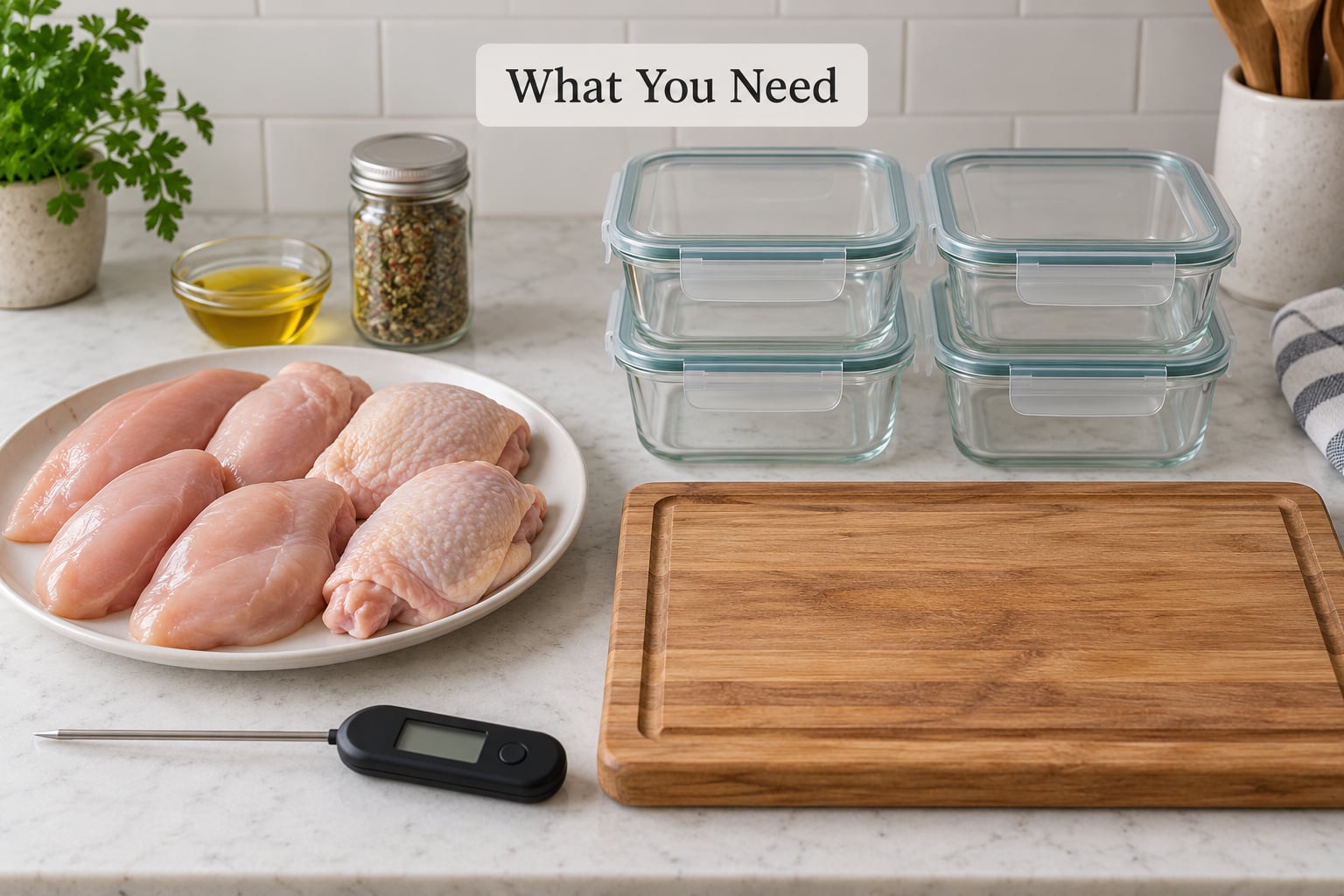
Chicken first, then a cut decision. Boneless skinless chicken breasts cook fast and slice cleanly, which suits grain bowls and wraps. Boneless skinless thighs cost less, forgive overcooking and stay juicy after a microwave reheat. Bone-in drumsticks work too, but you are paying for bones and portions land unevenly.
Plan on 3 to 4 ounces of cooked chicken per person per meal. That is roughly the size of a deck of cards, and it is the number most home cooks settle on once they realize a single serving is smaller than they pictured.
For the rest of the session you want:
- A neutral oil such as olive, canola or avocado, about 1 tablespoon per pound
- Salt, black pepper, garlic powder and whatever profile you are chasing this week
- An instant-read thermometer. This is the one tool that separates good results from timer roulette
- A rimmed sheet pan or two, ideally foil-lined for cleanup
- A large cutting board and a sharp knife
- Airtight containers sized for single meals rather than one big family tub
- Ice or a bowl of ice water for cooling, plus freezer bags and a marker for the freezer batch
Shallow containers matter more than people expect. A deep pile of chicken cools from the middle outward, and the center sits in the danger zone far too long. Most of what goes wrong in how to batch cook chicken for the week traces back to a throwaway tub and a timer instead of a thermometer.
Step-by-Step: How to Batch Cook Chicken for the Week
1. How to Figure Out Portion Size for Meal Prep
Multiply first, then buy. Count the meals you need across the week, not the days, because breakfasts and snacks do not use the same chicken.
| Household | Meals covered | Raw chicken needed | Cooked yield |
|---|---|---|---|
| 1 person | 5 meals | 2 lb | about 8 to 10 portions |
| Couple | 10 meals | 3.5 lb | about 16 to 20 portions |
| Family of 4 | 20 meals | 7 lb | about 32 to 40 portions |
| Family of 4, lighter portions | 20 meals | 5 lb | about 24 portions |
| Family of 6 | 30 meals | 10 lb | about 48 portions |
A rough rule works fine when you do not want to weigh anything: raw chicken loses about 25 percent of its weight to water, so 4 ounces raw yields roughly 3 ounces cooked. To feed four people a full week of chicken, cook between 5 and 7 pounds.
2. Prep and Season the Chicken
Heat the oven to 400F while you prep. Pat every piece dry with paper towels, then pound thicker breasts to an even thickness or slice them horizontally. Even thickness is the single biggest reason a sheet of chicken cooks evenly instead of having dry edges and a raw middle.
Toss the chicken with oil, salt, pepper and garlic powder as the base. Add a spice profile per tray if you want one batch to cover several cuisines: one tray with smoked paprika and cumin, another with Italian herbs and lemon zest, a third plain with just salt and pepper for the picky eater at the table.
Skip the overnight acid marinade when the chicken is going into a container for later. Marinades with vinegar, citrus or yogurt tenderize the surface, and that tenderized surface turns mushy after three days in the fridge. Use a quick 30-minute marinade if you like, or add acid fresh at eating time.
Arrange the pieces on the pan in a single layer with no overlap and no crowding. If two trays will not fit, cook them in two rounds rather than stacking.
3. Cook the Chicken Safely to 165F
Poultry must reach an internal temperature of 165F or 74C. Check the thickest piece with the instant-read thermometer, and check more than one piece, because a single reading tells you about one piece.
For chicken breast, pull it off the heat at 160F and let carryover heat finish the job during the rest. For thighs, you can go straight to the probe reading with no drama.
| Method | Time at 400F or equivalent | Batch size | Best for |
|---|---|---|---|
| Oven sheet pan | 18 to 25 minutes for breasts | 3 to 5 lb per pan | Even cooking, easy cleanup, neutral flavor |
| Oven sheet pan, thighs | 30 to 38 minutes | 4 to 6 lb per pan | Moist, forgiving, reheats well |
| Broiler | 8 to 12 minutes, second rack down | 2 to 3 lb | Fast browning, watch it closely |
| Slow cooker on low | 4 to 6 hours | up to 5 lb | Hands off while you do other prep |
| Air fryer | 10 to 14 minutes at 400F | 1.5 to 3 lb | Small batches and quick re-crisping |
| Stovetop skillet | 6 to 8 minutes per side | up to 1.5 lb | Fast, needs a crowded-pan watch |
A slow cooker earns its counter space in this job. Cook thighs low and slow with a little liquid and the batch largely cooks itself while you roast a tray of vegetables, and there is nothing to watch or judge.
Rest the chicken 5 to 10 minutes after it leaves the heat. Slicing straight out of the oven squeezes the juices out and onto the board.
4. Cool and Store the Chicken
Do not put a steaming tray straight into the fridge. Break the chicken into pieces, spread them in shallow containers or spread them on a rack over a tray, and get them into the refrigerator within 2 hours of finishing. The USDA treats that two-hour rule as a cornerstone of safe leftover handling.
| Storage method | How long it keeps | Container and packing |
|---|---|---|
| Refrigerator | 3 to 4 days | Airtight, shallow, single-meal portions |
| Freezer, best quality | 2 to 3 months | Freezer bags pressed flat, labeled with date and meal |
| Freezer, safe window | up to 4 months | Same method, quality starts dropping after month 3 |
| Cooler, packed with ice | Same day only | For transport, not for a week of lunches |
Plan a Sunday cook for a Monday to Thursday week. That keeps every container inside the 4-day window with nothing sitting past its best texture. For a full seven days, freeze the pieces you will not eat in the first four.
5. Portion and Reheat Throughout the Week
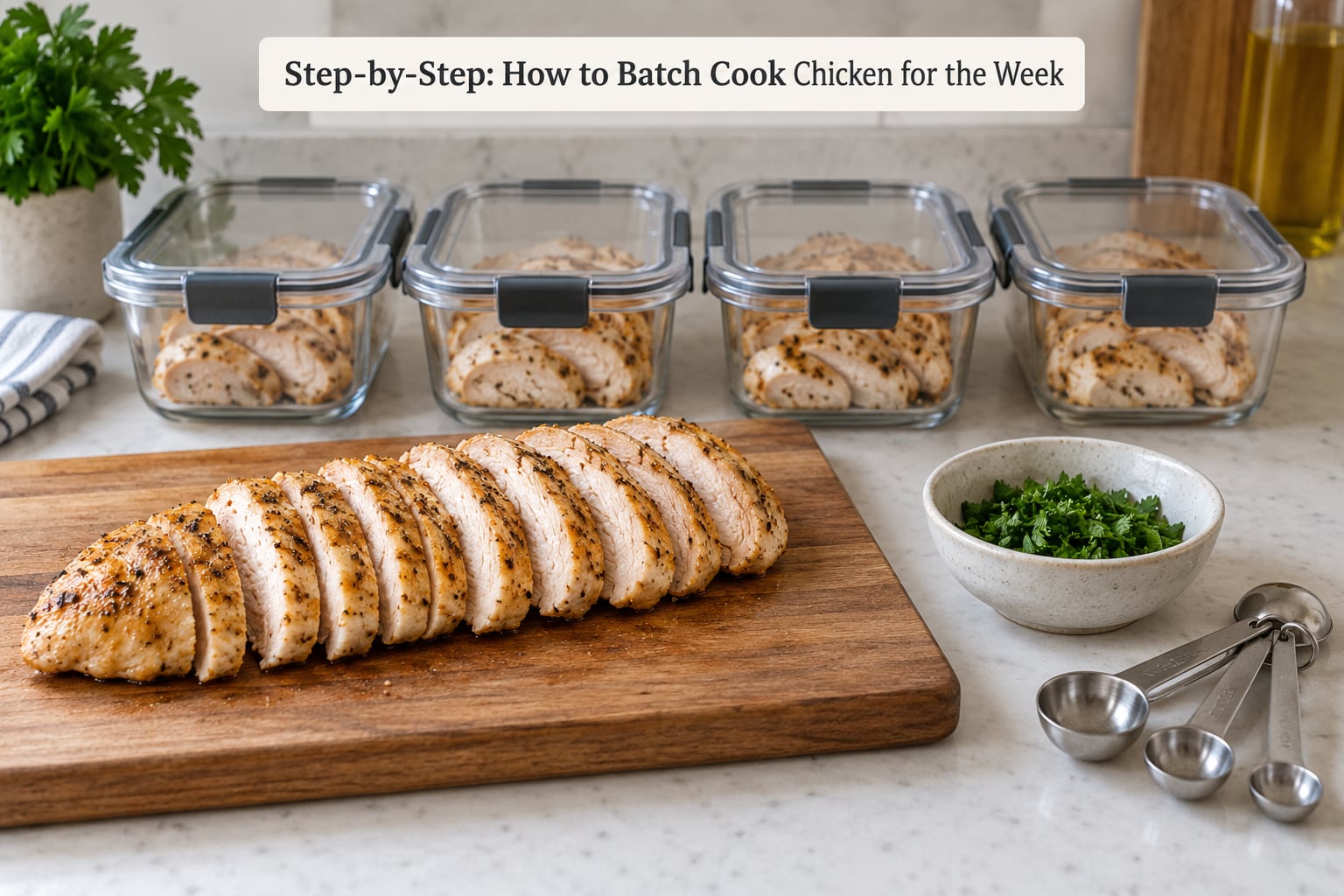
Slice or shred once the chicken is cool enough to handle. Slicing keeps a clean shape for bowls and plates, and shredding mixes better with saucy dishes like chili, soups and stir-fry. Both freeze well, so portion them the way you will actually eat them. Then label every container with the day it belongs to, because an unlabeled tub is how a week of prep turns into a week of bin.
Keep sauces, dressings and salsa in separate small containers. Chicken that sat submerged in dressing for three days is chicken nobody wants on day four.
For reheating, add a small splash of broth, water or butter to the container and cover it loosely. Microwave on 50 percent power in two short bursts rather than one full-power cycle, and stir in between. A skillet over medium-low heat with a lid and a tablespoon of broth gives you the best result, and a low oven works too if you have a few extra minutes.
The practical rule is simple: either pull the chicken slightly early the first time or reheat it gently with some moisture. Thighs are far more forgiving than breasts here, and both halves of that matter.
One last habit: thawing frozen portions in the fridge the night before beats thawing them on the counter, which is a two-hour rule violation waiting to happen.
Common Mistakes
| What went wrong | Cause | Fix |
|---|---|---|
| Dry, shrunken chicken | Cooked past 165F or reheated at full power | Pull breast at 160F, rest it, reheat at low power with a splash of broth |
| Rubbery or chewy texture | Uneven thickness, or slicing with no rest | Pound or butterfly to even thickness, rest 5 to 10 minutes |
| Pale or flat flavor | Underseasoned, or sauce sat on it for days | Salt before cooking, add acid and sauce at eating time |
| Crowded pan | Steam instead of browning, uneven cooking | One layer per pan, rotate racks halfway, cook in two rounds if needed |
| Skipped the thermometer | Timer guesses, and pans vary | Probe the thickest piece on every check, not just once |
| Warm center in the container | Deep containers cool too slowly | Shallow portions, refrigerate within 2 hours, ice bath if the batch is large |
| Soggy or mushy after 3 days | Acidic marinade stayed on cooked meat | Skip acid marinades for storage, add citrus or vinegar fresh |
| Tough after freezing | Reheated straight from frozen with no liquid | Thaw overnight, reheat gently with broth or butter |
One safety note worth repeating, since it comes up constantly: do not rinse raw chicken before cooking. Washing splashes raw bacteria across the sink and the counter, and the heat of cooking is what kills it. Pat it dry with paper towels instead, which also helps browning.
Frequently Asked Questions
How long does batch-cooked chicken last in the fridge?
Cooked chicken keeps 3 to 4 days in the refrigerator at or below 40F, which is the USDA and FDA window most meal-prep guidance uses. If you cooked on Sunday, eat it Monday through Thursday. Container depth changes the clock: shallow, single-meal portions cool fast and hold their texture for the full four days, while a deep family tub can taste tired by day three. Anything past day four belongs in the freezer.
Can I freeze cooked chicken for meal prep?
Yes, and frozen chicken reheats better than most people expect if you do it right. Cool the chicken fully, divide it into single-meal portions, press freezer bags flat so they stack, and label each with the date. Frozen cooked chicken keeps its best quality for 2 to 3 months and stays safe longer. Thaw in the fridge overnight, then reheat with a splash of broth so it does not turn tough.
Is chicken breast better than chicken thighs for batch cooking?
Neither is better; they suit different weeks. Breasts cook in 18 to 25 minutes, cost more per ounce and slice cleanly for salads and wraps, but they punish overcooking. Thighs take 30 to 38 minutes, run cheaper and tolerate reheating far better because of their higher fat content. If your week includes lunches that get microwaved, thighs are the safer pick for most households.
How do I keep batch-cooked chicken from drying out?
Four habits do most of the work. Pound thick breasts to an even thickness so they finish cooking together, pull breast off the heat at 160F and let carryover heat carry it to 165F, store it in shallow containers instead of one deep pile, and reheat with a splash of broth or butter under a lid at reduced power. Thighs reheated the same way stay noticeably juicier than breasts.
Can I batch cook chicken with vegetables?
Yes, and it saves the most time of any trick here. Roast the chicken on a bed of chopped vegetables and let them steam, or put the tray in while you cook grains on the stove. Cut the vegetables into the same size as each other, or they will be done at wildly different times. One caution: crowded pans steam instead of browning, so use a second tray if the vegetables form a layer more than one piece deep.
What is the safest way to reheat cooked chicken?
Reheat only what you plan to eat and bring the temperature to 165F. The microwave is fine at reduced power with a splash of liquid and a loose cover, stirred halfway through. A covered skillet over medium-low heat gives a more even result with less moisture loss. Reheating straight from frozen works, but moving the portion to the fridge first produces noticeably better texture.
Conclusion
Start with the count, not the pan. If you take one thing from how to batch cook chicken for the week, make it this: count the meals your household actually needs, buy 4 ounces of raw chicken per person per meal, and season a neutral base with one spice track on the side for variety.
Then cook to 165F with a thermometer rather than a timer, rest the chicken, get it into shallow containers inside two hours, and freeze whatever will not be eaten within four days. Reheat with a splash of broth and a loose cover, and the week takes care of itself.