Learning how to shop the perimeter of the grocery store is mostly about the route you walk, not the rules you memorize. Fresh produce, bakery, deli, meat and seafood, dairy, eggs and frozen foods sit along the outer walls; the center aisles hold the canned, boxed and packaged stuff. Go around the outside, pick cold items last, and your cart fills with food you will actually cook.
It takes about 30 to 45 minutes for a normal weekly shop once you know the loop, and the first few trips feel like a scavenger hunt. Then it becomes the fastest way I know to get balanced food into the house without a fight at the checkout.
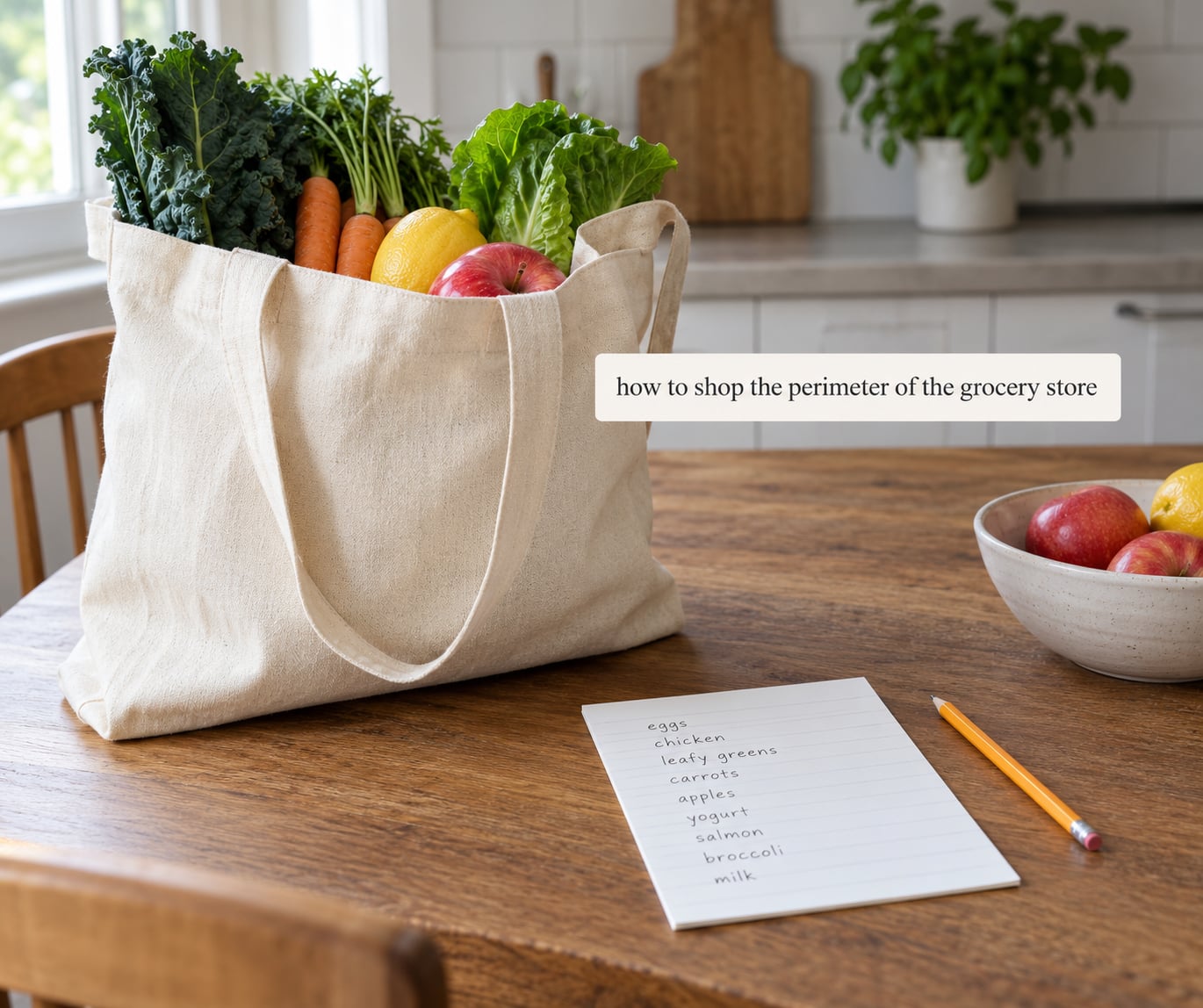
Table of Contents
- What You Need
- Step-by-Step: How to Shop the Perimeter of the Grocery Store
- 1. Start with produce and buy only what has a meal attached
- 2. Choose a protein source with a plan for cooking it
- 3. Add whole grains and other starches
- 4. Pick healthy fats and a few useful extras
- 5. Check labels without turning shopping into homework
- 6. Use the store layout to keep your perimeter shop balanced
- 7. Plan meals before checking out
- 8. Review the basket before paying
- Common Mistakes
- Frequently Asked Questions
- What is the perimeter of a grocery store?
- Why should you shop the perimeter of a grocery store?
- Is shopping the perimeter of the grocery store cheaper?
- Do I have to give up frozen and canned food if I shop the perimeter?
- What are the 5 4 3 2 1 rule and the 3 3 3 rule for groceries?
- How do I use the perimeter method in a store with a different layout?
- Conclusion
What You Need
You need three things before you walk in, and none of them are a nutrition textbook.
A list tied to meals, not to items. Write down four or five dinners and two lunches, then name the ingredients. Chicken, rice, peppers, yogurt, oats. An ingredient list produces a cart you can cook from; an item list produces a cart full of condiments and nothing to put them in.
A way to carry it all. Reusable bags for the perimeter goods, and a hand basket or insulated tote if you are driving a long way home. Cold items go in the tote so they are not sitting on a warm dashboard for 40 minutes.
An actual meal-planning habit, however loose. Fifteen minutes on a Sunday beats any app. Most perimeter failures I have watched happen because someone bought a beautiful pile of produce with no dinner attached to it, and three days later it was compost.
And go fed. A hungry shopper is a person who eats a sample tray, then buys a bag of tortilla chips to go with the samples. This one is the least glamorous tip on the list and probably the most effective.
Step-by-Step: How to Shop the Perimeter of the Grocery Store
Start at produce and walk one direction around the store. Go back the way you came, in the same direction, every trip, until the route stops requiring thought. Cold items last, always, because the longer they sit unrefrigerated the shorter they last.
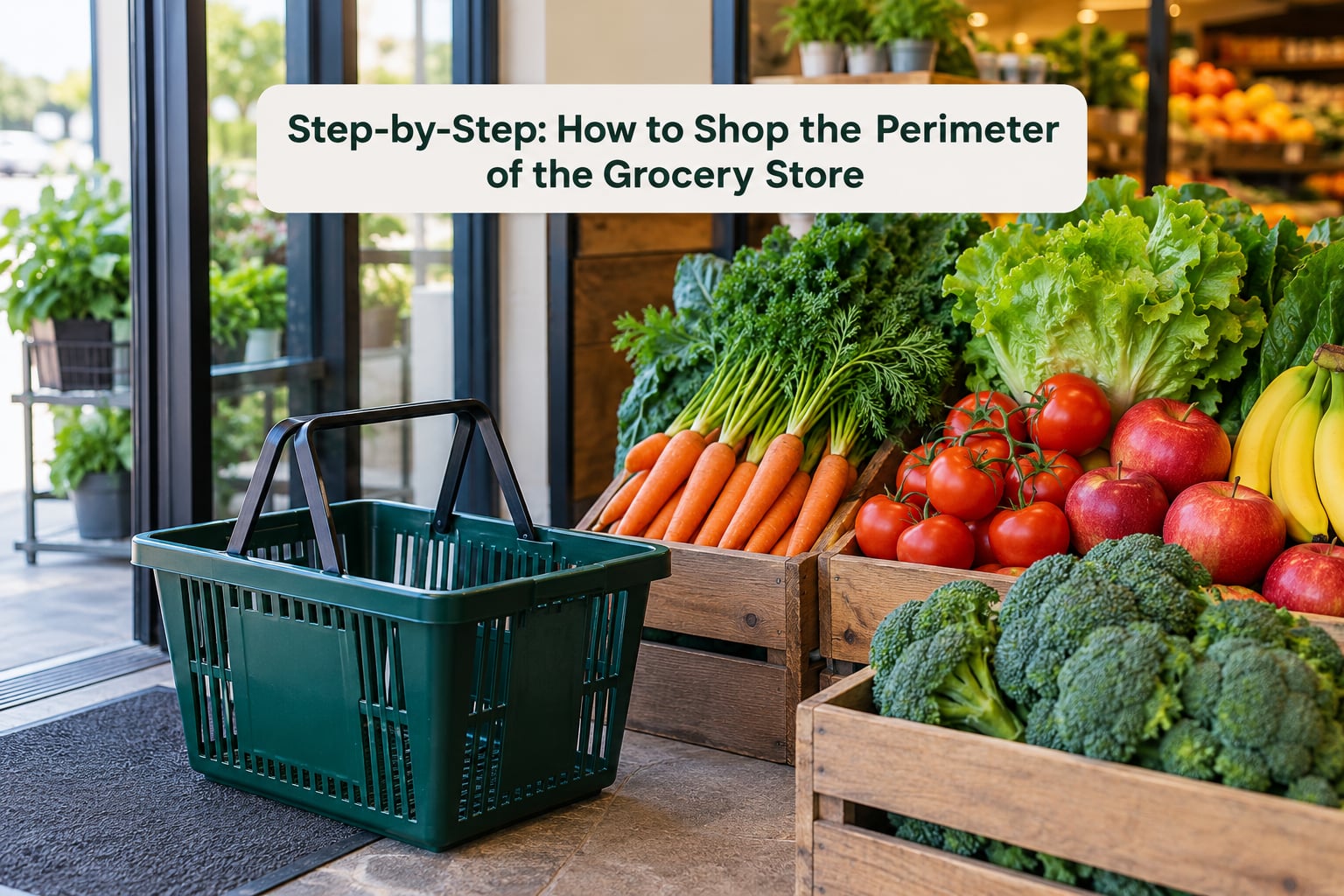
1. Start with produce and buy only what has a meal attached
Produce is the first stop because most of it does not keep. Walk the wall, not the case, so you see everything. Buy for the next three to four days, not the next three weeks, unless you are freezing what you buy on the way home.
Think in roles rather than items. Sturdy vegetables like cabbage, carrots, onions, potatoes and squash hold for a week or more. Leafy greens, berries, mushrooms and summer fruit are a two-day purchase. Buy the long-keeping stuff in volume and the delicate stuff in small amounts.
Seasonal produce is the budget move. Whatever is cheapest and most abundant that week is what most of the country is cooking, and that is why recipes for it exist. If you cannot name three meals for a vegetable, skip it, and this holds true for a store half full of avocados as much as it does for the leafy greens.
Skip anything already marked down for ripeness unless you are cooking it that night. A bruised peach you will eat tomorrow is a bargain. The same peach in four days is a bag of smells in the crisper.
2. Choose a protein source with a plan for cooking it
The protein counter is where most perimeter trips stall, because there are too many good options. Compare on four things: preparation time, how long it keeps, what your household eats, and how often you want to cook the same thing.
Beans and lentils are the quiet workhorse. Dried, they cost almost nothing and keep for a year. Canned, they are a pantry item rather than a perimeter one, which surprises people, but the nutrition gap between the two is small. Cook a big batch on a Sunday and they become soup, chili, curry and a burrito filling across the week.
Eggs cook in minutes and keep well. Yogurt and most cheeses need no heat at all, which makes them the answer on a night when nobody wants to cook. Tofu and tempeh handle a stovetop or an oven and suit a plant-based table just as well as a meat one.
Fresh chicken, turkey and fish are the most perishable proteins in the store. Buy them for a specific meal, not because they looked good. From a food safety angle, cook poultry to 165F, ground meat to 160F, and whole cuts and fish to 145F, then refrigerate or freeze within two hours.
Deli meat sits in the same refrigeration case, and it is a good reminder that the perimeter rule is a starting point rather than a command. Bacon, sausage, cured ham and cold cuts are perimeter foods, and you do not have to buy them.
3. Add whole grains and other starches
Carbs are the part of the perimeter most beginners skip, and skipping them is how dinner becomes protein and a salad every single night. Buy starches that are minimally processed and that you can cook without a recipe.
Oats are the best first purchase. They cook in the microwave or a pot, they work for breakfast and for a savory base, and they keep for months in a sealed container. Brown rice and other whole grains cook in a rice cooker or a pot and portion out into containers for the week.
Whole-grain bread from the bakery section is the perishable version, and it is worth buying when the loaf was baked that day and the label lists whole wheat as the first grain. It goes stale in about three days, so buy two slices worth of use, not a loaf to admire on Monday.
Potatoes, sweet potatoes and corn are perimeter starches too, and they are often cheaper and more filling than their packaged cousins. Compare the unit price on the shelf rather than the sticker on the front, since the big number on a package is not what you pay per pound.
4. Pick healthy fats and a few useful extras
Unsaturated fats are worth a small, deliberate purchase. Olive oil, avocado, nuts and seeds all fit, and so does peanut butter with nothing added to it beyond peanuts and salt.
Buy nuts in a size you can finish in a couple of weeks. Once they go rancid there is no recovering them, and rancid oil is a real problem with a jar of mixed seeds in the back of a cupboard. Small jars or resealable bags solve it.
Avocados are the classic perimeter budget trap, and they are worth a note. They are seasonal, they ripen at different speeds, and the price in the display does not tell you which is ready today. Buy two and keep one at room temperature, or skip them entirely and use olive oil, which costs far less per meal.
From the same shelf, pick up spices, vinegar, mustard and a salsa or two. Condiments do not make a meal, but they are what turns a tray of roasted vegetables into dinner you look forward to.
5. Check labels without turning shopping into homework
Perimeter goods need little label reading. A banana does not have one. The packaged items that come off the perimeter, frozen meals, prepared salads, yogurt drinks and bread, do.
Four glances are enough on a packaged food. Check the serving size, because a serving is often half of what is in the bag. Look at added sugars on the nutrition panel. Check sodium if you are watching it. And look at fiber and protein, the two numbers that tell you whether a food will hold you for more than an hour.
Ingredients are read in order, longest name first, and that is the only real shortcut worth learning. If hydrogenated oil, glucose syrup or a long run of unpronounceable words sit at the top, that is a heavily processed item and you do not owe it a place in the cart.
One nutrient does not decide whether a food is healthy. A granola bar with good fiber and 300 calories is a fine snack, and a “healthy” salad dressing with 400 calories and no fiber is dessert. Judge the whole item, not the number on the front.
6. Use the store layout to keep your perimeter shop balanced
Now you understand the store layout as a tool. The outer walls carry fresh and refrigerated departments, and the center aisles carry shelf-stable packaged goods, snacks, sodas, condiments and the dry staples most people actually need. Endcaps sit at aisle mouths and are stacked with whatever the store wants to move that week.
That layout is not a conspiracy. Fresh departments need cold cases and short shelf life, so they go on the walls where the refrigeration and the floor space are. Boxed and bagged goods are easier to stack in the middle, where they generate a longer browse. Your route is a result of that design, which is exactly why a deliberate route beats an aimless one.
There are real exceptions, and they belong in your cart. Canned and dried beans, canned fish, oatmeal, brown rice, whole-grain pasta, whole-grain bread in a center-aisle bakery section, nuts, seeds, peanut butter, dried fruit, low-sodium canned tomatoes, olive oil, whole-grain crackers and frozen fruits and vegetables. Nutritionists regularly point out that the perimeter rule leaves out some of the cheapest, highest-fiber food in the store.
Avoid all of it and you can end up eating worse than the person who shops the middle. Layouts also differ more than the rule suggests. Co-ops, warehouse clubs, discount grocers and small ethnic markets put produce in the middle, keep only a token refrigerated case on the wall, and stock the perimeter with beer, wine and frozen pizza. Learn the actual map of the stores you use.
If the produce sits in the middle of your store, treat that aisle as the perimeter and the wall cases as the add-on. That is still how to shop the perimeter of the grocery store, just on a map that is drawn differently. The habit matters more than the geometry.
7. Plan meals before checking out
At the end of the loop, before the line, look at what you are carrying and name the meals. Not the ingredients, the meals. If you cannot name two, the item goes back on the shelf.
Leftovers are the cheapest meal in any kitchen. If you bought a whole head of cabbage, plan three uses across the week rather than one big dinner with half of it in the fridge. Rotisserie chicken, canned beans and cooked grains all stretch further as a second meal than a first one.
For one-person households, this step matters more than for any other kind of shopper. Buy the smaller bag, the single portion, or the bulk size you can divide at home and freeze the day you get back. A bag of grated cheese sized for a family is a bad buy if you are one.
8. Review the basket before paying
The last 60 seconds at the register save the most money. Do a quick pass and ask four questions of everything in the cart.
- Do I have two of this already? Check pantry items, condiments and the freezer before the line forms.
- Does everything have a named meal behind it?
- What is the most perishable thing in here, and can I use it before it turns?
- Did I add any snack or drink I did not write on the list?
The last one catches nearly every impulse purchase. A full shopping trip can end with a small chocolate bar, and the total of those small additions is usually where the surprise shows up on the receipt.
Read the receipt when you get home. Note what you spent, note the two items you regret, and carry the better decisions into the next list. It is the cheapest habit in this entire method.
Common Mistakes
Buying produce in a volume your household cannot finish. This is the number one failure, and it is what turns a fresh-food habit into a compost habit. Buy long-keeping vegetables generously and delicate fruit sparingly, and freeze berries, bananas and surplus greens on the day you get home rather than hoping.
Treating every perimeter item as automatically healthy. The wall of a store also holds bacon, cold cuts, doughnuts, ice cream, frozen pizza and prepared salads with heavy dressings. The layout is a signal about processing and freshness, not a nutritional guarantee. Use your four-glance label check on anything that came in a package.
Refusing every center aisle. Canned beans, canned fish, oats, whole grains, nuts, seeds and peanut butter are shelf-stable, affordable and among the most useful foods in the store. A strict no-aisles rule costs you money and variety for nothing.
Shopping in a loop you have never walked before. A new store is a new map, and the exit is always past the snack endcaps. Take a lap without buying anything when you switch stores, and note where produce, protein and frozen live before you start filling a cart.
Forgetting storage. Fresh spinach wilts in days, and berries mold faster than most people expect. Separate ethylene producers like apples, bananas, tomatoes and pears from greens, and put anything you will not eat in the next three days into the freezer, washed and dry.
Two habits fix most of the rest. Shop fed, and shop from a list you wrote at home. Everything above is downstream of those two.
Frequently Asked Questions
What is the perimeter of a grocery store?
The perimeter is the outer ring of the store: the departments that run along the outer walls and the front, including fresh produce, bakery, deli, meat and seafood, dairy and eggs, and frozen foods. The center aisles hold canned, boxed and packaged goods, snacks, sodas and condiments. The name comes from the store layout, not from any rule about what you are allowed to buy.
Why should you shop the perimeter of a grocery store?
Two reasons. First, most unprocessed and fresh food sits on the walls, so a perimeter route naturally loads your cart with fruit, vegetables, protein and dairy. Second, the center aisles are full of snacks, sodas and endcap displays designed to catch you mid-browse, so staying on the outside cuts impulse purchases and shortens the trip. Research on store layouts backs this up, and independent measurement of shopping habits shows younger shoppers use the perimeter far more than older ones.
Is shopping the perimeter of the grocery store cheaper?
It can be, but it is not automatic. The perimeter holds the store’s most expensive items too, including out-of-season produce, berries, avocados, fresh fish and organic items. Where it saves is in impulse spending and food waste. It also costs more to stick to strictly, since there are fewer coupons and sales on the wall than in the center aisles.
Do I have to give up frozen and canned food if I shop the perimeter?
No, and you should not. Frozen and canned produce usually keeps more of its nutrients than fresh produce that has sat in a truck and a display case for a week, and those versions are often cheaper with a longer shelf life. Most of what you hear about fresh being better comes from flavor and texture, not nutrition. Canned beans, canned fish and frozen vegetables are excellent buys whether you are following the perimeter rule or ignoring it.
What are the 5 4 3 2 1 rule and the 3 3 3 rule for groceries?
The 5 4 3 2 1 rule is a shopping-list framework built around vegetables, fruit, protein, grains and dairy or a related staple, with the numbers expressing proportions on your plate. The 3 3 3 rule is a portion memory aid that splits a plate into three equal parts. Versions of these lists circulate with different numbers attached, so treat them as guides rather than rules, and check the source before you follow one strictly.
How do I use the perimeter method in a store with a different layout?
Map the store first. In warehouse clubs, co-ops, discount grocers and small markets, produce and bulk dry goods often sit in the middle and the wall cases hold only milk, eggs and frozen items. In those stores, walk the produce and protein sections wherever they are, then loop the refrigerated cases at the end. The habit of a planned, repeatable route is what works, not the specific shape of the loop.
Conclusion
Pick four meals before your next trip, enter at produce, walk one direction, leave the cold stuff for the end, and keep canned beans, oats and nuts on your list even though they sit in the middle. Fifteen minutes of planning is what turns this from a good idea into a routine that repeats, and it is the whole of how to shop the perimeter of the grocery store once you stop treating the walls like a rule.