Reviewed for 2026.
Added sugar shows up on a food label under dozens of different names: cane sugar, corn syrup solids, dextrose, maltodextrin, fruit juice concentrate, agave nectar, turbinado, and dozens more. Because the ingredient list uses every one of those names instead of a single word, the names for added sugar on food labels are the only reliable way to spot sugar hiding in a product you would never think of as sweet.
This guide breaks those names into families you can recognize on sight, explains how the Added Sugars line on the Nutrition Facts panel was built, and gives you a repeatable way to compare two products in about thirty seconds.
Table of Contents
- What Are the Names for Added Sugar on Food Labels?
- How Do You Spot Added Sugar in an Ingredient List?
- The top three ingredient rule in practice
- Three steps to scan an ingredient list quickly
- Where added sugar hides in savory foods
- What is not added sugar
- What Does the Added Sugars Line on Nutrition Facts Mean?
- Why serving size changes the whole comparison
- When the line is missing
- Which Sugar Names Are Most Common?
- Cane and beet sugar
- Corn sweeteners
- Tree fruit concentrates and syrups
- Grain and starch sweeteners
- The 15 names that cover most of what you will read
- Sugar alcohols and non-nutritive sweeteners are not added sugars
- How Can You Compare Products With Less Added Sugar?
- How much counts as too much
- Frequently Asked Questions
- What is the hidden name for sugar in food labels?
- What does added sugar mean on a nutrition label?
- What does it mean when a food label says no added sugar?
- Does tapioca syrup count as sugar?
- Are sugar alcohols and artificial sweeteners counted as added sugar?
- How can I tell if a food has added sugar without a Nutrition Facts panel?
- Conclusion: Start with the Added Sugars Line
What Are the Names for Added Sugar on Food Labels?
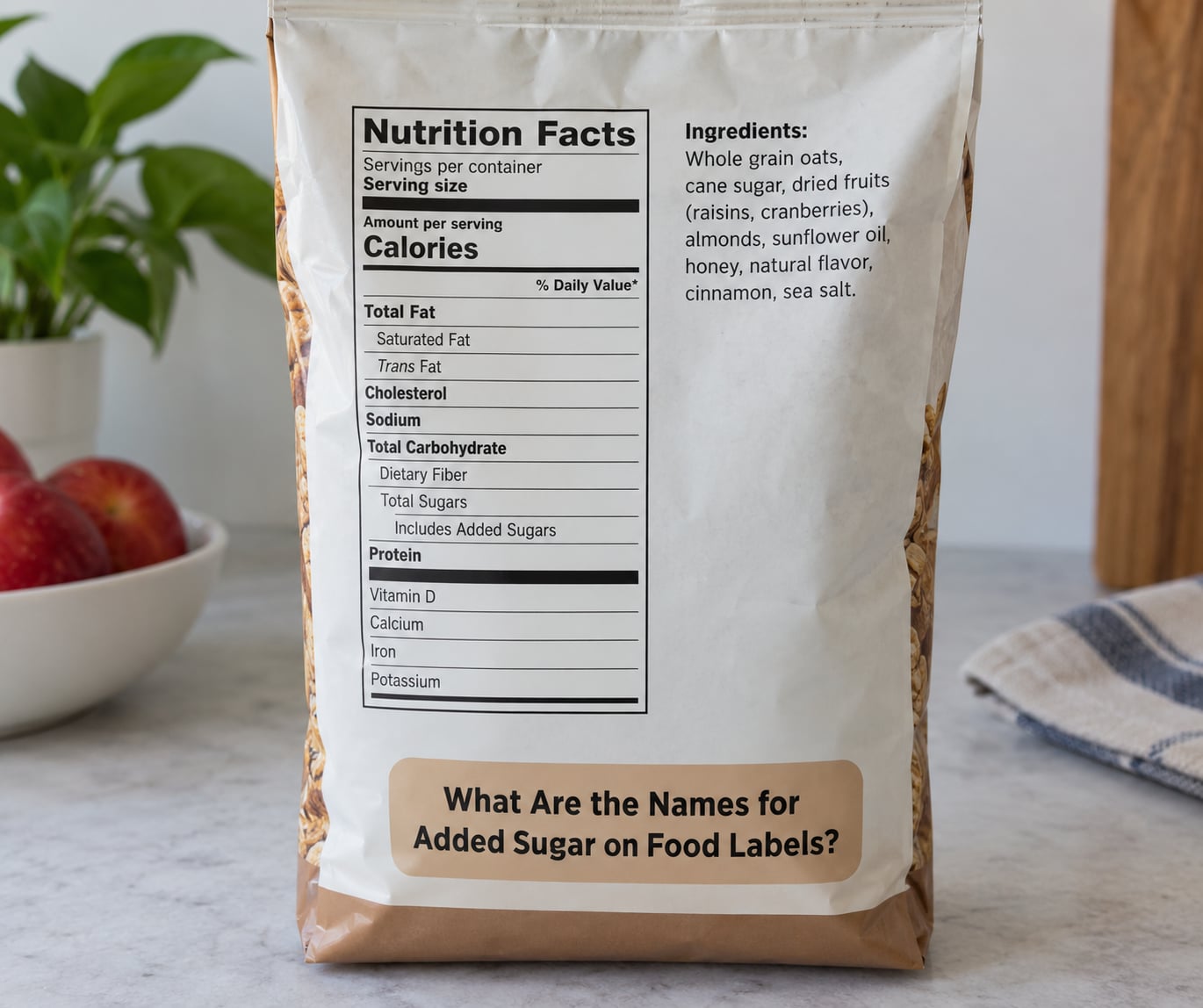
There is no single hidden name. The FDA simply requires that sugar be declared by the name used in the ingredient list, so the same sweetener appears as table sugar in one jar and as evaporated cane juice in the next. Here is one alphabetized block covering the names you will actually meet on US shelves.
- Agave nectar
- Agave syrup
- Anhydrous glucose
- Barley malt
- Barley malt syrup
- Beet sugar
- Blackstrap molasses
- Brown rice syrup
- Brown sugar
- Cane juice
- Cane syrup
- Canola syrup (high-fructose)
- Carbohydrate syrup
- Chicory inulin syrup
- Coconut sugar
- Corn syrup
- Corn syrup solids
- Crystalline fructose
- Crystalline sucrose
- Date syrup
- Dehydrated cane juice
- Dextrose
- Dextrose monohydrate
- Dried glucose syrup
- Dried grape juice
- Dried honey
- Evaporated cane crystals
- Evaporated cane juice
- Evaporated cane syrup
- Fructose
- Fruit juice concentrate
- Fruit syrup
- Galactose
- Glucose
- Glucose-fructose syrup
- Glucose syrup
- Golden syrup
- Granulated sugar
- Grape juice concentrate
- High-fructose corn syrup
- Honey
- Honey powder
- Honey syrup
- Hydrolyzed starch
- Invert sugar
- Isoglucose
- Karo syrup
- Lactose monohydrate
- Liquid invert sugar
- Maltitol syrup
- Maltodextrin
- Maltose
- Maltose syrup
- Malt syrup
- Maple syrup
- Methyl glucoside
- Muscovado sugar
- Nectar
- Olive sugar
- Panela
- Palm sugar
- Pasteurized cane juice
- Peanut butter syrup
- Pineapple juice concentrate
- Polyglycitol syrup
- Potato starch
- Rapidly invertible syrup
- Rapidly invertable syrup
- Raw sugar
- Refiner’s syrup
- Rice syrup
- Rose hips concentrate
- Sorghum syrup
- Soybean syrup (unsweetened)
- Starch syrup
- Sucre
- Sucrose
- Sugar syrup
- Taffy
- Tapioca syrup
- Tawny syrup
- Tea syrup
- Thickset molasses
- Treacle
- Turbinado sugar
- Unsulfured molasses
- White sugar
One thing the lists out there never tell you: nobody has ever counted the total. Sources claim 50 names, then 61, then 69, then 200, then 262. Each number comes from a different private compilation, none of them from the FDA, and none of them matches the others. So treat any single count as a starting point rather than a fact, and learn the patterns instead.
How Do You Spot Added Sugar in an Ingredient List?
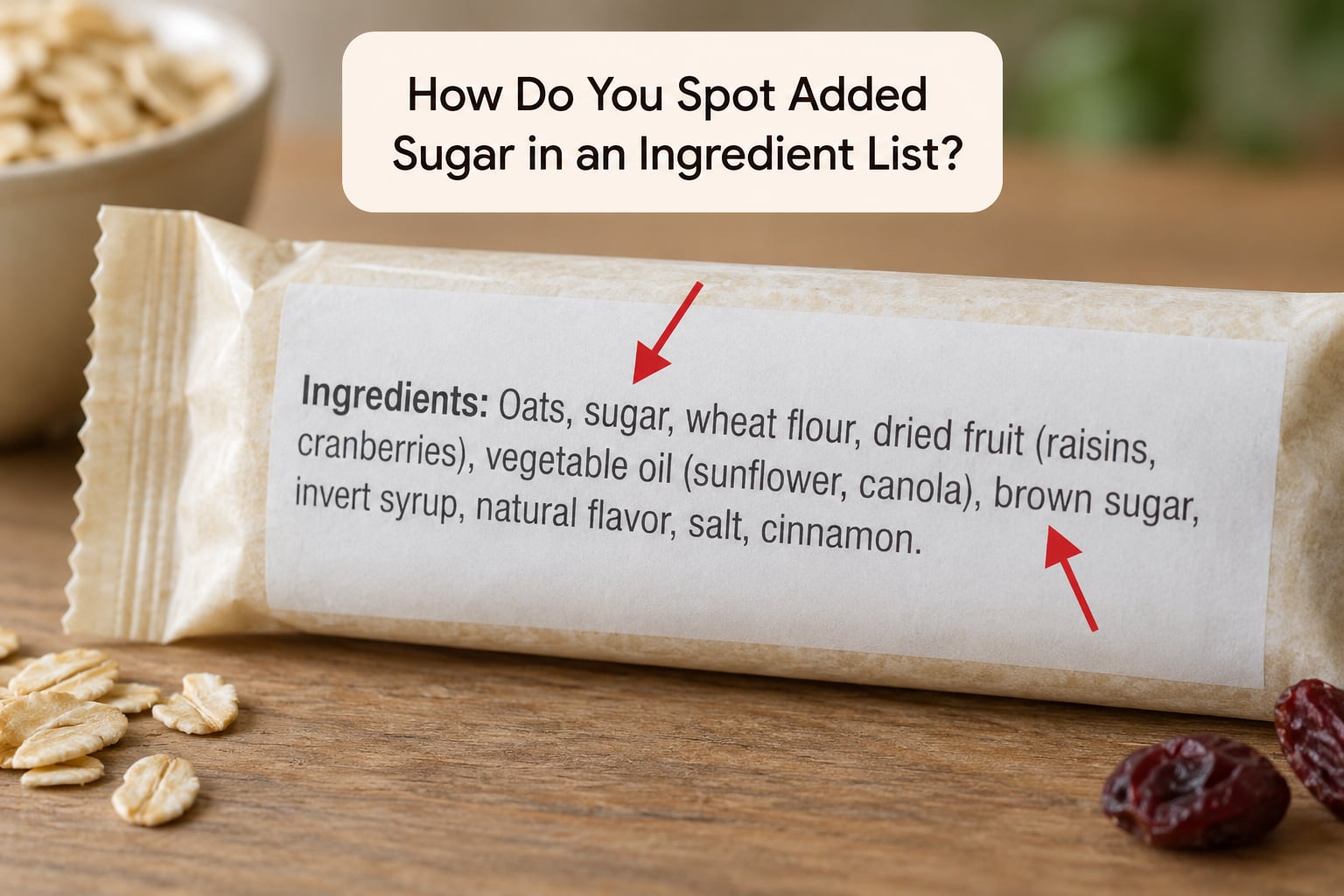
Ingredients are listed by weight, in descending order. The first three positions carry the most weight of anything on the list, which is why the FDA and the European Union both treat them as the ones worth reading.
If sugar is the first ingredient, the product is mostly sugar by mass. If it is third, it still outranks everything after it. What makes sugar tricky is that one sweetener can be written as two or three separate names, each small enough to sit below the top three.
The top three ingredient rule in practice
Take a granola bar. The list might read: whole grain oats, honey, dried cranberries, sunflower oil, cinnamon. Nothing screams sugar. Honey is second, dried cranberries are third, and the cranberries are sweetened too.
Now take a granola bar that lists syrup, corn syrup solids, and sugar as ingredients four, six and eleven. No sugar name sits in the first three, yet the package carries more sugar per serving than the bar above. The same total, hidden in pieces.
Three steps to scan an ingredient list quickly
- Read the first three ingredients only. That is where sugar hides most often.
- Search the rest of the list for syrup, sugar, juice concentrate, malt, nectar, molasses, treacle, or molasses-type words.
- Add the names together mentally. Four separate sugar ingredients still counts as sugar, four times over.
Where added sugar hides in savory foods
Sugar is not only in dessert. It balances acidity in tomato sauce, browns the crust of bread, keeps jam spreadable, and cuts the sharpness of a dressing. Barbeque sauce regularly contributes around 10 g of added sugar in a typical serving, bread carries several grams per slice, and cereal and granola are frequently sweetened with more than the fruit in them suggests.
What is not added sugar
Sugar that comes with the food intact does not count. Whole fruit, plain milk and unsweetened dairy carry sugars that stay in the naturally occurring total. The FDA also exempts 100 percent fruit juice concentrate and fruit juice concentrate used in preserves made from a single fruit, and concentrates used purely as a functional ingredient.
Products made of a single sugar or syrup, such as a bag of pure cane sugar or a bottle of maple syrup, label that one ingredient rather than showing an Added Sugars line.
What Does the Added Sugars Line on Nutrition Facts Mean?
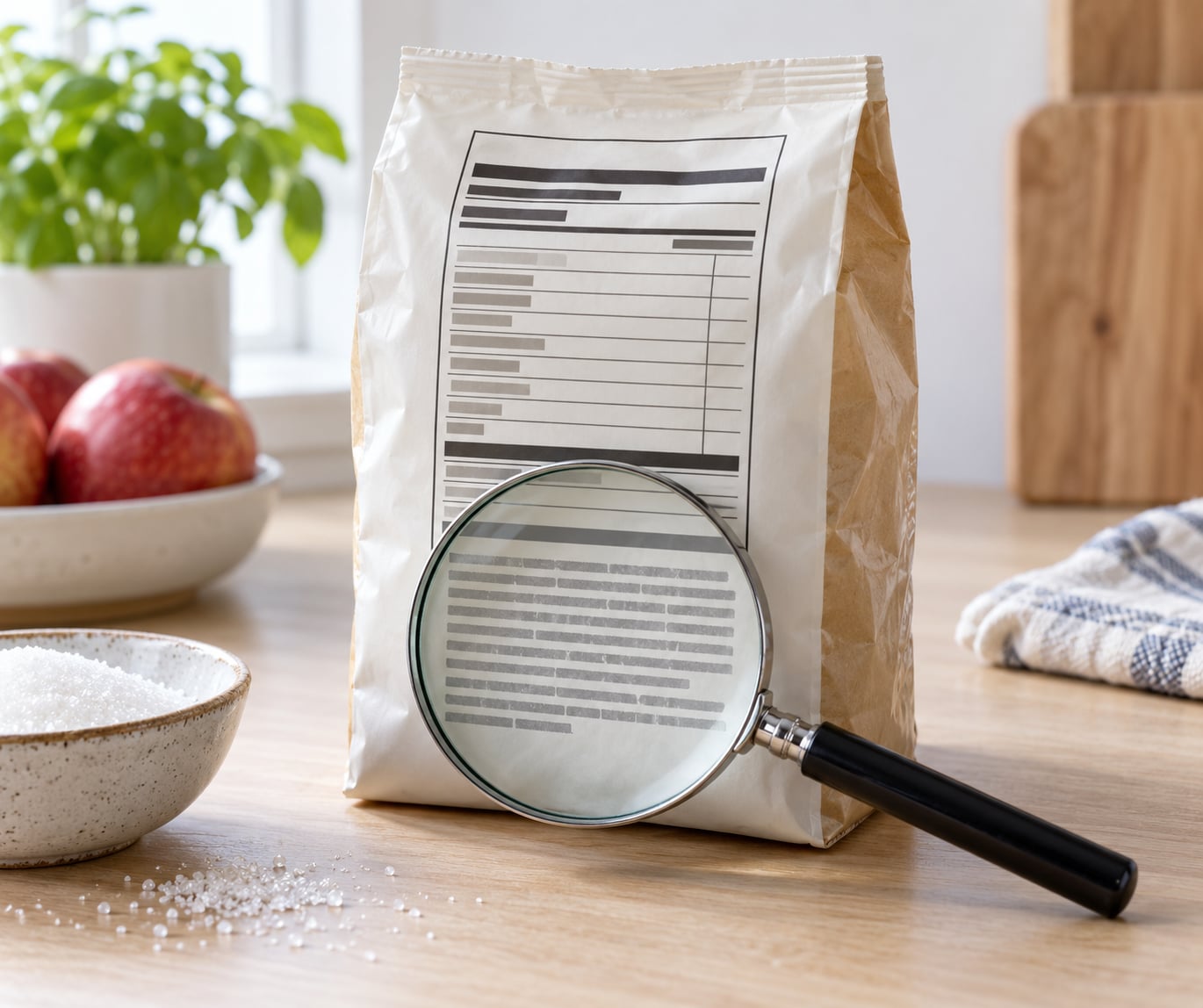
The Added Sugars line tells you how much of the total sugar in a serving was added during processing or preparation. Total Sugars is the wider number underneath it, and it includes both the added portion and whatever arrived naturally with fruit, milk or vegetables.
FDA rules put Added Sugars directly beneath Total Sugars on the panel, followed by the percent Daily Value. The Daily Value for added sugar is 50 g on a 2,000-calorie diet, which is about 10 percent of daily calories from added sugar alone.
| Panel line | What it covers | How to use it |
|---|---|---|
| Total Sugars | All sugar: added plus naturally occurring | Shows the whole sugar load including from whole fruit and milk |
| Includes X g of Added Sugars | Only sugar added during processing, or concentrated fruit and vegetable juices | The number most people are actually trying to limit |
| % Daily Value for Added Sugars | Added sugar as a share of the 50 g Daily Value | 5 percent or less is low, 20 percent or more is high |
Why serving size changes the whole comparison
Serving sizes are set by the manufacturer, not by nutrition. A 30 g serving of cereal can look modest until you notice the box lists three servings and you routinely eat the bottom third of it in one sitting. The same thing happens with cereal, trail mixes, nut butters and bottled sauces.
The rule of thumb that holds up in practice: multiply the grams per serving by the number of servings the package actually contains before you compare two products.
When the line is missing
If a product has no Added Sugars line at all, it is usually one of three things: a single-ingredient sugar or syrup, a food with too little added sugar to declare, or a label produced outside the US. On UK packaging, front-of-pack traffic lights give total sugars per 100 g but no separate added figure. In Germany and much of the EU, there is no added-sugars line either, so the ingredient list is your only tool, and sugar compounds sit under one E-number.
Which Sugar Names Are Most Common?
Grouped by where they come from, the names stop looking random. Cane and beet names are table sugar in different clothing, corn names are starch broken down into syrup, tree-fruit names are juice boiled down, and grain names are starch converted for thickness and browning.
Cane and beet sugar
Sucrose, granulated sugar, cane sugar, beet sugar, white sugar, cane juice, evaporated cane syrup, evaporated cane crystals, raw sugar, turbinado, demerara, muscovado, panela, coconut sugar, palm sugar, brown sugar, invert sugar, liquid invert sugar, sucrose, and taffy. All of it is the same molecule, refined to different colors and crystal sizes.
Corn sweeteners
High-fructose corn syrup, corn syrup, corn syrup solids, corn sugar, dextrose, dextrose monohydrate, glucose, glucose syrup, glucose-fructose syrup, isoglucose, anhydrous glucose, crystalline fructose, glucose solids, anhydrous dextrose, and fructose. Corn is the largest single source of added sugar in the American food supply, and corn syrup solids show up in everything from bread to barbecue sauce.
Tree fruit concentrates and syrups
Fruit juice concentrate, apple juice concentrate, pear juice concentrate, pineapple juice concentrate, dried grape juice, white grape juice concentrate, date syrup, fruit syrup, and nectar. These are used as cheap sweeteners in cookies, energy bars and fruit-flavored yogurts.
Grain and starch sweeteners
Maltodextrin, maltose, malt syrup, barley malt, barley malt syrup, diastatic malt, rice syrup, brown rice syrup, sorghum syrup, tapioca syrup, starch syrup, quick-cooking syrup, hydrolyzed starch, carbohydrate syrup, methyl glucoside, and dextrin. Many of these are not sweet enough to be called sugar on the tongue. They are there for texture, browning and shelf life, and the panel still counts them as added sugar.
The 15 names that cover most of what you will read
If you only memorize a short list, use these: cane sugar, sucrose, sugar, high-fructose corn syrup, corn syrup, corn syrup solids, dextrose, cane juice, brown sugar, maltodextrin, fruit juice concentrate, agave nectar, honey, molasses, and syrup of any kind. Anything ending in syrup, except pure corn syrup and pure maple syrup reads to most shoppers as table sugar.
| Name on the label | Source | What it actually is |
|---|---|---|
| Cane sugar, beet sugar, sucrose, turbinado, demerara | Sugarcane or sugar beet | Refined sucrose, the same molecule in different crystal sizes |
| High-fructose corn syrup, corn syrup solids | Corn starch | Starch hydrolysed into glucose or glucose and fructose |
| Dextrose, glucose, crystalline fructose | Corn starch | Pure single sugars pulled out of hydrolysed corn starch |
| Fruit juice concentrate, date syrup | Tree fruit or vegetable | Juice boiled down to a thick, cheap sweetener |
| Maltodextrin, malt syrup, rice syrup, tapioca syrup | Grain or cassava starch | Starch partly broken down, added for texture and browning |
| Honey, agave nectar, maple syrup, molasses, treacle | Nectar or plant sap | Concentrated plant sugars that keep some nutrients |
Sugar alcohols and non-nutritive sweeteners are not added sugars
Erythritol, sorbitol, xylitol, mannitol, lactitol, isomalt, maltitol, and stevia, monk fruit, sucralose, aspartame, acesulfame potassium, and advantame do not appear on the Added Sugars line. Sugar alcohols are counted under total sugars in some presentations and treated as sweeteners on others, which is why labels vary. Allulose, approved for use as a sugar alternative in the US, is likewise treated separately.
How Can You Compare Products With Less Added Sugar?
Use the same six checks in the same order every time. A consistent routine beats a long product knowledge base, because the routine works on brands and names you have never seen before.
- Check the serving size first, then multiply grams of added sugar by the servings in the container.
- Read the first three ingredients and treat any sugar name there as the dominant ingredient.
- Count the sugar ingredients in the whole list. Three names means three contributions.
- Compare percent Daily Value: 5 percent or less is low, 20 percent or more is high.
- Ignore front-of-pack phrases such as natural, no HFCS, real fruit and whole grains. They describe sourcing and ingredients, not sugar quantity.
- Check the claims, using the table below rather than your assumption.
| Claim on the package | What it means | What to verify |
|---|---|---|
| No added sugar | No sugar or sugar-containing concentrate was added during processing | Total Sugars, which can still be high from fruit or milk |
| Unsweetened | No sweetener of any kind added, including non-nutritive ones | Total Sugars for naturally occurring sugar |
| Sugar-free | Less than 0.5 g of sugar per serving | Serve size, since the threshold is per serving |
| Lightly sweetened | A regulatory term for a product with at least 50 percent less added sugar than the standard reference | Compare the grams directly, not the claim |
| No high-fructose corn syrup | Simply that one sweetener was replaced with another | Added Sugars line, which often does not drop |
How much counts as too much
The FDA Daily Value for added sugar is 50 g per day on a 2,000-calorie diet, roughly 12 teaspoons. The American Heart Association recommends lower daily limits: about 36 g (9 teaspoons) for men and 25 g (6 teaspoons) for women, and children over two.
For context on what a single item can do, a 12-ounce soda has carried as much as 11 teaspoons (46 g) of added sugar, and a single serving of a leading yogurt brand has been measured at about 7 teaspoons (29 g) despite a healthy image on the front. People managing blood sugar, diabetes or weight should treat those personal limits as a conversation with a doctor or registered dietitian rather than a number from a label guide.
Frequently Asked Questions
What is the hidden name for sugar in food labels?
There is no single hidden name. Sugar appears under many aliases at once: sucrose, cane sugar, dextrose, corn syrup solids, maltodextrin, fruit juice concentrate, agave nectar and honey are all common. Because ingredients are listed by weight, any of them in the first three positions means sugar is a main ingredient. When a label looks sugar-free but the Added Sugars line is high, look for several sugar names split across lower positions.
What does added sugar mean on a nutrition label?
Added sugar is any sugar or syrup added to a food during processing or preparation, including concentrated fruit and vegetable juices used as sweeteners. It is declared on its own line under Total Sugars, with a percent Daily Value based on 50 g per 2,000-calorie diet. Sugar that comes with whole fruit, milk or vegetables is not added sugar and stays in the naturally occurring part of Total Sugars.
What does it mean when a food label says no added sugar?
It means no sugar, syrup or sugar-containing concentrate was added during processing. The product can still be high in Total Sugars, because whole fruit, fruit juice or milk brings its own sugar. A juice drink can carry no added sugar and still show a large Total Sugars figure. Check the Total Sugars line and the serving size before assuming the product is low in sugar.
Does tapioca syrup count as sugar?
Yes. Tapioca syrup is a starch-derived sweetener and counts as added sugar on the Nutrition Facts panel, even though it is not made from cane or beet sugar. It is made from cassava starch converted into glucose syrup, so it behaves and counts much like any other added syrup. The same applies to rice syrup, sorghum syrup, barley malt and tapioca syrup, all of which land in the Added Sugars line.
Are sugar alcohols and artificial sweeteners counted as added sugar?
No. Erythritol, sorbitol, xylitol, mannitol, maltitol, isomalt, lactitol, stevia, monk fruit, sucralose and aspartame do not appear on the Added Sugars line, and neither does allulose. Sugar alcohols fall under total sugars in some presentations and are treated as sweeteners in others, so check how a specific package categorizes them. A product sweetened only with these ingredients can read zero for added sugar.
How can I tell if a food has added sugar without a Nutrition Facts panel?
Read the ingredient list in order and treat the first three entries as decisive. Watch for words ending in syrup, plus sugar, juice concentrate, malt, nectar, molasses and treacle. If none of those appear, look for less obvious starch sweeteners such as maltodextrin, dextrose or hydrolyzed starch, which count as added sugar even when they do not taste sweet. Multiply grams by servings in the container rather than trusting a single serving.
Conclusion: Start with the Added Sugars Line
Turn the package over, find Added Sugars under Total Sugars, multiply by the number of servings in the container, and only then look at the ingredient list to see which names produced that number. Repeat the same three moves on the next product and the comparison stops being guesswork.
The names for added sugar on food labels look endless, but the patterns behind them are few: cane and beet names are table sugar, corn names are starch turned syrup, concentrates are boiled fruit juice, and grain names are starch for texture. Learn those four groups and most of the ingredient list stops being a puzzle. If your own nutrition needs, blood sugar or weight goals call for a specific limit, a registered dietitian can help you set one that fits.