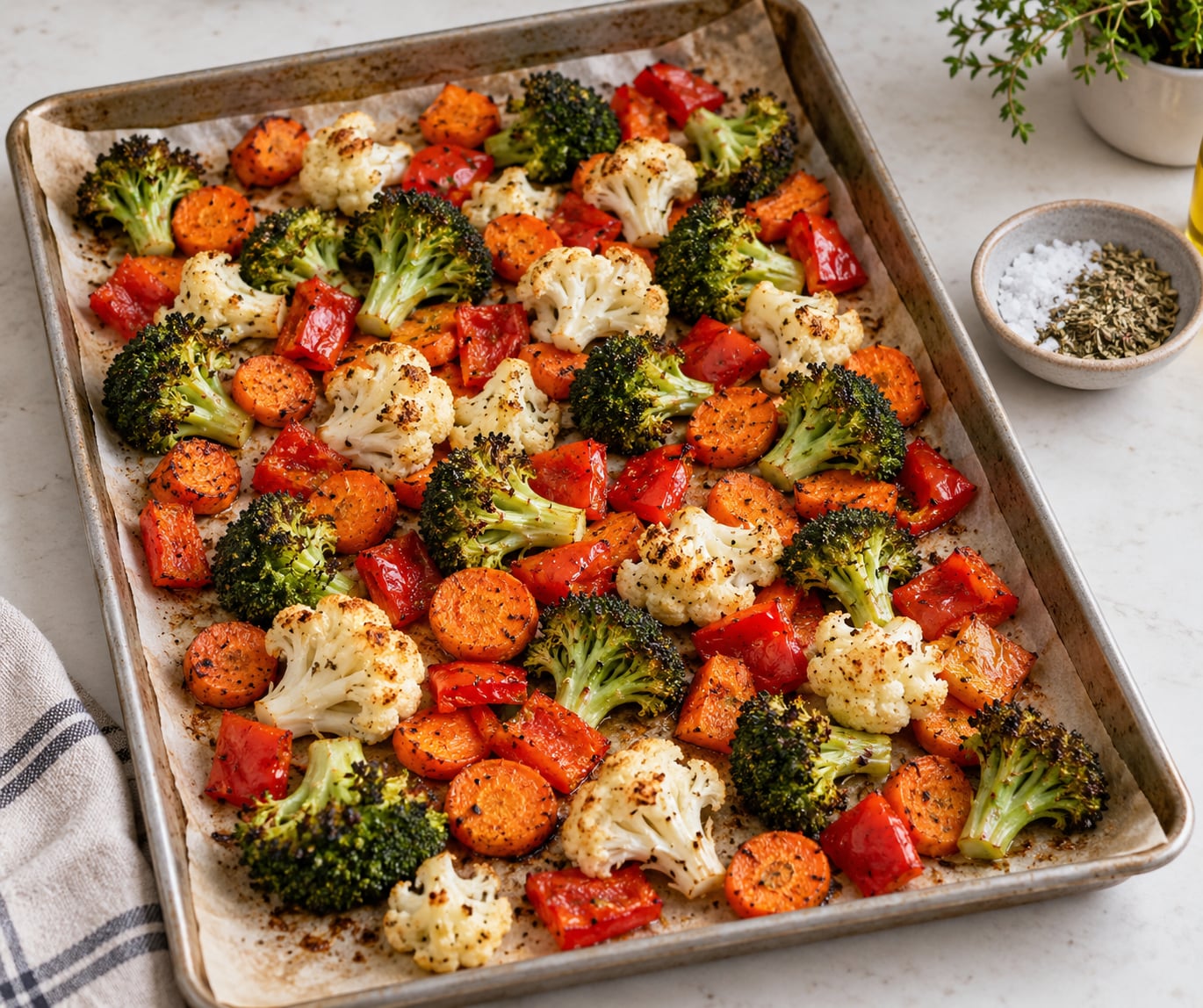
To roast vegetables without oil, line a rimmed sheet pan with parchment paper, cut the vegetables into even pieces, add 1 to 2 tablespoons of broth, water, or vinegar along with salt and spices, and roast at 425 F (220 C) for 25 to 40 minutes. The trick is moisture management, since oil is not what creates browning.
The honest part first: oil-free roasted vegetables do not taste identical to oil-roasted ones. You are trading a little caramelization for a lighter dish, and the trick is that the caramelization does not disappear, it just needs more heat and a drier surface. Once you stop treating oil as the source of flavor and start treating it as a moisture seal, the whole method gets a lot easier.
It also helps to know why people go this route. A tablespoon of oil carries roughly 120 calories, so a single tablespoon per serving is about 120 calories lighter than the same roast with oil. Plenty of home cooks land here for low-calorie eating, IBS, cholesterol management, or just a preference for tasting the vegetable rather than the fat. None of that requires giving up good food, which is exactly what the rest of this guide is about.
Table of Contents
- What You Need
- Step-by-Step
- How to Roast Vegetables Without Oil: Choose the Right Vegetables
- How to Roast Vegetables Without Oil: Season for Flavor
- How to Roast Vegetables Without Oil: Roast Until Tender and Browned
- How to Roast Vegetables Without Oil: Foil, Air Fryer, and Broiler Variations
- Common Mistakes
- Frequently Asked Questions
- Can I roast vegetables without parchment paper?
- What temperature is best for roasting vegetables without oil?
- Why are my vegetables sticking to the baking sheet?
- How do I make oil-free roasted vegetables taste less bland?
- Can I roast frozen vegetables without oil?
- How long do oil-free roasted vegetables keep?
- Conclusion
What You Need
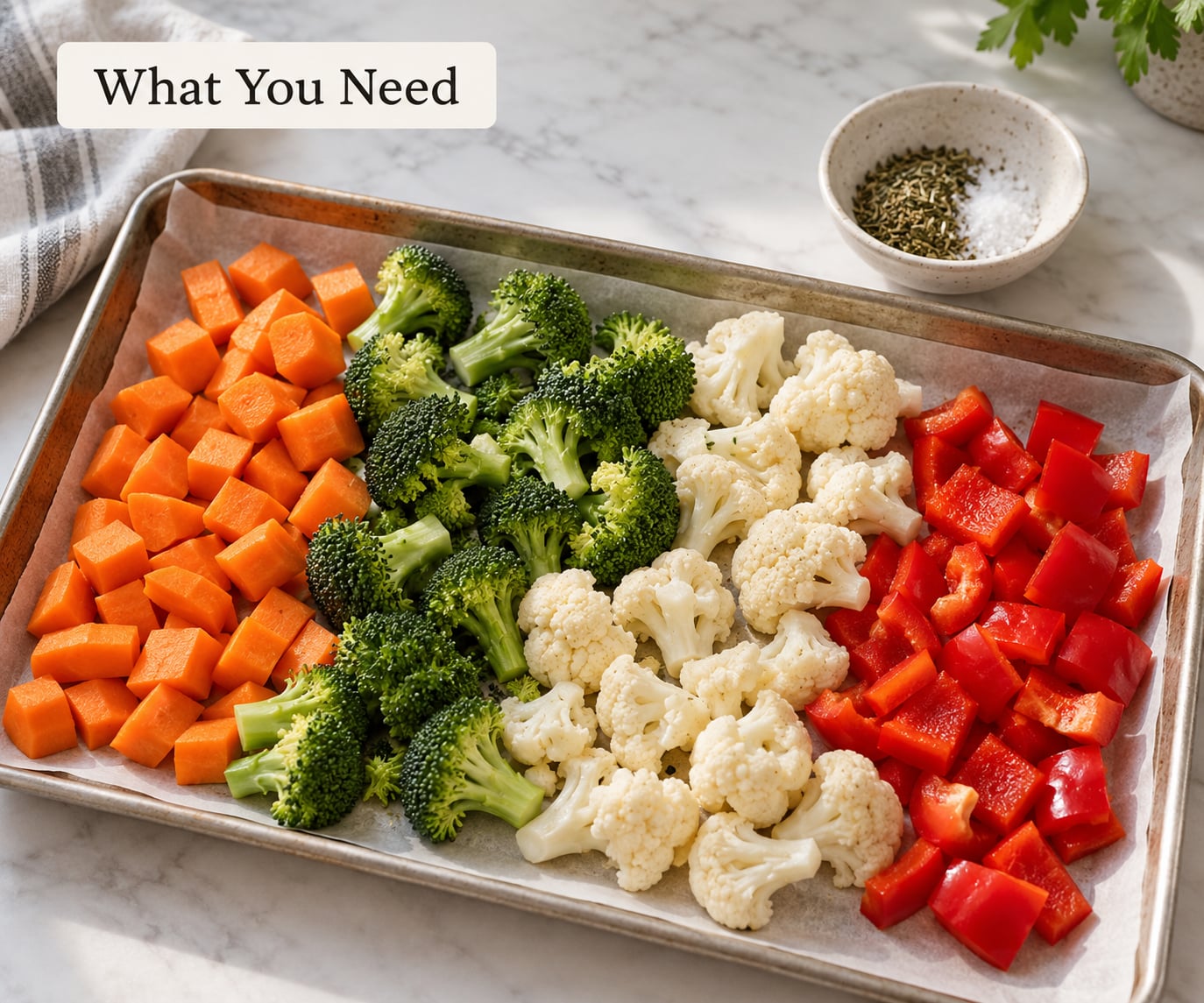
Almost nothing. That is the pleasant surprise for anyone who expects oil-free cooking to mean specialty gear.
- A rimmed half-sheet pan. The rim is what stops broth and released moisture from running under the parchment and onto your oven floor. A flat or unrimmed pan is the number one reason vegetables steam instead of roast.
- Parchment paper or a silicone baking mat. Parchment is the surest anti-stick option and browns a little better. A silicone mat conducts heat differently, so browning takes a few extra minutes, but nothing welds itself to the pan.
- A sharp knife and a cutting board with a damp towel underneath. Even pieces are the whole game. A cheap knife rocks through carrots unevenly and you get burnt tips next to hard centers.
- Salt, black pepper, and two or three pantry spices. Garlic powder, onion powder, smoked paprika, cumin, curry powder, dried herbs. You need more seasoning than you would with oil, because oil amplifies flavor and dry heat does not.
- A small liquid. Vegetable broth, water, balsamic vinegar, lemon juice, or the liquid from a can of chickpeas. One to two tablespoons per full pan is plenty.
Optional but useful: a small squeeze bottle or mister for water, a foil sheet for the steam method, and an instant-read thermometer if you plan to oil only the pan instead of the vegetables.
Step-by-Step
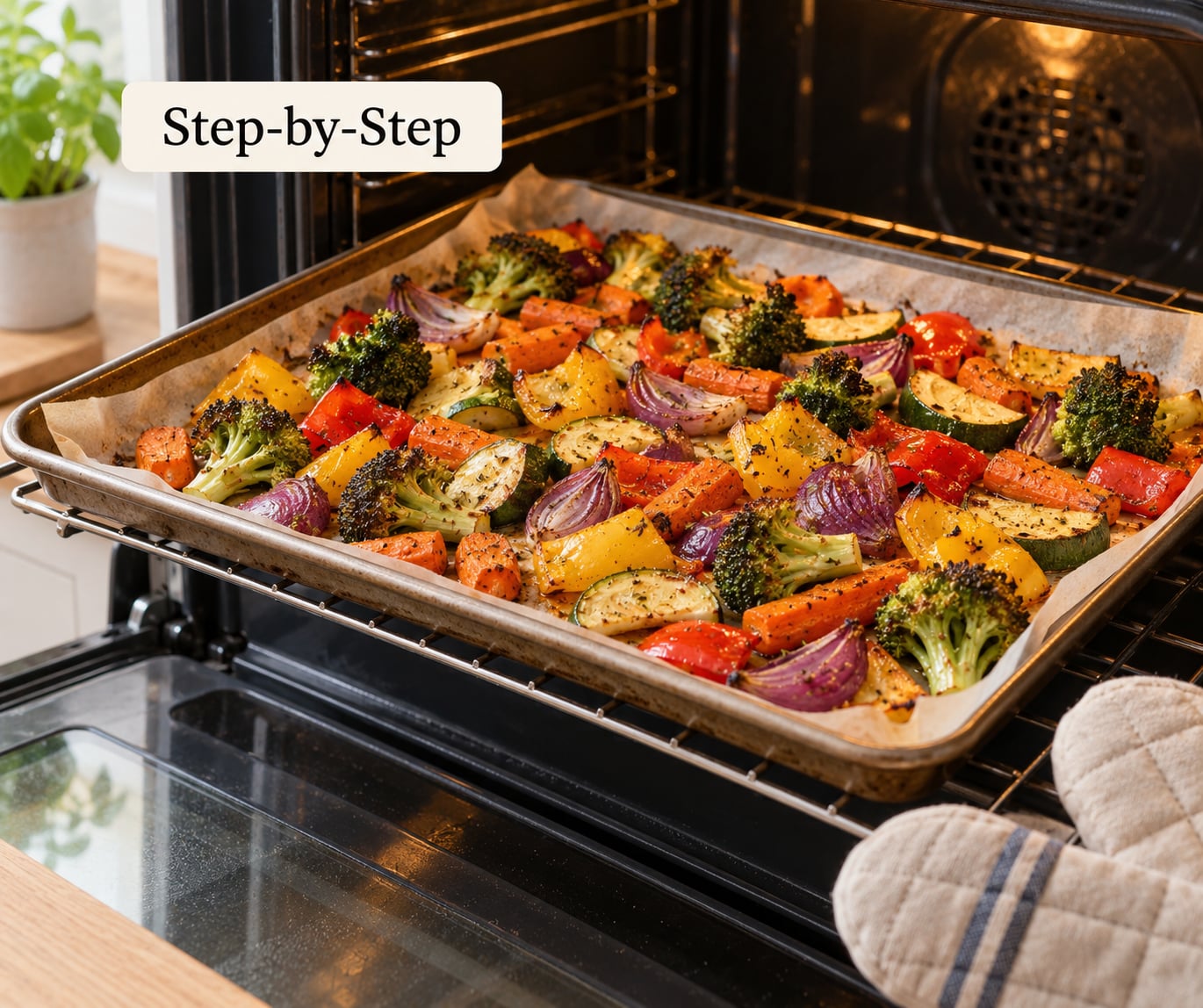
How to Roast Vegetables Without Oil: Choose the Right Vegetables
Starchy roots and delicate vegetables cannot share a timer. Potatoes, sweet potatoes, carrots, beets, parsnips, and winter squash need longer and a head start, while broccoli, cauliflower, peppers, zucchini, cabbage, green beans, mushrooms, and eggplant cook fast and burn before they finish.
Cut everything to roughly the same size so it finishes together. Carrots into coins, broccoli into florets of similar scale, squash into chunks about the size of a poker chip. When a piece is much smaller than its neighbors, it caramelizes and dries while the big ones are still raw, which is the single most common complaint in home cooking forums.
Spread it in one layer with a little space between pieces. If the pan looks full, use two pans. Steam and crowding produce exactly what the recipe is trying to avoid.
For dense roots, either pre-steam them for 4 to 6 minutes in a covered pot, or use the foil method described further down. Home cooks in the r/PlantBasedDiet discussion call steam-then-roast the single biggest improvement to their results, and repeat that it fixes both the burnt edges and the hard middle.
How to Roast Vegetables Without Oil: Season for Flavor
Without oil as a carrier, you season in layers. Start with salt, add a little liquid, then spices, and finish with acid after cooking.
Here is what works in place of oil, with the best use for each:
- Vegetable broth is the workhorse. It seasons the vegetables from the inside and keeps them moist in the middle of the roast. A couple of tablespoons per pan is enough. Watch for sogginess if you go heavy, and add it at the start rather than the end.
- Balsamic vinegar gives a sharp, almost roasted flavor that survives high heat. Use a light hand, since it burns before it mellows. This is the most-used substitution in the oil-free recipes that rank for this query.
- Lemon or lime juice works for a shorter roast, and it goes on at the end rather than the start. Citrus added before a long roast turns bitter. It also mimics salt on the tongue, which is why seasoned lemon juice stands in for a lot of the missing salt.
- Apple cider vinegar or red wine vinegar for a sharper, more savory edge on sturdy roots.
- Soy sauce, tamari, or miso for real depth. Soy sauce brings salt and umami in one pour. Dissolve miso in a little warm broth first, because a spoon of paste on cold vegetables scorches.
- Aquafaba, which is simply the salty liquid in a can of chickpeas. It behaves like a thin egg white: it clings to the surface and helps spices adhere instead of sliding off. A tablespoon or two does the job.
- Water for pure moisture management when you plan to use plenty of dry spices and a strong finishing sauce. Water has no flavor of its own, which is sometimes exactly what you want.
Skip anything sweet for long roasts. Maple syrup, honey, and reduced fruit juice scorch at 425 F well before the vegetables are tender, leaving you with bitter edges.
Dry spice blends need moisture to stick. Mix your spices with a splash of the liquid first, or mist the vegetables lightly with water, then dust them. Salt goes on early, and about a third of it goes on at the halfway stir, which seasons the whole piece rather than only the surface.
How to Roast Vegetables Without Oil: Roast Until Tender and Browned
Use 425 F (220 C) as your default. The extra 25 degrees over 400 F drives surface moisture off faster, which is the entire job here, and a shorter cook time is less time for the vegetables to dehydrate. Drop to 400 F (200 C) for a convection oven, since moving air already pulls moisture out faster, and for delicate vegetables like asparagus or thin zucchini.
Preheat the oven and let the pan heat with it. A cold pan starts the vegetables steaming, and steamed vegetables never brown.
- Heat the oven to 425 F (220 C) and let the empty pan warm up inside it.
- Line the pan with parchment paper or set a silicone mat on the warmed pan.
- Arrange the vegetables in a single layer, densest pieces toward the edges where the heat is strongest.
- Drizzle 1 to 2 tablespoons of broth, vinegar, or aquafaba over the pan and toss with tongs so every piece is dampened.
- Season with salt, pepper, and spices, misting lightly if the spices are not sticking.
- Roast for 25 to 40 minutes depending on the vegetable. Leave them alone for the first 15 to 20 minutes so the underside can brown undisturbed.
- At the halfway mark, turn the pieces with tongs and add a small splash of liquid if the pan looks dry. This is the step that prevents leathery vegetables.
- Return to the oven for 10 to 15 more minutes until the centers yield to a knife and the edges are deep brown.
- Dress off the heat with citrus, herbs, tahini, salsa, or a vinegar dressing.
Those times assume a full-sized vegetable cut into bite-size pieces. A whole head of cauliflower needs considerably longer than florets from the same head, which is another good reason to cut before you weigh the time.
| Vegetable | Pre-steam | Temperature | Approximate time |
|---|---|---|---|
| Potatoes, cut into chunks | Yes, 4 to 6 minutes | 425 F (220 C) | 35 to 45 minutes |
| Sweet potato, cubed | Yes, 4 to 6 minutes | 425 F (220 C) | 30 to 40 minutes |
| Carrots, coins or batons | No | 425 F (220 C) | 25 to 35 minutes |
| Beets, cubed | Yes, 6 minutes | 425 F (220 C) | 35 to 45 minutes |
| Winter squash, chunks | Yes, 5 minutes | 425 F (220 C) | 30 to 40 minutes |
| Broccoli florets | No | 425 F (220 C) | 20 to 28 minutes |
| Cauliflower florets | No | 425 F (220 C) | 25 to 35 minutes |
| Bell peppers, chunks | No | 425 F (220 C) | 25 to 35 minutes |
| Zucchini, half-moons | No | 400 F (200 C) | 20 to 25 minutes |
| Mushrooms, halved | No | 425 F (220 C) | 20 to 28 minutes |
| Green beans | No | 425 F (220 C) | 18 to 25 minutes |
| Red cabbage, wedges | No | 425 F (220 C) | 25 to 35 minutes |
| Eggplant, thick slices | No | 425 F (220 C) | 25 to 35 minutes |
Test doneness with a fork or the tip of a knife rather than a timer. It should slide into the thickest piece with no resistance, and the cut face should look opaque with no translucent core. Vegetables keep cooking on the hot pan for a couple of minutes after they leave the oven, so pull them a shade before you think they are done.
How to Roast Vegetables Without Oil: Foil, Air Fryer, and Broiler Variations
Three other setups solve the same problem in different ways.
Foil steam-then-roast. This is the most endorsed community method for oil-free vegetables. Put the vegetables in the pan with 2 to 3 tablespoons of broth, seal the pan tightly with foil, and roast at 400 F for 20 to 30 minutes. The trapped steam cooks the interiors through. Then pull the foil off, raise the heat to 425 F, and roast another 20 to 30 minutes until the moisture is gone and the edges brown. It is slower, and it is the most forgiving method for dense roots.
Air fryer. At 400 F (200 C) for 12 to 18 minutes, shaking the basket every 5 minutes or so. A small amount of broth or aquafaba in the basket keeps them from drying out. The short cook time and strong fan are exactly the conditions oil-free roasting wants. A toaster oven works the same way at about 400 F for 30 to 40 minutes, with a rotation halfway.
Broiler finish. Roast as normal, then set the pan under the broiler for 2 to 3 minutes at the very end, watching constantly. This is the fastest way to caramelize a surface that refuses to brown. Move the pan to the top rack first, and use tongs, not your hands.
Stovetop, if you are already there. Heat a dry pan over medium-high heat, add the vegetables, and let them sit untouched until they brown. Deglaze with a splash of broth or vinegar, toss, and repeat. The browned bits on the pan are the flavor oil was providing, and the liquid lifts them back into the dish.
Common Mistakes
Vegetables stick to the pan. Two causes. The pan is bare metal without a liner, or the vegetables are too wet. Line the pan with parchment, dry the cut surfaces before they go in, and only add liquid after the vegetables are arranged, so the paper stays dry underneath. Parchment needs a rimmed pan to hold it flat; on a flat sheet it curls and the vegetables ride up with it.
Burnt outside, raw inside. The pieces are different sizes, or they are crowded. Cut to a uniform size, use two pans instead of one, and pre-steam the dense vegetables. A single layer with visible gaps between pieces is the goal, not a full-looking tray.
Dry, shriveled, leathery. The cook time was too long or the oven too cool. Raise the heat to 425 F, add a splash of broth at the halfway point, and shorten the total time. Dry heat is the same thing that gives you browning, and it is also what pulls water out of the vegetable.
Soggy and pale. The pan was covered with foil for the whole cook, or the vegetables released so much water that they sat in a puddle. Uncover before the browning stage, and if there is a shallow pool of liquid on the parchment partway through, spoon it out.
Seasoning slides off or burns. Dry spices need a damp surface to grip. Mist with water or broth before dusting, use powdered rather than whole spices where you can, and add delicate herbs after cooking. Finishing with flaky salt, fresh herbs, and a squeeze of lemon does more for the flavor than doubling the salt earlier.
Everything tastes flat. You seasoned once at the start and stopped. Layer it instead: salt and vinegar early, spices at the start, a splash of liquid halfway, and acid plus herbs and a fat-based sauce such as tahini at the end. That last step is what people describe as the difference between plain and rich.
Two more small habits help. Crowd nothing, and never put a second batch of raw vegetables on a pan that already has roasting vegetables on it, because the temperature drops and nothing browns. Also skip coconut oil as a stand-in: it is technically oil-free-adjacent but widely disliked, and one of the top results in a home cooking discussion was a cook who tried it and called it a terrible mistake because of the flavor.
Frequently Asked Questions
Can I roast vegetables without parchment paper?
Yes, but expect sticking. Oil-free vegetables have nothing coating them, so they bond to metal and bare pan surfaces more readily than oiled vegetables do. A silicone baking mat is the best substitute and can be used at 425 F. If you use a bare pan, add 1 to 2 tablespoons of broth or water to the pan before the vegetables go in, which creates steam and keeps the food from welding itself down. Well-used aluminum foil on a rimmed sheet also works in a pinch.
What temperature is best for roasting vegetables without oil?
425 F (220 C) is the best default. The higher heat drives surface moisture off faster, which is what allows browning without oil, and it shortens the overall cook time so the interiors do not dry out. Drop to 400 F (200 C) for a convection oven, since the moving air already removes moisture, and for delicate vegetables such as asparagus or thin zucchini. Go lower only if you are using the foil steam method, where 400 F is standard.
Why are my vegetables sticking to the baking sheet?
Usually a missing liner, a wet pan, or too much liquid. Line a rimmed sheet with parchment paper or a silicone mat, and put the vegetables on before you add broth so the paper stays dry underneath. Hold back a splash of liquid for the halfway stir. Wet vegetable surfaces also stick, so pat chopped pieces dry before seasoning. A bare metal pan works only if you have added liquid to create steam, which keeps food from bonding to the surface.
How do I make oil-free roasted vegetables taste less bland?
Season in layers rather than once. Salt and a splash of vinegar or citrus at the start, dry spices over a lightly misted surface so they adhere, a little broth or aquafaba at the halfway stir, and then finish off the heat with lemon juice, fresh herbs, flaky salt, and a fat-based sauce such as tahini, salsa, or a nut butter dressing. Aquafaba, the liquid from canned chickpeas, clings to the vegetables much like oil and helps spices stick. That final step is usually the whole difference.
Can I roast frozen vegetables without oil?
Yes, and it is one of the easiest oil-free methods because the vegetables are already evenly cut and there is no prep. Roast them straight from the freezer on a lined pan at 425 F for 25 to 35 minutes, shaking or turning once at about 15 minutes. Keep them in a single layer and do not thaw them first, since thawed vegetables release water and roast instead of brown. Add a splash of broth or vinegar at the halfway point if the pan looks dry.
How long do oil-free roasted vegetables keep?
Refrigerated in an airtight container, they keep about 3 to 4 days. Reheat them on a parchment-lined sheet pan in a 400 F oven for roughly 10 minutes rather than in a skillet or microwave, which steams them and softens the edges. Expect the texture to be a little softer than the original roast, with less browning, and refresh the flavor with a squeeze of lemon, a fresh herb, or a sprinkle of flaky salt. Freezing is best avoided since they turn watery when thawed.
Conclusion
Start with the simplest version and build from there: preheat to 425 F, line a rimmed pan with parchment, cut the vegetables to one size, spread them in a single layer, and add 2 tablespoons of vegetable broth with salt and pepper. Leave them alone for 20 minutes, turn, then roast until the edges are deep brown and a fork slides into the thickest piece without resistance.
Once that works, add one change at a time. Aquafaba for better spice adhesion, a foil steam phase for stubborn roots, an air fryer for speed, or a tahini and lemon drizzle at the end for the richness that used to come from a tablespoon of oil. This is a regular weeknight method once you stop treating it as a compromise.