
Is Greek yogurt good for weight loss? Yes, plain Greek yogurt is one of the most weight-loss-friendly everyday foods, and the reason is its protein-to-calorie ratio. A typical 6 oz serving runs about 15 to 20 g of protein for roughly 100 to 150 calories, with much less sugar than regular yogurt. It does not burn fat on its own, though. It helps when it keeps you satisfied long enough to eat less for the rest of the day.
Table of Contents
- Is Greek Yogurt Good for Weight Loss?
- How Does Greek Yogurt Support Weight Loss?
- What Nutrients Does Greek Yogurt Contain?
- Does Protein in Greek Yogurt Help You Feel Full?
- How Greek yogurt compares to other breakfast proteins
- Is Low-Fat Greek Yogurt Always Better for Weight Loss?
- How Do Flavored Yogurts and Added Sugar Affect Calories?
- How Do You Choose Greek Yogurt for Weight Loss?
- How Much Greek Yogurt Should You Eat?
- How Can You Use Greek Yogurt in Meals and Snacks?
- Who May Need to Avoid or Limit Greek Yogurt?
- Frequently Asked Questions
- Does Greek yogurt burn belly fat?
- Is Greek yogurt better than regular yogurt for weight loss?
- Is nonfat Greek yogurt the healthiest option?
- Can I eat Greek yogurt every day?
- Is fruit-flavored Greek yogurt okay for weight loss?
- Conclusion: Start With the Label and Portion Size
Is Greek Yogurt Good for Weight Loss?

The honest answer has two halves. Greek yogurt is an unusually useful building block for a calorie-controlled eating pattern, and it is not a magic food that changes results on its own.
- Protein density: most strained varieties deliver 15 to 20 g per 6 oz serving, roughly double what regular yogurt offers.
- Low sugar load: plain varieties sit near 5 to 6 g of naturally occurring sugar per serving, with nothing added.
- Low calorie density: you can eat a satisfying serving without spending a large slice of a daily calorie budget.
- Versatility: it works as a breakfast base, an afternoon snack, a smoothie thickener and a sour cream substitute.
Whether you actually lose weight still depends on your overall eating pattern and activity. If yogurt replaces a 400-calorie packaged snack, it helps. If it gets layered with granola, honey and nut butter on top of an already full day, it quietly stops helping.
How Does Greek Yogurt Support Weight Loss?
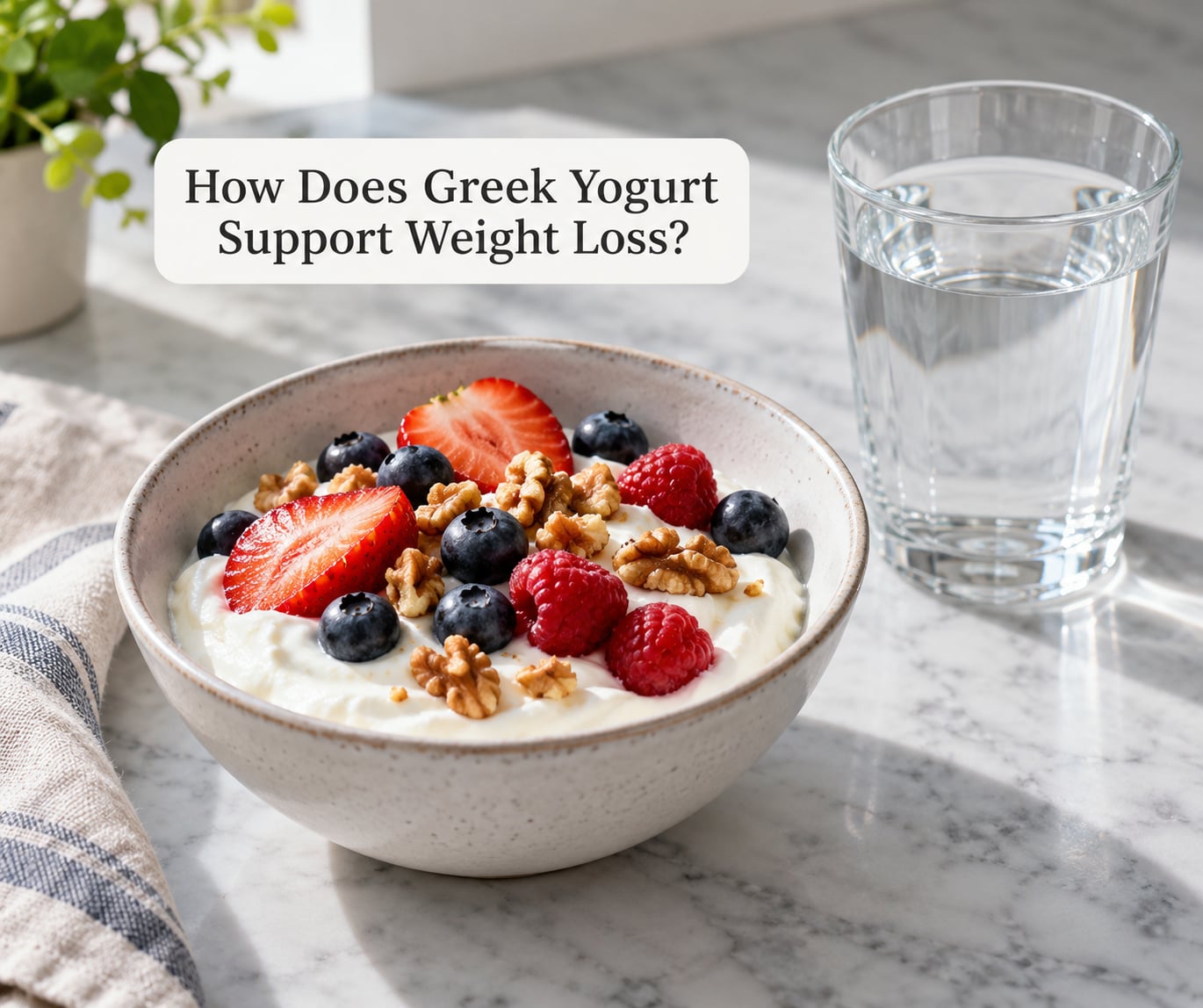
Greek yogurt helps through fullness and portion control, not through a fat-burning effect. Protein is the main driver.
- Protein raises fullness. Higher-protein meals tend to delay hunger longer than meals built mostly on refined carbohydrate.
- Protein tempers the hunger hormone. Diets with more protein tend to show lower levels of ghrelin, the hormone that drives the feeling of hunger.
- Steadier blood sugar. Plain Greek yogurt is low in carbohydrate, so it does not produce the sharp spike and drop that often precedes a mid-afternoon snack.
- Easy portion control. A 150 g tub is a fixed serving, which takes guesswork out of a calorie-controlled day.
- Muscle protection. Protein intake while dieting helps preserve lean mass, so weight lost comes from fat rather than muscle.
Harvard Health and USDA FoodData Central are the usual references for these nutrition figures. What neither can tell you is whether a specific yogurt will work for you. That comes down to the label and your own tolerance.
What Nutrients Does Greek Yogurt Contain?
Amounts vary by brand and style, so the label always wins. Plain strained yogurt is typically rich in protein and calcium, moderate in carbohydrate, and light on fat. Products carrying a live and active cultures declaration also provide bacterial cultures such as Streptococcus thermophilus and Lactobacillus bulgaricus.
| Per 6 oz serving | Plain Greek | Regular yogurt | Flavored Greek | Nonfat Greek | Low-fat Greek |
|---|---|---|---|---|---|
| Calories | About 100 to 150 | About 100 to 110 | About 140 to 200 | About 90 to 120 | About 100 to 130 |
| Protein | 15 to 20 g | About 8 to 10 g | 13 to 17 g | 17 to 20 g | About 16 to 19 g |
| Total fat | About 2 to 4 g | About 2.5 g | 2 to 4 g | Under 1 g | 2 to 3 g |
| Carbohydrate | About 5 to 8 g | About 12 g | 18 to 25 g | About 5 to 7 g | About 6 to 8 g |
| Total sugar | About 5 to 6 g | About 12 g | 14 to 24 g | About 4 to 6 g | About 5 to 6 g |
| Calcium | About 180 to 200 mg | About 300 mg | About 150 to 200 mg | About 200 mg | About 200 mg |
Notice the calcium trade-off. Regular yogurt carries more calcium per serving because much of it stays in the whey that gets strained away. If bone health is your main goal, eat both.
Does Protein in Greek Yogurt Help You Feel Full?
Protein does help with fullness, and Greek yogurt packs a lot of it into a small volume. It does not guarantee weight loss. Fullness is a tool, and tools only work when you use them.
Common guidance puts a protein target between 0.54 and 0.9 g per pound of body weight per day. For a 180-pound adult, that is roughly 100 to 160 g across the whole day. A 6 oz cup of Greek yogurt with 17 g of protein covers a useful slice of that without much of the calorie budget.
How Greek yogurt compares to other breakfast proteins
Two large eggs supply about 12 g of protein for roughly 140 calories, so Greek yogurt gives more protein per calorie. Cottage cheese runs similar to yogurt, around 165 calories and 23 g of protein per 8 oz cup in one published comparison. Protein shakes are comparable on protein but far lower on calories. Eggs win on satiety per calorie for some people and on how long they keep them full.
Is Low-Fat Greek Yogurt Always Better for Weight Loss?
No. Nonfat yogurt is not automatically the healthier or better choice for weight loss. It cuts calories per serving, but it also comes with its own trade-offs.
- Calorie saving is modest. Moving from full fat to nonfat typically saves a few dozen calories per serving, not enough to matter much on its own.
- Fat supports fullness. Fat slows gastric emptying, and many people find a small amount of fat in a breakfast keeps them satisfied longer.
- Nonfat can taste grittier. Protein-fortified and nonfat formulas get blamed for chalky texture often enough that people switch brands over it.
- Nonfat often needs thickeners. Xanthan gum and guar gum are common in these formulas, along with sweeteners in sugar-free versions.
A workable rule: pick the fat level that keeps you eating the yogurt regularly. Someone who loves full fat and stays at 200 calories per serving will do better than someone who eats 130 calories of nonfat and then picks a cookie an hour later.
How Do Flavored Yogurts and Added Sugar Affect Calories?
Flavored yogurt can be fine for weight loss, but only if you account for what the flavor cost you. The added sugars line is where the truth lives.
Flavored varieties carry roughly 20 to 22 g of added sugar in some cases, which is more than a serving of most breakfast cereals. That sugar arrives fast, rarely fills you, and can make a yogurt that looks like a health food behave like dessert. Fruit-on-the-bottom varieties are the worst offenders, because the fruit sits under a layer of sweetened yogurt and people often eat the whole tub.
Three options if you want sweetness. Buy plain and add fresh fruit yourself, choose a small flavored portion and pair it with something protein-rich, or pick a sugar-free variety while knowing that artificial sweeteners such as sucralose or aspartame may replace the sugar. Some people on calorie-controlled plans find that a daily serving of plain yogurt plus berries costs fewer calories than any of those.
How Do You Choose Greek Yogurt for Weight Loss?
Read the label in this order. It takes about thirty seconds, and it settles the question faster than any front-of-pack claim.
- Protein per serving: aim for at least 15 g. Check the serving size too, because a 32 oz tub lists a serving that may not match what you actually eat.
- Added sugars: under 6 g per serving is a sensible ceiling. If total sugar is high but added sugar is zero, it is naturally occurring lactose.
- Strained or Greek-style: strained yogurt is strained. Greek-style yogurt is thickened with ingredients like cornstarch and can carry more sugar and less protein than regular yogurt despite the name.
- Ingredients: a short list starting with milk and live cultures is a good sign. If milk sits third behind sugar and starch, skip it.
- Live and active cultures: look for the declaration if gut health matters to you.
- Fiber: plain yogurt has little, so pair it with fruit, oats or chia rather than expecting it to cover that gap.
- Texture tolerance: if a brand turns gritty, a small amount of blended banana or a splash of milk fixes it, and switching fat levels is another option.
People working on calorie-controlled plans often track protein per 100 g rather than per serving, since most trackers log food in grams. One recurring community example is a 150 g tub of plain Greek yogurt logged at around 220 calories, which was described as filling enough to make a low-calorie day feel generous rather than restrictive.
How Much Greek Yogurt Should You Eat?
There is no fixed daily prescription, and anyone who gives you one is guessing. Portion size follows your label, your hunger and the rest of your day.
- 150 to 170 g tub: a single serving of about 100 to 150 calories. This is the most common amount, and it fits most daily budgets comfortably.
- 200 to 250 g: reasonable as a breakfast base when you are keeping the rest of the day lighter, especially if you are hitting a protein target.
- 340 to 450 g: a large tub. Eating half to three-quarters is common; eating the whole thing in one sitting often turns a snack into a major meal, and it can be gritty by the end.
The toppings are where portions quietly get lost. People working on tight calorie budgets report spending a surprising share of a day’s calories on granola, honey, nuts and nut butter spooned over yogurt that started at 130 calories. A useful cap: one added topping, measured, roughly a tablespoon of nuts or a couple of tablespoons of berries.
How Can You Use Greek Yogurt in Meals and Snacks?
Preparation changes the calorie total more than the yogurt does. A few combinations that work.
- Breakfast oats: half a cup of oats cooked in milk, cooled, then stirred through yogurt with a spoonful of berries.
- Fruit and nuts: plain yogurt, a small handful of berries, and ten or so almonds. Simple, and it stays under a few hundred calories.
- Savory snack: yogurt with cucumber, a little garlic, dill and lemon as a dip. People often find this keeps them full longer than a sweet option.
- Smoothie base: yogurt, a handful of berries, a scoop of protein powder and ice. It thickens the blend without dried powder.
- Sour cream substitute: equal parts yogurt and a little lemon juice in sauces, on baked potatoes or over chili. You get most of the tang with fewer calories.
- Nighttime hunger: a small serving of plain yogurt is a common answer in weight-loss communities for late-night hunger, because it is filling without being a heavy meal.
- Frozen: frozen yogurt with fruit instead of a sauce stays closer to the original calorie count than ice cream topped with fruit does.
Who May Need to Avoid or Limit Greek Yogurt?
Most adults tolerate yogurt well, but some groups have genuine reasons to limit it or get advice before adding it to their routine.
- Lactose intolerance: strained yogurt usually contains less lactose than milk because it is strained and fermented, but tolerance varies. Some people are fine with yogurt and not with milk.
- Milk protein allergy: this is different from lactose intolerance, and it is a medical allergy. Speak with a doctor before trying yogurt.
- Digestive upset from high protein: concentrated high-protein diets can cause gas, bloating, constipation or loose stools for some people, particularly if fiber and water are low.
- Calorie-dense toppings: yogurt itself is rarely the problem, so people managing a specific condition should count what goes on top.
If you have a medical condition, are pregnant, or are following a diet for a specific diagnosis, talk to a doctor or registered dietitian before changing what you eat. General food information like this cannot account for your medical history.
Frequently Asked Questions
Does Greek yogurt burn belly fat?
No food burns belly fat on its own. Greek yogurt supports fat loss indirectly, because its protein and low sugar keep you full and make a calorie-controlled eating pattern easier to follow. A review of 22 studies found that people who ate yogurt tended to have lower body fat, less weight gain and smaller waist circumference. That is an association in a group, not proof that yogurt caused it. Losing visceral fat depends on your overall calorie balance, movement and sleep.
Is Greek yogurt better than regular yogurt for weight loss?
For weight loss, Greek yogurt usually edges out regular yogurt because it carries roughly double the protein and about half the sugar per serving. Regular yogurt tends to hold more calcium, since some stays in the whey that gets strained away. If your priority is a filling, low-sugar breakfast, Greek is the stronger pick. If the reason you eat yogurt is bone health, either works, and many people simply eat both across the week.
Is nonfat Greek yogurt the healthiest option?
Not necessarily. Nonfat yogurt usually saves only a few dozen calories per serving, and the fat it removes slowed digestion and helped with fullness. Nonfat formulas also lean on thickeners like xanthan gum and guar gum, and they are often blamed for a chalky or gritty texture that makes people give up on the yogurt entirely. Choose the fat level that keeps you eating it consistently, as long as your daily calorie budget has room for it.
Can I eat Greek yogurt every day?
For most adults, yes, daily use is fine within an overall balanced eating pattern. Common ranges in weight-loss communities run from five to seven servings a week, sometimes every day, conditional on fitting the day’s calories and macros. Watch for two things instead of the frequency: added sugar in flavored varieties, and calorie-dense toppings. A 150 g plain tub at roughly 100 to 150 calories is an easy daily serving, but that changes if the bowl includes granola and nut butter.
Is fruit-flavored Greek yogurt okay for weight loss?
It can be, if the added sugar still fits your day. Check the added sugars line first, because some flavored varieties carry 20 to 22 g per serving, which is more than most breakfast cereals. Fruit-on-the-bottom tubs are the ones to be most careful with, since the fruit sits under sweetened yogurt. A practical alternative is plain yogurt with fresh fruit added at home, which gives you the flavor for a fraction of the sugar and the calories.
Conclusion: Start With the Label and Portion Size
So is Greek yogurt good for weight loss? It can be a strong part of an eating plan, because protein keeps you full and plain varieties are low in sugar and low in calorie density. It does nothing on its own. The results come from what it replaces and how much of it you eat.
Here is what to do first. Pick a strained plain yogurt with at least 15 g of protein and under 6 g of added sugar per serving, measure one serving instead of eating from the tub, and pair it with something high in fiber such as berries, oats or chia. Give it a month, then weigh yourself, check the waist measurement, and decide from that whether the portion is still keeping you full.