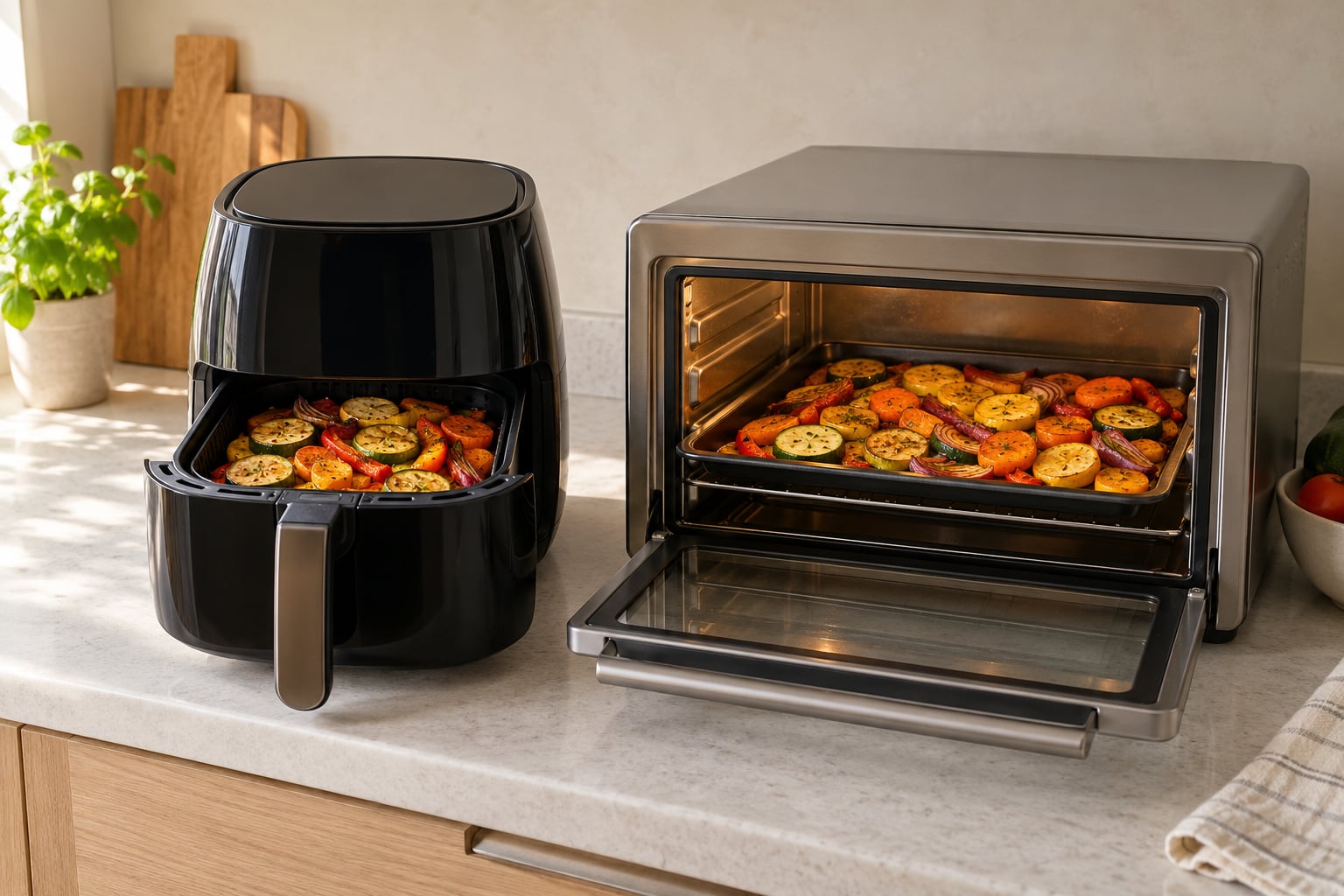
If you are comparing an air fryer vs oven for healthy cooking, the honest answer is that both can do the job and the gap between them is narrower than most advertising suggests. The air fryer wins on speed, oil use and small crispy portions. The oven wins on capacity, baking and one-dish meals.
Air fryer health claims usually start life as a comparison with deep frying, not with your kitchen oven. That distinction matters more than anything else in this guide, so I will come back to it a few times.
Table of Contents
- Air Fryer vs Oven for Healthy Cooking at a Glance
- Which Is Healthier: Air Fryer or Oven?
- Is an air fryer really healthier than an oven for healthy cooking?
- Where the air fryer genuinely wins on health
- Where the oven holds the advantage
- Browning compounds
- How Air Fryers and Ovens Cook Differently
- Air Fryer vs Oven: Cooking Time and Crispy Texture
- Temperature conversion when adapting oven recipes
- Which Uses Less Oil?
- Air Fryer vs Oven: Nutrition, Portions, and Everyday Use
- Safety, Cleaning, and Versatility
- What not to put in an air fryer
- Which Should You Choose?
- Frequently Asked Questions
- Is an air fryer healthier than an oven?
- How much oil should I use in an air fryer compared with an oven?
- Does an air fryer help with weight loss?
- Are air fryers safe to use every day?
- Can I cook large meals in an air fryer?
- Which is faster, an air fryer or an oven?
Air Fryer vs Oven for Healthy Cooking at a Glance
| Criterion | Air fryer | Oven |
|---|---|---|
| Oil needed | A light spray or toss for most foods | Light oil, or none with parchment and convection |
| Preheating | 2 to 5 minutes | 10 to 20 minutes |
| Cook time for typical servings | 8 to 20 minutes | 20 to 45 minutes |
| Crispness on small foods | Excellent | Good with convection or broiling |
| Typical batch size | 1 to 4 servings, one thin layer | 4 to 10 servings, multiple pans |
| Baking, casseroles, bread | Limited to small cakes and flat bakes | Full range |
| Cleaning | Basket and drawer, non-stick | Rack, tray and door glass |
| Energy per meal | Lower, mostly because it runs shorter | Higher on a full preheat |
| Food safety | Same internal temperature targets | Same internal temperature targets |
Read that table as a workflow difference rather than a quality ranking. An air fryer is a fast, small convection oven. A standard oven is a bigger box that also heats from the top and bottom elements.
Which Is Healthier: Air Fryer or Oven?
Is an air fryer really healthier than an oven for healthy cooking?
Only in specific situations, and the situations are common enough to matter. If you would shallow-fry chicken in a skillet with a tablespoon of oil, the air fryer cuts the fat sharply. If you would roast that chicken on a tray in the oven with no added oil, the two results are close.
The widely repeated figure of 70 to 80 percent less fat comes from studies that compared air frying against deep frying in a full pot of oil. Air fryer food also shows about 90 percent less acrylamide than deep-fried food in the same comparisons. Both numbers are real, and both are the wrong yardstick for a home cook who already roasts and bakes.
That is not a small detail. Deep frying submerges food in hot fat at temperatures between 300 and 375°F. Roasting and air frying both cook with dry heat. Compare an air fryer to the oven on your own habits, not to a fryer.
Where the air fryer genuinely wins on health
- Crisp food without added oil. A 2 lb batch of fries with one teaspoon of spray beats a skillet of fried fries by a wide margin.
- Portion control. A small basket makes it awkward to cook a huge amount at once, which suits people managing portions.
- Less drip fat. Rendered fat collects in the drawer instead of being served on the plate.
- Shorter cook time. Less time at temperature means less moisture loss and fewer chances to overcook.
Where the oven holds the advantage
- Temperature control. You can hold a low oven at 225°F for slow roasting without worrying about a small basket.
- Multiple dishes at once. A roast, a tray of veg and a baking dish all cook together, which is how batch healthy cooking actually works.
- No crowding. An air fryer basket needs a single layer for food to crisp; a second layer steams.
- Water-soluble vitamins. Vitamin C and B vitamins leach into water, so any roasting method that keeps the food dry holds more of them. Air frying is very good at this, but so is a hot oven.
Browning compounds
Browning is where an air fryer needs sensible limits. High heat on starchy foods produces acrylamide, and very high heat on fatty meats produces polycyclic aromatic hydrocarbons, or PAHs, and advanced glycation end products, or AGEs. The FDA has not set a regulatory limit for acrylamide, though it has asked food producers to reduce it where practical.
An air fryer browns faster than an oven because moving hot air drives off surface moisture quickly. The practical guidance is to keep potatoes and other starchy items around 350°F or below, use 340°F for pastries, and pull meat out before charring.
Two habits cut those compounds meaningfully. Soak cut potatoes in cold water for 15 to 30 minutes before cooking, which washes off surface starch, then dry them well. Marinate meat in something acidic with garlic and herbs before high heat; studies on grilled meat show marinating lowers PAH formation.
How Air Fryers and Ovens Cook Differently
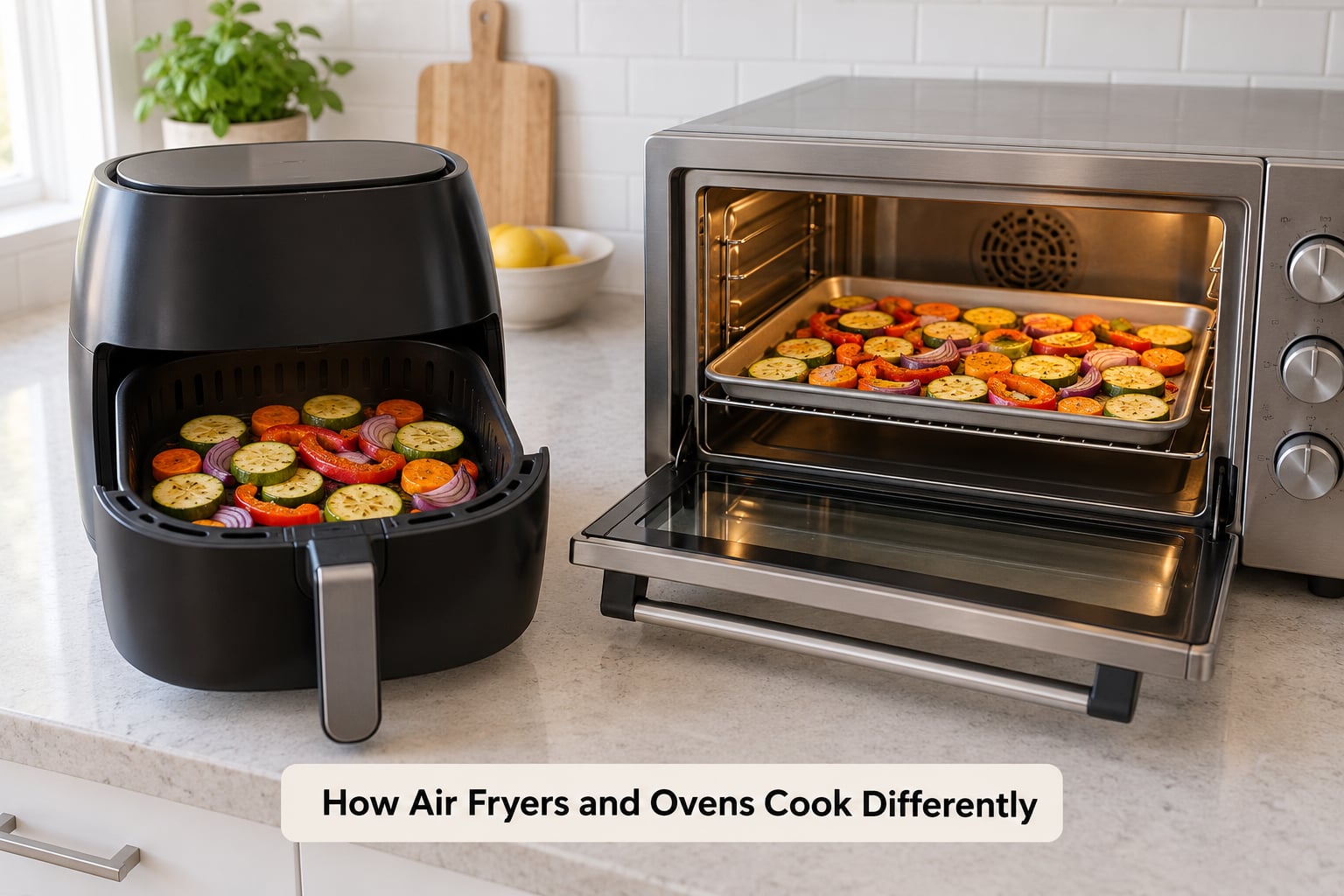
An air fryer has one heating element near the top and a fan that forces that air past the food and back again at speed. The perforated basket lets the air reach all sides. It is convection cooking with the fan turned up and the box made small.
A conventional oven has top and bottom elements, sometimes a rear fan for true convection, and a much larger cavity. A fan-forced oven gets close to an air fryer for vegetables and roasting. A conventional oven without the fan relies on radiant heat, which is gentler and slower.
That difference explains the cooking times. An air fryer preheats in minutes because there is little metal to heat. A full-size oven can take 15 to 20 minutes to reach temperature, and that preheat is part of the cost of every meal.
It also explains texture. Food in an air fryer is surrounded on every side by moving hot air, so it dries and browns fast. Food in a conventional oven sits in still air, so it browns from the top and bottom first.
Air Fryer vs Oven: Cooking Time and Crispy Texture
The air fryer is faster in almost every direct comparison, and most of the difference comes from preheat rather than from the cooking itself.
- Chicken breast, 1 lb: about 18 to 22 minutes in an air fryer at 380°F, versus roughly 25 to 30 minutes in a 400°F oven.
- Chicken wings, 2 lb: about 25 minutes at 400°F with shaking twice, versus about 35 to 40 minutes in the oven.
- Salmon fillet: 10 to 12 minutes at 390°F, versus 15 to 18 minutes in the oven.
- Frozen fries, 1 lb: 15 to 18 minutes at 400°F, versus 25 to 30 minutes on a baking sheet.
- Broccoli, 1 lb: 10 to 12 minutes at 380°F, versus 18 to 22 minutes roasted.
Those are ranges from my own kitchen, not lab numbers, and they shift with the model and how full the basket is. Treat them as a starting point rather than a rule.
Texture divides cleanly by food size. Small, thin, dry foods want the air fryer: fries, wedges, wings, fish, medallised chicken, chips, sliced vegetables, small pastries. Moist, thick, or large foods want the oven: whole roast chicken, a joint of meat, casseroles, bread, a whole butternut squash, lasagne.
Temperature conversion when adapting oven recipes
This is the question readers search for most, and the answer is no. 350°F in an air fryer is hotter and drier in practice than 350°F in an oven.
- Drop the oven temperature by 25°F, so 400°F becomes 375°F.
- Reduce the cook time by about 20 percent, then check early.
- Do not crowd the basket. Cook in batches if needed.
- Shake or rotate halfway through, which is what people on cooking forums describe as the one real habit change.
- Expect more browning, so pull earlier than the oven recipe says.
The last point is where acrylamide sneaks in. Cramming a full basket and cooking at full temperature to compensate for the longer time is the classic mistake, and it undoes much of the health advantage.
Which Uses Less Oil?
The air fryer usually wins on oil, though the amount depends far more on the food and your technique than on the appliance. A tablespoon of oil poured over vegetables is a tablespoon of calories no matter which box they go in.
| Food | Air fryer | Oven |
|---|---|---|
| Roasted vegetables | 2 to 3 sprays, or toss with 1 tsp oil | 1 to 2 tsp oil for 2 lb, or none with parchment |
| Chicken breast | Spray plus dry rub | Rub, or 1 tbsp oil in the tray |
| Fish fillet | Spray plus lemon or herbs | 1 tsp oil or a little butter |
| Frozen breaded foods | No added oil at all | Spray or a light drizzle |
| Roast potatoes | 1 tsp oil tossed in the basket | 1 to 2 tbsp oil |
| Cakes and muffins | Grease only the liner | Standard butter or oil in the batter |
Frozen breaded items are the clearest case. Air fryers cook them well with zero added oil, which is not true in a conventional oven where they usually need a spray to crisp. Potatoes are the case where the gap narrows, because oil is what gives them their texture.
Olive and avocado oils handle high heat well and add unsaturates, but they still carry nine calories per gram. A spray bottle gives you control in a way that a pour does not.
One more practical note from people who cook in an air fryer every day: the oil does not need to be preheated in the basket, and reheated food absorbs less oil than food cooked from raw. A basket that has been used a few times has a seasoned surface that helps more than any special spray.
Air Fryer vs Oven: Nutrition, Portions, and Everyday Use
The appliance changes your calorie count mostly through portion size and frequency of use, not through any chemical difference in the food.
A 4 to 6 quart air fryer holds a single layer. Many people cook in that one basket and eat from it, which naturally lands at three to four servings. A 5 quart basket on a family of four is usually full after one batch of chicken.
Meal prep is where the split shows. An air fryer gives you four or five trays of protein and veg in 30 minutes while you do something else. An oven gives you larger quantities per cycle, plus the ability to cook a grain and a tray of veg at the same time.
For reheating, most people find the air fryer wins. A slice of pizza or a bowl of vegetables reheats in 4 minutes with the edges still crisp, where a microwave goes soft and an oven takes 12 minutes for one slice.
On energy, the air fryer usually comes out ahead for a small meal because the cavity is small and it runs for less time. Over a full roast or a tray of cookies, the oven wins on cost per item. The difference is modest either way, so pick for the cooking, not the electricity bill.
Safety, Cleaning, and Versatility
Both appliances are safe when used as intended, and both need the same attention to internal temperature. Heat does not kill bacteria on its own schedule, so use a thermometer rather than colour or texture.
- Poultry, whole or ground: 165°F or 74°C.
- Ground meat: 160°F or 71°C.
- Whole cuts of beef, pork, lamb and fish: 145°F or 63°C, with a three-minute rest.
Air fryer specific safety points: leave clearance around the unit so air can move, do not use it in a closed cupboard, and put it on a heatproof surface. Never cover the intake. Do not plug it into an extension or a power strip, since these draw a lot of current.
New units can smell of plastic or chemicals on the first few runs. Run empty at 200°F for 20 minutes with the window open before the first real cook. If the smell lingers, the manufacturer warranty or a replacement is the answer, not more cooking cycles.
What not to put in an air fryer
- Whole eggs in their shells, and any metal or foil in the basket.
- Tender leafy greens and anything wet enough to create steam, which stops the fan and the browning.
- Batters that drip, unless you use a small liner and a rack underneath.
- Dried-out braised or stewed dishes, which burn rather than reheat.
- Large whole items that touch the lid and stop the fan.
Cleaning is easier in the air fryer. The basket and drawer are non-stick in most models, need a wipe or soak rather than scrubbing, and should be washed once the coating has cooled. Air fryer parchment liners are convenient, though reuse them a few times rather than cooking on a fresh sheet every time.
The oven has more surfaces: rack, drip tray, door glass and the cavity. It also does more damage to a kitchen, so a self-clean cycle or an outside-clean cycle is worth the electricity if your model has one.
On coatings, look for cookware sold as PFOA-free, avoid non-stick spray inside the basket because it gums the coating over time, and replace the drawer if the coating flakes. Longevity is a legitimate health consideration here.
Which Should You Choose?
Choose the air fryer if you mostly cook one to three people, if crisp texture matters to you, if you want to cut oil, and if weeknight cooking happens in the time between getting home and sitting down. It also handles frozen food, snacks and reheating better than anything else at that size.
Choose the oven if you cook for four or more, if you roast joints and whole vegetables, if you bake anything that needs structure, or if you batch cook on a Sunday. A fan-forced oven narrows the gap further, because it uses the same circulating hot air.
Many people end up wanting both, and that is not wasteful. The oven takes the roast and the baking; the air fryer takes the fries, the wings and the Tuesday leftovers. That split is the pattern most regular air fryer users describe on cooking forums.
If you are starting from nothing and cooking for one or two people, a countertop air fryer is the cheaper, faster way to begin. If you already have a working oven, an air fryer oven with a dedicated air fry function covers the same ground in one appliance for people who cook big meals.
Frequently Asked Questions
Is an air fryer healthier than an oven?
Usually only slightly, unless you would otherwise deep-fry. The famous 70 to 80 percent fat reduction figures compare air frying with deep frying, not with roasting in your oven. Roast the same chicken with no added oil in both appliances and the calories are nearly identical. The air fryer wins on oil for fried-style foods, speed, portion control and crispness without added fat.
How much oil should I use in an air fryer compared with an oven?
Less in most cases, but not zero. Use one spray or about half a teaspoon for 2 lb of vegetables, the same as roasting. For roast potatoes, one teaspoon tossed through is enough. Frozen breaded foods need no added oil in an air fryer and usually need a spray in an oven. Sprays give you far better control than pouring oil straight from the bottle.
Does an air fryer help with weight loss?
It can support weight loss but it is not a weight loss tool on its own. What helps is cooking more food at home, using less oil, and eating sensible portions. A small basket encourages smaller servings, and the short cook time makes weeknight meals realistic. If a device changes nothing about what you eat, it changes nothing about your weight. For a personal plan, talk to a registered dietitian.
Are air fryers safe to use every day?
Daily use is fine for most people. Give the unit clearance so air can circulate, place it on a heatproof surface, and plug it directly into a wall socket rather than an extension or power strip. New machines can smell of plastic, so run one empty cycle at 200u0026deg;F with a window open first. Stop using it if the non-stick coating flakes or a chemical smell persists.
Can I cook large meals in an air fryer?
Only small batches, and that is the main limitation. Food needs a single layer with space around it for air to circulate, and anything touching blocks the fan and steams instead of browning. A larger basket holds a roast chicken or fish fillets, but a full dinner for four usually means three or four cycles. Dual basket models help because they run two trays at the same time.
Which is faster, an air fryer or an oven?
The air fryer, mostly because of preheating. A countertop unit reaches temperature in 2 to 5 minutes, while a full oven can take 15 to 20 minutes. Cook times then differ by roughly 20 to 30 percent, so a chicken breast takes about 18 to 22 minutes in an air fryer and 25 to 30 minutes in a 400u0026deg;F oven. If you cook large quantities, the oven wins on time per serving.
Start with the appliance your next three meals actually need. If those are small, crisp and quick, the air fryer earns its counter space. If they are roasts and Sunday batches, use the oven and spend your oil budget on better ingredients instead.