The couch to 5K plan explained for beginners comes down to three sessions a week, each one built from short runs separated by walking breaks, worked through slowly until you can run 30 minutes without stopping. It is free, it needs no gym, and the whole thing usually takes about nine weeks.
Most people find the first two weeks almost disappointingly easy, then hit something much harder in weeks four to six. Knowing that in advance is half the battle, so here is what the sessions actually look like, how to tell when you are ready to move on, and what to do when life gets in the way.
This is general exercise information, not a training prescription. If you have a heart condition, diabetes, a recent injury, or any concern about starting exercise, speak to a doctor or another qualified health professional before you begin.
Table of Contents
- What Is the Couch to 5K Plan?
- How Does the Couch to 5K Plan Work?
- What Should Beginners Do Before Starting?
- How Do I Follow the Couch to 5K Plan for Beginners?
- A Beginner-Friendly Couch to 5K Weekly Example
- How Can I Make the Intervals Easier?
- How Do I Know When I Can Progress?
- What Can I Do If I Miss a Week?
- How Do I Stay Motivated?
- Frequently Asked Questions
- How long does it take to finish the Couch to 5K plan?
- How many times a week should I run on Couch to 5K?
- What is the hardest week on the Couch to 5K plan?
- Can I repeat a week if I am not ready to progress?
- Is running a 5K bad for your knees?
- Do I need a running watch or an app to follow the plan?
- Conclusion
What Is the Couch to 5K Plan?
Couch to 5K is a free, beginner running plan that takes someone with no running fitness from walking to running 30 minutes continuously, roughly a 5K or 3.1-mile distance, over about nine weeks. It works through three short sessions each week made of jogging intervals broken up by walking. The goal is a finish, not a time.
The version most people meet first is the NHS Couch to 5K, a nine-week programme originally built for people who want to walk or run a 5K in under an hour. You will also see the C25K app, which runs on the same interval logic with audio cues so you never have to watch a timer. Nike Run Club and Strava both host the programme too, and all of them are usable at the same three sessions a week.
None of these is a training plan in the coaching sense. They are a pacing schedule: the running gets longer, the walking gets shorter, and your body is given roughly two days to adapt in between.
How Does the Couch to 5K Plan Work?
The whole method rests on repeating the same pattern three times a week. You walk to warm up, run a short interval, walk to recover, and run another one. Over the weeks the running stretches and the walking shrinks until the walks disappear entirely.
Here is the general shape of it, as exercise guidance rather than a set of instructions for you personally. Sessions are listed for each week and are identical across your three weekly runs unless a note says otherwise.
| Phase | What a session looks like | Time on your feet |
|---|---|---|
| First two weeks | Alternating brisk walk and a very short jog, repeated several times | Around 20 to 30 minutes |
| Middle three weeks | Longer jog intervals, shorter walks between them | Around 30 to 35 minutes |
| Six to eight | Long continuous runs with the last walking gaps removed | Around 35 to 45 minutes |
| Final week | One continuous run, then a time trial or a 5K event | As long as your body allows |
Two things matter more than the exact numbers. The first is the gap between sessions. Forty-eight hours is the working minimum, which is why the plan lands on three days rather than five. Tendons, knees and shins adapt more slowly than lungs, and most of the injuries people associate with “getting into running” come from too little recovery between efforts.
The second is effort. Beginners routinely run their intervals far too hard, which turns an easy aerobic session into an anaerobic one that takes days to recover from. Use the talk test: you should be able to speak in full sentences while you run. If you can only manage a few words, slow down until you can chat. The plan works on time, not pace, so slow is always acceptable.
Over the same period your aerobic base grows. That is the less visible adaptation that matters most for keeping the habit going long after the nine weeks are over.
What Should Beginners Do Before Starting?
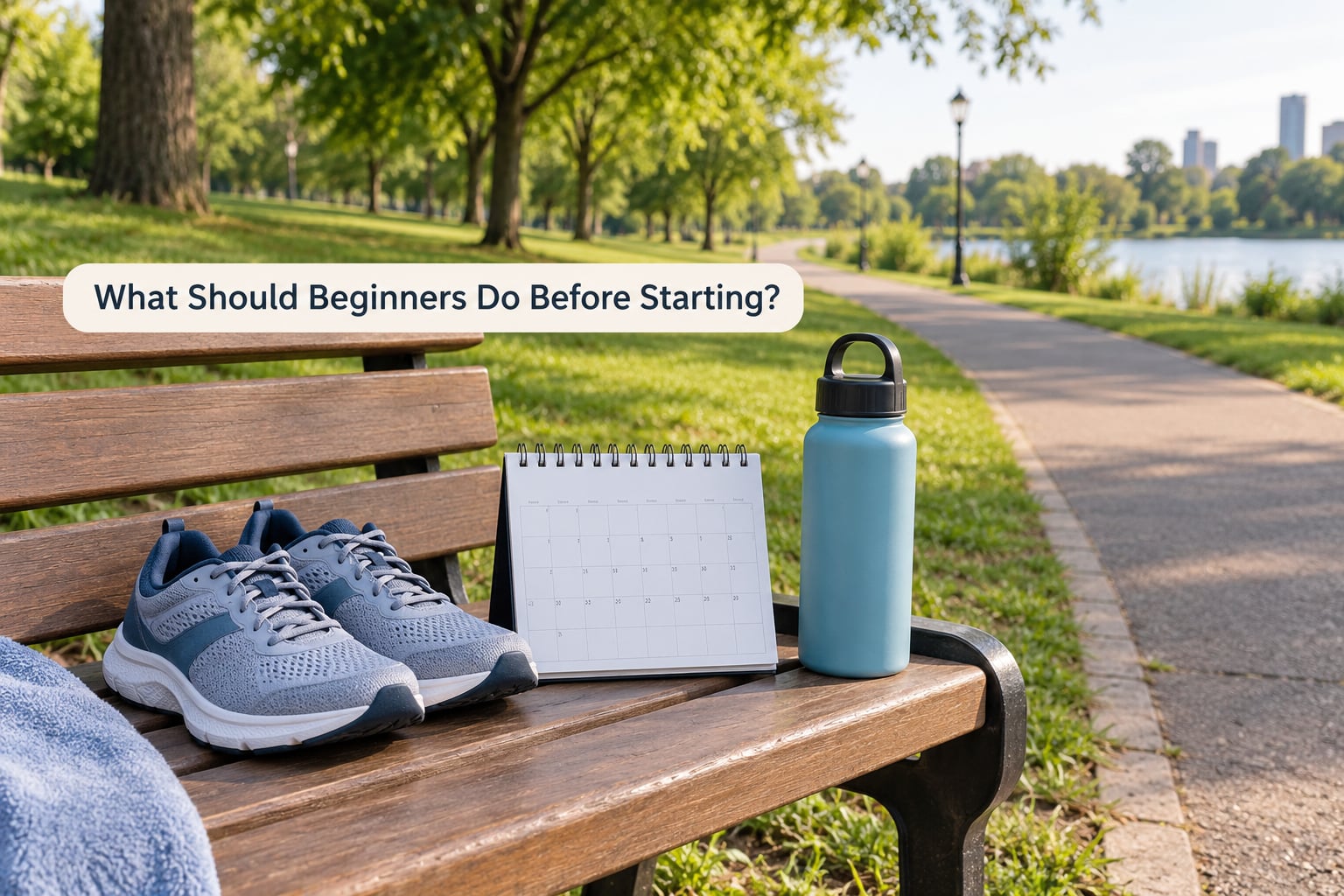
You need far less preparation than most guides imply. Pick shoes you can walk a long way in without discomfort, choose a flat route you know well, and turn up.
- Shoes: comfort beats everything. Running shoes for beginners do not need to be expensive or technical, and they do not need to be running-specific if the ones you own already feel good. There is no test that says you have the right pair. Shoes that fit, feel fine and have not gone flat are enough.
- Route: a park loop, a school field, a quiet street, a treadmill. Familiarity matters more than scenery because you will be counting intervals, not looking at views.
- Kit: whatever you would wear for a long walk. A watch is helpful for timing but optional, since the app or a kitchen timer covers it.
- Warm-up: three to five minutes of easy walking before your first interval. This is not optional and it takes two minutes.
Set a start date that is not a Monday of a particularly busy week. Two runs in the first fortnight is the realistic target, not three, if that is what it takes to make three a habit later.
How Do I Follow the Couch to 5K Plan for Beginners?
Start at week one of whichever version you have chosen, and stay there until the sessions feel genuinely easy. The first session of the whole programme is a walk-run-walk alternation with runs short enough that you could hold a conversation through all of them. If that feels underwhelming, that is the plan working as intended.
Which version you are following matters less than people think. The NHS plan, the C25K app and most copies of the schedule share the same architecture: three sessions a week, walk-run intervals, progressively longer runs. Some are timed and some are distance-based, and the timed version is easier for a true beginner because you can pace yourself against the clock rather than guess how fast a mile is.
Start by writing three sessions into your calendar before you begin. Wednesday, Saturday and Sunday works for a lot of people. Non-consecutive days matter; specific days do not. If you can protect the time slot and treat it like an appointment, the rest takes care of itself.
A Beginner-Friendly Couch to 5K Weekly Example
The schedule below is a general illustration of how alternating workout and recovery days look, not a prescription. Use it as a shape, and take the actual intervals from whichever plan you have chosen.
- Day one (workout): five minutes walking warm up, then a set of short runs with equal walking recoveries between them, repeated around six to eight times. Finish with a walk to cool down.
- Day two (recovery): rest, or a gentle 20 to 30 minute walk. Anything that raises your heart rate a little without leaving you tired counts.
- Day three (workout): repeat day one exactly. Repetition is the point; doing something different because you feel good is how beginners get ahead of their own tendons.
- Day four (recovery): rest.
- Day five (workout): repeat day one, or a longer easy session once the intervals grow.
- Remaining days: rest, light walking, or cross-training such as cycling or swimming. Do not add extra running.
Record the date and how each session felt. That log becomes more useful than any tracker app after week three, because it is the only record that shows you whether you were genuinely ready to move up or just had a good day.
How Can I Make the Intervals Easier?
If a session feels too hard, it is almost always the pace rather than the structure. These adjustments, in the order I would try them:
- Slow down until the talk test passes. Most of the difficulty disappears here.
- Walk the interval instead of running it. You still get the time on your feet and the aerobic work, which is what matters.
- Shorten the session. A clean 15 minutes beats a struggle through 30.
- Stay on flat ground. Hills multiply effort without adding training value.
- Use a running partner who stays at your pace rather than theirs.
If you are working from a paper schedule or a printed week table instead of an app, mark each changeover on a timer or your phone rather than trying to count seconds in your head. Losing count mid-session is common and it is how sessions accidentally stretch past what your body can handle.
How Do I Know When I Can Progress?
Move up when a session finishes easily rather than barely. The signal is that you recover well afterwards, you could hold a conversation through the runs, and you feel you could do it again tomorrow without a real cost.
Green signs you are ready: the session ended before you wanted it to end, your breathing came down within an hour of finishing, any muscle soreness is the broad, dull kind rather than localised, and you did not have to will yourself through the last interval.
Red signs to stop for: sharp pain in a knee, ankle, hip or foot, pain that gets worse as the session goes on rather than easing, pain that changes how you run, dizziness, chest tightness, or breathlessness far beyond what a gentle session should cause. Rest the affected area and get advice from a qualified health professional rather than trying to run it off. Persistent soreness that survives more than a few rest days is the same kind of signal.
One honest expectation gap worth naming: the plan is built around 30 minutes of continuous running, not a fixed distance. Plenty of people finish week nine able to run for half an hour comfortably at a pace that covers less than 5K, and are surprised by it. If you want the distance specifically, keep going with easy runs and let the pace come down over a few more weeks.
What Can I Do If I Miss a Week?
Missing time is normal and it is not a reason to start over. Here is how I would think about it.
- A week here and there: carry on from where you stopped. Nothing was lost that a week of running cannot recover.
- Two weeks off: repeat the last week you completed. Walking fitness comes back much faster than running fitness, so you will feel able to move on sooner than you actually are.
- A month or more off: go back two or three weeks rather than to week one. That keeps the intervals short enough to rebuild without punishing your joints.
Do not try to catch up. Two back-to-back runs to “make up” a session is exactly the pattern that produces shin splints, and the missed week will still be there afterwards.
Fitness loss after a break is normal and reversible. What is not normal is pain that shows up during the break itself, or symptoms that persist once you start again. Those deserve a conversation with a doctor before you continue.
If illness rather than laziness interrupted you, treat it the same way. Restart gently and treat the first session back as a recovery session.
How Do I Stay Motivated?
The people who finish are rarely the fittest. They are the ones who protected the time slot. A few things that work better than willpower:
- Track sessions, not distance. A tick for showing up is easy to get and hard to argue with.
- Set process goals. “Three sessions a week for nine weeks” is far more motivating than “run a 5K”, because most weeks contain no 5K at all.
- Prepare kit the night before. Shoes by the door removes the single easiest excuse.
- Tell somebody. A friend who asks how the run went is a well-measured accountability device.
- Expect the wobble. Weeks five to seven are the mental stretch, not the physical one, and the people who plan for that hump tend to push through it.
- Allow 10 to 12 weeks. Finishing in eleven weeks is a success. Coming back in week five to start again is not.
Most of the people who abandon the plan are not exhausted by running. They are annoyed, or embarrassed, or stuck on a route where slower runners feel conspicuous. A quiet path solves that faster than any amount of motivation.
Frequently Asked Questions
How long does it take to finish the Couch to 5K plan?
Most people complete the standard nine-week version and take around nine weeks to do it. Plenty of beginners need longer, and repeating a week is a normal part of the process rather than a sign of failure. Finishing in ten to twelve weeks is still finishing. If you have been inactive for years, a slowed-down version with more walking will suit you better than the standard schedule.
How many times a week should I run on Couch to 5K?
Three sessions a week, on non-consecutive days, with at least 48 hours between each one. Three is the number the plan is built around, and adding a fourth run is the most common early mistake. Rest days are where your tendons and joints adapt. Use cross-training such as cycling or swimming on the other days if you want to keep moving without adding impact.
What is the hardest week on the Couch to 5K plan?
Weeks five to seven are usually the hardest, because the walking breaks shrink and then disappear, so you have to run continuously for longer than you have before. The difficulty is more mental than physical at that point. Lower your expectations for those weeks, run slower than feels necessary, and remember that everyone else on the path is struggling in the same way.
Can I repeat a week if I am not ready to progress?
Yes, and you should. If a week’s sessions leave you sore, tired or injured rather than merely pleasantly worked, repeat that week instead of moving on. The sign you are ready is that a session ends before you want it to end and you recover comfortably afterwards. Progressing a week early is far more likely to cause shin splints than repeating one costs you.
Is running a 5K bad for your knees?
Easy running at a conversational pace is generally low load and safe for most people. The warning signs are sharp or one-sided knee pain, pain that worsens during the run instead of easing, or pain that changes how you run. Soreness in both quads a day or two after a first session is normal. Sharp, localised or persistent knee pain is a reason to stop and speak to a doctor or physiotherapist.
Do I need a running watch or an app to follow the plan?
No. The plan itself is free and the schedule can be followed on paper, or with a kitchen timer for the changeovers. An app simply plays audio cues at each changeover so you do not have to look at anything. That is genuinely useful for many beginners, but a watch is optional, and you do not need to track pace or distance at all to finish.
Conclusion
The first action is small: put on the shoes you already own, pick a short flat route you know, and complete one easy walk-run session this week. Talk through the runs, keep two days between sessions, and move up a week only when the session ends before you want it to end.
If your fitness, weight, joints or medical history give you any doubt about starting, talk to a doctor or qualified health professional first. They can tell you what is sensible for you in a way no general plan can.