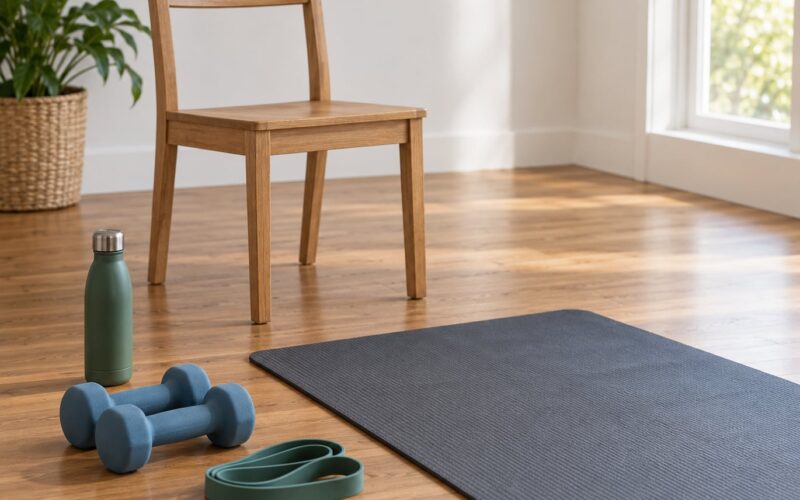
You do not need a gym to stay active on a trip. The practical answer for how to stay active on vacation without a gym is simple: build your days around walking, one short body-weight session, and ten minutes of mobility work, then let the rest of the trip be a vacation. Most of it needs a pair of shoes you already packed and about 25 minutes.
The reason people panic mid-trip is that they try to recreate a full gym week in a week that was never built for it. That fails, then it becomes a reason to stop entirely. A maintenance approach asks less and gets you through the trip without soreness, guilt, or a wasted week.
Below is the routine I actually use. Six steps, one gear list, and the mistakes that quietly undo most travel fitness plans.
Table of Contents
- What You Need
- Step-by-Step: How to Stay Active on Vacation Without a Gym
- 1. Plan movement around the trip instead of trying to recreate your gym routine
- 2. Walk more during sightseeing and daily travel
- 3. Use short body-weight sessions for strength and balance
- 4. Add mobility and recovery for long travel days
- 5. Turn ordinary vacation choices into extra movement
- 6. Keep the routine consistent without making vacation harder
- Common Mistakes
- Frequently Asked Questions
- What is the 3-3-3 rule for working out?
- What happens if I skip the gym for two weeks?
- What are some ways to stay active without going to the gym?
- Is it okay to work out 4 days on 3 days off?
- How long should a vacation workout be?
- Is hotel room exercise safe for beginners?
- Conclusion
What You Need

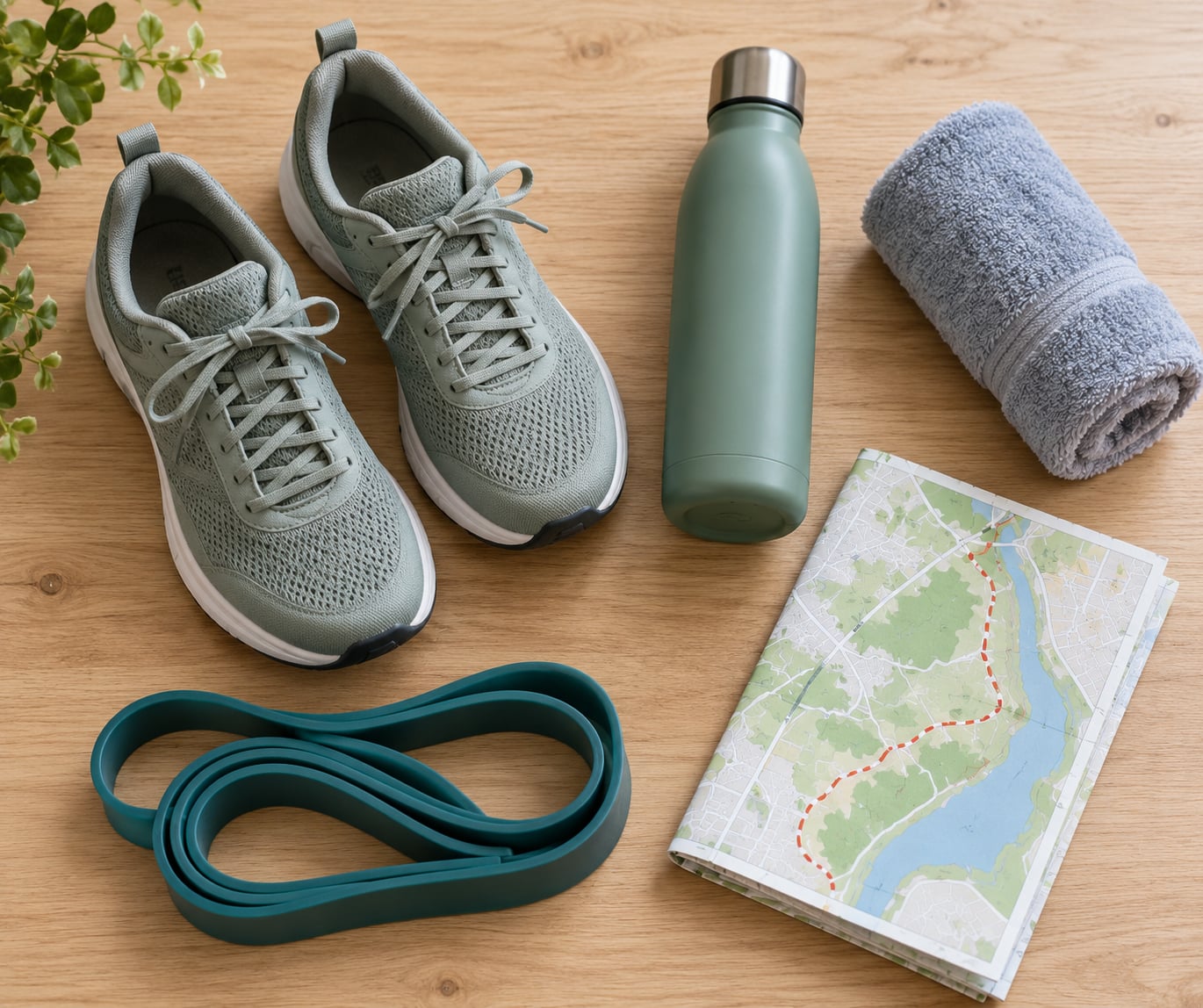
Start with what already exists in your suitcase. Everything else is optional, and packing less gear means less to lose, less to carry through airports, and less temptation to bail when setup takes longer than the workout.
- Walking shoes you can wear for four hours. Not running shoes unless you run. Broken-in footwear matters far more than any gadget, and new shoes on a trip is a recipe for blisters.
- A refillable water bottle. Movement plus heat plus flights dehydrates you faster than sitting on a plane does, and dehydration is the quiet cause of a lot of vacation headaches.
- One resistance band, loop or tube style. It weighs nothing, adds real resistance to rows and presses, and is the one piece of portable fitness equipment travelers recommend most often.
- Support items: a sturdy chair, a wall, a countertop, a towel on smooth floor. Your hotel room already contains a full bodyweight gym. You just have to notice it.
- Ten minutes of planning before you fly. Look up one walkable attraction near your hotel and one free outdoor workout option. That single step is what separates people who move from people who meant to.
If you want to pack more, add a jump rope, a set of core sliders for carpeted floors, or a short resistance loop set. One thing, not five. Travelers who bring a full portable setup often end up using the band and nothing else.
Step-by-Step: How to Stay Active on Vacation Without a Gym
1. Plan movement around the trip instead of trying to recreate your gym routine
The single biggest mistake is trying to keep a training week intact. Travel breaks your sleep, your schedule, your meals and your equipment. A plan that needs the old structure has nowhere to land.
Set one flexible target instead: 10,000 steps a day plus one 15-minute session three or four times during the trip. That is enough to maintain fitness. It is not a challenge, and you can hit it while sightseeing, which is the part that makes it work.
Look at your itinerary and mark three things:
- Two walkable anchors. One near where you sleep, one near a planned attraction. Even a small town’s main street usually has enough to walk.
- Two or three realistic session slots. Morning before the day starts, or early evening while it is cooler. Pick slots based on energy, not on the clock.
- One deliberately restful day. Long travel day, late arrival, a kid who needs you. Rest is part of the plan, not a failure of it.
Two weeks of doing nothing is not a disaster. Cardio fitness drops roughly 5 to 10 percent and muscle mass changes only slightly, and most of it comes back within a few weeks of normal training. Detraining is a slow fade, not a cliff. That is genuinely reassuring once you say it out loud.
2. Walk more during sightseeing and daily travel
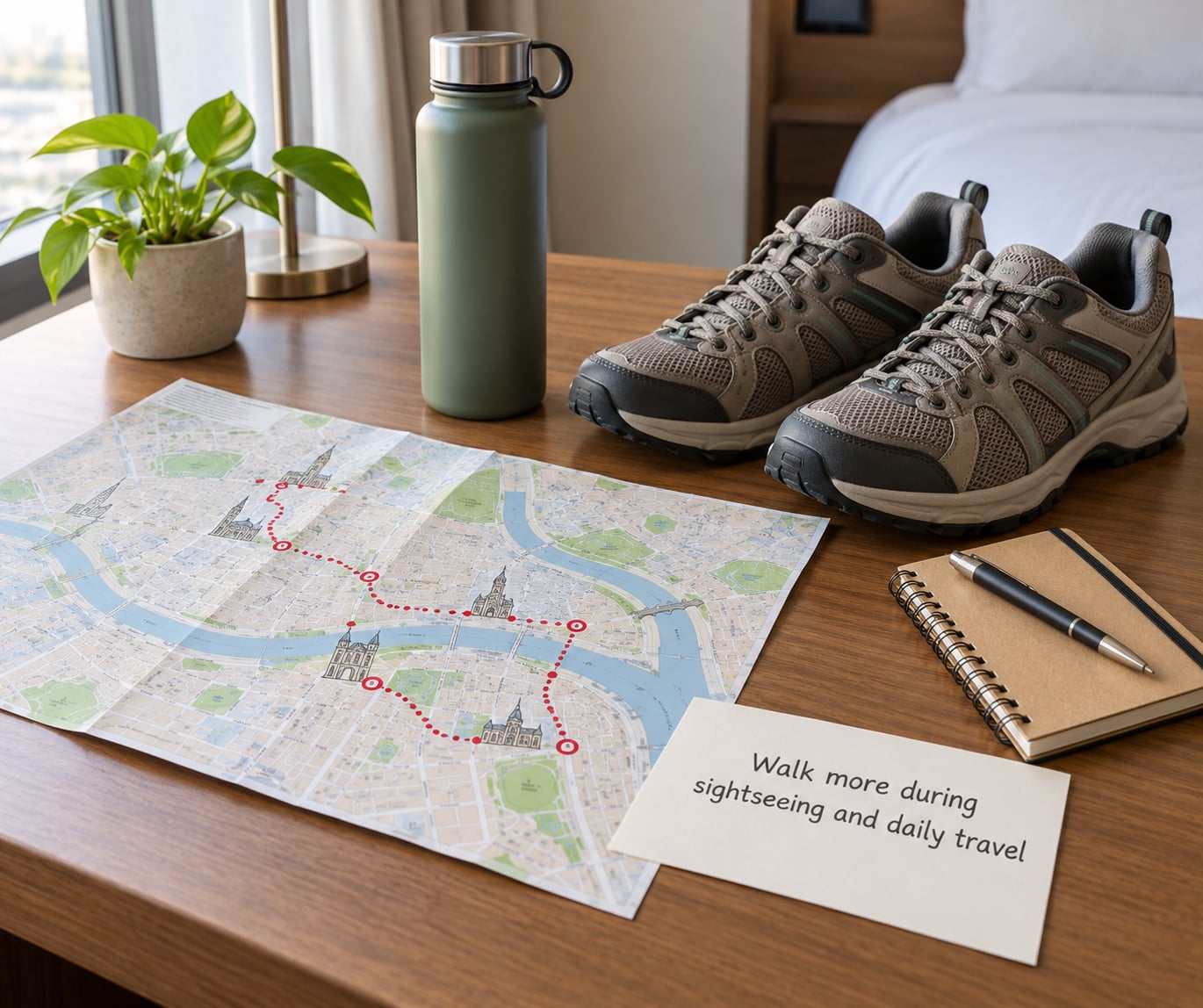
Walking is the underrated part of this whole plan. Travelers routinely clock 8,000 to 12,000 steps on a sightseeing day without intending to, and that volume is real cardiovascular work, not filler.
Add steps where they cost nothing:
- Walk the long way between neighborhoods, or add one extra block to reach the museum, the beach, or dinner.
- Take the stairs when they add less than two minutes to your route.
- Walk the airport, the station, or the terminal during a long layover instead of sitting at the gate.
- Swap a taxi for a walk when the distance is under 20 minutes and the weather is reasonable.
Track time or steps loosely, not obsessively. Counting steps is useful for noticing that today was a 900-step day, which is when you decide to take an evening walk. It stops being useful the moment a number starts to feel like a score you are failing.
On active sightseeing days your legs may feel tired in the evening. That is not a signal to add a workout. It is the workout already having happened.
3. Use short body-weight sessions for strength and balance
Hotel room strength work is about volume, not intensity. The goal is to keep muscles familiar with load, not to train to failure in a strange bed at 11 p.m. after a flight.
Run two rounds of this circuit, resting 60 to 90 seconds between moves, and stop the set when your form starts to break:
- Squat to a chair. 2 sets of 10 to 15. Tap the chair lightly, stand straight back up.
- Wall or countertop push-ups. 2 sets of 8 to 15. Move the hands lower to make it harder.
- Glute bridges. 2 sets of 12 to 20, two seconds at the top.
- Calf raises. 2 sets of 15 to 20, holding a wall or suitcase for balance.
- Supported balance hold. 2 sets of 20 to 40 seconds per leg, fingertip on a wall.
- Band rows. 2 sets of 15 if you brought a band. Sit on the floor, band around your feet, pull to your ribs.
Scale it down by doing one round. Scale it up by adding reps or a slow three-second lowering phase. A twenty-minute version beats a skipped hour every single time.
Early morning beats evening for most people. Nobody asks you for the time, the noise carries less, and it happens before the schedule takes over. People who move on vacation usually do it first thing, and the ones who wait until after dinner are the ones who skip it.
4. Add mobility and recovery for long travel days
After a six-hour flight or a full walking day, your hips, ankles, calves and shoulders feel tight. Ten minutes of gentle mobility work does more for how you feel tomorrow than any workout you would force through tonight.
Keep it simple, one minute each, with no forcing:
- Standing hip flexor stretch, one foot forward, pelvis tucked slightly back.
- Heel drops off a step or curb for calf length.
- Seated hamstring stretch with a soft knee.
- Cat-cow on hands and knees, slow and rhythmic.
- Doorway chest stretch for the shoulders and chest.
- Box breathing, four seconds in, four out, five rounds.
Stay inside a comfortable range. Stretching should feel like release, not like a contest, and if a movement causes sharp pain, stop it. If you have an injury, a recent surgery, or a condition that makes exercise risky, talk to your doctor or a physical therapist before starting something new on your own.
5. Turn ordinary vacation choices into extra movement
You are already paying for the trip. Choosing the active version costs you almost nothing and often beats a second workout.
- Beach day: swim, paddle, play frisbee, walk the shoreline at low tide. The sand makes running hard on the calves, so stick to walking and swimming rather than trying to run your normal pace.
- City trip: rent bikes, take a long walking tour, walk a museum district end to end, or find a public calisthenics park with bars and dip stations.
- Cruise: laps of the deck early morning when it is empty, stairs between decks, or a dance class if the ship has one.
- Road trip: a ten-minute walk at every rest stop instead of sitting in the car scrolling.
- Family trip: playground circuits, scooter laps, a scavenger hunt that covers a whole neighborhood. This one works when nobody else in the group wants to exercise.
- Business travel: a 15-minute circuit in the room between meetings, or a fast walk outdoors during a break.
Match intensity to energy and weather. A hot afternoon is not the time to insist on your hardest session, and a day when you are genuinely tired is not a failure. Move a little anyway. Walking around dinner after a long flight still counts as a win.
6. Keep the routine consistent without making vacation harder
A simple rhythm works better than a demanding program. Most weeks look like this:
- Every day: your walking target, spread naturally through sightseeing.
- Three or four days: one 15 to 20-minute body-weight session.
- Daily: ten minutes of mobility, ideally in the evening when things are quiet.
- One day: full rest from structured training. Walking only.
When you miss a day, do not double up and do not quit. Most people lose a vacation routine within two days of one skip, because they decide the streak is broken. It is not broken. The next session simply happens, and it is usually small.
Then ease back in when you get home. If you trained hard every day of the trip, give yourself three to four days of lighter work first. Coming back stronger is fine; coming back injured is not.
Common Mistakes
Trying to match your normal training volume. A vacation week has more walking, worse sleep and worse food. Match what you can sustain there, and hold everything else until you are home.
Chasing step numbers. Ten thousand steps is a reasonable target, not a pass or fail test. On a day that gives you 3,000 steps, an evening walk or a mobility session is the answer, not more stairs to punish yourself with.
Skipping the warm-up. Ten seconds of marching, arm circles and a few bodyweight squats before a session protects a body that slept badly and sat for nine hours.
Wearing the wrong shoes. New trainers on a trip means blisters, and blisters mean two days of doing nothing. Wear what you have already walked in.
Forgetting water. Carry the bottle and refill it whenever you pass a fountain or fill a tap. Dehydration makes every set feel harder than it is.
Dropping everything after one missed session. This is the big one. People get one busy day, feel guilty, and quit for the rest of the trip. A short session after a miss beats an abandoned plan.
Doing hard sessions on unfamiliar surfaces. Sand, uneven trails and slippery boat decks are harder on ankles and calves than the same effort on flat ground. Take the surface down a notch and stop if something feels wrong.
Frequently Asked Questions
What is the 3-3-3 rule for working out?
The 3-3-3 rule is a travel habit, not an official training program: three body-weight sessions a week, three sets per exercise, and about thirty minutes per session. It works well on a trip because the numbers are small enough to keep anywhere a hotel room can hold. Adjust it down to one or two sets on low-energy days rather than skipping entirely.
What happens if I skip the gym for two weeks?
Most adults lose very little strength in two weeks. Cardio fitness can drop roughly 5 to 10 percent, and any muscle loss is small and mostly reverses within a few weeks of regular training. That is why ten minutes on a hotel floor is worth doing. You are not preserving everything perfectly, you are keeping the changes small and easy to win back.
What are some ways to stay active without going to the gym?
Walking through sightseeing and neighborhoods, body-weight circuits using a chair, wall and floor, short mobility and stretching sessions, and swapping usual vacation choices for active ones such as swimming, cycling, hiking or playground laps. Daily movement such as 10,000 steps plus three or four short strength sessions per trip is enough to maintain most of your current fitness.
Is it okay to work out 4 days on 3 days off?
For most healthy adults, four training days with three rest days is a reasonable pattern, including on vacation. On a trip the training days are shorter, so the extra recovery matters more. Keep one full rest day, treat walking as easy movement rather than training, and back off further if you are sore, sleeping badly or adjusting to new food.
How long should a vacation workout be?
Ten to twenty-five minutes is the realistic range. Short sessions you actually complete beat long ones you skip, especially on active sightseeing days when your legs are already working. Ten minutes of mobility on a rest day is a legitimate session. If a session runs longer and you enjoy it, keep going, but do not make length the price of admission.
Is hotel room exercise safe for beginners?
Body-weight movements like squats to a chair, wall push-ups and glute bridges are low risk for most people when you control the range and stop before your form breaks. If you have an existing injury, joint replacement, pregnancy, osteoporosis or a heart condition, ask your doctor or a physical therapist what is safe for you before starting, and get clear medical advice for any warning sign such as chest pain or dizziness.
Conclusion
Pick one movement habit for this trip and start tomorrow morning. A walk plus one short body-weight session is the version that survives bad weather and long travel days.
Walk more than you think you will, keep a chair and a wall in your toolkit, and stop worrying about the sessions you missed. That is how to stay active on vacation without a gym, and it is enough to make the trip feel good rather than like a detour from training.