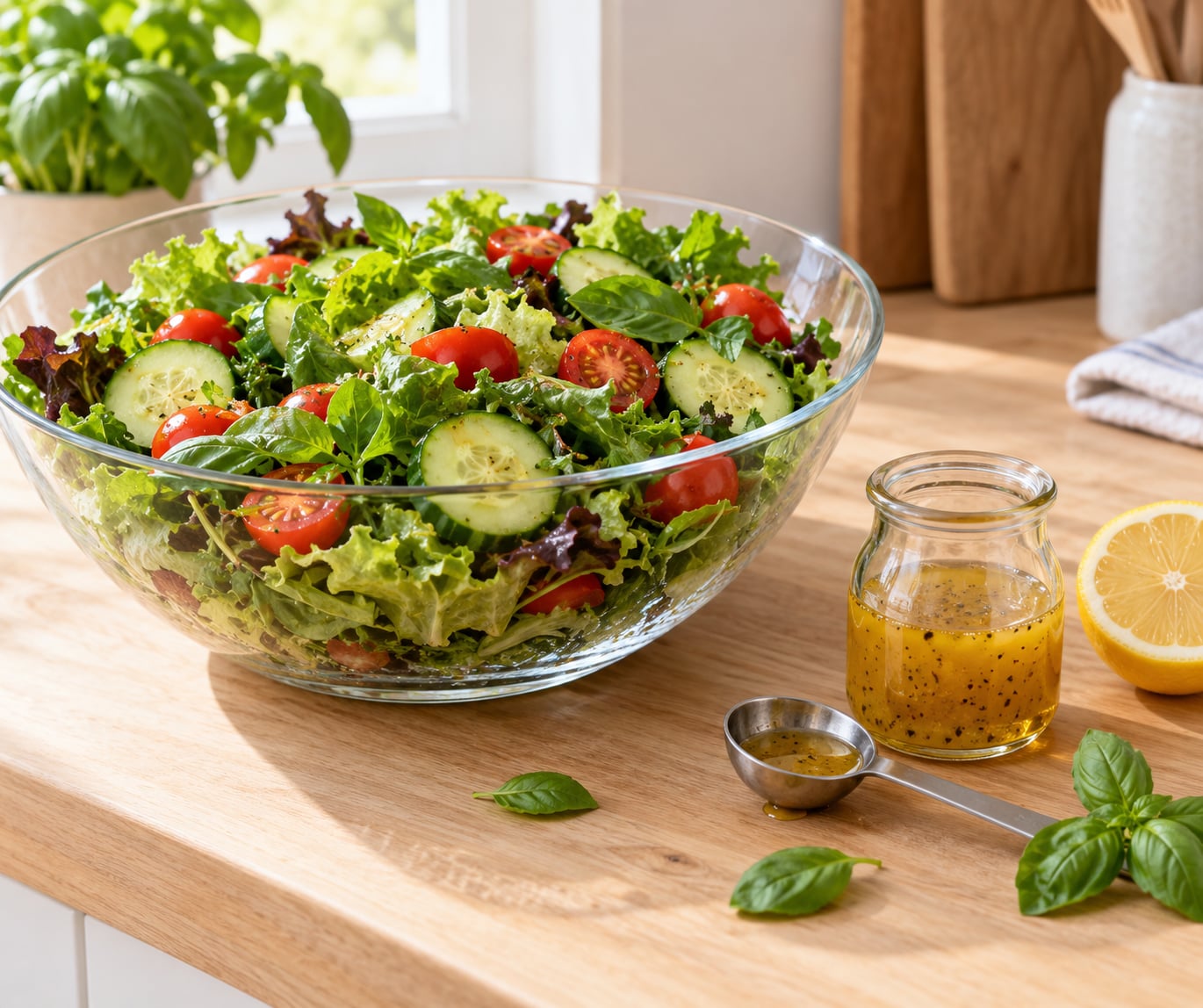
Salad dressing calories run from about 1 calorie per tablespoon for lemon juice to roughly 124 for extra-virgin olive oil, and a restaurant pour is often four tablespoons. The leaves in the bowl supply only about 20 to 30 calories on their own, so the dressing usually carries most of the meal.
That is the whole reason cutting salad dressing calories works so well. You are not removing something a salad needs. You are adjusting the single ingredient doing most of the damage, and you can do it without turning the bowl into dry leaves.
Everything below is general nutrition information for adults. If you are managing a medical condition or working to a specific calorie target, a registered dietitian can help you fit dressing into it.
Table of Contents
- Salad Dressing Calories: What to Know Before You Cut
- Which Salad Dressings Are Highest in Calories?
- The fat-free trade-off nobody mentions
- How to Cut Salad Dressing Calories Without Losing Flavor
- What the 3:1:1:1 rule actually means
- How to tell a change is working
- Smarter Swaps for Heavy Dressings
- How to Read a Salad Dressing Nutrition Label
- Simple Portioning Habits That Make the Biggest Difference
- Frequently Asked Questions
- How many calories are in a typical salad with dressing?
- Which salad dressing is lowest in calories?
- How much salad dressing is too much?
- Are restaurant salad dressings higher in calories than homemade?
- Do I need to avoid salad dressing to lose weight?
- The One Habit That Does Most of the Work
Salad Dressing Calories: What to Know Before You Cut
Dressing calories come almost entirely from fat, and fat carries 9 calories per gram. One tablespoon of olive oil at about 124 calories is roughly 14 grams of pure fat, which is why an oil-based dressing costs more per spoonful than a vinegar-based one.
Creamy dressings add sugar, emulsifiers and thickened starch on top of the fat, which is why ranch and Caesar sit above honey mustard even though both start from dairy. Here are typical figures for the dressings people actually buy or mix at home.
| Dressing | Per 1 tbsp | Per 2 tbsp (home pour) | Per 4 tbsp (restaurant pour) |
|---|---|---|---|
| Lemon or lime juice | 1 kcal | 2 kcal | 4 kcal |
| Balsamic or red wine vinegar | 5 kcal | 10 kcal | 20 kcal |
| Fat-free bottled vinaigrette | 10 kcal | 20 kcal | 40 kcal |
| Greek yogurt dressing | 30 kcal | 60 kcal | 120 kcal |
| Bottled Italian dressing | 60 kcal | 120 kcal | 240 kcal |
| Honey mustard | 60 kcal | 120 kcal | 240 kcal |
| Homemade vinaigrette, 3 parts oil to 1 part vinegar | 95 kcal | 190 kcal | 380 kcal |
| Ranch | 80 kcal | 160 kcal | 320 kcal |
| Blue cheese | 85 kcal | 170 kcal | 340 kcal |
| Caesar | 95 kcal | 190 kcal | 380 kcal |
| Thousand Island | 100 kcal | 200 kcal | 400 kcal |
| Extra-virgin olive oil | 124 kcal | 248 kcal | 496 kcal |
These are typical ranges for standard recipes, not measurements from your bottle. Brand, recipe and pour size move the number a lot, so the label on the jar you own beats any table, including this one.
The gap between the first and last row is the whole story. A balsamic-only pour and a quarter-cup of oil differ by close to 500 calories on the same salad.
Which Salad Dressings Are Highest in Calories?
Caesar, Thousand Island and blue cheese rank highest per tablespoon because they combine a large fat load with added sugar. Plain olive oil is technically higher per spoonful, but people pour far less of it than they pour ranch.
Three factors decide where a dressing lands on that table: how much fat it contains, how much added sugar sits in the mix, and how big a serving the bottle assumes. A light dressing also carries a hidden penalty, because it is thinner and weaker on the tongue, so people pour roughly double and land back near the original calories.
Sodium is the second cost nobody puts on the front of the bottle. Bottled dressings regularly run 300 to 500 mg per serving, which is most of the daily limit recommended for adults and can defeat the point of ordering the salad.
The fat-free trade-off nobody mentions
Fat-free dressing cuts calories and often reduces how well your body absorbs carotenoids from the salad, the pigment family behind the orange in carrots and the red in tomatoes. Absorption studies put that loss at a noticeable fraction when a fat-free dressing replaces the oil, so a teaspoon of real oil alongside the fat-free sauce is a reasonable compromise rather than an either-or choice.
People posting in weight-loss communities tend to land somewhere similar once they have tried the alternatives. Some simply dislike the texture of bottled fat-free dressing and prefer to mix oil, vinegar, lemon and spices instead.
How to Cut Salad Dressing Calories Without Losing Flavor
Portion first, recipe second. If you fix how much goes in the bowl, you can keep the dressing you actually enjoy and still take off 100 to 200 calories before touching ingredients.
- Measure your pour once. Put a tablespoon in a spoon and look at it before you pour. That single calibration fixes the estimate most people get wrong, because free-pours routinely land at three or four tablespoons.
- Dip instead of pouring. Fork dipping, where you dip the fork tines in the dressing before lifting each bite, uses roughly a tablespoon instead of a three-tablespoon pour. On ranch at 80 calories per tablespoon, that is about 160 calories saved without changing the recipe.
- Halve it and add vinegar. Mix equal parts dressing and red wine vinegar, balsamic or lemon juice. Acidity carries the flavour that the fat was providing, and you have halved the calories in one move.
- Build a vinegar-forward dressing from scratch. Four tablespoons of extra-virgin olive oil with six to eight tablespoons of balsamic, a squeeze of lemon, a spoon of Dijon, garlic and basil lands around 70 to 80 calories per two tablespoons, and regulars say it tastes better than the bottle.
- Use Greek yogurt for the creamy base. Blend half Greek yogurt with half your favourite creamy dressing. You keep the thickness and the tang, and the fat drops noticeably. Cottage cheese works the same way when blended smooth.
- Lean on mustard and herbs for seasoning. Dijon, horseradish, minced pickles and a pile of chopped herbs add savoury depth with almost no calories, so you can afford a smaller amount of oil and still taste something developed.
- Add dressing in stages. Toss lightly, taste, then add more. Most people pour everything in the first pass and then find the bowl too wet anyway.
- Move the bottle away from the table. A bottle on the counter gets used. A measured amount in a small side cup gets used once.
- Use sprays and packets for the days you are not cooking. A measured spray or a single-serve packet removes the guesswork on takeaway salads and at the salad bar.
What the 3:1:1:1 rule actually means
The 3:1:1:1 rule is a home dressing ratio of three parts olive oil to one part vinegar, one part mustard and one part sweetener or seasoning. Oil is three-quarters of the mix, which is where nearly all the calories sit, so changing that ratio is the fastest way to move the number without dropping the dressing altogether.
Cut it to 2:1:1:1 and you have halved the oil in roughly a quarter of the time it takes to find a new recipe. Go to 1:1 and you are close to a vinegar-forward dressing, which is where the biggest savings live.
How to tell a change is working
Check two things, not one. First, calories per serving on the label or in your notes, before and after the swap. Second, whether you still finish the salad, because a dressing you find unpleasant gets replaced with croutons, cheese or a second helping of something else.
People who keep a change report the second measure matters more. A dressing that tastes like nothing gets abandoned within a week, and abandoned dressing habits do not lower calorie intake.
Smarter Swaps for Heavy Dressings
The three heaviest dressings on the table are Caesar, ranch and blue cheese, and each has a lower-calorie replacement that keeps the character rather than just the colour.
| Instead of | Try | Typical difference per 2 tbsp | What changes |
|---|---|---|---|
| Caesar (about 190 kcal) | Greek yogurt Caesar with a little Parmesan and anchovy | Around 110 kcal saved | Slightly tangier, keeps the garlic and anchovy depth |
| Ranch (about 160 kcal) | Half ranch, half fat-free Greek yogurt | Around 80 kcal saved | Thinner and more tangy, less sweet |
| Blue cheese (about 170 kcal) | Greek yogurt with a crumbled blue cheese stirred through at the end | Around 90 kcal saved | You still get the salty crumble |
| Thousand Island (about 200 kcal) | Mustard and vinegar with a spoon of yogurt | Around 140 kcal saved | Loses the ketchup sweetness entirely |
| Bottled Italian (about 120 kcal) | Home batch of oil, balsamic, lemon, Dijon and herbs | Around 40 kcal saved | Less sweet, far less sodium |
| Honey mustard (about 120 kcal) | Dijon with a splash of honey and lemon juice | Around 60 kcal saved | Sourer, sharper, less honeyed |
| Olive oil (about 248 kcal) | Vinegar with a teaspoon of oil, plus herbs | Around 120 kcal saved | Not creamy at all, which is the point |
The swap that works best depends on what you are ordering. A Greek yogurt version of ranch holds up on a bowl of lettuce and cucumber, and falls apart on a wedge salad where the original gets used as a filling. Match the replacement to the salad rather than the reverse.
How to Read a Salad Dressing Nutrition Label
Read the servings per container line first, then the serving size. Everything else on a dressing label is a multiplier of those two numbers, and the serving size is almost never what lands in your bowl.
- Find servings per container. A bottle listing 12 servings holds twelve label portions, not twelve tablespoons.
- Find the serving size. Most creamy dressings say two tablespoons, which is a small amount. Some oil-based bottles say one tablespoon, which flatters the per-serving number.
- Convert to your actual pour. A quarter cup is four tablespoons, so double the two-tablespoon figure to see what the label is really costing you.
- Check added sugars. Creamy and light dressings often list 4 to 8 grams per serving, which is where the sweetness in a reduced-fat bottle comes from once the fat is stripped out.
- Check sodium. Bottled dressings regularly run between 300 and 500 mg per serving, which matters if you are watching salt as well as calories.
Here is the worked example that makes the gap obvious. Take a Caesar dressing listed at 190 calories per two tablespoons in a 12-serving bottle. Two tablespoons gives you 190 calories. A quarter cup gives you 380, and the entire bottle works out to 2,280 calories. People who use half the bottle over four salads are eating about 1,140 calories of dressing across the week.
The same bottle poured at a measured tablespoon instead costs about 95 calories. Same product, same shop, a completely different week of numbers.
Simple Portioning Habits That Make the Biggest Difference
If you genuinely cannot estimate a pour, habits beat willpower, and these are the ones that survive a busy week.
- Measure one tablespoon and look at it once. This single act fixes your personal baseline. Most people are pouring two to four times what they picture.
- Put dressing in a side cup and use a spoon. You stop pouring by instinct and start using by decision.
- Ask for dressing on the side. It works at restaurants and at the salad bar, where the dressing otherwise arrives already coating everything.
- Dip your fork. The tactic people in food-logging communities repeat most often, and the easiest one to try tonight.
- Mix it in gradually. Add half, toss, taste, add more. You usually stop before the amount you would have poured.
- Keep the bottle out of reach. A bottle that lives on the counter gets used every day without a decision.
- Plan a heavy dressing for a smaller salad. If you are having ranch, that is the day the bowl is small and the protein is large.
- Use single-serve packets on busy days. They remove the estimate entirely, which is why they work for people who never measure anything else.
Check your toppings too, because on a restaurant salad they can outrank the dressing. Bacon, croutons, nuts and hard cheese carry more calories than the sauce, and on a spinach salad with hot bacon dressing the toppings usually do most of the damage rather than the dressing itself.
Frequently Asked Questions
How many calories are in a typical salad with dressing?
A plain side salad of lettuce, tomato and cucumber usually sits around 20 to 30 calories. A two-tablespoon pour of vinaigrette or ranch adds 120 to 200 calories on top, so the dressing commonly supplies 60 to 90 percent of the finished bowl. Once you add cheese, croutons, nuts or avocado, those toppings can pass the dressing. Treat the sauce as a separate item in your food log.
Which salad dressing is lowest in calories?
The lowest-calorie options are the ones built on vinegar and water rather than oil. Lemon or lime juice runs about 1 calorie per tablespoon, balsamic and red wine vinegar about 5, and a fat-free bottled vinaigrette about 10. Among creamy dressings, Greek yogurt bases land near 30 calories per tablespoon. Add a small amount of oil for flavour and you still finish far below ranch or Caesar.
How much salad dressing is too much?
For most adults, a two-tablespoon pour is a normal amount and lands somewhere between 120 and 200 calories for a standard dressing. A quarter cup is four tablespoons and doubles that. There is no medical limit here, so the useful test is practical: measure what you pour, compare it to two tablespoons, and adjust from there.
Are restaurant salad dressings higher in calories than homemade?
Yes, usually, because of portion size rather than recipe. Restaurant pours land near four tablespoons, which is double a typical home pour, so a 190-calorie Caesar becomes roughly 380. Bottled versions also add sodium and sugar that homemade batches leave out. Ordering dressing on the side and measuring it into a small cup closes most of the gap.
Do I need to avoid salad dressing to lose weight?
No. Cutting dressing helps because it carries most of a salad’s calories, not because the fat itself is the problem. A small amount of real oil also helps your body absorb carotenoids from the vegetables, so a portion-controlled dressing usually beats both a free pour and a dry bowl of leaves.
The One Habit That Does Most of the Work
Measure one tablespoon into a spoon tomorrow and compare it with what you normally pour. Almost everyone finds they use two to four times more than they picture, and correcting that one gap takes more calories off a salad than any recipe swap will.