Yes, cycling is good for losing belly fat, but not for the reason most people think. It is an efficient calorie burner and a joint-friendly way to build an aerobic base that you can maintain for years, and the belly shrinks as part of an overall fat loss. It does not target the stomach, and on its own it rarely outruns what you eat.
The honest version is a short one. Cycling helps you create the calorie deficit that pulls fat off your body, including abdominal fat. Whether your waist changes comes down to how much energy you burn in total and how much you eat back, not to how many minutes you spend in the saddle.
Table of Contents
- What Is Cycling Good for Fat Loss?
- Can Cycling Help You Lose Belly Fat?
- How Many Minutes of Cycling Should You Do?
- Is Cycling Good for Losing Belly Fat Compared With Walking?
- What Type of Cycling Burns the Most Calories?
- How Can You Combine Cycling With a Healthy Routine?
- Frequently Asked Questions
- Can cycling specifically reduce belly fat?
- How often should I cycle to lose belly fat?
- Does cycling burn more calories than walking?
- Should I cycle every day or rest between sessions?
- Is an indoor bike as good as an outdoor bicycle?
- What should I eat after cycling to support fat loss?
- Conclusion
What Is Cycling Good for Fat Loss?
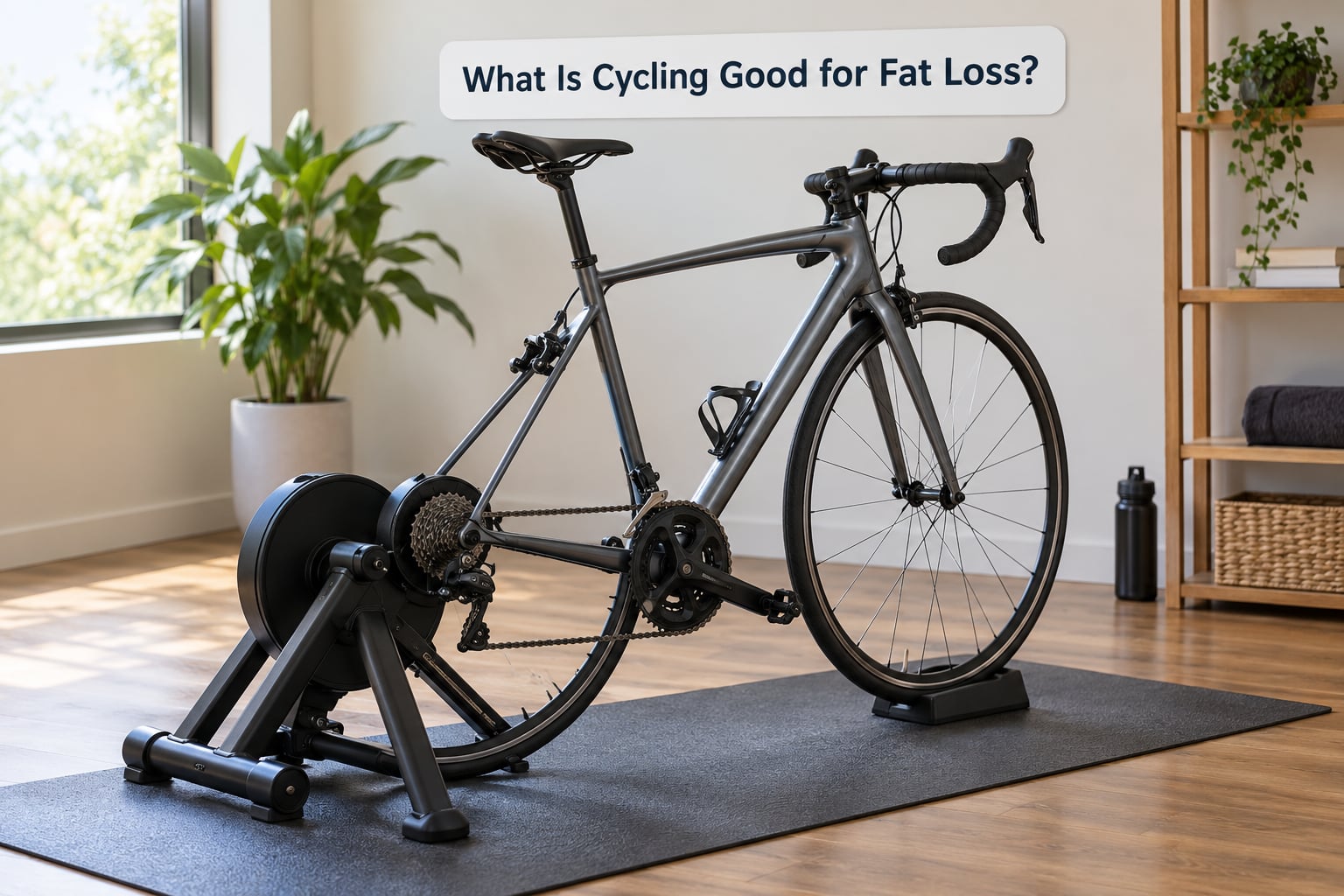
Cycling is one of the more reliable fat-loss exercises because it burns a lot of energy per minute and asks very little of your joints. Estimates commonly put cycling at roughly 400 to 900 calories an hour depending on your body weight, speed, terrain and how hard you are pushing. Treat that as a range, not a receipt.
What makes it unusually practical is durability. Plenty of people start running and stop within a month because of shins, knees or a bad back. The same person can ride for an hour twenty years later, which matters enormously because fat loss is a months-long project, not a two-week event.
It also scales. A beginner can ride flat ground at an easy pace, and the same bike becomes a hard interval tool once fitness improves. That range is why cycling shows up in almost every fat-loss plan that actually works.
Can Cycling Help You Lose Belly Fat?
It can, and it cannot target it. Belly fat responds to an overall calorie deficit, and cycling is a good way to widen that deficit. What your body decides to burn, and in what order, is not something you steer from the saddle.
Abdominal fat comes in two layers. Visceral fat sits deep around your organs and is the type most closely tied with metabolic and cardiovascular risk. Subcutaneous fat sits under the skin, which is what you pinch at your waist and what most people mean by belly fat. Both shrink with sustained fat loss, and neither shrinks from crunches alone.
The research on cycling commuters is the strongest argument for the habit rather than the workout. A study of around 150,000 active commuters from the London School of Hygiene and Tropical Medicine found cycling commuters had lower body mass index than walking commuters: about 1.71 kg/m2 lower in men and 1.65 kg/m2 lower in women. Body fat was roughly 2.75% lower in men and 3.26% lower in women. That is ordinary people moving more in daily life, not athletes in a lab.
Here is the objection I hear most often, and it is a fair one: “I biked to work for four years and still had belly fat.” That rider was probably in a calorie surplus on the weekends, or their commuting replaced steps without adding meaningful energy expenditure. The study does not prove cycling causes fat loss on its own. It shows that people who cycle as transport tend to have less body fat than people who do not.
So the answer to is cycling good for losing belly fat is a qualified yes. It is a good tool, not a magic one, and the diet side is doing at least half of the work.
How Many Minutes of Cycling Should You Do?
Consistency beats session length. Thirty focused minutes four times a week will do more for your waist than a heroic two-hour ride once a month, because weekly totals accumulate and monthly heroes do not.
Public health guidance suggests about 150 minutes of moderate aerobic activity a week, and cycling counts fully toward that. Most adults aiming for fat loss also add resistance work on two or three days.
| Fitness level | Session length | Sessions per week | Weekly total |
|---|---|---|---|
| Complete beginner | 15 to 20 minutes | 4 to 5 | 60 to 100 minutes |
| Some base | 30 to 45 minutes | 3 to 4 | 120 to 180 minutes |
| Regular rider | 45 to 90 minutes | 3 to 5 | 180 to 360 minutes |
A sensible progression for someone starting from scratch: ride 20 minutes at easy effort three times in week one, add five minutes per session the following week, and stop increasing duration when you reach 40 to 45 minutes. Only then think about adding intensity.
One caution on the machines. Many bikes, watches and apps estimate calories generously, and several riders quietly add back a snack with the number they just burned. A rough range is a better planning tool than a false precision figure.
Is Cycling Good for Losing Belly Fat Compared With Walking?
Both work. Cycling burns more energy for the same amount of time, and walking is easier to sustain for most people. For belly fat specifically, the activity you actually repeat for months beats the activity that burns slightly more on paper.
| Factor | Cycling | Walking |
|---|---|---|
| Energy use | Higher per hour, especially at moderate to hard effort | Lower per hour, but easy to keep going |
| Joint impact | Very low | Low |
| Space needed | Outdoor space or an indoor bike | Almost none |
| Ease of starting | Needs a bike and a safe route | Shoes and a doorstep |
| Long session tolerance | Good, especially seated | Good, but slower |
| Best for | Time-poor adults, heavier riders, knee or ankle pain | Beginners, walking-heavy routines, recovery days |
That last row is the one that decides most cases. Someone weighing 250 pounds with sore knees will get far more from cycling than from trying to run. Someone with a reliable habit of two long walks a day may not need to change anything at all.
Walking also has one underrated advantage: it scales into cycling. Ride for twenty minutes, then walk for twenty. That is a normal session, not a failure of one.
What Type of Cycling Burns the Most Calories?
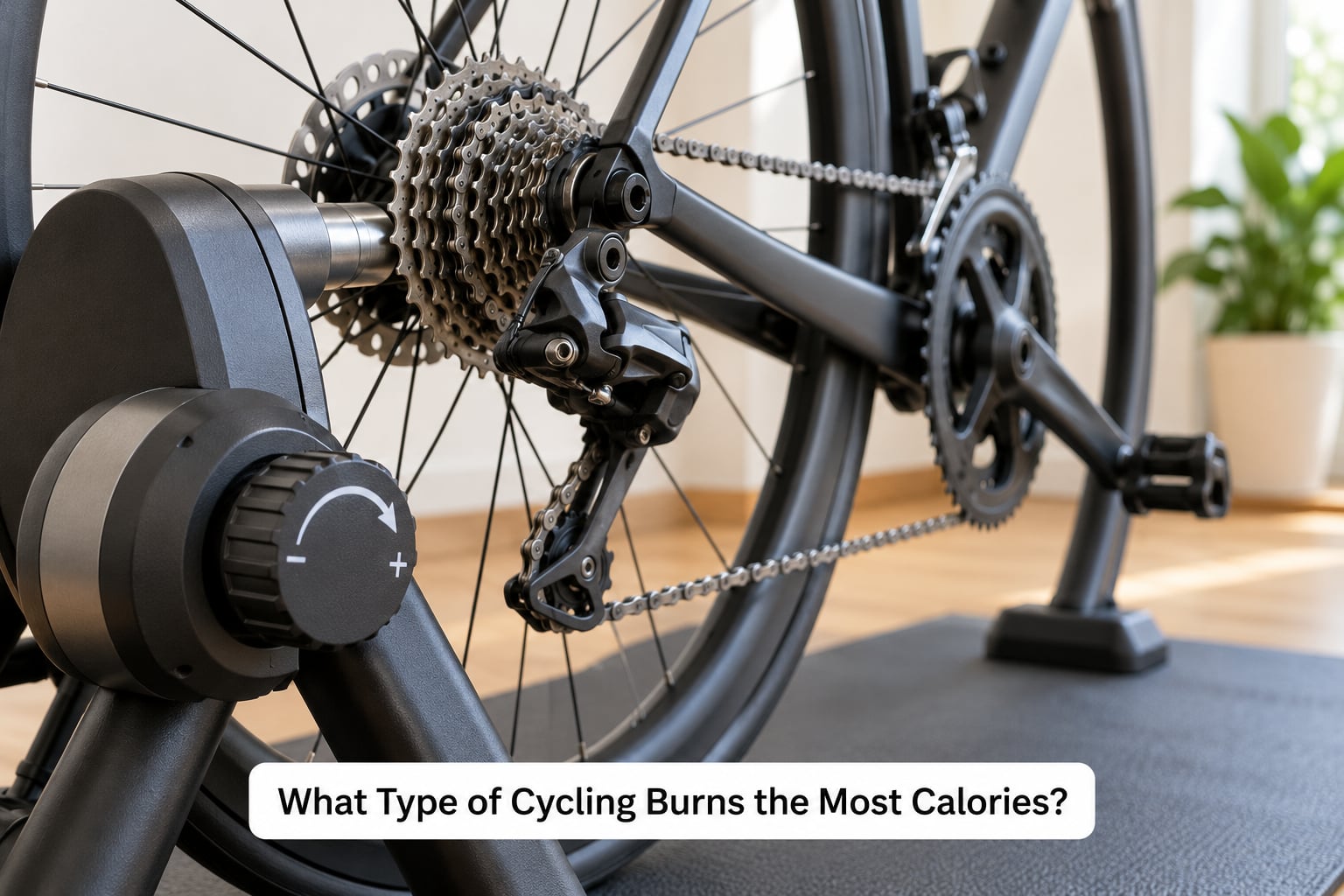
The most expensive kind is the hardest effort you can hold and recover from, done most weeks. That is usually a mix of steady aerobic riding and short hard efforts, not one or the other alone.
Four formats cover almost everyone:
- Steady outdoor riding at moderate effort. The default and the most sustainable. Comfortable conversation pace, 45 to 90 minutes, a few times a week.
- Indoor cycling with real resistance. Equally effective for fat loss if the resistance is high enough to be hard. Sitting too easy on a stationary bike is the most common indoor mistake.
- Hills or standing climbs. Heavy legs, high burn, and outdoors you get the scenery. Knees take more load here, so ease in if you are new.
- Short sprints or intervals. For example six to ten efforts of 30 seconds hard with easy recovery. Time efficient and hard to recover from, so it fits alongside steady riding rather than replacing it.
If your goal is belly fat rather than a race time, intervals are optional. A meta-analysis of interval training studies found that high-intensity interval training did not produce superior fat loss compared with longer, lower-intensity aerobic sessions of similar duration. Both work. Pick the one you will keep doing, and treat the other as seasoning.
For beginners, start outdoors on flat ground or indoors at a resistance where you can pedal steadily for a full session. Add hills or sprints once plain riding feels boring rather than exhausting.
How Can You Combine Cycling With a Healthy Routine?
Cycling fits into fat loss as one pillar among several, and the pillars lean on each other. Most people fail on the food side, not the pedalling side.
A workable starting point:
- Three to five rides a week at a mix of moderate and hard, spread across the week.
- A modest calorie deficit. Somewhere in the region of 300 to 500 calories a day is plenty and far easier to hold than an aggressive cut. For one rider I read about on a cycling forum, the change that finally moved his belly was dropping sugary drinks, nothing about the riding.
- Protein at each meal. It keeps you fuller on fewer calories and helps you keep muscle while eating less.
- Two sessions of resistance work a week. Squats, presses, rows, carries. More muscle means a better resting metabolic rate, and the routines suggest pairing cycling with strength work for exactly this reason.
- Sleep and rest days. Soreness that lasts three days is usually a sign the week was too hard, not a sign of a good workout.
Then fix the usual reasons progress stalls. Eating back the burn is the big one: a rider who covers a 600-calorie session with a drive-through has simply reset the week. Riding too easy every time is the second, because comfortable pace for a fit person is barely a workout. Riding only at the weekend is the third, since the weekend ride cannot undo nine sitting days.
Track with a tape measure, not just a scale. Measure your waist at the navel, same time of day, once a week. Daily weight swings of a pound or two come from water, salt and timing, which is why forum advice keeps circling back to weighing weekly on the same scale in the same conditions.
If you have heart or joint problems, are pregnant, or are returning after a long break, check with a doctor before starting a new routine. Nothing in this guide replaces advice about your own body.
Frequently Asked Questions
Can cycling specifically reduce belly fat?
No specific targeting, but yes overall. Cycling burns calories and builds the deficit that reduces fat across the whole body, abdominal fat included. Crunches and core work train the muscles under the fat but do not remove it. The body decides the order in which fat comes off, and many people notice their waist last, so patience matters.
How often should I cycle to lose belly fat?
Three to five sessions a week is the range most people land on. Public health guidance points to about 150 minutes of moderate aerobic activity weekly, so three 50-minute rides or five 30-minute rides both hit it. Frequency matters more than length, and adding one ride a week is usually easier to sustain than doubling your longest ride.
Does cycling burn more calories than walking?
Yes, for the same time spent. A moderate-to-hard ride burns considerably more per hour than a relaxed walk, because you are supporting your own body weight against gravity continuously. Walking still burns energy and is easier to sustain for long periods. Neither one targets belly fat on its own, so consistency matters more than the choice.
Should I cycle every day or rest between sessions?
Most riders do better with rest. Muscle, tendons and the cardiovascular system recover during the days you are not riding, and hard sessions stacked back to back tend to burn out. Three to five rides with a day or two between hard efforts suits most adults, with a longer easy ride on the other days.
Is an indoor bike as good as an outdoor bicycle?
For fat loss, yes, provided the resistance is high enough to be genuinely hard and the weather never becomes an excuse. Indoor riding has the advantage of steady conditions and no traffic. Outdoors gives hills, wind and variety that make sessions more interesting, which for many riders is the difference between consistency and quitting.
What should I eat after cycling to support fat loss?
Protein plus carbohydrates, in a normal portion. Carbohydrates replenish glycogen and help recovery; protein supports muscle repair and keeps you full. Eating to replace every calorie burned works against fat loss, so treat the post-ride meal as a normal meal rather than a reward for the workout.
Conclusion
Is cycling good for losing belly fat? Yes, as part of a plan. It burns a serious amount of energy, protects your joints, and is easy to keep for years, which is exactly what fat loss asks of you. What it will never do is pick the belly and ignore the rest of you.
Start smaller than you think. Ride 20 to 30 minutes three or four times a week at an effort that leaves you breathing hard, keep food portions honest, and measure your waist weekly rather than your weight daily. Add resistance work twice a week and leave one or two days for recovery.
Give it eight to twelve weeks before you judge the plan. If the scale has barely moved but your waist has, you are recomp and that is progress. And if you have any health concerns, a quick conversation with a doctor before you start is worth the ten minutes.