If you only remember one number, remember this: most adults do best with 2 to 4 working sets of 8 to 15 reps per exercise, keeping 1 to 3 reps in reserve, and training 2 to 4 days a week. That is the honest answer to how many reps and sets for fat loss, and everything below just unpacks why the rep count matters far less than most fitness pages tell you.
The part that actually removes fat is a calorie deficit, not a rep scheme. What reps and sets decide is how much muscle you keep while you are in that deficit, and muscle is the reason the weight stays off afterwards.
Table of Contents
- How Many Reps and Sets Are Best for Fat Loss?
- Fat Loss Rep and Set Ranges at a Glance
- What Is a Set in Strength Training?
- How Many Sets Should You Do per Exercise?
- 2 Sets vs. 3 Sets for Fat Loss
- How Many Reps Should I Do for Fat Loss?
- Low-Rep, Medium-Rep, and High-Rep Workouts
- How Many Workouts per Week Are Needed?
- How to Progress Reps and Sets for Fat Loss
- How Reps and Sets Fit with Walking and Nutrition
- Common Rep and Set Mistakes
- Frequently Asked Questions
- Should I do 10 reps or 15 reps for fat loss?
- How many total sets per week do I need to lose fat?
- Do I need high-rep cardio to lose fat?
- What should I do when my weight loss stalls?
- Are bodyweight exercises enough, or do I need weights?
- What is the 3-3-3 rule in the gym?
- Conclusion: Start With 2-3 Sets of 8-15 Reps
How Many Reps and Sets Are Best for Fat Loss?
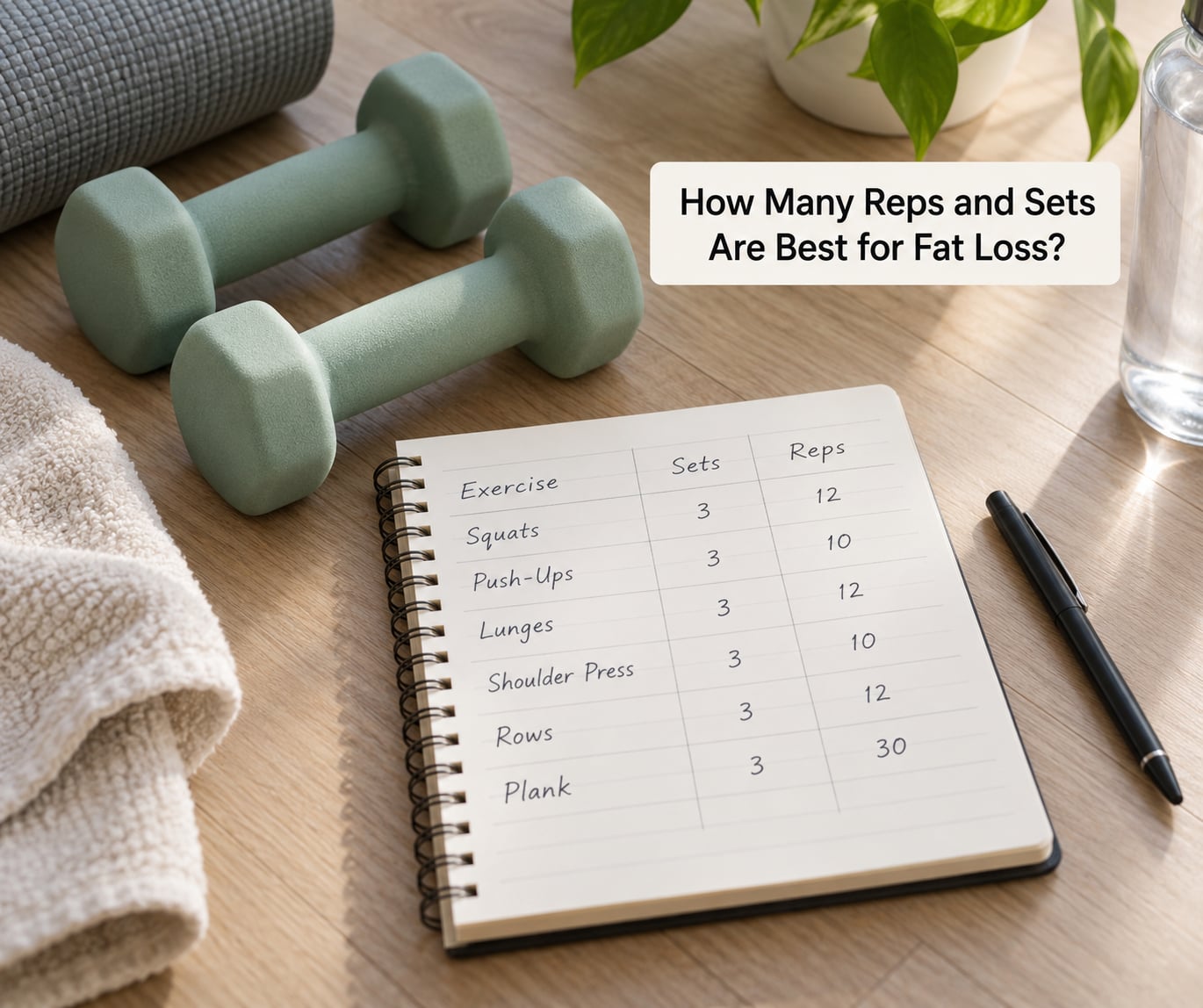
The best set and rep range for fat loss is 3 sets of 8 to 15 reps per exercise, with 1 to 3 reps left in the tank, performed two to four times a week while you eat in a moderate calorie deficit. Beginners can start with 2 sets and add the third once two weeks of training feel unremarkable. Nothing more complicated is required.
That covers the range of the honest disagreement. Research on resistance training has moved away from strict rules like “8 to 12 for size, 15 to 20 for fat loss” because those lines were drawn by commercial interests, not by studies. Lifters on r/naturalbodybuilding make the same point: proximity to failure is the useful signal, not an arbitrary number on a chart.
Reps in reserve, or RIR, simply means how many more clean reps you could have completed at the end of a set. If your last rep of a set of 12 was hard but you could have squeezed out three more with decent form, you finished at about 3 RIR. For most people cutting fat, 1 to 3 RIR is the working target, and going to absolute failure on every set is neither required nor free.
Why hold on to muscle during a deficit at all? Because muscle is metabolically active tissue. A large share of the energy you burn on a normal day comes from resting metabolism, so the muscle you keep is part of what keeps you losing weight after the diet loosens up. People who cut aggressively without lifting tend to lose both fat and lean mass, then regain the fat and a bit more.
The order of operations in the gym follows from the same logic. Do your lifting first, when you are fresh and can keep technique clean, and put cardio after it if you are doing both on the same day. A 20-minute walk at the end or on a separate day costs you nothing.
Fat Loss Rep and Set Ranges at a Glance
The table below is a set of starting points, not a treatment plan. Experience level, how much you can recover, and how many hours a week you actually have all change the answer.
| Level | Rep range | Sets per exercise | Weekly frequency | Suits best |
|---|---|---|---|---|
| Beginner (first 6 months) | 8 to 15 | 2 to 3 | 2 to 3 sessions | Learning technique, building the habit, coming back after a break |
| Intermediate (6 months to 2 years) | 6 to 15 | 3 to 4 | 3 to 4 sessions | Adding size, keeping strength up through a cut |
| Advanced (2 years plus) | 4 to 15 | 4 to 5 | 4 to 5 sessions | Specialising, often split across the week |
| Strength focus | 4 to 8 | 3 to 5 | 3 to 4 sessions | Keeping heavy lifts meaningful in a deficit |
| Time-limited session | 10 to 20 | 2 | 2 to 4 sessions | Busy adults who need 30 to 40 minutes |
One caveat that matters: soreness is not a measure of effectiveness. A workout can leave you sore for three days and train nothing new, and you can make real progress without being sore at all. Track reps, load and how the set felt, not how your legs felt the next morning.
What Is a Set in Strength Training?
A rep is one complete repetition of a movement, from start to finish. A set is one complete round of reps for an exercise, done without stopping. So 3 sets of 10 reps means you perform 10 squats, rest, 10 more, rest, and one final 10.
Volume is the total work you did, usually expressed as sets multiplied by reps, or as volume load when you multiply by weight as well. Three sets of 10 squats at 60 kg is 30 reps of work, or 1800 kg lifted, depending on which measure you are tracking. Volume is what you raise week to week to keep progressing.
Rest periods are the other half of the prescription. For general strength and body composition work, 60 to 120 seconds is a sensible default. Heavier compound sets need 2 to 3 minutes because your nervous system and blood pressure need time to settle.
Take 3 sets of 10 bodyweight squats as a concrete example. Sit, stand, rest 90 seconds, repeat twice more, and you have a full working set of volume for one movement pattern in about five minutes. Beginners often do fine with two rounds of that, and quality reps always beat chasing a number.
How Many Sets Should You Do per Exercise?
Two to three working sets per exercise is a practical starting point for most adults. The number that matters more than per-exercise sets, though, is the total you give each muscle group across the week, because that is where recovery and growth actually get decided.
| Experience | Sets per muscle group per week | Weekly sessions | Split that works |
|---|---|---|---|
| Beginner | 8 to 10 | 2 to 3 | Full body, every session hits everything |
| Intermediate | 10 to 14 | 3 to 4 | Full body or upper and lower |
| Advanced | 14 to 20 | 4 to 5 | Push, pull, legs, or a body-part split |
Full-body training is the most forgiving option for beginners, because every session touches every muscle and you get a dose of each movement several times a week. An upper and lower split suits people with a bit more training age, because each session can hold more volume before it becomes a marathon.
Home routines work exactly the same way, they just run out of equipment. With a couple of adjustable dumbbells, bands and a floor, you can hit every movement pattern for two to four sets per session. The limitation is usually how heavy the compound movements can get, not the number of sets you are allowed to do.
2 Sets vs. 3 Sets for Fat Loss
Two working sets is a legitimate starting point, and for a brand-new lifter it is often the better one. It costs less time, leaves more room for technique practice, and makes it easier to come back for a third set later. The trade-off is a smaller training stimulus, so you should expect slower progress and add volume once the first few weeks stop feeling difficult.
Three sets gives you more total volume without adding a whole new exercise to your week. It costs roughly five extra minutes per exercise and a little more recovery demand. For most people who have trained for a few months and want to keep muscle during a cut, three sets of 8 to 15 is the sweet spot.
The honest tiebreaker is adherence, not anatomy. The person who trains two sets four times a week for a year beats the person who planned three sets and managed two sessions in a month, every time.
How Many Reps Should I Do for Fat Loss?
The 8 to 15 rep range is the most versatile zone for fat loss because it works for nearly every exercise type, leaves room to add load as you get stronger, and produces a set that is challenging without being a burnout. It is also forgiving of imperfect technique, which matters most in the first months.
Lower rep ranges, say 5 to 8, are useful for heavy compound lifts where the load is the point. They keep strength meaningful during a cut, and r/workout regulars who lift through a deficit often keep a couple of heavy sets in the mix for exactly that reason. Higher rep ranges, 15 to 20, are legitimate for machines and isolation work, but they are not special for fat loss.
This is where the biggest myth in the space lives. Lighter weights and more reps do not burn meaningfully more fat, and you cannot choose where the fat comes from. Fat is lost through a sustained energy balance, not by picking a rep range that targets a stubborn area. Every gym blog claiming otherwise is selling something.
| Exercise type | Rep range | Sets | Rest between sets |
|---|---|---|---|
| Heavy compound (squat, deadlift, bench, overhead press) | 5 to 10 | 3 to 4 | 2 to 3 minutes |
| Machine or moderate compound (rows, leg press, chest press) | 8 to 12 | 3 | 90 to 120 seconds |
| Isolation (curls, lateral raises, extensions) | 10 to 15 | 2 to 3 | 60 to 90 seconds |
| Bodyweight (push-ups, lunges, bodyweight rows) | 12 to 20 | 2 to 3 | 60 to 90 seconds |
Low-Rep, Medium-Rep, and High-Rep Workouts
Low-rep work, roughly 4 to 8 reps, is a strength tool. Sets are long, rest is long, and the session is demanding, which is why it works well as one or two sets inside an otherwise normal week. It suits intermediate and advanced lifters who want to keep heavy numbers moving while cutting.
Medium-rep work, 8 to 15 reps, is the default for almost everyone. It is the range where most people can control their form, add weight gradually, and keep several reps in reserve at the end. If you take one thing from a rep chart, take this one.
High-rep work, 15 to 30 reps, is best used for isolation moves, machines, and short conditioning finishers. It is not more effective for fat loss, and grinding out 30 sloppy reps of a heavy compound is a good way to hurt yourself. r/beginnerfitness beginners often discover this the hard way after a set of 30 that felt impressive and did nothing useful.
How Many Workouts per Week Are Needed?
Two to four full-body sessions a week is a realistic framework for most beginners, and consistency matters more than the count. Three short sessions of 35 minutes will beat two heroic 90-minute sessions followed by a month off, every single time.
A fifth session is worth adding when two conditions hold: your recovery is genuinely good, and the extra session does not damage the ones you already have. Signs that you are ready include stable performance week to week, sleep that returns to normal within a day or two, and a schedule that can absorb the extra session for months rather than weeks.
Formal resistance training is only part of the picture. Walking, daily movement, chores, and standing at a desk all matter, and they add up quietly across a week. Count them separately, because 30 minutes of lifting plus a daily walk is a very different week from 30 minutes of lifting and nothing else.
Fat loss itself is not decided by a prescribed workout count. It is decided by a sustainable energy balance, and the training is there to protect the muscle that keeps that balance working.
How to Progress Reps and Sets for Fat Loss
Progress in a cut should be slow and boring. Pick a rep range you can handle, such as 3 sets of 10, and keep the technique steady for a while. When you can reach 10 clean reps on every set with about 2 reps still in reserve, that is your cue to progress.
There are two ways forward from there, and the order matters. First, add reps within your range, going from 10 to 12, then 12 to 15. When you hit the top of the range on all sets, add a small amount of weight, usually 2 to 5 percent, and drop back to the bottom of the range. Only add a fourth set once the weight has stalled twice.
Hold steady or reduce volume when fatigue piles up. A week where your numbers fall, you feel unusually tired, or sleep suffers is a signal to keep the load and trim a set rather than to push harder. If strength keeps dropping across a month, that is a strong reason to look at the size of the deficit, and to talk to a doctor or a registered dietitian rather than to out-discipline the problem.
A simple three-week example: in week one you do 3 sets of 10 at a weight that leaves 2 reps in reserve. In week two you do 3 sets of 12 at the same weight. In week three you do 3 sets of 10 at a slightly heavier weight. That is progression, and it does not require a spreadsheet.
Stop and seek qualified medical advice for sharp pain during a lift, dizziness, chest pain, or any symptom that worries you. Do not train through those, and talk to your doctor before starting or changing a routine if you are pregnant, managing a medical condition, or returning after an injury or surgery.
How Reps and Sets Fit with Walking and Nutrition
Resistance training is one pillar of fat loss, not the whole building. It decides how much lean mass you keep; your food intake, your movement, and your sleep decide whether you are in a deficit at all.
Protein matters here more than almost anything else in the article. During a deficit, adequate daily protein helps you hold on to muscle while your body is being asked to lose fat. Research commonly points to roughly 1.6 to 2.2 grams per kilogram of body weight per day, which is general guidance rather than a prescription for you. A registered dietitian can adjust it for your own situation.
More exercise does not automatically create more fat loss. A hard session can burn a few hundred calories, which is a small slice of a day, and adding huge cardio blocks often collides with recovery and appetite. Walking is the easiest thing to add because it does not fight your training.
Consistency closes the loop. Sleep, portions, protein and a routine you can still follow in a busy week do more than any single session. And again, if you are managing a condition, pregnant, injured, or dealing with symptoms, speak with a doctor or pharmacist before changing what you do.
Common Rep and Set Mistakes
Doing far too many sets. Twenty working sets for one muscle in a session is not a flex, it is a recovery problem you will pay for later. Stay near the weekly range for your experience and add only when the previous week felt easy.
Chasing soreness. The old 25-15-10-5 burn-out ladders feel brutal and impressive. They are not a better way to lose fat, and they wreck the next session. Pick an effort level you can repeat on Thursday.
Training to absolute failure on every set. Leaving 1 to 3 reps in reserve costs you almost nothing in results and buys you recovery, technique and a sustainable cut. Reserve absolute failure for the occasional last set of an isolation movement.
Switching exercises too often. You cannot progress on a movement you restart every fortnight. Keep an exercise long enough to watch the numbers move, usually a few months, before judging it.
Skipping the warm-up. A few light sets of the movement you are about to do heavy costs five minutes and makes the working sets feel better and safer.
Resting too briefly for heavy work. Two minutes after a heavy squat is not wasted time, it is what makes the next set look like the first one. Cut rest short only on isolation work where the goal is a burn.
Adding weight before the technique is consistent. If the last rep of every set looks different from the first, the weight is ahead of you. Drop back, fix the reps, and the load will follow.
Frequently Asked Questions
Should I do 10 reps or 15 reps for fat loss?
Both work, and the difference matters far less than most charts suggest. Ten to fifteen reps covers nearly every exercise type and gives you room to add load as you improve, which is what actually protects muscle during a deficit. Pick a number, hit it with good form, and stop each set with one to three reps still possible. Change the rep range only when the current one stops giving you progress.
How many total sets per week do I need to lose fat?
Beginners usually do well with 8 to 10 sets per muscle group per week, intermediate lifters around 10 to 14, and advanced trainees 14 to 20. That weekly total matters more than how many sets you do in a single session. Spread it across two to four days rather than cramming it into one workout, and remember that total sets across similar movements add up too.
Do I need high-rep cardio to lose fat?
No. Cardio creates a calorie deficit, but so does eating less, and it does not change which part of your body loses fat first. If you enjoy it, use it as a supplement to your training and your daily movement rather than as the engine of the whole plan. Walking is the easiest form to keep up because it does not interfere with recovery from lifting.
What should I do when my weight loss stalls?
Check your food intake first, because a stalled scale almost always traces back to portions, drinks or changed activity rather than to your rep scheme. If intake looks honest, look at recovery: sleep, stress and fatigue. Drop one set per muscle for a week, or take a lighter week, then rebuild. Persistent stalls are worth discussing with a doctor or registered dietitian.
Are bodyweight exercises enough, or do I need weights?
Bodyweight work is enough to lose fat and to build a solid foundation, especially if you can vary the angles and control the difficulty. Dumbbells make progression easier because there is a clear next step when reps get easy. With only bands or no equipment, pause the rep range at a point where you are close to failure and use tempo to make the sets harder.
What is the 3-3-3 rule in the gym?
The 3-3-3 rule is not a fat-loss rule, and it is not backed by research. It is a gym myth, alongside the 30-30-30 idea, both of which turn a simple habit into a rigid formula. For fat loss, the useful principles are plain: train two to four times a week, do two to four working sets of 8 to 15 reps per exercise, rest 60 to 120 seconds, and progress slowly.
Conclusion: Start With 2-3 Sets of 8-15 Reps
Pick six movements you can do well, do 2 to 3 working sets of 8 to 15 controlled reps on each, and train two to four times a week. Increase the difficulty only when recovery has been good and the last set still had a couple of reps in reserve.
Nutrition, daily movement, sleep and a routine you can still follow in a busy week matter more than a perfect rep chart. And if you have a medical condition, are pregnant, or are managing an injury, get individual advice from a doctor or registered dietitian before you change anything.