Most adults training a few times a week can start with one or two full rest days, and beginners often do better with two or three. The real constraint is not the calendar but the recovery window: give the same muscle group roughly 24 to 48 hours before you train it hard again.
That answer changes with your training load, your job, your sleep and how you actually feel between sessions. This guide covers what counts as a rest day, how many you need for weight loss and muscle maintenance, and how to build a weekly schedule you can keep.
Table of Contents
- Rest Days Explained: How Many You Need for Weight Loss
- What Is a Rest Day?
- The 24 to 48 hour rule
- How Many Rest Days Do Most Adults Need?
- Training days mapped to rest days
- Rest Days Explained: How Many You Need for Your Routine
- Does Weight Loss Require More Rest Days?
- Full Rest or Light Activity?
- How Can You Tell When You Need More Rest?
- How to Build a Rest-Day Schedule That Works
- Anchor them between the hard days
- Plan for a deload every four to eight weeks
- Eat and sleep as if you are training
- Two schedules that work
- Coming back after a break
- Frequently Asked Questions
- Rest days explained: how many do you need?
- Do rest days help you lose weight?
- Should I rest every day if I feel tired?
- Is walking on a rest day allowed?
- How do I know when I should take an extra rest day?
- Conclusion: Start With One or Two Rest Days
Rest Days Explained: How Many You Need for Weight Loss
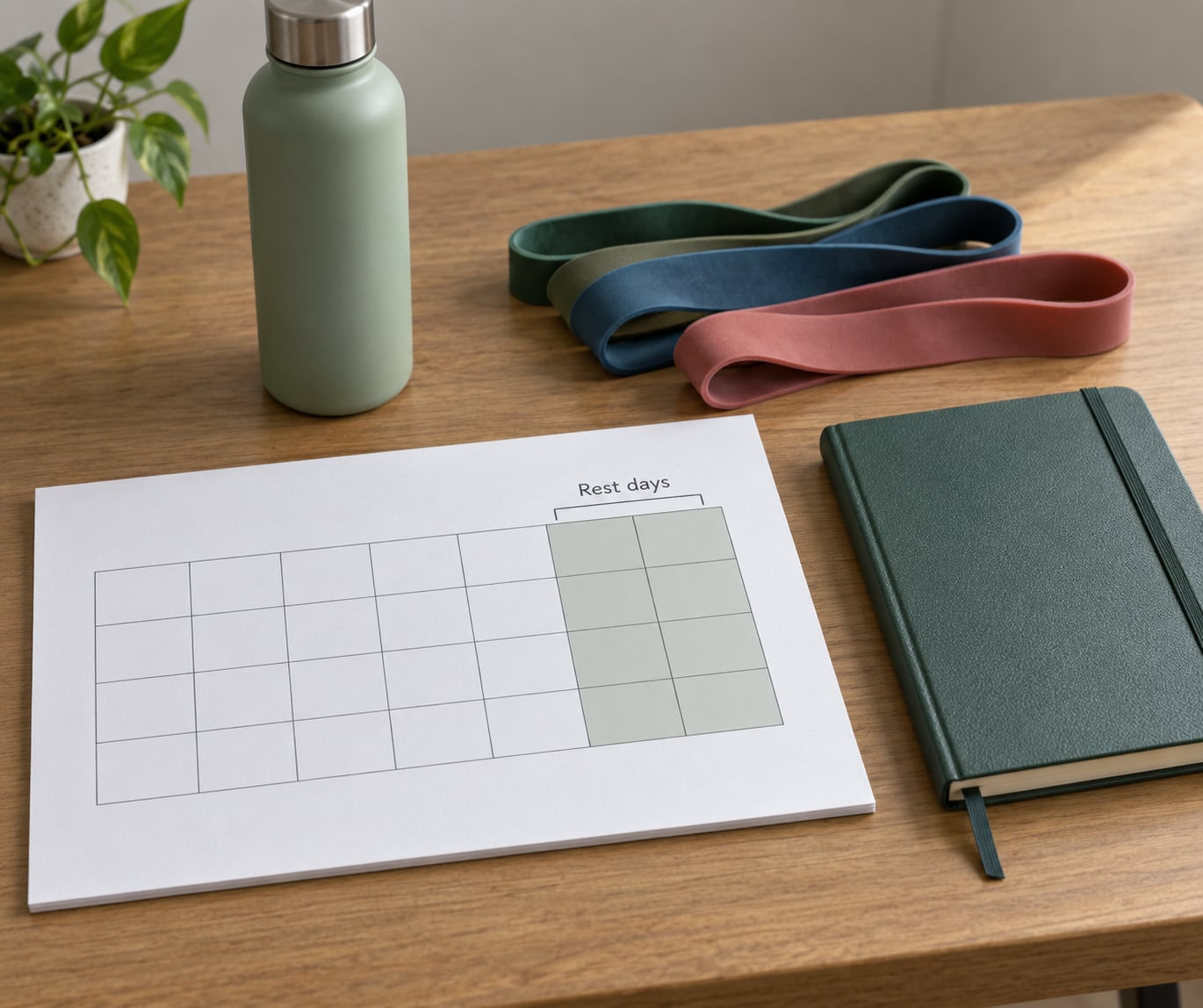
Here is the short version. One or two full rest days per week suits most adults doing moderate exercise, two or three suits beginners, and a person training six days a week still needs at least one. For weight loss specifically, rest days do not slow anything down, because the calorie balance is decided by your whole week rather than by any single session.
The number is a starting point, not a rule. What changes it is how hard each session is, how long you sleep, how stressful your work is, and whether your performance and mood are holding steady week to week.
Planned rest also solves a common problem in 2026: people feel guilty on the days they do not train. Naming those days in advance turns them from wasted time into the reason the other sessions work at all.
What Is a Rest Day?
A full rest day is a calendar day with no planned structured exercise. No lifting, no running intervals, no class. Your body is still moving, of course, but nothing is done on purpose to make you fitter.
That distinction matters more than people expect. Household chores, a walk to the shop, standing at a desk and chasing a toddler all burn energy without counting as training, and they do not stop you being in a calorie deficit. Ordinary life is not a workout.
A second point is that a rotating split changes the maths. If you train chest and triceps on Monday and back and biceps on Tuesday, each muscle group gets its own recovery gap even on a busy six-day week. Lifters using push, pull, legs or an upper and lower split report needing far fewer blank days than people doing full body workouts, and that matches how the tissue actually recovers.
The 24 to 48 hour rule
Muscle protein synthesis, the process that rebuilds muscle after training, rises for roughly a day or two after a session and then falls back. Train the same group again inside that window and the work happens on tissue that has not finished repairing itself. Waiting about 48 hours between hard sessions on the same group is the practical rule most people use, and beginners usually want the longer end of it.
How Many Rest Days Do Most Adults Need?
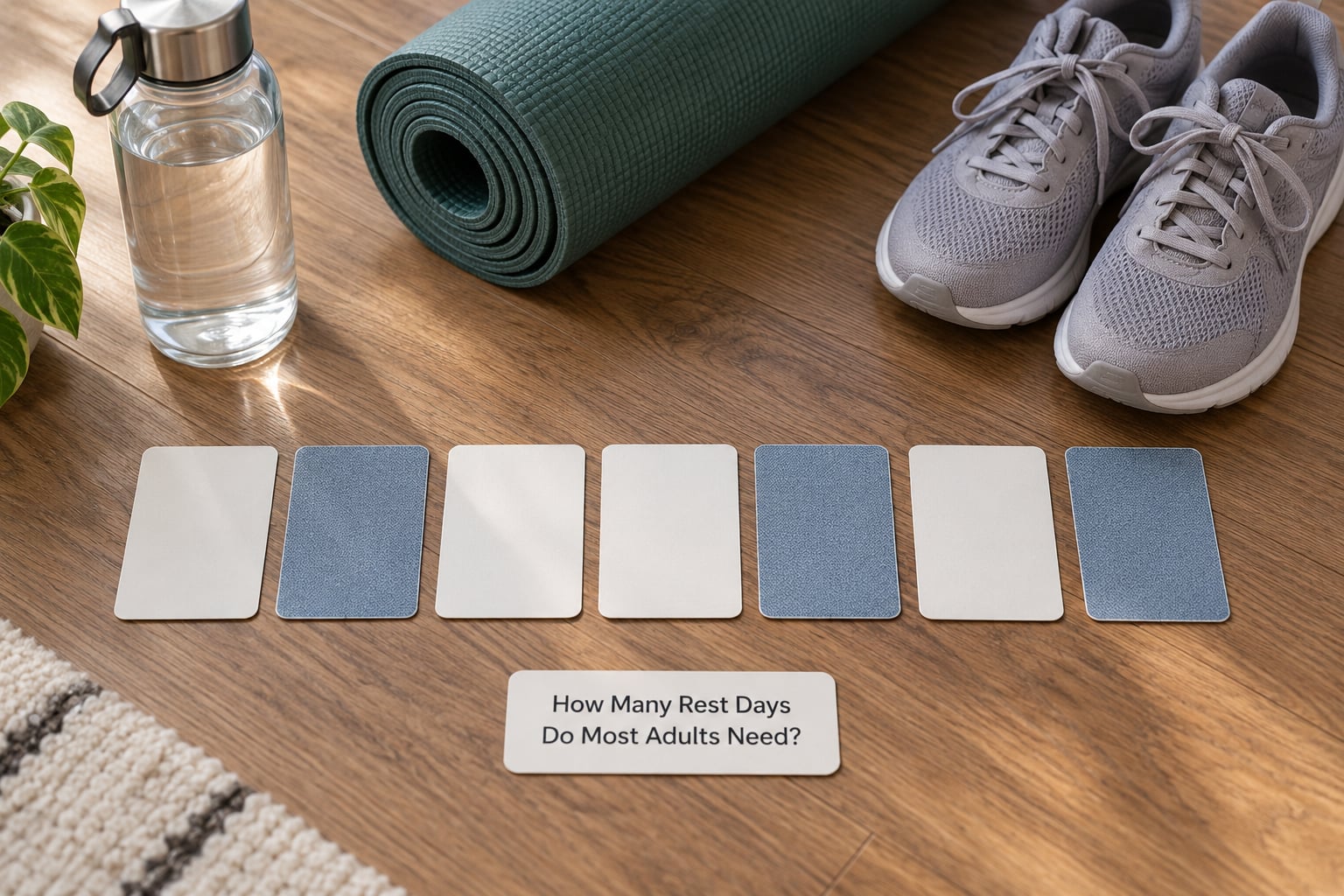
Start from the number of days you train, then adjust for intensity. Here is the general guidance most trainers and public health bodies give for adults in good health.
| Who you are | Typical training | Full rest days per week |
|---|---|---|
| New to exercise (under a year) | 2 to 3 sessions, mostly full body | 2 to 3 |
| Steady, moderate exerciser | 3 to 4 sessions, moderate effort | 2 to 3 |
| Regular gym-goer, some volume | 4 to 5 sessions, split or full body | 1 to 2 |
| Higher volume, lifting plus conditioning | 5 to 6 sessions, hard sessions | 1 to 2 |
| Demanding work, poor sleep, shift work | Anywhere from 2 to 5 sessions | 2 to 4 |
The American Council on Exercise has long suggested at least one full day off every seven to ten days, which lines up with the low end of these ranges. Individual difference is real, and the numbers above are general information rather than a plan written for your body.
Most people land on that middle row and then spend weeks second-guessing it. If you searched rest days explained how many you need hoping for a single number, this is the honest answer: two full rest days on a three to five day week, then let the rest of the table adjust you.
Training days mapped to rest days
The question people ask most is simply how the days divide up. Here is a plain mapping you can copy.
| Training days per week | Full rest days | Typical split |
|---|---|---|
| 2 | 5 | Full body, spaced three days apart |
| 3 | 4 | Full body Mon, Wed, Fri |
| 4 | 3 | Upper and lower, two cycles |
| 5 | 2 | Push, pull, legs plus two days |
| 6 | 1 | Push, pull, legs twice |
Two rest days on a five-day week is the most common setup, and it is where most people land. One day is workable on a six-day split, but it only holds up when sessions are short, load is managed and sleep is decent. Four or more full rest days is not automatically a mistake, but it does start to trade away training stimulus unless the sessions that remain are hard enough.
Rest Days Explained: How Many You Need for Your Routine
Working out the number for yourself is less about formulas and more about reading a short list of signals. Check these in order, roughly once a week.
- Session length and effort. Anything over 75 minutes of hard work counts as a big session, even if it felt short. Three big sessions in a week usually pair with two rest days.
- Sleep. Seven to nine hours is the usual adult range. A week of short nights asks for more recovery, not more training.
- Life stress. A demanding week at work costs more recovery than an easy one, even if the training is identical.
- Soreness. Mild muscle soreness on day two is normal. Sharp pain, swelling or soreness that lasts past three days is not.
- Performance. The same weight that moved easily last week feeling heavy now is one of the clearest signals.
- Mood and motivation. Dreading sessions you normally enjoy is worth taking seriously.
- Hunger and energy. Constant hunger and crashes during sessions often show up before anything else does.
If four of those seven point the same way for a week, add a rest day. If most of them are fine and you have been resting three or four days, take one back and see what happens.
Does Weight Loss Require More Rest Days?
Weight loss itself does not demand extra rest days. What raises recovery needs is the combination of a calorie deficit with hard training, short sleep and a busy life.
During a deficit, your body has less stored energy to work with. Glycogen, the fuel your muscles run on, runs lower, and sessions that felt moderate can start feeling heavy. Add five hours of sleep a night to that and you have a setup where extra rest genuinely helps, because muscle protein synthesis competes with everything else your body is trying to do.
There is a useful middle ground here. Cutting calories does not mean training harder on the days you feel tired. Keeping your food intake steady on training days, eating enough protein spread through the day, and holding sessions at a moderate effort usually preserves more progress than pushing through a deficit with daily hard training.
On the other hand, rest is not a fat-burning tool. A day off does not move the scale. Over a week or two, the pattern that works is one where your training is consistent enough to hold muscle while your food intake creates the deficit.
If you feel persistently exhausted, dizzy, in pain, or unusually short of breath during ordinary activity, stop reading articles and speak to a doctor. That is a health question, not a programming one, and it deserves a proper look.
Full Rest or Light Activity?
Rest days fall into three kinds, and mixing them up is where most people go wrong. The giveaway is effort: a real rest option should feel easy, not like a workout in disguise.
| Type | What it looks like | Effort level | When to use it |
|---|---|---|---|
| Full rest | Nothing planned, ordinary daily movement only | None | When you are tired, sore, or after a hard week |
| Light daily movement | Walking around the neighbourhood, gardening, housework, standing desk | Very light | Anywhere, including on training days |
| Active recovery | Easy cycling or swimming, yoga, mobility work, foam rolling, a long slow walk | About 30 to 60 percent of max heart rate | When you feel good and just want to move |
For active recovery, use the talk test. If you can speak in full sentences without pausing for breath, you are in the right zone. Ten to thirty minutes is plenty. Foam rolling and mobility work are worth doing on rest days because they feel good and keep joints moving, but neither replaces sleep or food.
The most common mistake is turning an active recovery day into an hour of intervals because it felt good. If you are breathing hard, that was a training session, and the rest day has quietly disappeared.
How Can You Tell When You Need More Rest?
Watch for a cluster of changes rather than a single bad morning. Most people notice the performance drop a week or two after they notice the sleep and mood changes.
- Performance that drops week to week, at the same load
- Soreness that stays for more than a few days, or joint pain that lingers
- Sleep that gets shallower or more interrupted
- Irritability, restlessness or a shorter fuse than usual
- Constant hunger, or feeling light-headed during a session
- Motivation that vanishes and training feels like a chore
- A resting heart rate that sits higher than your normal baseline when you wake
- Feeling run down for weeks despite sleeping a normal amount
Persistent fatigue lasting more than a week, resting heart rate that stays elevated, or feeling unwell all deserve a conversation with a healthcare professional. Some of these signs overlap with medical conditions that have nothing to do with training.
Soreness deserves its own note, because it is the most misunderstood signal. Sore muscles two days after a session usually mean the session was novel or hard. Soreness does not reliably tell you whether a workout was effective, and it fades whether or not you trained again. Use it as one data point, not a verdict. Experienced lifters tend to be blunt about this: performance, sleep and mood tell you more than how your muscles feel the next morning.
One tired day is not evidence that your weekly plan is wrong. Fatigue that clears after a night of good sleep is normal. Fatigue that shows up the same way for two or three weeks is a pattern, and patterns are worth changing.
How to Build a Rest-Day Schedule That Works
Pick your rest days before the week starts and write them in the same place as your training. Decisions made in advance hold up better than decisions made at 6pm on a Wednesday.
Anchor them between the hard days
Placing rest after your biggest session works better than clustering it at the weekend. With a Monday and Thursday full body routine, Wednesday and Sunday give each muscle group roughly 48 hours. With push, pull, legs, rest naturally falls on the day after legs, which is usually the one you want anyway.
Plan for a deload every four to eight weeks
A deload is a planned lighter week, usually by cutting the number of sets and reps by around 40 to 50 percent while keeping the movement pattern and a light-to-moderate load. Most people do well with one every four to eight weeks during heavy blocks. It tends to fix the flat weeks that otherwise turn into a layoff.
Eat and sleep as if you are training
Protein spread across the day, regular meals and a consistent bedtime do more for recovery than anything you do on the rest day itself. Seven to nine hours of sleep is the range most adults need, and alcohol in the evening costs more sleep quality than most people expect.
Two schedules that work
Three training days, aimed at weight loss. Monday, Wednesday and Saturday full body, with Tuesday, Thursday, Friday and Sunday as rest or easy walking days. Two short sessions beat four long ones when energy is limited.
Five training days, aimed at muscle maintenance. Monday to Friday on a push, pull, legs rotation, with Saturday and Sunday off. Keep sessions under an hour so the schedule survives a demanding week at work.
Coming back after a break
Two weeks off costs less than most people fear, and four weeks off still leaves most of your strength in place. Restart at roughly 60 to 70 percent of the load and sets you used before, add one small jump per session, and stop early if the soreness lasts more than two days. Walking daily during the first fortnight makes the return easier.
Frequently Asked Questions
Rest days explained: how many do you need?
Most adults training three to five times a week need one or two full rest days, and beginners often need two or three. Whichever number you land on, leave roughly 24 to 48 hours between hard sessions on the same muscle group. Adjust the plan based on sleep, stress, soreness and how your performance changes week to week.
Do rest days help you lose weight?
They help indirectly rather than directly. Weight loss comes from a calorie deficit across the whole week, and a rest day does not change that. What rest days do is let you train consistently, keep muscle while you cut calories, and stay in a routine you can hold for months. Skipping them often backfires once fatigue piles up and your next sessions turn into wasted effort.
Should I rest every day if I feel tired?
One tired day is normal and does not mean your plan is wrong. If fatigue shows up the same way for two or three weeks, take an extra rest day and then build back gradually. Persistent exhaustion, dizziness, pain or feeling unwell for more than a week is worth raising with a doctor, because those symptoms go beyond ordinary training fatigue.
Is walking on a rest day allowed?
Yes, and it is usually good for you. A relaxed walk, housework or gardening sit well below training effort and do not interfere with recovery. Use the talk test as your guide: if you can chat in full sentences, you are at a level that supports recovery rather than a session in disguise. Hard intervals would make it a training day.
How do I know when I should take an extra rest day?
Look for a cluster, not a single sign. Dropping performance at the same load, sleep getting worse, low mood, constant hunger, soreness lasting several days and a higher resting heart rate together are a good reason to rest. If four or more of those show up for a week, add the day and cut session volume when you return.
Conclusion: Start With One or Two Rest Days
One or two full rest days per week is a reasonable starting point for most adults, and two or three is plenty if you are new to training. Keep roughly 48 hours between hard sessions on the same muscle group, and plan the rest days before the week begins.
Then review every week rather than guessing once. Check your sleep, your performance at the same load and how you feel between sessions, and add a day when several of those go wrong at the same time. If symptoms like persistent fatigue or pain last more than a week, speak with a doctor or a registered dietitian rather than adjusting the plan yourself.