Neither one wins on its own. HIIT burns more calories in less time, steady state cardio burns a higher share of fat per minute and is far easier to repeat, and fat loss comes down to a calorie deficit you can actually hold for months. So for hiit vs steady state cardio for fat loss, the right pick is whichever one you will still be doing in March.
That is the honest answer, and it is different from what you will read in most listicles promising a single winner. One camp says intervals are decisively better, the other says slow jogging is the answer. Both are oversimplifications of the same underlying physiology.
The rest of this guide breaks the two methods down by time cost, calorie burn, recovery demand and joint impact, so you can match one to your actual week instead of to a training theory.
Table of Contents
- HIIT vs Steady State Cardio for Fat Loss at a Glance
- Which Cardio Burns More Fat?
- What happens during the session
- What happens after the session
- Why your results will differ from someone else’s
- HIIT vs Steady State: The Main Differences
- Time commitment
- Intensity and repetition format
- Recovery and equipment
- Adherence by lifestyle
- HIIT for Fat Loss: When It Makes Sense
- Steady State Cardio for Fat Loss: When It Makes Sense
- How Do Calories and Exercise Intensity Affect Fat Loss?
- HIIT vs Steady State Cardio for Beginners
- How Many Calories Do You Burn With Each Type?
- HIIT vs Steady State for Muscle and Recovery
- Which Should You Choose?
- How to Combine Both Without Overdoing It
- Frequently Asked Questions
- Is 20 minutes of HIIT 3 times a week enough?
- Does HIIT burn more calories than steady state cardio?
- What type of cardio burns the most fat?
- Is steady state cardio better for beginners?
- Can I do HIIT and strength training on the same day?
- Can I lose fat with just walking?
- Conclusion
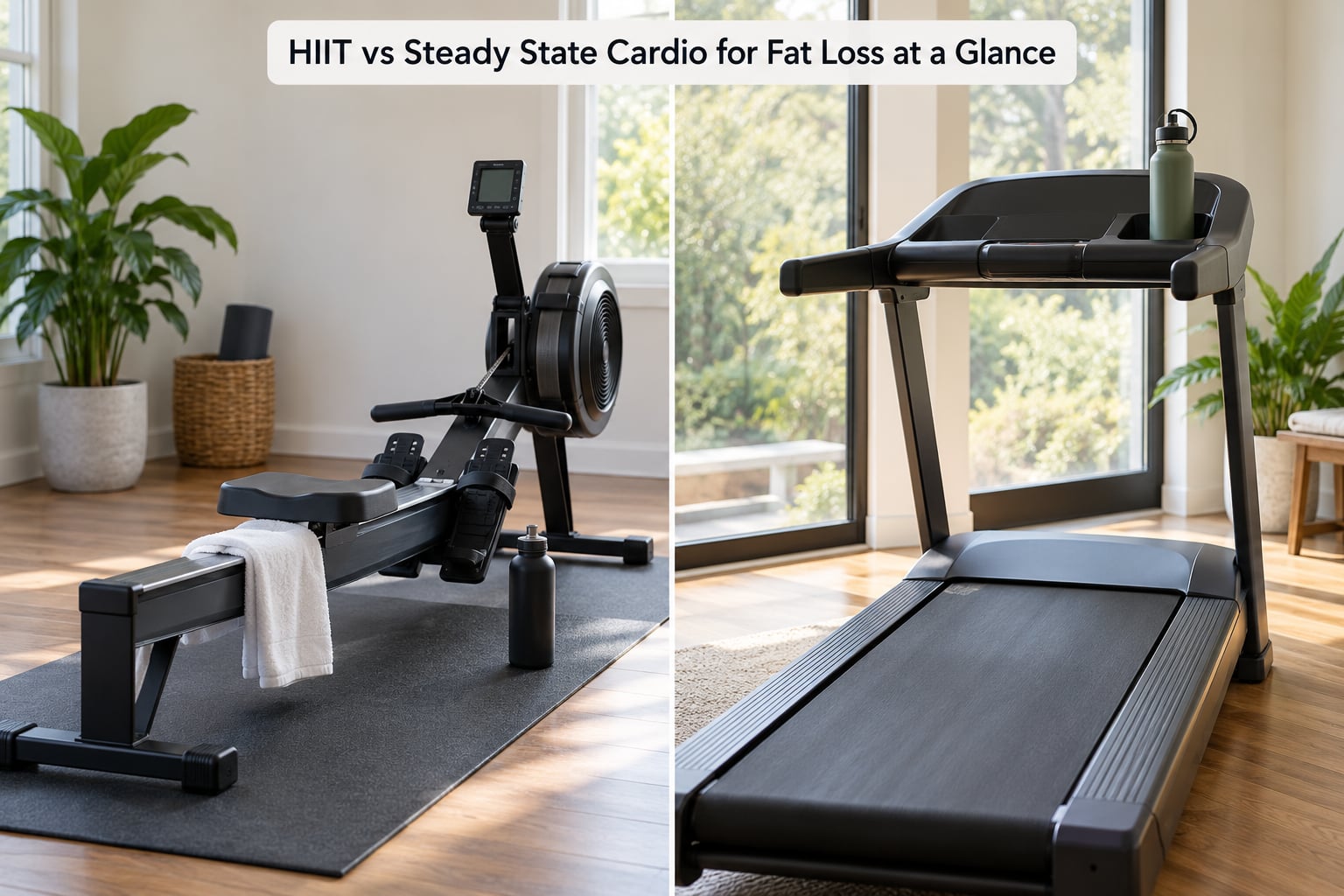
HIIT vs Steady State Cardio for Fat Loss at a Glance
| Factor | HIIT | Steady State Cardio |
|---|---|---|
| Intensity | Near maximal, roughly 80-95% of max heart rate | Moderate, roughly 50-70% of max heart rate |
| Session length | 15-30 minutes including recovery | 30-60 minutes or longer |
| Format | Hard efforts broken by short rests | Continuous, unbroken effort |
| Typical heart rate | Peaks high, drops between intervals | Settles into a steady band |
| Calories in a session | Higher per minute | Moderate per minute, higher in total over longer work |
| After the session | Extra burn continues for a while | Returns to baseline fairly quickly |
| Main fuel during the effort | Mostly carbohydrate | Larger share of fat |
| Recovery demand | High, often 24-48 hours | Low, easy to repeat next day |
| Joint impact | Higher, especially jumping and running | Low, especially cycling, swimming and walking |
| Best for | Time efficiency, fitness gains, trained readers | Beginners, recovery days, long easy volume |
Read that table as two different jobs rather than a ranking. Intervals are a high-intensity tool, steady state is a volume tool, and fat loss responds to how much total work you do across a week.
Which Cardio Burns More Fat?
During the workout, steady state cardio uses a larger percentage of fat as fuel. Over the day and the week, HIIT often produces more total calorie expenditure because you burn more per minute and keep burning extra for a while afterward. For fat loss over months, the second number matters more than the first.
What happens during the session
At moderate intensity your body draws a relatively even mix of fat and carbohydrate, and the fat share climbs as pace eases. That is the basis for calling Zone 2 the fat-burning zone, and the label is not wrong, it is just narrow.
Hard intervals flip that. Anything above roughly 80% of max heart rate runs mostly on carbohydrate, because fat cannot be broken down fast enough to meet the demand. If you are chasing fat oxidation during the workout itself, slow and steady genuinely wins the minutes you are counting.
What happens after the session
HIIT leaves something called excess post-exercise oxygen consumption, usually shortened to EPOC, which is the afterburn effect. Your body restores oxygen levels, repairs tissue and rebalances temperature in the hours after a hard session, and that repair costs energy above your resting baseline.
Be realistic about the size of it. EPOC after a typical 20-minute interval workout is measured in tens of calories, not hundreds, and it shrinks quickly. The afterburn is a genuine bonus, not a licence to skip portion control.
Why your results will differ from someone else’s
Two people doing identical sessions get different numbers. Body size, fitness level, lean mass, sex, the intervals you chose and how long your rests lasted all change the output. That is the source of most online arguments about which method burns more.
Searchers often ask what type of cardio burns the most fat, and the honest answer has two halves. The most fat per minute comes from easy, moderate work. The most fat lost per week comes from whichever routine you can sustain, because a routine you abandon burns nothing at all.
HIIT vs Steady State: The Main Differences
Time commitment
A full interval session usually takes 20 to 30 minutes including warm-up and cool-down. Steady state asks for 30 to 60 minutes to get a comparable sense of work done. If your week is genuinely full, that difference decides more than physiology does.
Intensity and repetition format
Intervals alternate hard efforts with short recoveries, usually work-to-rest ratios near 1:1 or 2:1. Steady state is continuous, and the talk test is the practical gauge: you can speak in full sentences, but not sing comfortably.
Recovery and equipment
HIIT needs real recovery time, and stacking it before heavy lifting is a fast route to stalled progress. Steady state can be done on a rest day and often is. Neither needs a gym, though intervals benefit from a rower, bike, or bodyweight movements, and steady state is as easy on foot as it is on a machine.
Adherence by lifestyle
Here is the part most articles skip. A 20-minute session you do four times a week beats a 60-minute session you do twice and then abandon. Predictable schedules favour intervals. Shift work, exhaustion and low fitness favour steady state.
HIIT for Fat Loss: When It Makes Sense
HIIT makes sense when time is your binding constraint and you already have a base of training. Twenty minutes on a rower with eight hard efforts is a genuinely large stimulus for a small slice of the week.
It also builds cardiovascular fitness quickly. Improvements in VO2 max, your capacity to work at high intensity, tend to show up in weeks rather than months, and that carries over into everyday activity where most of your calories actually get spent.
There are good secondary effects too. Intervals improve insulin sensitivity, and the psychological high often makes people more consistent for a few days after a hard session.
Now the honest part. HIIT is not automatically the faster route to fat loss. It is one tool among several, and it stops working the moment fatigue, poor sleep and hunger start eating your calorie deficit. Lifters on r/Fitness describe the pattern clearly: heavy HIIT stacked on leg days leaves them wrecked, and progress stalls until some of it becomes easier work.
Steady State Cardio for Fat Loss: When It Makes Sense
Steady state earns its place for beginners, for recovery days, and for anyone whose joints, weight or current fitness makes intervals a bad starting point. A 40-minute brisk walk after dinner costs you nothing in recovery and still moves the needle on weekly energy expenditure.
It builds the aerobic base that makes everything else easier. Do that for a few months and a later interval session feels less like punishment, which is why plenty of coaches front-load the easy work.
It is also lower impact. Cycling, swimming, elliptical work and walking all qualify, and none of them load joints the way repeated sprinting does. For anyone managing joint pain or returning after a long break, this is not a compromise, it is the smart opening move.
And it is repeatable in a way intervals never are. Most people do not quit walking because it got boring. That is the whole argument for steady state when fat loss is the goal rather than a fitness test.
How Do Calories and Exercise Intensity Affect Fat Loss?
Fat loss happens when your energy expenditure stays above your intake over time. Intensity changes how many calories a minute costs and how sore you get, but it does not change the underlying arithmetic. A 20-minute session and a 20-minute session are equal in time, not in effect.
The mainstream weekly baseline is 150 minutes of moderate-intensity activity, which is the figure the CDC and WHO use. Many steady state readers clear it without noticing, which is a useful reality check if you think you need to suffer to count.
Intensity matters more than beginners expect in one specific way: hard sessions are hard to repeat, and repetition is where most fat-loss journeys are won or lost. Consistency across weeks is the variable to protect.
What is not a treatment plan, and worth saying plainly: nutrition decides the deficit, and no amount of cardio compensates for eating well past hunger on the weekend. If you want individual guidance, a registered dietitian is the right person to ask, not a forum thread.
HIIT vs Steady State Cardio for Beginners
Beginners should usually start with steady state, and there is no shame in it. Twenty-five to forty minutes of walking, cycling or swimming three or four times a week builds the base without the joint shock or the dread that kills week three.
Add intervals once two things are true: the easy sessions stop feeling effortful, and you can finish a hard effort without your form collapsing. For most people that lands somewhere around the third or fourth week of consistent work.
When you do start, the equipment-free version is plenty. Eight hard efforts of twenty seconds on, forty seconds off, repeated twice, is a legitimate first session. No sprinting, no burpees if your knees object.
Progress by adding minutes, not intensity, for a few weeks. Most beginners who get injured or burned out are not undertrained, they are impatient with the boring middle part.
How Many Calories Do You Burn With Each Type?
Calorie estimates for cardio are approximations built on averages, and the errors are large. Use them to compare options, never to decide whether you ate too much.
| Session | What drives the estimate | Typical spread for a mid-size adult |
|---|---|---|
| 20 minutes of intervals | Peak effort, interval length, rest time | roughly 180-320 kcal |
| 30 minutes of brisk walking | Pace, body size, terrain | roughly 150-250 kcal |
| 45 minutes of jogging | Speed, body size, fitness | roughly 350-550 kcal |
| 60 minutes of cycling | Resistance setting, terrain, cadence | roughly 350-600 kcal |
| 30 minutes of swimming | Stroke, pace, pool vs open water | roughly 250-450 kcal |
Note the pattern. A long session can out-burn a short one in a single sitting even though the short one burns more per minute. Interval design changes the number more than most people expect, and twenty minutes of walking intervals is a different session from twenty minutes of running intervals.
Body size moves these numbers more than any device or brand will admit. If the ranges look wrong for you, they are wrong for you. Track your own trend over several weeks instead of trusting a single reading.
HIIT vs Steady State for Muscle and Recovery
HIIT burns more muscle during the session, particularly with running and jumping, which is why the meal afterwards matters more for people doing it hard. It also creates more fatigue, so the session that follows tends to go worse.
For anyone lifting seriously, the practical rule is to separate the two. Put intervals two or more days away from heavy lower-body work, or accept that both sessions will be mediocre. Combining heavy HIIT with heavy squats on the same day is where lifters report stalled progress and rising fatigue.
Steady state is the better filler between lifting sessions because it costs almost nothing in recovery. Active recovery, mobility work and an easy walk all fit in the gaps without competing with the work that matters.
Stop and see a doctor if you get chest pain, faintness, unusual breathlessness or joint pain during exercise. That applies to every intensity level, and it applies to beginners more than anyone else.
Which Should You Choose?
Choose HIIT when your week is tight, you have some training base, and you want cardiovascular gains alongside fat loss. It is the better answer for a schedule that cannot absorb an hour most days.
Choose steady state when you are starting out, returning after a break, managing joint pain, or lifting weights regularly and needing easy days between sessions. It is the better answer for low-impact movement and long sessions.
Choose both for most people. The common pattern is two interval sessions plus two to three steady state sessions per week, with resistance training in between as the anchor. That matches what most people report in fitness forums, where the consensus answer to this debate is consistently do both, on different days.
One last filter. Pick the version of the workout you like, and the version you will repeat. The best program is the one still running months from now, not the most impressive one on paper.
How to Combine Both Without Overdoing It
A workable week looks like this, and it adjusts to any starting point:
- Day 1 – strength training, full body or upper body focus
- Day 2 – 20 to 30 minutes of intervals, moderate effort, not all-out
- Day 3 – 30 to 45 minutes of steady state, conversational pace
- Day 4 – strength training, or full rest if the week has been hard
- Day 5 – 30 to 45 minutes of steady state or a long brisk walk
- Day 6 – second interval session, or an easy day if the first one was hard
- Day 7 – rest, mobility, or a relaxed walk
Build it gradually. Add minutes before you add intensity, and give yourself a week at each level before changing anything.
Watch for the signs you are doing too much: resting heart rate creeping up, poor sleep for several nights, constant hunger, motivation that drops flat, and performance that declines across sessions. When two or more show up at once, cut one session and hold steady for a week.
If fat loss stalls despite consistent work, change one variable rather than everything. Shift one steady session to intervals, or lengthen the easy sessions, and give it three weeks before judging it.
Frequently Asked Questions
Is 20 minutes of HIIT 3 times a week enough?
For most people starting out, yes. Three 20-minute sessions is a solid dose that fits alongside two or three steady state sessions and some strength work, and it clears the usual 150 minutes of moderate activity per week. It is not a magic number. What decides results is the calorie deficit around it and whether you can keep the routine for months.
Does HIIT burn more calories than steady state cardio?
Per minute, yes. HIIT burns more calories in a 20-minute session than easy work does in the same 20 minutes, and the afterburn adds some extra on top. But a 45-minute jog can out-burn a 20-minute interval session in a single sitting. Compare the week, not the workout, and the picture gets much closer than the arguments online suggest.
What type of cardio burns the most fat?
Easy to moderate cardio burns the highest share of fat per minute, which is why Zone 2 work gets called the fat-burning zone. Hard intervals burn more total calories but use mostly carbohydrate during the effort. For fat lost over weeks, total weekly activity and a consistent calorie deficit matter far more than which zone you trained in.
Is steady state cardio better for beginners?
Usually, yes. Low-impact steady work builds the aerobic base, costs almost nothing in recovery, and is far easier to keep doing for months. Most beginners get better results from a comfortable pace they repeat than from intervals they dread. Add hard work once the easy sessions stop feeling like effort at all.
Can I do HIIT and strength training on the same day?
You can, but expect a trade-off. Legs and lungs compete for the same resources, so both sessions tend to be worse than either done fresh. Most lifters get better results by keeping two hard days at least a day or two apart and filling the gaps with easy walking, cycling or swimming.
Can I lose fat with just walking?
Yes, and for plenty of people walking is the part that actually works long-term because it needs no recovery and no motivation. 10,000 steps a day is a common target and a reasonable one for many adults, but the number matters less than clearing 150 minutes of moderate activity weekly and staying in a calorie deficit.
Conclusion
Fat loss comes from a calorie deficit you can hold and activity you can repeat. HIIT gets you there faster per session and pushes your fitness harder, steady state gives you volume that costs almost no recovery, and combining both beats picking one.
So pick the approach that matches your week, and pick something you can actually start. Choose easy work for your first sessions if you are new or returning, add intervals once that feels ordinary, and add minutes before you add intensity. Whatever you start, keep it for longer than feels comfortable, because that is where this question actually gets settled.