To evaluate a nutrition claim you see online, work through six checks in order: pin down exactly what is being claimed, trace it back to the original source rather than the summary, identify the kind of study behind it, judge how strong that evidence is, check who paid for it, and only then decide whether it changes anything you do. Ten focused minutes is enough for most claims.
You need this because nutrition claims are built to be short and memorable, while the evidence behind them is long, hedged and often thin. A headline that reaches your feed has usually passed through several hands, and each retelling tends to lose the caveats that made the original finding accurate.
This guide is general education about information, not medical advice, and it is not a plan for treating a condition. If a claim concerns a diagnosis, a medication, a supplement you take, a pregnancy or an eating disorder, take it to a doctor or a registered dietitian rather than to a search engine.
Table of Contents
- What You Need
- Step-by-Step: How to Evaluate a Nutrition Claim You See Online
- 1. Write Down the Exact Claim
- 2. Find the Original Source
- 3. Check What Kind of Evidence It Is
- 4. Look for Biases and Missing Context
- 5. Compare the Claim With Trusted Guidance
- 6. Decide What You Can Trust
- Common Mistakes
- Treating the headline as the conclusion
- Assuming one study proves a universal rule
- Reading association as causation
- Overlooking the study’s own limitations
- Misreading the serving size
- How to Evaluate a Nutrition Claim on a Food Package
- Treating testimonials as proof
- Looking to the internet instead of a professional
- Frequently Asked Questions
- Can you give me an example of a nutrition claim?
- How do we evaluate the credibility of online health information?
- What is the 3-3-3 rule for nutrition?
- Are detox and cleanse claims true?
- How do I check if a nutrition study was funded by a company?
- Should I trust what an AI assistant tells me about nutrition?
- Conclusion
What You Need
The toolkit is small. Most people already have all of it and simply skip the step of using it deliberately.
- The exact wording. Copy the claim as written, including the qualifications. Screenshots help, because posts get edited.
- A way to inspect the link. A phone is fine. Long-press a link to see where it actually goes before you tap it.
- Access to credible sources. Cochrane, PubMed, the NIH Office of Dietary Supplements, the CDC, WHO guidance and USDA FoodData Central are all free and searchable.
- Someone qualified to ask. A registered dietitian or your pharmacist will answer a narrow question in five minutes that could take you an afternoon.
- About ten minutes. Longer than that usually means you are drifting, not verifying.
One warning before you start. Nutrition misinformation is not always wrong because it is new or sensational. Sound findings get distorted in the retelling, and honest studies do get overturned. You are checking whether a claim matches its evidence right now, not scoring the poster’s character.
Step-by-Step: How to Evaluate a Nutrition Claim You See Online
Run these six steps in order. Stopping early is the most common failure, because steps one and two are quick and feel like the work.
- Write down the exact claim, including the food or supplement, the outcome and the population it applies to.
- Find the original source, not the post, video or news summary that repeated it.
- Identify what kind of evidence it is: systematic review, randomised trial, observational study, laboratory finding or personal story.
- Look for bias and missing context, including who funded the work and what the study did not measure.
- Compare the claim with current guidance from WHO, NIH, CDC or a national health body.
- Classify the claim as reasonably supported, promising but uncertain, exaggerated, or unsupported.
1. Write Down the Exact Claim

Copy the sentence word for word, then split it into four pieces: what is being eaten or taken, what effect is promised, who the effect applies to, and how big the effect is stated to be. A claim missing any of those four is not yet a claim you can check.
It also helps to name the type, because different types carry different legal and evidentiary burdens. A nutrient content claim is a factual statement about what is in the food, such as high in fibre or low in sodium. A health claim links a nutrient to an effect on a disease, such as supporting heart health. A structure/function claim describes what a nutrient does in the body, such as supporting the immune system. A qualified claim adds honest hedging words such as some or may, which legally signal limited evidence.
You know the step worked only if you could hand the sentence to someone else and they would check exactly the same thing you are about to check.
2. Find the Original Source
Follow the citation to the study, guideline or dataset itself. If a post names no source at all, that is a finding in itself: an unsourced claim cannot be evaluated, only believed or discarded.
On the original, note four things. Who the authors are and whether they hold relevant credentials. When it was published, since nutrition findings and guidance do get revised. Whether it went through peer review, meaning outside researchers checked the method before publication. And whether funding or commercial interests are disclosed.
A link to a news article instead of the paper is a warning sign, not a dead end. Headline writers routinely convert a cautious finding into a sweeping one.
3. Check What Kind of Evidence It Is
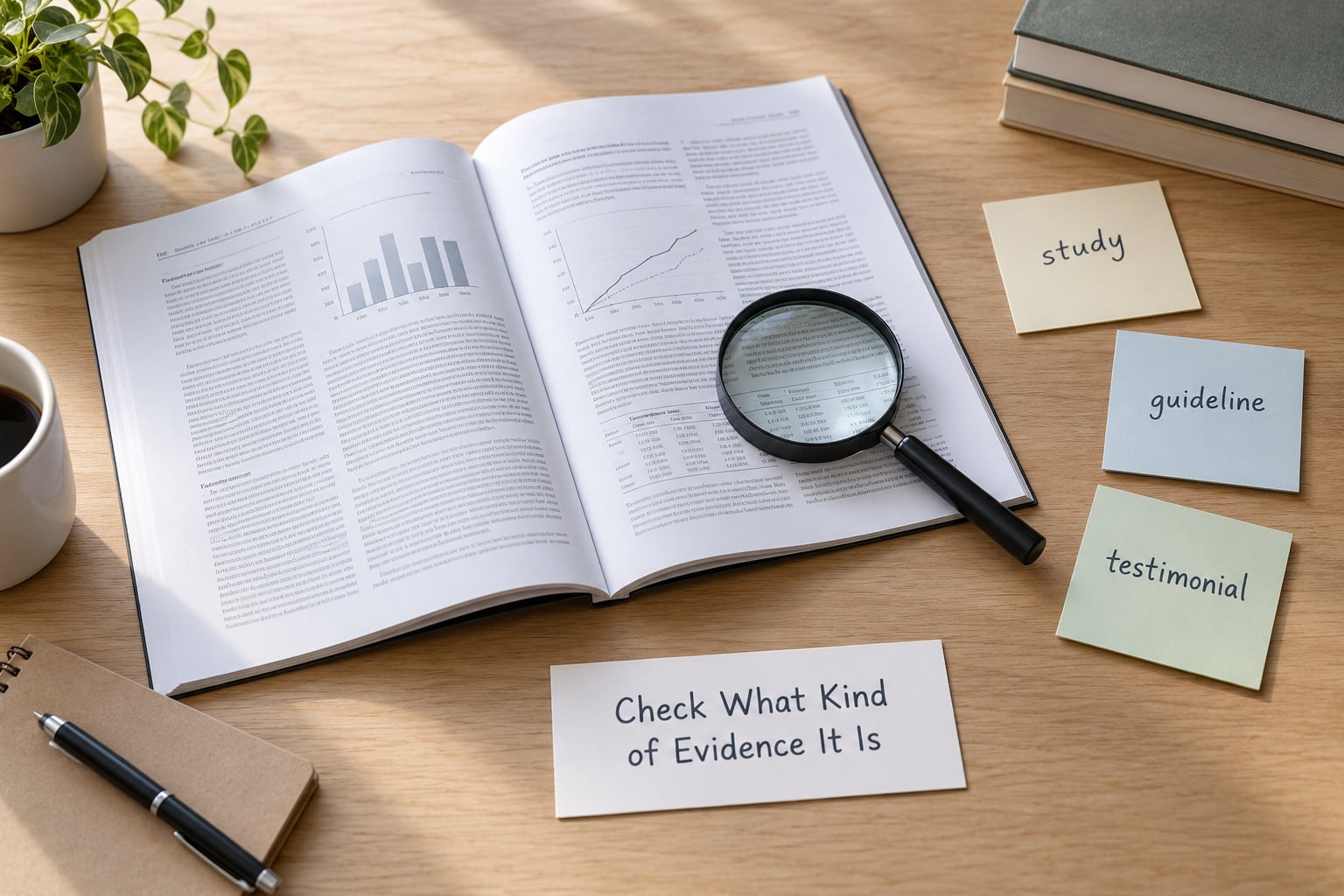
Not all research carries the same weight, and the label on the study tells you where it sits. From strongest downward:
- Systematic review or meta-analysis. Researchers search several databases using a fixed method and combine many studies. Strongest single form of published evidence.
- Randomised controlled trial. Participants are assigned to groups, ideally with a placebo comparison. Best design for testing whether something causes an effect.
- Cohort or case-control study. Observational. Useful for spotting patterns, but the groups were not assigned.
- Cross-sectional survey or laboratory study. A snapshot or a petri dish. Good for generating ideas, weak for proving outcomes in people.
- Expert opinion, conference abstract or preprint. Useful and not automatically wrong, but not yet settled. Preprints have not been peer reviewed.
- Testimonial or anecdote. One person’s experience. It tells you something happened to them, nothing about whether it will happen to you.
Then read the conclusion and check it against the results. If the paper reports a small, short-term change but the conclusion promises broad benefits, the gap between those two sentences is where marketing lives.
4. Look for Biases and Missing Context
Five checks cover most of it. Sample size: a study of a dozen people cannot support a rule for millions, whatever it found. Comparison group: without a proper control, improvement may come from expectation, attention or simply time.
Duration matters too, since a two-week result is not a two-year result. On funding, check the acknowledgements and conflict-of-interest statement for industry money, and read it as context rather than as automatic disqualification.
Then the wording problem known as association versus causation. People who eat more of something may differ in many other ways, so a study finding that two things occur together has not shown that one produced the other.
Two more patterns are worth naming. Cherry-picking is reporting the one analysis that looked good while omitting the others. And a claim about a group may simply not apply to you: study populations are usually narrow, so a finding about older adults tells you little about a healthy 25-year-old.
Watch the absolute words too. Cure, detox, cleanse, boost immunity, flush toxins, clinically proven and 100 percent natural signal that marketing wrote the sentence. On a regulated food label, phrasing like supports rather than prevents also reflects a real legal difference in what the manufacturer had to show.
5. Compare the Claim With Trusted Guidance
Compare the claim with what trusted bodies currently say, not with what another influencer said last month. For a summary of where to look:
- Cochrane Library. Independent systematic reviews; the reference point when a question has been studied repeatedly.
- PubMed. Abstracts for most biomedical literature; filter by review type to find the strongest designs first.
- NIH Office of Dietary Supplements. Plain-language fact sheets on specific nutrients, including what is known and what remains uncertain.
- CDC and WHO guidance. Current recommendations on diet patterns, sodium, added sugar, alcohol and food safety.
- USDA FoodData Central. Verified nutrient values for foods, useful when a post invents nutrition numbers for a restaurant meal.
- Your national food-safety or consumer-protection body. Useful for checking whether a packaging claim is permitted where you live.
Two cautions. Guidance evolves, so a conclusion written ten years ago may no longer be the mainstream view, and mainstream guidance describes populations, not individuals. If a single study contradicts decades of guidance, that study is usually the weaker of the two, and it is worth finding out why.
6. Decide What You Can Trust
Sort the claim into one of four buckets and say so out loud, because a decision you have not labelled tends to drift into action.
- Reasonably supported. Backed by good evidence in humans, and it matches current guidance.
- Promising but uncertain. Plausible, studied a little, not settled. Fine to watch, not fine to build a diet around.
- Exaggerated. A real finding wearing bigger clothes. Often true if you strip the words away.
- Unsupported. No traceable source, no plausible mechanism, or an absolute promise. Discard.
Treat a claim as one input rather than an instruction. Nutrition works as a pattern across months and years, so no single food, powder or protocol deserves the same weight as the whole pattern.
Common Mistakes
Treating the headline as the conclusion
Headlines compress and sharpen. The fix: read the abstract and the conclusion section, not the headline and the first paragraph, which is usually written for general readers and tends to overreach.
Assuming one study proves a universal rule
A single trial, often small and short, rarely settles a nutrition question. Multiple independent studies and reviews converging on the same answer is what changes guidance.
Reading association as causation
When a headline links two things that turned out to occur together, check whether anyone assigned the exposure at random. If not, other explanations remain open.
Overlooking the study’s own limitations
Researchers are usually candid about their limits, in a paragraph near the end. It is the part that survives peer review and the part that news coverage drops, so go looking for it deliberately.
Misreading the serving size
A package serving is not a portion and rarely matches the amount eaten. Doubling or halving every number on the panel is the fastest way to see whether the nutrient content claim still works for you.
How to Evaluate a Nutrition Claim on a Food Package
Turn the package around. Check the serving size and how many servings are in the container, then look at the nutrient values against the daily value percentages. A front-of-package phrase such as natural, light or plant-based describes the product, not its nutritional effect, and it creates a halo that makes people infer a benefit that the panel does not state.
Treating testimonials as proof
Before-and-after posts cannot control for attention, expectation or simultaneous changes, and the people who post them are not a random sample of anything. One person’s dramatic result is worth asking about, not concluding from.
Looking to the internet instead of a professional
Useful rule: if the claim is about changing what you eat, general information is fine online. If it is about your medication, symptoms, bloods, pregnancy, disordered eating or a child’s growth, ask a doctor or registered dietitian. Symptoms that are severe, sudden or worsening deserve a call rather than a search.
Frequently Asked Questions
Can you give me an example of a nutrition claim?
A nutrition claim is any statement about what a food, drink or supplement does for you. Nutrient content claims describe what is in the product, such as high in fibre or low in sodium. Health claims connect a nutrient to a health effect, such as supporting heart health. Structure/function claims describe what a nutrient does in the body, such as supporting the immune system. Checking any of them starts with finding the original source behind the wording.
How do we evaluate the credibility of online health information?
Six checks, in order: write down the exact claim and who it applies to; trace it to the original study rather than the summary; identify the evidence type; look for bias, small samples and missing context; compare the finding with guidance from bodies such as the NIH, CDC or WHO; and note who funded the work. Then classify the claim as reasonably supported, promising, exaggerated or unsupported, and say it out loud so the decision sticks.
What is the 3-3-3 rule for nutrition?
The 3-3-3 rule is a menu-planning convention used by restaurants, meaning three starter options, three main courses and three desserts. It helps a kitchen balance a menu and control costs. It has nothing to do with judging whether a nutrition claim is true, and you will not find it in any dietary guideline. If you have seen it used in a nutrition context, treat that usage as marketing rather than a scientific rule.
Are detox and cleanse claims true?
There is no good evidence that detox diets or cleanse programmes remove waste products your organs already handle. Some involve laxatives or very low intake, which can cause real harm, including nutrient deficiency and dangerous weight loss in a short time. The word detox on a label is usually a marketing choice rather than a regulated medical claim. If someone tells you a protocol is essential for health, ask what happens to people who skip it, and who profits from the products.
How do I check if a nutrition study was funded by a company?
Open the paper and read the funding statement and conflict-of-interest declarations, usually before the abstract or in the notes at the end. Look for a named company, a trade body or an ingredient supplier. Then search the journal or funder alongside the researcher’s name to see the pattern. Industry funding is not proof the finding is false, and serious journals publish funded studies routinely. It does mean you should read the methods and limitations with a little more care.
Should I trust what an AI assistant tells me about nutrition?
Treat it as a starting point, never as the source. These systems can state a plausible-sounding claim with confident wording and no study behind it, invent references, and blend outdated advice into fluent prose. Use an answer to build the question, then take the question to Cochrane, PubMed, the NIH or a dietitian. If a piece of nutrition advice does not survive being checked against a real source, you have learned nothing useful from it.
Conclusion
Start with the original source, not the post. Copy the claim, find the paper or guideline, judge the design and the funding, then compare it with guidance from the NIH, CDC or WHO before you change a single meal.
Ten minutes is enough for most claims, and skipping the source hunt is the only way to get it badly wrong. Everything here is general education about information quality; advice about your own health belongs with a doctor or registered dietitian.