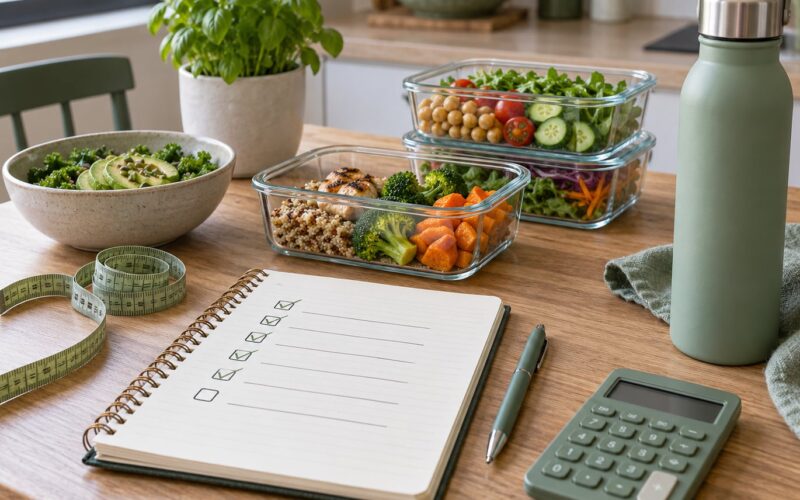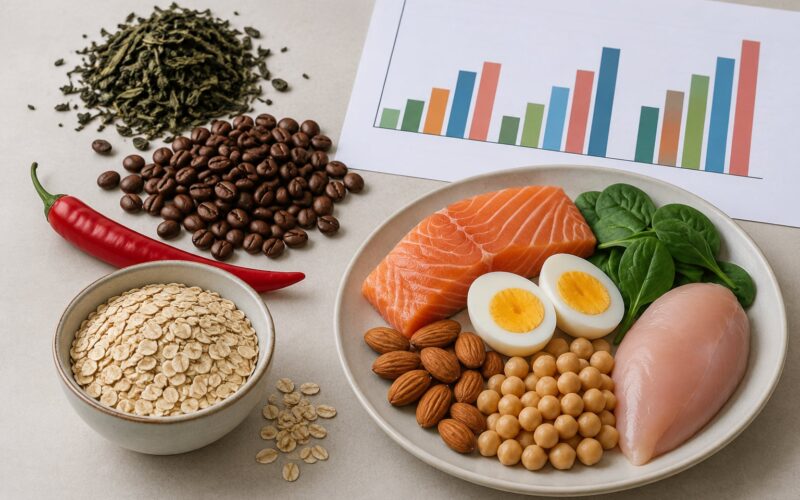
Yes, you can lose fat and keep a regular period. The difference is pace and intake: a mild deficit of a few hundred calories a day, a floor of roughly 1,200 to 1,500 calories for smaller bodies, a weekly loss of no more than about 1 percent of your bodyweight, and enough protein, dietary fat, sleep and recovery. Cut harder than that and the reproductive hormones slow down, ovulation gets irregular and cycles fade to a light period or stop altogether.
That is a real thing and not a myth you can wish away. When energy intake stays too low for too long, the hormonal conversation between your brain and ovaries changes, and menstruation is often the first thing you notice. It is also usually reversible, though it can take months.
This guide is general information for adults. It is not a diagnosis, a treatment plan or a substitute for care from a doctor or registered dietitian. If your cycle has changed and stayed changed, that is a conversation to have with a clinician rather than a puzzle to solve with a stricter menu.
For background, the Office on Women’s Health and peer-reviewed work published in the National Library of Medicine’s PMC repository both describe the link between low energy availability and menstrual function. The mechanism below is drawn from that research, in plain language.
Table of Contents
- What You Need to Lose Fat Without Losing Your Period
- Step-by-Step
- How to Eat Enough While Losing Fat Without Losing Your Period
- Choose a Gradual Rate of Fat Loss
- Move in Ways You Can Recover From
- Protect Sleep and Stress
- Track Your Cycle and Your Recovery
- Know When to Ask a Healthcare Professional
- Common Mistakes
- Frequently Asked Questions
- Does losing fat always make your period stop?
- How can I lose fat without restricting my meals too much?
- Should I exercise if I have not had a period?
- How much weight loss is considered gradual?
- What causes a missed period besides fat loss?
- When should I see a doctor about a missed period?
- Conclusion
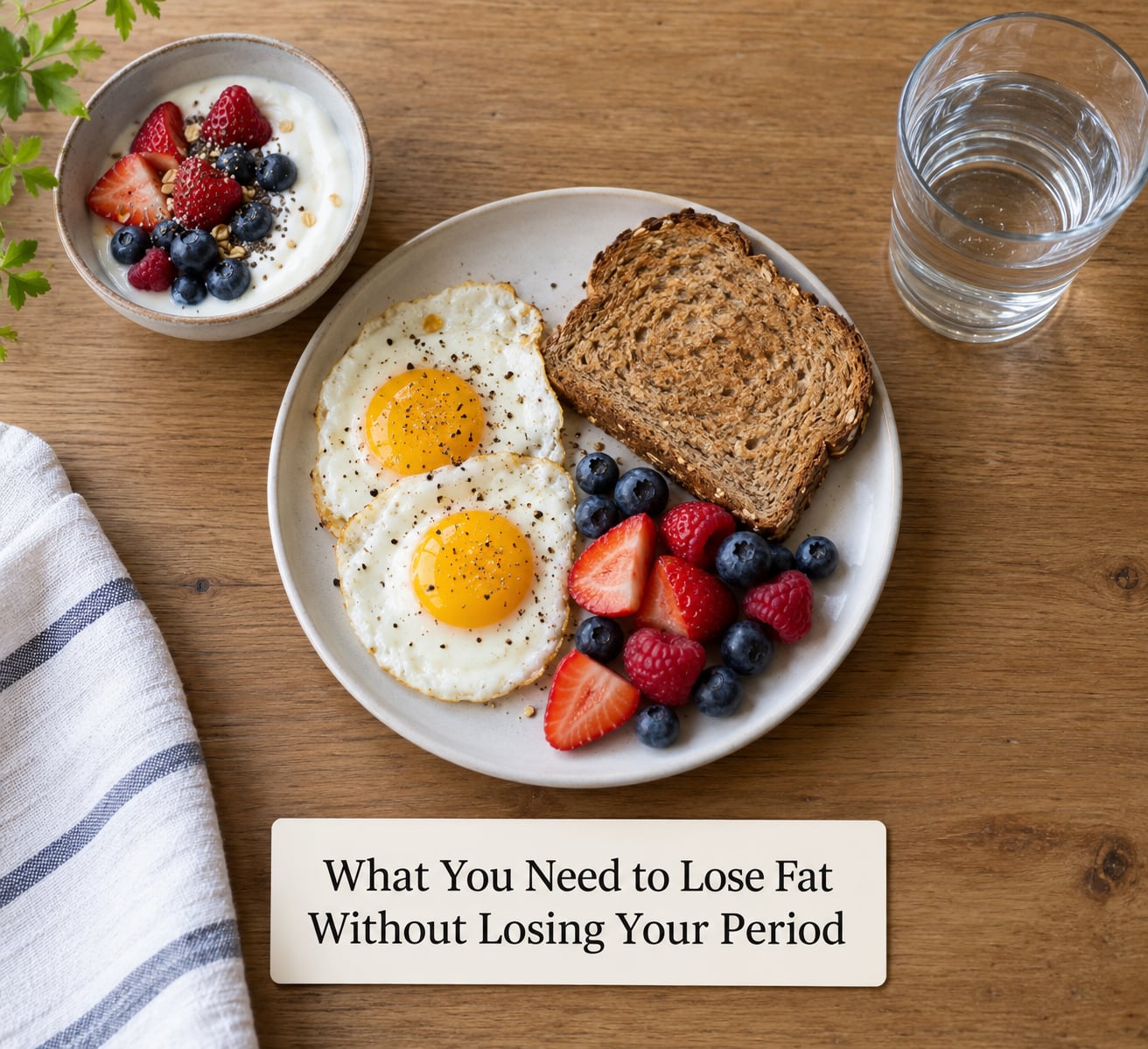
What You Need to Lose Fat Without Losing Your Period
Nothing exotic. No fat-burning supplement, no metabolism reset, no expensive program. What you need is an ordinary, repeatable eating pattern and a body of movement you can recover from.
- Three regular meals, plus a snack on days you train or on days you are hungrier than usual.
- A protein source at every meal: eggs, fish, chicken, beans, lentils, tofu, Greek yogurt, cottage cheese.
- Fruit and vegetables at most meals, for fiber, volume and micronutrients.
- Satisfying carbohydrates: rice, potatoes, oats, bread, beans. Carbs are not the enemy of a regular cycle.
- A source of dietary fat: olive oil, avocado, nuts, seeds, fatty fish, whole eggs. Fats matter for hormones.
- Water through the day, and enough food around your training sessions.
- Movement you enjoy and can sustain: walking, strength training, swimming, cycling, mobility work.
- Enough sleep, and a way to track your cycle and your energy side by side.
That last one is the item people skip, and it is the one that tells you the most. A notebook, a calendar or a simple app is enough. Write down the day your period starts, how many days of flow, your energy, your training and your sleep.
Step-by-Step

The process is gradual, not dramatic. You change your eating pattern first, add gentle activity, then check in twice a month against two checkpoints: how your cycle is behaving and how your energy and training are holding up.
If your cycle is unaffected and your energy is steady, you continue. If the period gets lighter, late or absent, you pause the deficit and raise intake, and you consider whether training volume needs to come down.
How to Eat Enough While Losing Fat Without Losing Your Period
Fat loss happens when energy intake sits slightly below what you use. The word that matters is slightly. A common range that comes up in clinical discussions of this question is a 300 to 500 calorie daily deficit, and a floor many practitioners use as a warning sign is around 1,200 calories, higher for taller or heavier bodies.
Those are conversation starters, not a personal prescription. What you can do without a calculator is build meals that fill you up, because hunger and under-eating drive the cycle changes people notice.
Protein does the heavy lifting for fullness. Most adults in a fat-loss phase aim somewhere around 1.2 to 2 grams of protein per kilogram of bodyweight, spread across meals rather than loaded into dinner. Fats do the hormone work and make food taste good enough that you keep eating. Most of the guidance in this space points to keeping a meaningful share of calories from fat rather than pushing it to the edge.
A sample day, adjusted to your own preferences and hunger:
- Breakfast: two eggs with toast and fruit, or Greek yogurt with berries and a spoon of nuts.
- Lunch: a bowl of rice or potatoes with beans or chicken and a big salad, oil-based dressing.
- Dinner: fish or tofu with potatoes and cooked vegetables.
- Snack: fruit with peanut butter, or yogurt with seeds, eaten before training rather than skipped.
Regular meals also protect the plan. The people who struggle most are the ones who restrict hard during the week and eat back far more on the weekend, which ends up moving the weekly average in the wrong direction.
Choose a Gradual Rate of Fat Loss
A widely used ceiling is 0.5 to 1 percent of bodyweight per week. For someone at 140 pounds, that is roughly 0.7 to 1.4 pounds a week, and for someone at 200 pounds, roughly 1 to 2 pounds a week. Faster loss sounds more efficient and is the single most common reason people lose their cycle.
Here is how the weekly rates tend to land in practice:
- Under 0.5 percent of bodyweight per week: slow and very easy to sustain, cycles usually unaffected.
- 0.5 to 1 percent: the range most clinicians treat as the safe working target.
- 1 to 2 percent: watch your cycle, energy and training closely.
- Over 2 percent: commonly linked with lighter or missing periods, and worth a conversation with a clinician.
Watch trends, not the daily number. Weight moves up by a few pounds around your period from water retention, and it shifts with sodium, bowel movements and how much you walked the day before. A three-day average, written once a week, tells you far more than a number you argue with every morning.
Two habits protect the pace. The first is a planned break: the consensus in both the AI summaries for this topic and the community advice people share is to limit a strict dieting phase to 12 to 16 weeks, then spend two to four weeks at roughly maintenance before starting again. The second is raising intake in steps rather than jumping straight back up, which is what reverse dieting means, and it is gentler on the system than an abrupt 800-calorie jump.
A plateau is not a reason to cut harder. Check your water, your steps, your sleep and how long you have been dieting before you touch the deficit.
Move in Ways You Can Recover From
Walk most days, train two or three times a week, and keep some mobility work. Strength training is genuinely useful here because it preserves muscle during a deficit, and walking is easy to scale down when you need to.
When adjustment is needed, cut volume before intensity. Shorter sessions and fewer miles usually serve recovery better than the same sessions at higher intensity. A deload week, where you train but keep loads or pace easy, every four to six weeks is a reasonable habit during a cut.
Endurance training stacks with everything else. A deficit plus long runs plus lifting is a very common combination, and it is also one of the more common setups described in community accounts of cycle trouble. If that is your week, treat the training as part of the nutrition conversation rather than a separate thing.
Normal post-workout tiredness passes within a day or two. Resting heart rate that stays elevated, a wrecked night of sleep, low mood and falling performance across several sessions are the signals to do less for a while. Stop and get medical advice if you feel faint, have chest pain or feel unwell well past the session.
Protect Sleep and Stress
Seven to nine hours is the range most sleep guidance lands on, and it does two useful things here: it makes a deficit far easier to stick to, and it supports the recovery your training depends on. Short sleep raises appetite and makes cravings louder, which quietly pushes people into eating less than planned.
Stress loads up on top of the deficit. Work stress, poor sleep, hard training and a calorie gap at the same time is a lot of pressure, and it is a pattern clinicians look for when cycles change.
One point of clarity, because it gets repeated constantly online: poor sleep and a hard training week do not by themselves stop a period. They can make an existing problem worse and can mask what the real cause is. A missing period has many possible causes, and writing it off as stress is not the same as ruling stress out.
Track Your Cycle and Your Recovery
Write down five things each week: period timing if it arrives, flow if it does, energy, hunger and training. Waist measurement at the navel, once a week under the same conditions, often moves when the scale does not. That is the pattern one Reddit poster described, losing an inch or more of waist while the scale barely budged.
Around menstruation, a swing of a few pounds is common and usually water, not fat. People report losing little or nothing during the period itself and then a steady drop in the weeks after, which is why weekly averages beat daily readings.
Do not use a tracking app to diagnose yourself. What tracking does is tell you whether a pattern is forming, and a pattern is the thing to take to a doctor.
Know When to Ask a Healthcare Professional
Book an appointment rather than adjusting your meals again if any of these apply:
- Your period has stopped for three months or more, or was already irregular.
- Cycles are repeatedly changing month to month for no clear reason.
- You have severe or persistent pelvic pain, or pain that is new.
- You are soaking through protection hourly, passing clots, or feeling weak.
- You feel faint, dizzy or short of breath.
- Pregnancy is possible, or your contraception has changed.
- Your weight has changed quickly in either direction.
A clinician can check a hormone panel, thyroid function and other causes, and a registered dietitian can size your intake without you guessing. Medications also belong on that list, including GLP-1 medicines, which reduce appetite and can push intake lower than people expect.
Common Mistakes
Crash dieting for a week, then eating like you never stopped. The average lands where it always lands, and the swing disrupts the cycle. Fix: hold one steady pattern for twelve to sixteen weeks, then take a real break at maintenance.
Skipping meals because the calendar says fasting days. A fasting window is not a fast on a 1,200-calorie day, and the total still has to hold the line. Fix: eat enough on the days you do eat, and include a snack before training.
Cutting carbohydrates and fat at the same time. Fat is a building block for the hormones involved here, and removing both leaves meals that do not fill you. Fix: keep a portion of your calories from fat and let whole grains stay in.
Training harder to earn the deficit. Adding volume to eat more is a neat idea that stops working. Fix: hold training steady or trim it first, and change nutrition before you add punishment cardio.
Trusting the scale alone. Cycle water can erase a month of work in your head. Fix: average weekly weights, measure your waist, and track how clothes fit.
Ignoring a change that repeats. One light period is worth watching. Three is a reason to book an appointment. Fix: set a date to review your tracking, and keep the appointment if the pattern held.
Waiting for the problem to fix itself. It often does not while the deficit continues. Fix: raise intake, cut training volume, and get help if the pattern does not reverse within a few months.
Frequently Asked Questions
Does losing fat always make your period stop?
No. Plenty of people lose body fat steadily and keep a regular cycle. What tends to show up first is a lighter or shorter period, and that is the early signal worth acting on. Cycle changes are far more common in aggressive cuts, very low intakes, and weeks when training volume and life stress are all high at once. If a pattern repeats, treat it as information rather than something to push through.
How can I lose fat without restricting my meals too much?
Build meals around protein, fiber-rich carbohydrates, fat and produce, and eat three times a day. Keep a mild deficit of a few hundred calories rather than a large one, and treat a rough floor of 1,200 to 1,500 calories as a line not to cross without input from a dietitian. Taking a maintenance break every twelve to sixteen weeks makes a slower pace far easier to hold.
Should I exercise if I have not had a period?
Gentle movement such as walking is generally fine. You do not need to stop training because a cycle was missed, but you should not add volume or intensity while your body is recovering. If the absence is due to low energy availability, more training can keep the cycle suppressed. Book an appointment if it reaches three months, and sooner if you have pain, heavy bleeding or feel faint.
How much weight loss is considered gradual?
Around 0.5 to 1 percent of your bodyweight per week is the range most clinicians treat as a working target for keeping a cycle regular. At 140 pounds that is about 0.7 to 1.4 pounds a week, and at 200 pounds roughly 1 to 2. Measure trends over weeks rather than days, because menstrual water retention can move the scale by a few pounds on its own.
What causes a missed period besides fat loss?
Quite a few things. Low energy availability from under-eating or heavy training is the most common, alongside intense stress, PCOS, thyroid problems, high prolactin, perimenopause, and medications that shift hormones, including some contraception and GLP-1 drugs. A false pregnancy test, breastfeeding and long-distance endurance training can also play a part. Only testing can separate them, so a doctor, not an app, is the right place to start.
When should I see a doctor about a missed period?
Arrange an appointment if three months pass with no period, if you are not certain you are pregnant, if cycles keep shifting without settling, or if you have severe or persistent pain, very heavy bleeding, clots, dizziness or fainting. A clinician can check a hormone panel, thyroid function and other causes, and rule out the ones that are not about food. Earlier is always fine when something feels off.
Conclusion
Start with the food, not the training. Build three regular meals that include protein, a carbohydrate you actually enjoy and some fat, hold the deficit to a few hundred calories, and add walking and two strength sessions a week.
Then track two things: your weekly weight average and your cycle. If the period gets lighter or late, raise your intake and trim training volume before you change anything else. And if a change repeats or a period disappears for three months, that belongs with a doctor or registered dietitian, not with a stricter menu.