Overnight oats for weight loss work when the jar carries enough protein, fiber and fat to hold you until lunch, and the plain soaked-oats versions most people make fall short on all three. The fix is a ratio, not a fancier ingredient list: aim for 20 to 30 g of protein and 8 to 12 g of fiber in a single serving, and you will not be hunting for food by 10am.
It takes about five minutes of work and a night in the fridge. Below is the base recipe I keep coming back to, the numbers behind why it works, and the seven mistakes that quietly turn a filling breakfast into a hungry one.
Table of Contents
- What You Need
- Step-by-Step: Overnight Oats for Weight Loss
- How to Make Overnight Oats Filling Enough to Last Until Lunch
- How to Make Them Filling Without Adding Too Many Calories
- Common Mistakes
- Using instant or quick oats instead of rolled
- Leaving out protein
- Pouring too much liquid
- Adding too much chia
- Using sweetened yogurt or fruit-flavored varieties
- Free-pouring calorie-dense toppings
- Portion drift and bloating
- Frequently Asked Questions
- Are overnight oats good for weight loss?
- How filling are overnight oats compared with other breakfasts?
- How much protein should I add to overnight oats?
- Can I make overnight oats without yogurt or milk?
- How long do homemade overnight oats last?
- Can I eat overnight oats if I am trying to lose weight?
- Conclusion
What You Need
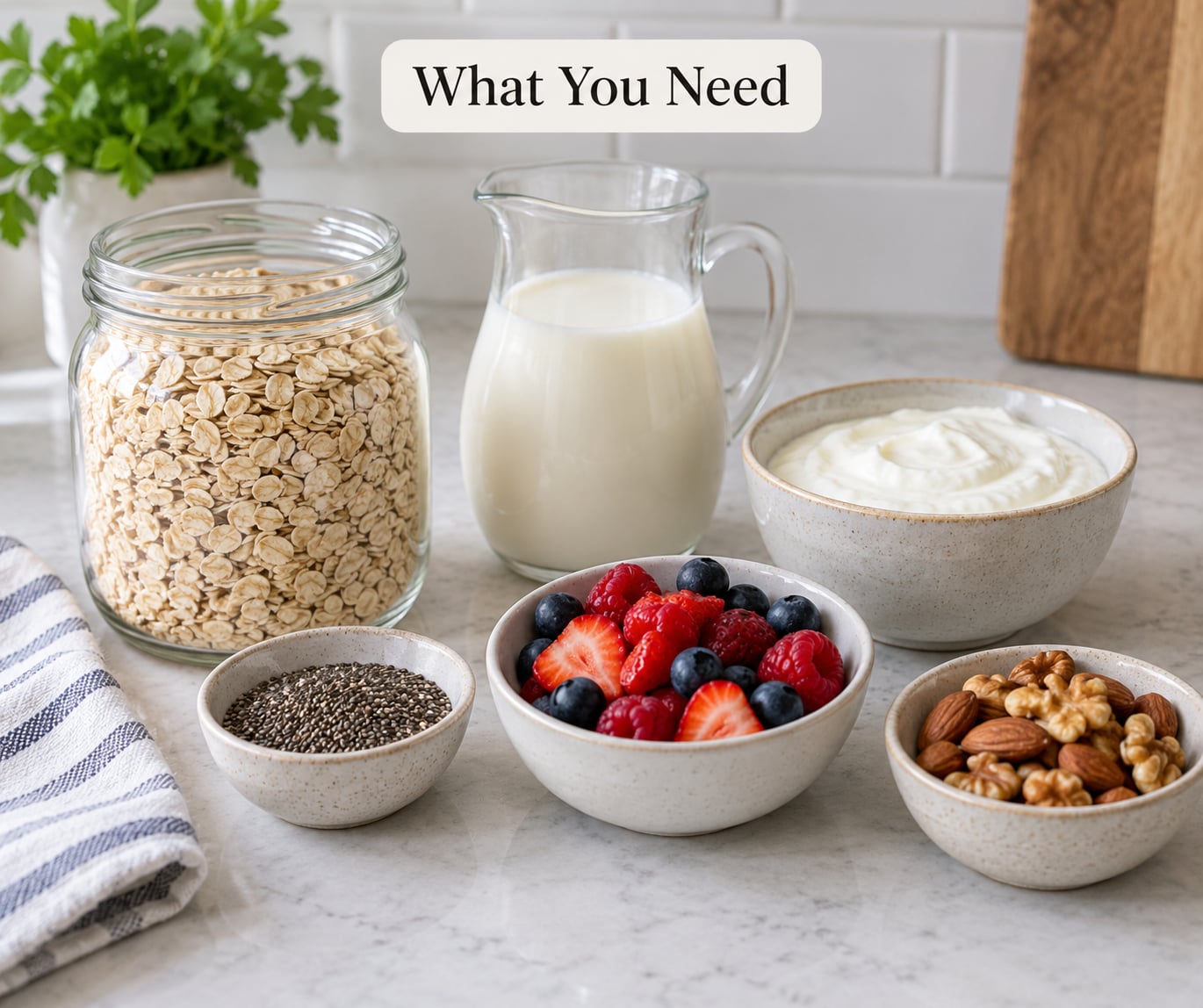
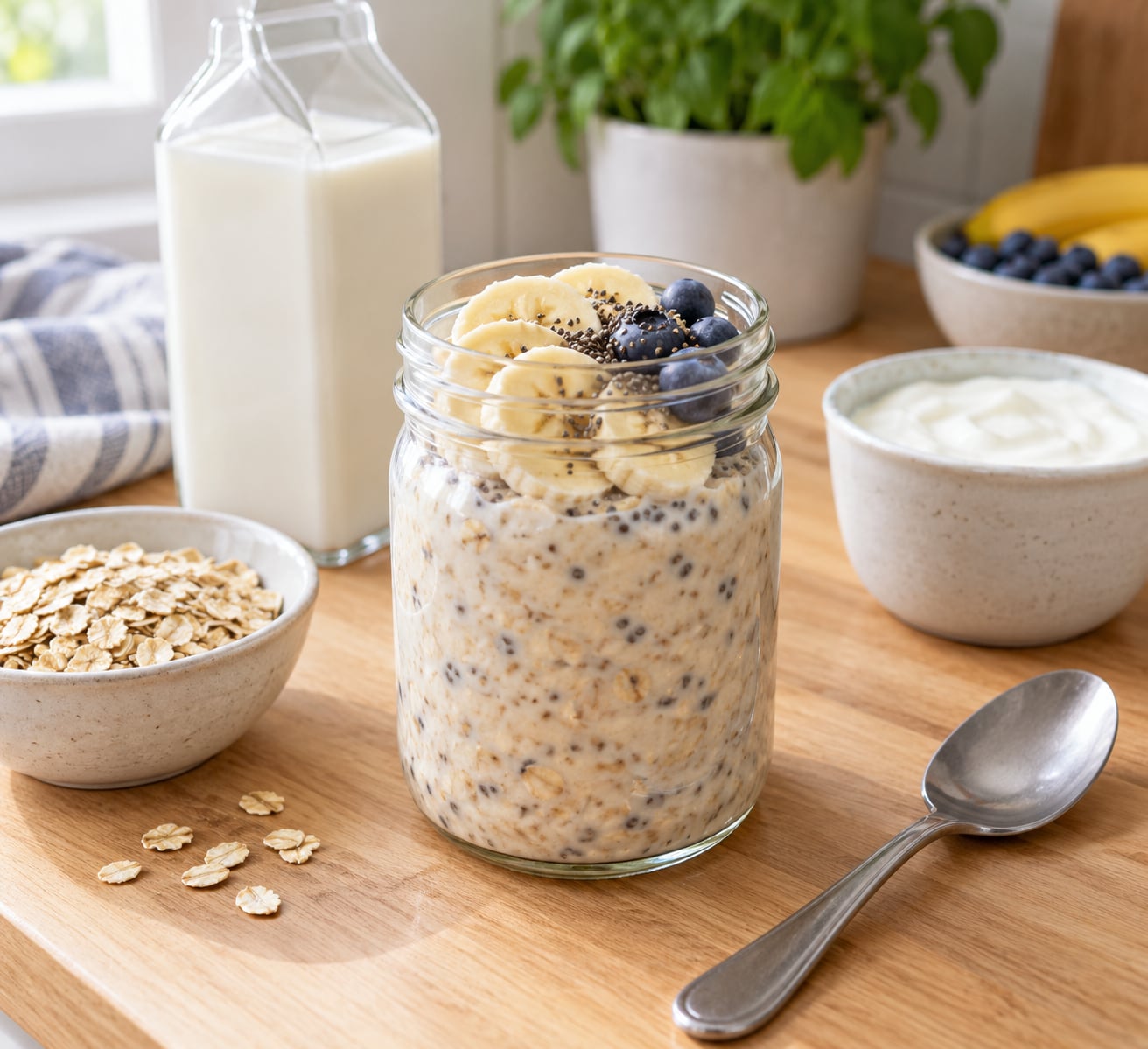
One filling serving needs four things working together: a base of oats for slow-release carbohydrate, a thickener for soluble fiber, a protein source, and something with fat. Most jars that fail are missing two of the four.
- Rolled or old-fashioned oats, 1/2 cup (about 45 g) — the base. Quick oats work and soak faster; steel-cut oats will not soften overnight and stay chewy no matter how long you leave them.
- Liquid, 1/2 cup (120 ml) — milk gives the best protein, while unsweetened almond milk, soy milk or oat milk keep it dairy-free. Oat milk is the mildest and the least protein, so add more elsewhere if you use it.
- Plain Greek yogurt, 1/3 cup (about 85 g) — roughly 15 to 20 g of protein on its own. Always buy plain; the fruit varieties carry 10 to 20 extra calories of sugar per serving.
- Chia seeds, 1 tablespoon (about 12 g) — 5 g of fiber and a gel that holds water in the stomach. Ground flax works the same way at the same spoonful.
- One protein booster (optional but recommended) — 1/2 scoop of vanilla or chocolate protein powder, 1 tablespoon of peanut or almond butter, or 2 tablespoons of hemp hearts.
- Fruit (optional) — half a banana, a handful of berries or a diced apple. Fresh or frozen both work; dried fruit is a different story entirely.
- Flavour (optional) — cinnamon, vanilla extract, cocoa powder, a pinch of salt.
The salt is not a garnish. A small pinch of salt takes an edge off sweetness and makes the rest of the flavour taste more like something you want again tomorrow, and it costs nothing.
Tools are minimal: a jar or lidded container with a 500 ml capacity, a spoon, and a fridge shelf. If you plan to cook in batches, a five-jar set is the difference between meal prepping on Sunday and skipping it.
For the ratio itself, scale by goal. The base above sits around 380 to 430 calories with roughly 28 g of protein and 11 g of fiber.
- Maximum fullness: 1/2 cup oats, 1/2 cup milk, 1/2 cup Greek yogurt, 1 tablespoon chia, 1/2 scoop protein powder. Around 500 calories, and the highest protein of the three.
- Lower calorie version: 1/3 cup oats, 1/2 cup unsweetened almond milk, 1/3 cup Greek yogurt, 1 tablespoon chia. Roughly 290 calories, still above 20 g of protein.
- Creamy but lighter: keep the oats at 1/2 cup and swap some of the milk for yogurt. More protein and less liquid slows the sugar rise.
- No dairy: 1/2 cup unsweetened soy milk for the milk and 1/3 cup soy yogurt for the Greek yogurt, then add a scoop of protein powder to make up the difference.
Two hours of soaking is often enough for rolled oats. Four is the sweet spot. Anything past eight hours and the oats turn gluey, which is a texture problem rather than a nutrition one.
Step-by-Step: Overnight Oats for Weight Loss
How to Make Overnight Oats Filling Enough to Last Until Lunch
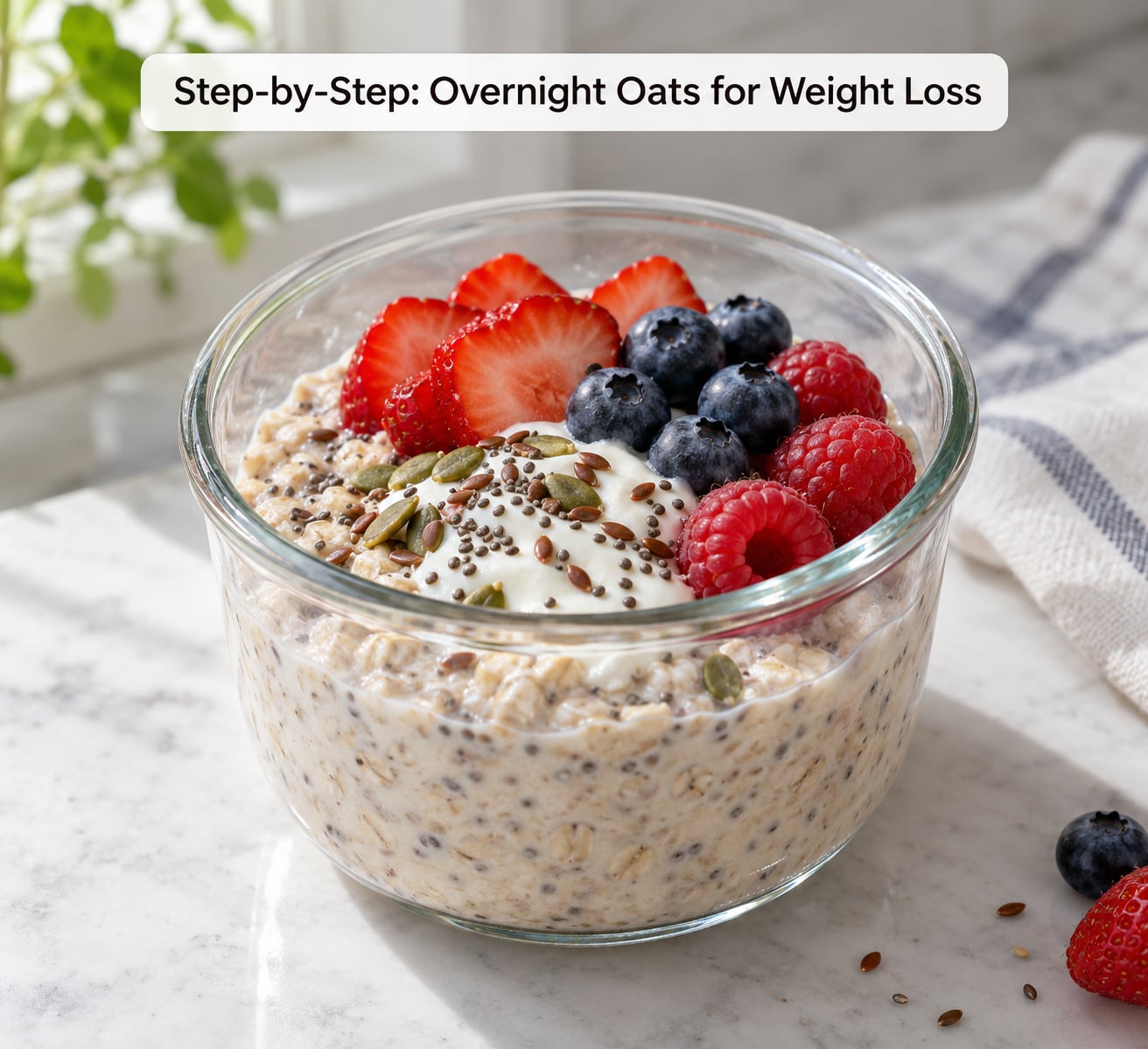
The order matters more than most recipes admit. Seeds go in last, liquid goes in first, and toppings wait until the morning so fruit stays firm and yogurt stays thick.
- Measure the liquid first. Pour 1/2 cup of milk into the jar, then add 1/3 cup of Greek yogurt. If you are using protein powder, stir it into the liquid now while it is still thin, otherwise you end up with powder pockets at the bottom.
- Add the oats. Stir in 1/2 cup of rolled oats until everything looks evenly wet. Scrape the bottom of the jar, because dry oats stuck to the base are the reason some jars come out lumpy.
- Add the seeds and flavour. Stir in 1 tablespoon of chia seeds, a pinch of salt and your cinnamon or cocoa. Mix for a full 20 seconds so the chia is dispersed rather than sitting in a clump, which is the single most common texture complaint.
- Cover and chill for four hours minimum. Cover the jar and refrigerate at or below 4°C. Quick oats soften in two to three hours; rolled oats need closer to four. An overnight soak is fine, just watch for the gluey stage if it sits for a full 12 hours.
- Check the texture in the morning. A filling jar is thick, spoonable and slightly gummy, closer to porridge than to pudding. Tilt the jar: if the oats slide as a single mass, they are ready. If they slump into a runny pool, stir in a tablespoon of dry oats and wait ten minutes. If they are stiff and dry, loosen with a splash of milk.
- Top it just before eating. Add your fruit, the nut butter or protein powder dollop, and any crunchy element. Adding toppings in advance is what makes the bottom of the jar turn watery by day three.
That sixth step is where most filling jars are quietly undone. A tablespoon of almond butter is worth keeping because the fat slows gastric emptying, but two tablespoons of granola is mostly sugar and oil dressed up as a health food.
Warming the jar is also an option. Thirty to forty-five seconds in the microwave, stirring halfway, makes cold oats more appealing on winter mornings and does not change the macros. If you are reheating a jar with dairy in it, heat it to 165°F until steaming throughout.
How to Make Them Filling Without Adding Too Many Calories
Fullness comes from three levers, and overnight oats can pull all three at once because the format forces you to soak rather than fry or bake. Oats and chia release soluble fiber, including beta-glucan, which forms a gel that slows how fast the jar leaves your stomach. Protein from yogurt, milk or powder signals to your body that it has been fed. Fat from nut butter or seeds rounds it out.
The practical target: 20 to 30 g of protein and 8 to 12 g of fiber per jar. Below 20 g of protein, most people are hungry again within ninety minutes regardless of how much oats they ate.
To add fullness without a big calorie bill, work in this order. Add protein first, since it costs the fewest calories per gram. Add chia or ground flax next, because 1 tablespoon adds roughly 5 g of fiber for about 60 calories. Add volume next with berries, cucumber or extra yogurt, which stretch the stomach without a meaningful calorie load. Save fat for last, because nut butter is nutritious and still dense at roughly 95 calories a tablespoon.
The biggest single change most people can make is swapping sweetened Greek yogurt for plain. That swap alone typically removes 40 to 80 calories per jar, and plain is not the sacrifice it sounds like when you have vanilla and cinnamon in the mix.
A note on sugar: maple syrup, honey and agave are the reason so many weight-loss jars behave like dessert. Half a tablespoon is about 25 calories and fine now and then, but a free-poured spoonful is 60 calories that buys almost no fiber. Monk fruit or stevia handles sweetness with no calories at all, and a mashed banana gives sweetness plus potassium and a little texture.
Common Mistakes
Almost every “overnight oats do not fill me up” complaint traces back to one of these seven things.
Using instant or quick oats instead of rolled
Quick oats are processed further and absorbed faster, so they raise blood sugar faster and carry less chew. Use them if you need speed, but rolled or old-fashioned oats are the better choice for a filling jar because the grain still has structure after soaking.
Leaving out protein
A jar of oats in milk is mostly carbohydrate, and carbohydrate alone rarely holds. Fold in yogurt, protein powder or a nut butter from the start, not as an afterthought, and check the label to see whether you actually hit 20 g.
Pouring too much liquid
Thin oats disappear fast because there is nothing to chew. Start at 1/2 cup of liquid per 1/2 cup of oats, add chia, then adjust the next morning. A slurry in the morning beats guessing tonight.
Adding too much chia
Two or three tablespoons is the range where most people draw the line. Beyond that, the gel gets pasty and some people feel uncomfortably full, which is its own problem.
Using sweetened yogurt or fruit-flavored varieties
This is the quietest calorie trap in the whole recipe. Fruit-on-the-bottom and honey-vanilla varieties carry enough added sugar to matter, and readers on calorie-counting plans usually list it as the thing that quietly ended their deficit.
Free-pouring calorie-dense toppings
Two tablespoons of granola, three tablespoons of raisins and a large drizzle of nut butter are the three most common additions, and together they can add 250 calories or more to a 400-calorie breakfast. Measure them with a spoon instead of shaking the container.
Portion drift and bloating
Most people measure a cup of oats by habit, which can double a breakfast’s calories. Half a cup dry weight is the portion that works for most adults, and heavier people may want to start at 1/3 cup.
Bloating and gas have their own causes worth naming. Large amounts of dried fruit, big doses of honey, and oats eaten fast with little water are the usual suspects, and swapping dried fruit for fresh, cutting the honey, and adding ground flax or hemp hearts settles it for a lot of people. Steel-cut oats, gluten-contaminated oats, and switching between varieties and sizes can all trigger it too.
You can eat oats every day, including chia, and it suits plenty of people. What matters is that the jar changes. A week of identical jars is how plans get abandoned, and variety is what keeps a daily oats breakfast alive. Check in with a dietitian or doctor if you have a condition such as celiac disease, a thyroid condition or a history of disordered eating, since they can advise on amounts that suit you.
Frequently Asked Questions
Are overnight oats good for weight loss?
Overnight oats can support weight loss because they are portioned, make-ahead and easy to make filling. Oats and chia provide soluble fiber that slows digestion, and protein from Greek yogurt or milk adds satiety. They work best at 20 to 30 g of protein and 8 to 12 g of fiber per jar, eaten within a calorie-controlled overall pattern.
How filling are overnight oats compared with other breakfasts?
A well-built jar with 25 g of protein and 10 g of fiber holds most people until lunch. A plain jar of oats in milk is far less filling than eggs, because most of its energy comes from carbohydrate. The comparison you care about is not oats versus other cereals, it is your jar versus a 250-calorie bar you want at 10am.
How much protein should I add to overnight oats?
Aim for 20 to 30 g of protein per jar. Half a cup of plain Greek yogurt gives roughly 15 to 20 g, and half a scoop of protein powder adds another 10 to 15 g, which covers most people without the jar tasting like a shake. Check the label on your yogurt, since brands vary widely.
Can I make overnight oats without yogurt or milk?
Yes. Use unsweetened almond milk, soy milk or oat milk, and add half a scoop of plant-based protein powder to replace the protein the dairy was providing. Oat milk is mild but thin on protein, soy is closest to dairy nutritionally. The chia and oats do the same work with or without dairy, so texture and fullness change very little.
How long do homemade overnight oats last?
Homemade jars keep about four days in the fridge at or below 4°C, provided you use a clean spoon each time and do not return a used one to the jar. Because dairy and cut fruit are perishable, four days is the practical ceiling. For longer storage, freeze individual jars and thaw them in the fridge overnight.
Can I eat overnight oats if I am trying to lose weight?
Yes, as long as the jar fits your overall calorie pattern. Watch the three quiet traps: sweetened yogurt, free-poured nut butter or granola, and a full cup of oats instead of half. A jar built around half a cup of rolled oats, plain Greek yogurt, chia and measured toppings usually lands between 300 and 450 calories with enough protein and fiber to be genuinely filling.
Conclusion
The formula is simple enough to remember in one line: half a cup of rolled oats, half a cup of liquid, a third of a cup of plain Greek yogurt, a tablespoon of chia, and a protein boost if you can manage it. That combination lands you near 25 g of protein and 10 g of fiber, which is where the fullness lives.
Start tonight with the base recipe and no toppings beyond cinnamon. Tomorrow morning, check the texture, add fruit, and judge it on whether you are still hungry at 10. From there, change one thing at a time, and measure anything that pours. Readers who want the arithmetic adjusted to their own targets can work through the numbers with a registered dietitian.