There is no single best time to eat carbs for fat loss, because your total calorie intake and how consistent you are matter far more than the clock. What timing changes is narrower and more useful: how well you train, how hungry you get at night, and whether you sleep.
So the honest answer to the best time to eat carbs for fat loss question is that it depends on your training schedule, your job, and the eating pattern you can actually repeat for months. This guide covers what the research says, where the “no carbs after 6pm” rule came from, and how to place your carbs so they work for you instead of against you.
One note before we start: this is general information, not personal nutrition advice. If you have diabetes, are pregnant, have a history of disordered eating, or are managing a diagnosed condition, talk to a doctor or a registered dietitian before changing how you eat.
Table of Contents
- Is There a Best Time to Eat Carbs for Fat Loss?
- How Does Carb Timing Affect Fat Loss?
- Total energy intake is still the lever that matters
- Your body really is on a clock, just not the one people think
- Training performance is where timing genuinely pays
- The two trials that argue in opposite directions
- Why the scale can confuse you this week
- Should You Eat Carbs Earlier or Later in the Day?
- The case for eating carbs earlier
- The case for eating carbs later
- How to choose without a religious position
- Best Time to Eat Carbs for Fat Loss Based on Your Goal
- If you train in the morning
- Best time to eat carbs for fat loss when you train in the evening
- If you do not train at all
- If you sit at a desk all day
- If you work shifts
- If you have insulin resistance, PCOS or prediabetes
- How to Build a Practical Carbs-for-Fat-Loss Meal Schedule
- How Many Carbs Should You Eat for Fat Loss?
- Are Low-Carb or Late-Night Carbs Better for Weight Loss?
- Common Carbs-for-Fat-Loss Timing Mistakes
- 1. Front-loading everything at breakfast
- 2. A carbohydrate-heavy lunch, then nothing until bed
- 3. Skipping dinner to “save” calories
- 4. Training fasted, then overeating afterwards
- 5. Chasing the scale after a carb-heavy day
- 6. Following a rule so rigid that a bad day ruins the week
- Frequently Asked Questions
- Does not eating after 7pm help lose weight?
- When is the best time to eat carbs when working out?
- Does eating carbs at night keep you awake?
- Is 100 carbs a day enough to lose weight?
- What happens after 2 weeks of no carbs?
- Is a no-carb diet good for weight loss?
- A Simple First Step for Fat Loss
Is There a Best Time to Eat Carbs for Fat Loss?

No, there is not. Not in the sense that most people mean it, which is a specific hour on a clock that unlocks fat loss.
Fat loss comes down to a sustained calorie deficit, enough protein to protect muscle, enough resistance training and daily movement to keep that muscle, and sleep good enough that you stay on plan. Those four things produce the result. Carb timing is a fifth lever, and a small one.
That is not a nothing-burger. Where you put carbs changes three practical outcomes: whether you can hit a hard session in the gym, whether you get ravenous at 9pm, and whether you fall asleep easily. Get those three right and timing is worth tuning. Get them wrong and no clock time saves you.
The consensus you hear in fitness forums about late carbs is about as blunt as it gets: carbs are the same, always, and they do not suddenly behave differently because it is dark outside.
That is largely correct, with one honest caveat. The molecule does not change. What changes is the context it lands in, and context is what we spend the rest of this guide on.
How Does Carb Timing Affect Fat Loss?
Total energy intake is still the lever that matters
Move the same 200 grams of carbs from dinner to breakfast and you have moved nothing that the scale cares about. Across trials where calories, protein and activity were matched, earlier versus later carbohydrate feeding produced nearly identical fat loss.
When studies do report a difference, the reasons are usually more interesting than the clock. Fewer separate feedings means less opportunity to overeat at any one sitting. Better pre-workout fuel means more training volume. A steadier afternoon means less evening snacking.
Your body really is on a clock, just not the one people think
Glucose tolerance and insulin sensitivity do follow a circadian pattern. Research on diurnal glucose and insulin response, including work from Biston and colleagues in the 1990s and Van Cauter’s group, found that the same meal generally produces a flatter glucose curve earlier in the day than in the evening.
Katayose and colleagues in 2009 also looked at metabolic rate during sleep and how it relates to body composition, which helped fuel the idea that night is metabolically special. The honest reading is that the effect is real and modest. It is a reason to front-load when you easily can, not a reason to strip dinner.
Training performance is where timing genuinely pays
This is the strongest practical case. Hard training pulls on glycogen, and glycogen comes from carbohydrate. Train heavy without enough fuel and you get fewer quality reps, slower recovery, and a worse session than the one you actually planned.
Most coaches and performance labs land in a similar place: something like 1 to 2 grams of carbs per kilogram of body weight in the one to two hours before training, and roughly 30 to 60 grams in the 30 to 60 minutes after, when you have time for a proper meal. Those are general reference ranges, not rules that fit everyone.
The two trials that argue in opposite directions
Sofer and colleagues published a six-month study in Obesity in 2011 where the group eating the bulk of its carbohydrates at dinner lost more body fat and reported better satiety than the group eating them earlier. Most fitness blogs have repeated that finding for a decade, often without the caveats.
Then Sakamoto and colleagues published work in 2024 on short-term nighttime carbohydrate restriction, which leaned the other way and pointed at metabolic markers that improved when carbohydrate was pulled back at night.
Read carefully, neither settles the question. One is a modest six-month dietary trial, the other a short-term metabolic study. They used different populations, different designs and different outcomes. The honest summary is that the evidence does not support a rigid night-carb rule in either direction, and that anyone telling you the research is one-sided has not read both papers.
Why the scale can confuse you this week
Carbohydrate stores bind water. The usual figure is roughly three parts water for every one part glycogen, so a day of higher carb intake can add a couple of pounds of water weight overnight that has nothing to do with fat.
This is the single most common reason people quit a cut in week two. If you start eating more carbs, the scale rises, you panic, you cut harder, and then you feel terrible and quit anyway. Weigh yourself weekly at the same time of day and look at the trend across three to four weeks instead of the daily number.
Should You Eat Carbs Earlier or Later in the Day?
Both sides have a real argument, so here is each one in its strongest form.
The case for eating carbs earlier
Your insulin sensitivity is typically best after an overnight fast, so a carbohydrate-heavy breakfast tends to produce a flatter blood sugar response than the same meal at 9pm. Front-loading also tends to stabilise appetite through the afternoon, which is where a lot of diet disasters begin.
It works well for people whose hunger spikes at night. If dinner is when you lose control of your intake, moving more of your carbohydrate earlier takes the edge off that without asking you to white-knuckle it.
The case for eating carbs later
The Sofer trial found better satiety and more fat loss in the night-carbohydrate group. Sleep is the practical argument too: a carbohydrate-rich dinner, especially one with some tryptophan in it, tends to support the serotonin production that helps you feel sleepy rather than wired.
Several coaches now deliberately move carbohydrate to dinner, which is easier for evening trainers and for anyone who simply does not feel hungry in the morning. That is a workable plan, not a fringe one.
How to choose without a religious position
Match the carbohydrate to the demand. If you train at 6am, your biggest carbohydrate meal belongs somewhere before or after that session. If you train at 7pm, put it around training and keep dinner reasonable.
If you do not train, match it to your weakest hunger window rather than to a rule. The person who bingees every night at 10pm gets a better outcome moving carbohydrate to lunch. The person who is starving by 8pm gets a better outcome keeping a real dinner with carbohydrate in it.
Best Time to Eat Carbs for Fat Loss Based on Your Goal
If you train in the morning
Eat before you go if the session is hard and long: something with carbohydrate plus protein one to two hours out, such as oats with yoghurt and berries, or toast with eggs. If you cannot eat early, have your larger carbohydrate meal right after training and keep lunch lighter.
Best time to eat carbs for fat loss when you train in the evening
Keep the bigger meal around the session. Lunch carries moderate carbohydrate, then a carbohydrate-plus-protein meal two hours before training, then a normal dinner that does not need to be carb-free.
If you do not train at all
Spread carbohydrate across three meals rather than loading one and starving the rest. Three moderate servings keep blood sugar steadier than one large serving followed by nothing, and steadier blood sugar is easier to keep a deficit with.
If you sit at a desk all day
This is the most common real-world pattern, and it favours earlier carbohydrate. There is no session to fuel, so put the larger portion at breakfast or lunch where it costs you nothing, and keep dinner on the lighter side.
If you work shifts
Anchor meals to your wake window rather than to the sun. Eat your main carbohydrate meal within a few hours of waking, whether that is 6am or 2pm, and keep the gap before bed moderate rather than extreme. Shift work inverts every assumption built on “morning” and “night”, which is another reason to stop treating those words as rules.
If you have insulin resistance, PCOS or prediabetes
Front-loading carbohydrate toward earlier meals generally fits the pattern of lower insulin sensitivity, and pairing carbohydrate with protein and fibre flattens the glucose response further. Keep portions of refined carbohydrate small and spaced.
This is where individual advice matters. A registered dietitian can help you build a plan that accounts for your actual numbers rather than a general schedule, and your doctor should be involved if you are on medication that affects blood sugar.
How to Build a Practical Carbs-for-Fat-Loss Meal Schedule
A schedule that survives a real calendar is flexible, repeated and boring. That is the point.
- Anchor protein first. Aim for a palm-sized portion at every meal. Protein is the macronutrient that does the most for satiety and lean mass during a cut, and it is the one worth tracking when everything else feels shaky.
- Fill half the plate with vegetables or salad. Volume for calories. This is what lets a moderate carbohydrate portion feel generous rather than mean.
- Give carbohydrate one or two cup-sized servings. That is roughly 30 to 45 grams, depending on the food. Most people who struggle with hunger are simply under-eating protein and fibre, not mis-timing their rice.
- Get fibre wherever you can. Oats, legumes, whole grains, berries, vegetables. Fibre slows digestion, softens the glucose curve and takes the edge off the 4pm slump that starts the snacking.
- Put the biggest portion where your training is. Not where a rule says.
Here is how that looks across a day for someone training in the evening.
- Breakfast: eggs, plain yoghurt, berries. Small or moderate carbohydrate, since there is no session to fuel yet.
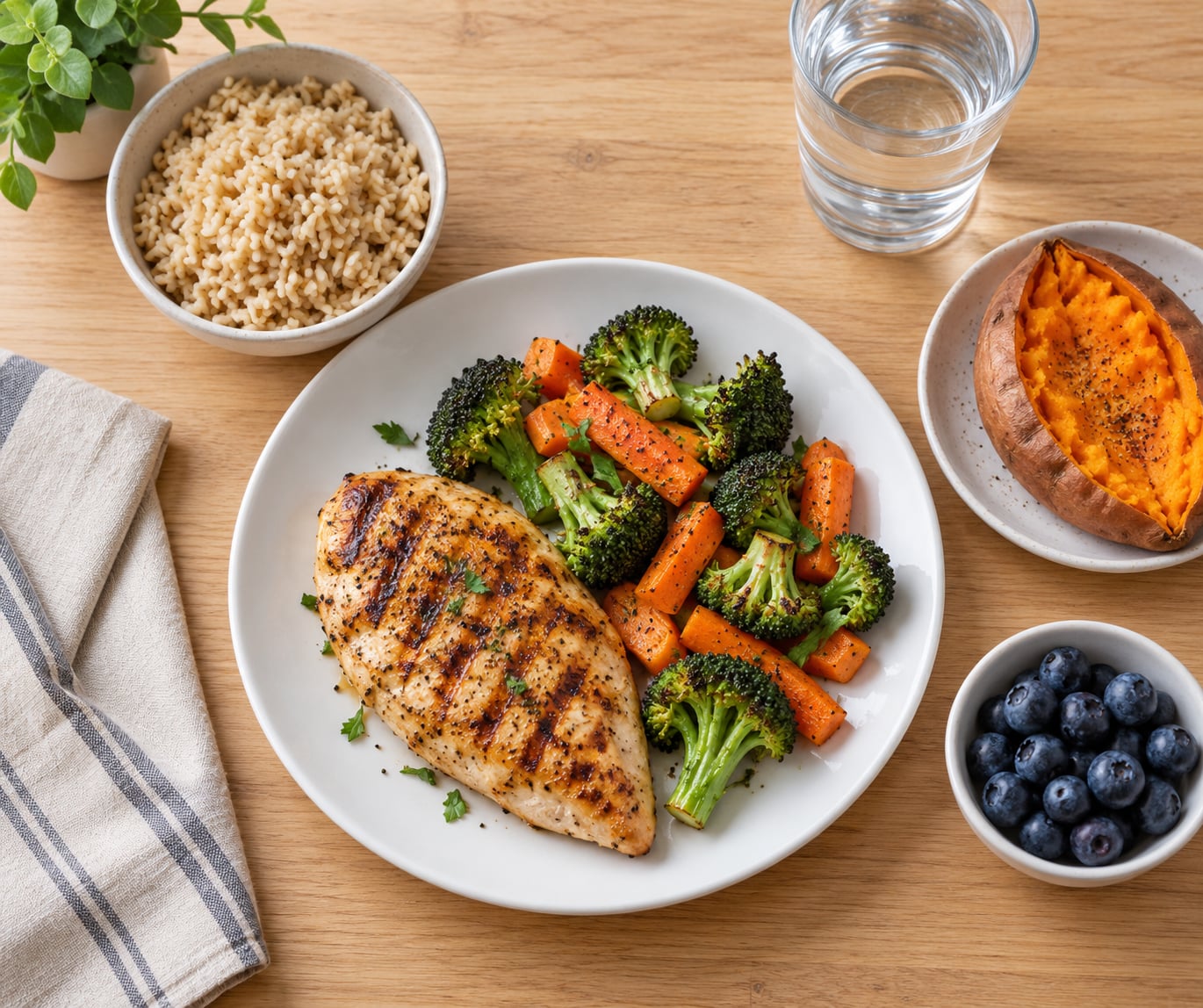
- Lunch: chicken and vegetables with a cup of rice or a baked sweet potato.
- Pre-workout, about two hours out: banana with yoghurt, or a slice of toast with peanut butter.
- Post-workout: within about an hour, a full meal with 30 to 60 grams of carbohydrate plus protein. Pasta, rice, potato or oats all count.
- Dinner: protein and vegetables, with carbohydrate if you are still hungry. If you cut it here after training hard, you will usually be hungry again by 10pm.
Fitting a higher carbohydrate target on a cut is mostly a volume problem, not a timing one. More carbohydrate means more food, so lean on oats, rice, pasta, potatoes, beans and fruit rather than trying to squeeze 200 grams into three small meals. If a low-carb approach feels like a constant burden, equal results usually come from eating more food rather than less.
How Many Carbs Should You Eat for Fat Loss?
There is no universal number, and anyone who gives you one without knowing your weight, your training and your preferences is guessing.
As a rough starting range, plenty of people doing well on a cut sit somewhere around 1.5 to 3 grams per kilogram of body weight per day. Some lifters need more to keep session quality high, and some sedentary people are fine with considerably less. Treat all of these as an experiment rather than a prescription.
Two adjustments matter more than the number itself. Increase carbohydrate when training volume goes up or when you feel flat in the gym, and reduce it when you are consistently overeating on protein and fats. And never drop carbohydrate so low that you cannot sustain the plan, because the plan failing is worse than the target being wrong.
A registered dietitian can turn this into numbers that fit your body and your history. If you want one starting data point before you talk to anyone, track total calories for two weeks and ignore carbohydrate entirely.
Are Low-Carb or Late-Night Carbs Better for Weight Loss?
Neither wins on the evidence, and the reason they appear to win is different in each case.
Low-carb approaches tend to work early because they remove a large, easy-to-overeat food group without asking you to count anything. People are rarely fighting a metabolic edge. They are fighting biscuits. Satiety from fat and protein is high, and cutting out refined carbohydrate usually fixes a real problem fast.
Late-night carbohydrate approaches work for a different reason: they reduce the hunger that causes the 10pm binge. Going carb-free at dinner, losing nothing for a few days, then eating at midnight out of sheer frustration is a pattern a lot of people recognise in themselves. That cycle is the real enemy of fat loss, and eating a moderate dinner with carbohydrate is how you break it.
There is a third pattern worth naming. Plenty of people who drop carbohydrate very low in the evening report restless sleep, and they trade sleep for a deficit they cannot feel yet. Carbohydrate at dinner supports serotonin production, and for some people that is the difference between asleep at 11pm and staring at the ceiling.
Choose based on which pattern describes you. If your problem is evening snacking, do not restrict carbohydrate at night. If your problem is mindless eating of refined carbs all day, a lower-carbohydrate approach across the board may be easier to sustain.
Common Carbs-for-Fat-Loss Timing Mistakes
1. Front-loading everything at breakfast
Packing the entire day’s carbohydrate into one meal leaves the afternoon flat and the evening hungry. Fix: split the carbohydrate across at least three meals and keep one serving near your training.
2. A carbohydrate-heavy lunch, then nothing until bed
You get a big glucose curve, a crash, and then a nine-hour gap that ends at the fridge. Fix: keep lunch moderate, not enormous, and eat a real dinner rather than pushing everything into one meal.
3. Skipping dinner to “save” calories
The saved calories come back late, usually as something less satisfying. This is the mechanism behind most late-night snacking. Fix: eat a smaller dinner with protein, vegetables and a modest carbohydrate serving instead of no dinner.
4. Training fasted, then overeating afterwards
Some people cannot handle food before an early session, and that is fine. What is not fine is arriving home at 8am and eating four times what the session needed. Fix: split the carbohydrate, with a portion before if you can manage it and the rest at the meal after.
5. Chasing the scale after a carb-heavy day
Glycogen holds water, so a high-carb day can add weight that is not fat. Fix: judge the trend across three to four weeks and stop weighing daily if it changes your behaviour.
6. Following a rule so rigid that a bad day ruins the week
“Nothing after 6pm” fails the first time a dinner runs late, and then people eat the whole forbidden category out of frustration. Fix: use a rule with a buffer, like finishing carbohydrate-heavy meals roughly three hours before bed, and treat a late meal as just a late meal.
Frequently Asked Questions
Does not eating after 7pm help lose weight?
Only if it helps you eat less overall. Cutting out food after 7pm works for some people simply because it removes late-night snacking, and for others it backfires into midnight eating. If you reliably sleep eight hours and feel comfortable without a late meal, it is a harmless personal rule. If you lie awake hungry, it is costing you. The best time to eat carbs for fat loss is whenever it fits your actual evening.
When is the best time to eat carbs when working out?
For most people, one to two hours before training with a carbohydrate plus protein meal, then 30 to 60 grams of carbohydrate within about an hour afterwards. Timing matters most when sessions are hard or long, or when you are in a deficit and recovery is already hard. On a light day of walking and mobility work, the window matters much less.
Does eating carbs at night keep you awake?
For most people, a moderate carbohydrate dinner makes sleep easier rather than harder, because carbohydrate supports serotonin production and serotonin is involved in sleep regulation. What keeps people awake is usually a very large late meal, or very low carbohydrate in the evening combined with physical hunger. If you are cutting carbohydrate hard at dinner and sleeping badly, that is a useful clue.
Is 100 carbs a day enough to lose weight?
It depends on your size, your training and the rest of your intake. Around 100 grams covers the brain and basic activity for many smaller, less active people, but it leaves little room for training quality and appetite control in someone lifting regularly. If you are cutting calories and also fighting hunger, adding carbohydrate back in is often what makes the plan sustainable.
What happens after 2 weeks of no carbs?
Most people drop several pounds in the first week, but much of that is water leaving with the glycogen stores rather than fat leaving your body. Energy often dips, training quality drops, sleep can get worse and cravings for carbohydrate get loud. Some people feel excellent on very low carbohydrate, and that is genuinely fine. The problem is doing it without knowing that the scale will mislead you in week one.
Is a no-carb diet good for weight loss?
It works for some people for a simple reason: it removes the easiest food to overeat. Zero carbohydrate is not required for fat loss, though. What matters is a calorie deficit you can hold, enough protein to protect muscle, and food quality that keeps you full. If zero carbohydrate is the only version of the plan you will actually follow, it beats a higher-carbohydrate plan you abandon in three weeks.
A Simple First Step for Fat Loss
Stop tracking the clock and start tracking three meals a day that each contain protein, vegetables and one normal portion of carbohydrate you actually enjoy.
Put the largest portion near your training, keep the rest steady across the day, and leave yourself a buffer of roughly three hours between a carbohydrate-heavy meal and bed. Then give it three or four weeks before you change anything, and judge progress by the trend rather than the daily number.
If you want a second opinion on your own numbers, a registered dietitian is the person for that conversation.