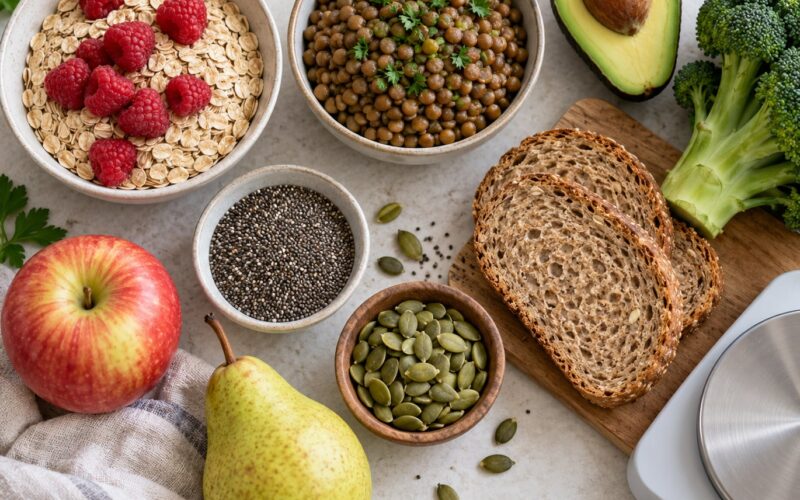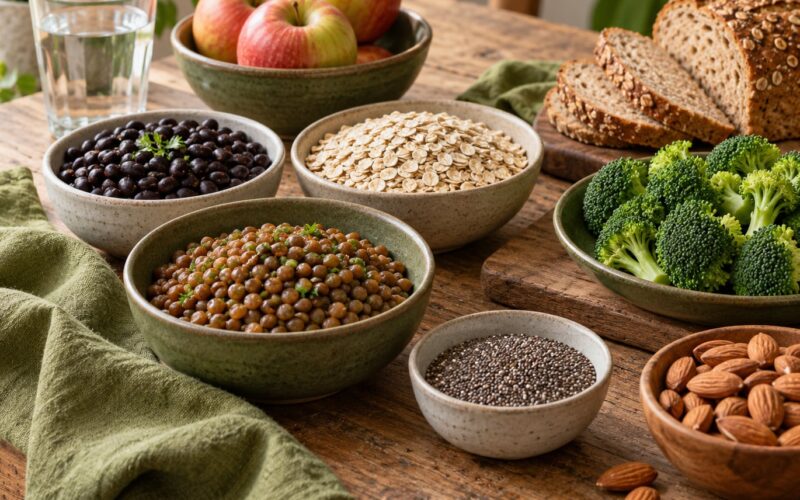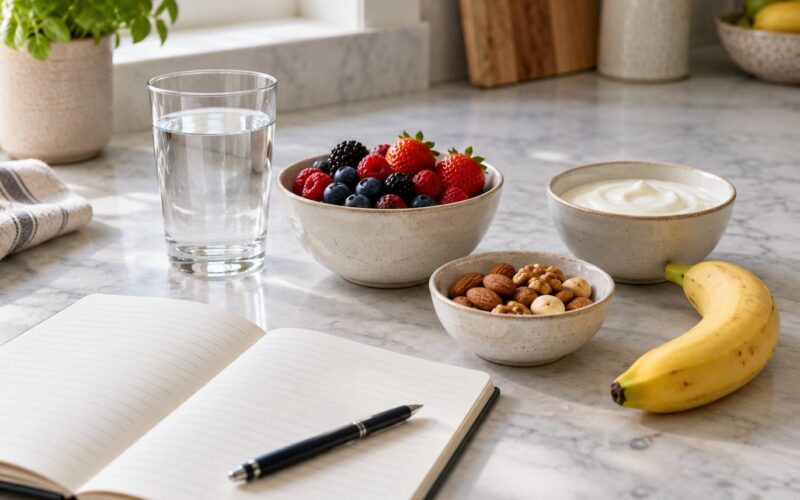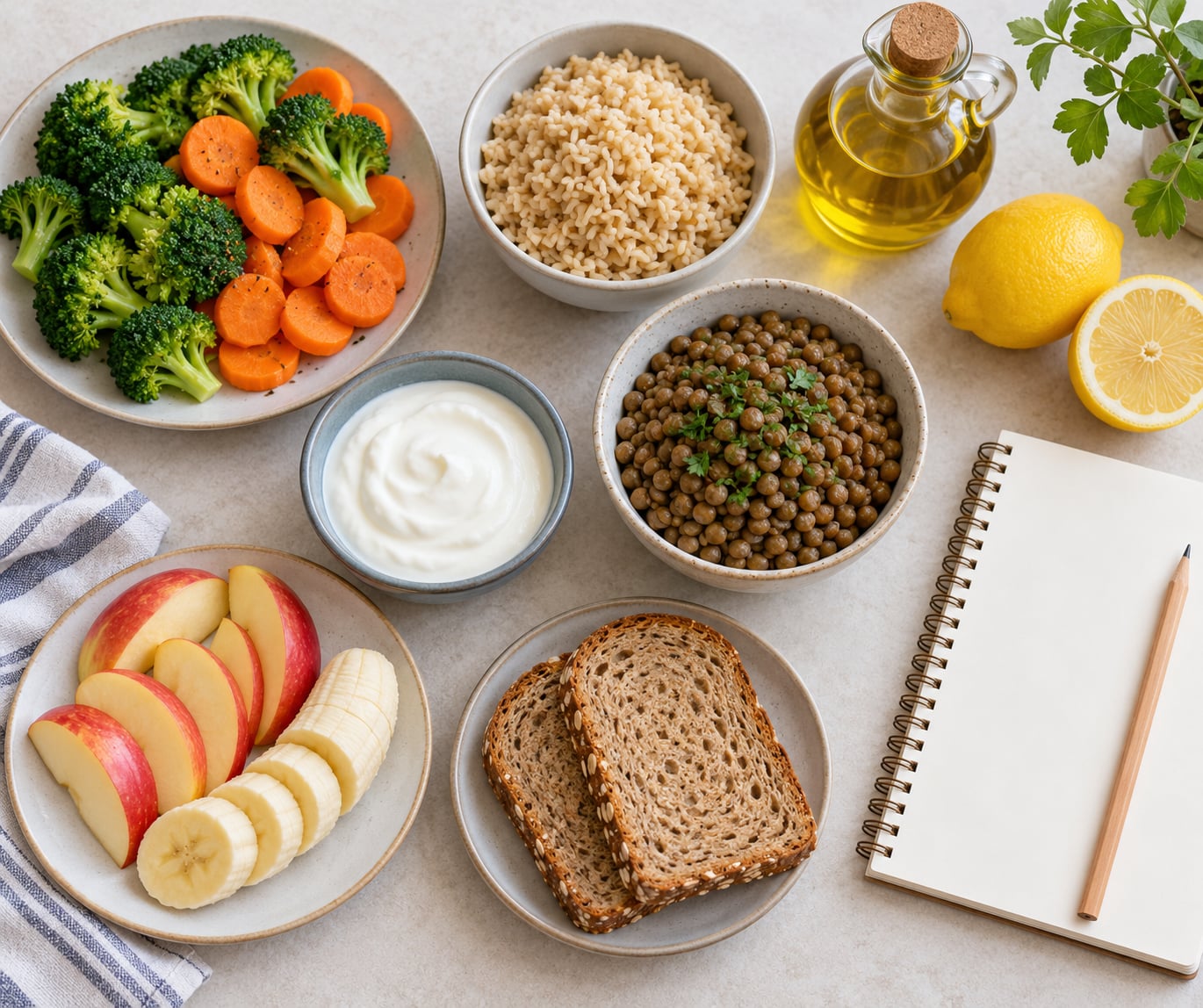
DASH stands for Dietary Approaches to Stop Hypertension, an eating pattern developed in the 1990s by the National Heart, Lung and Blood Institute (NHLBI). It centres on vegetables, fruit, whole grains and low-fat dairy, caps sodium at 2,300 mg a day (1,500 mg in the low-sodium version) and aims for about 4,700 mg of potassium daily. This guide explains what a dash diet meal plan looks like, what a serving actually is, and how to build a week you can keep.
What follows is general nutrition information, not medical advice. If you take blood pressure or diuretic medication, or you have kidney disease, check with your doctor or a registered dietitian before you change what you eat.
Table of Contents
- What Is the DASH Diet?
- How does the DASH diet lower blood pressure?
- Who is DASH for?
- What Does a DASH Diet Meal Plan Include?
- What does a serving size really mean?
- How the servings change at 1,500 and 1,200 calories
- How Do You Follow a DASH Diet Meal Plan?
- Step 1: Set two numbers for the week
- Step 2: Build each meal from the plate method
- Step 3: Choose breakfast, lunch, dinner and one or two snacks
- Step 4: Swap, do not just subtract
- Step 5: Ramp up over four weeks instead of starting cold
- Step 6: Cook once, eat five times
- A 7-Day DASH Diet Meal Plan for Beginners
- What Foods Should You Limit on the DASH Diet?
- How to read a label in under a minute
- Eating out without guessing
- Alcohol and coffee
- How Can You Make a DASH Diet Meal Plan Easier?
- Frequently Asked Questions
- How long does it take for a DASH diet meal plan to lower blood pressure?
- Does the DASH diet help you lose weight?
- Do I have to count calories on the DASH diet?
- Can I eat eggs, peanut butter and Greek yogurt on the DASH diet?
- Do I need to give up dairy to follow DASH?
- Should I talk to my doctor before starting DASH while on medication?
- Conclusion: What to Do First
What Is the DASH Diet?
The DASH diet is an eating pattern, not a diet with a fixed menu or a banned-food list. You keep eating ordinary food; you just shift the balance toward produce, grains and low-fat dairy and away from sodium and saturated fat. Nothing is off limits forever, and there is no special product to buy.
It was designed as a research feeding plan at NHLBI, and the name says exactly what it targets: high blood pressure. Studies behind it found that people following the pattern brought their systolic pressure down within a couple of weeks, often before other habits changed.
How does the DASH diet lower blood pressure?
It works from two directions at once, which is why it outperforms most single-food approaches.
First, less sodium means less fluid volume circulating in the blood, so the pressure inside your vessels drops. Second, the potassium, magnesium and calcium in fruit, vegetables, beans, whole grains and low-fat dairy help blood vessels relax and stay structurally sound.
The combination matters more than either half. Harvard’s guide to the DASH diet describes it this way: sodium reduction lowers fluid volume, while potassium and magnesium relax vessel walls and calcium supports the vessel structure itself.
Who is DASH for?
It suits anyone diagnosed with or at risk of hypertension, and plenty of people use it for reasons that have nothing to do with blood pressure. It is regularly recommended for cholesterol management, blood sugar control and weight management, because the same swaps that trim sodium also cut saturated fat and refined carbohydrate.
It works at 1,200, 1,500 and 2,000 calories, so you are not locked into one intake. It also adapts to vegetarian, vegan, kosher, halal and gluten-free eating with simple swaps.
What Does a DASH Diet Meal Plan Include?
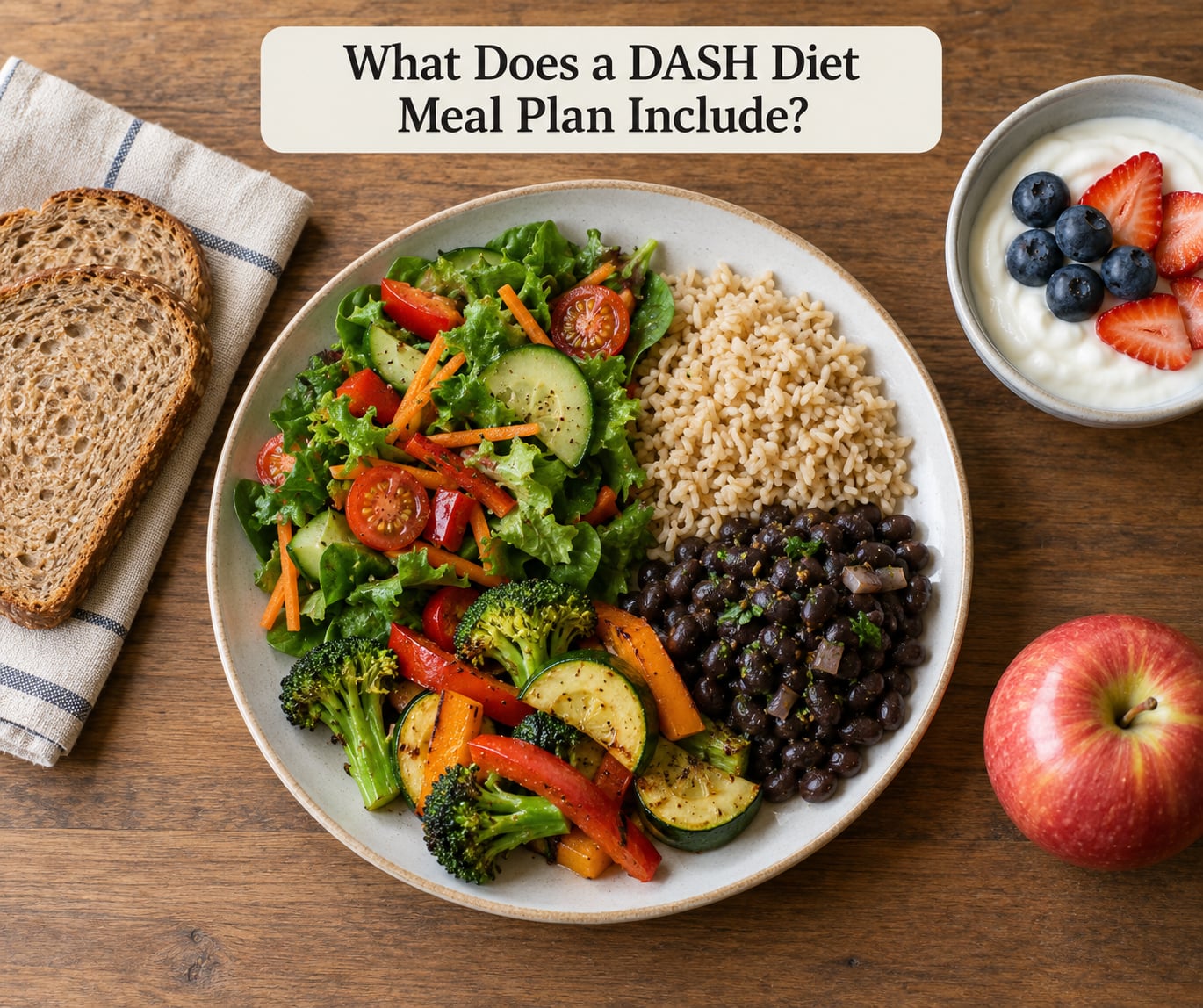
A dash diet meal plan is built around food groups and serving counts rather than a shopping list of named products. The reference numbers below come from the NHLBI 2,000-calorie pattern, which is the version most references are built on.
| Food group | Servings per day at 2,000 calories | What one serving looks like |
|---|---|---|
| Grains | 6 to 8 | 1 slice whole-wheat bread, half a bagel, half a cup of cooked brown rice, quinoa or oatmeal |
| Vegetables | 4 to 5 | 1 cup raw, or half a cup cooked, of broccoli, spinach, carrots, tomatoes or beans |
| Fruit | 4 to 5 | 1 medium apple, orange, banana or pear, half a cup of berries, or a quarter cup of dried fruit |
| Low-fat or fat-free dairy | 2 to 3 | 1 cup of milk or yogurt, or 1.5 ounces of cheese |
| Lean meat, poultry, fish | 6 or fewer ounces | 3 ounces cooked, about the size of a deck of cards |
| Nuts, seeds and legumes | 4 to 5 per week | 1 tablespoon nuts or seeds, 2 tablespoons peanut butter, or half a cup cooked beans |
| Fats and oils | 2 to 3 | 1 tablespoon olive or canola oil, or 2 tablespoons light salad dressing |
| Sweets and added sugars | 5 or fewer per week | 1 small piece of cake, one scoop of ice cream, or 1 tablespoon sugar or jam |
Vegetables and fruit carry the highest serving counts, and that is not an accident. They are the lowest-sodium, highest-fibre foods in the pattern, so they fill the plate while doing the most work.
What does a serving size really mean?
A serving is a household measure, not a weight you have to weigh out every morning. Half a cup of cooked rice, one slice of bread, one medium fruit. If you cook for a household, measure once at the start of the week and eyeball it after that.
Restaurant portions run roughly two to three times a home serving. That gap surprises people more than anything else on this list, which is why portion awareness matters as much as food choice.
How the servings change at 1,500 and 1,200 calories
Same foods, fewer of them. Most of the cut comes from grains, fats and dairy, while the vegetable and fruit counts stay close to the 2,000-calorie version.
| Food group | 1,200 calories | 1,500 calories | 2,000 calories |
|---|---|---|---|
| Grains | 4 to 5 | 5 to 6 | 6 to 8 |
| Vegetables | 2 to 3 | 3 to 4 | 4 to 5 |
| Fruit | 2 to 3 | 3 to 4 | 4 to 5 |
| Low-fat or fat-free dairy | 2 to 3 | 2 to 3 | 2 to 3 |
| Lean meat, poultry, fish | 3 ounces or fewer | 4 to 5 ounces | 6 ounces or fewer |
| Nuts, seeds and legumes | 3 per week | 4 per week | 4 to 5 per week |
| Fats and oils | 2 | 2 to 3 | 2 to 3 |
| Sweets and added sugars | 3 or fewer per week | 4 or fewer per week | 5 or fewer per week |
Choosing the right column matters. Someone who needs 1,200 calories following a 2,000-calorie serving chart is eating roughly a third more than they should, and will wonder why nothing is happening.
How Do You Follow a DASH Diet Meal Plan?
Plan three things, not thirty. The pattern works because it repeats, so the goal is a repeatable template you can fill in with whatever is in the fridge.
Step 1: Set two numbers for the week
Pick your calorie column from the table above, then pick a sodium target: 2,300 mg a day for the standard pattern, or 1,500 mg for the low-sodium version. Write both on the fridge. Numbers that are not written down get forgotten by Thursday.
Step 2: Build each meal from the plate method
Half the plate vegetables, a quarter whole grains, a quarter lean protein, fruit or low-fat dairy alongside. That ratio does the sodium work for you, because the biggest plate is the one that costs the least.
Keep meat to six ounces or less a day and cook it without brining, curing or rubbing in salt. Skip the salt shaker at the table entirely; that single habit carries a surprising share of the daily total.
Step 3: Choose breakfast, lunch, dinner and one or two snacks
Oats with fruit and low-fat milk, whole-grain toast with peanut butter, a bean bowl over brown rice, or yogurt with berries all fit without thinking about it. Snacks exist so nobody raids the cupboard at 9pm.
Breakfast is where most people quietly load up on sodium, so it deserves the same attention as dinner. Cereal, yogurt, oatmeal and fresh fruit win over the usual pastry-and-coffee pattern.
Step 4: Swap, do not just subtract
Removing salt without replacing it is how people quit in week two. Garlic, onion, lemon, vinegar, smoked paprika, cumin, chili flakes, fresh dill, basil, cinnamon and unsalted citrus peel do more work than people expect.
One reader on r/Cooking credited the biggest change in their readings not to any specific food, but to cooking at home instead of eating out. The swap, not the deprivation, is the part that held.
Step 5: Ramp up over four weeks instead of starting cold
If you currently eat one meal a day or eat out for half your meals, jumping straight into three meals plus snacks feels like a cliff. A slower ramp works better for most beginners.
- Week 1, sodium only. Change nothing else. Drop the salt shaker, stop buying the three highest-sodium items in your basket, and read labels on what you already buy. Keep your meal structure exactly as it is.
- Week 2, add one vegetable. Introduce a vegetable at one meal a day, and swap one refined grain for a whole grain.
- Week 3, work on breakfast and dairy. Move breakfast to oats, whole-grain toast or yogurt, and add one low-fat dairy serving if you have none.
- Week 4, assemble the plate. Now shift lunch and dinner to the half-vegetables method, and plan your snacks for the week.
That order follows what people on r/bloodpressure asked for: a plan that builds up, where month one only tackles the thing that matters most. Changing sodium first, while your other habits stay as they are, is far more likely to stick.
Step 6: Cook once, eat five times
Sunday batch cooking is the difference between following DASH on a Wednesday and abandoning it. Cook a pot of lentils, a tray of roasted vegetables, a batch of brown rice and a hard-boiled egg tray. Assemble from those through the week.
Roast vegetables with oil, garlic and pepper instead of salt. A roasted tray of carrots, broccoli and sweet potato will do more for your week than any single recipe.
A 7-Day DASH Diet Meal Plan for Beginners
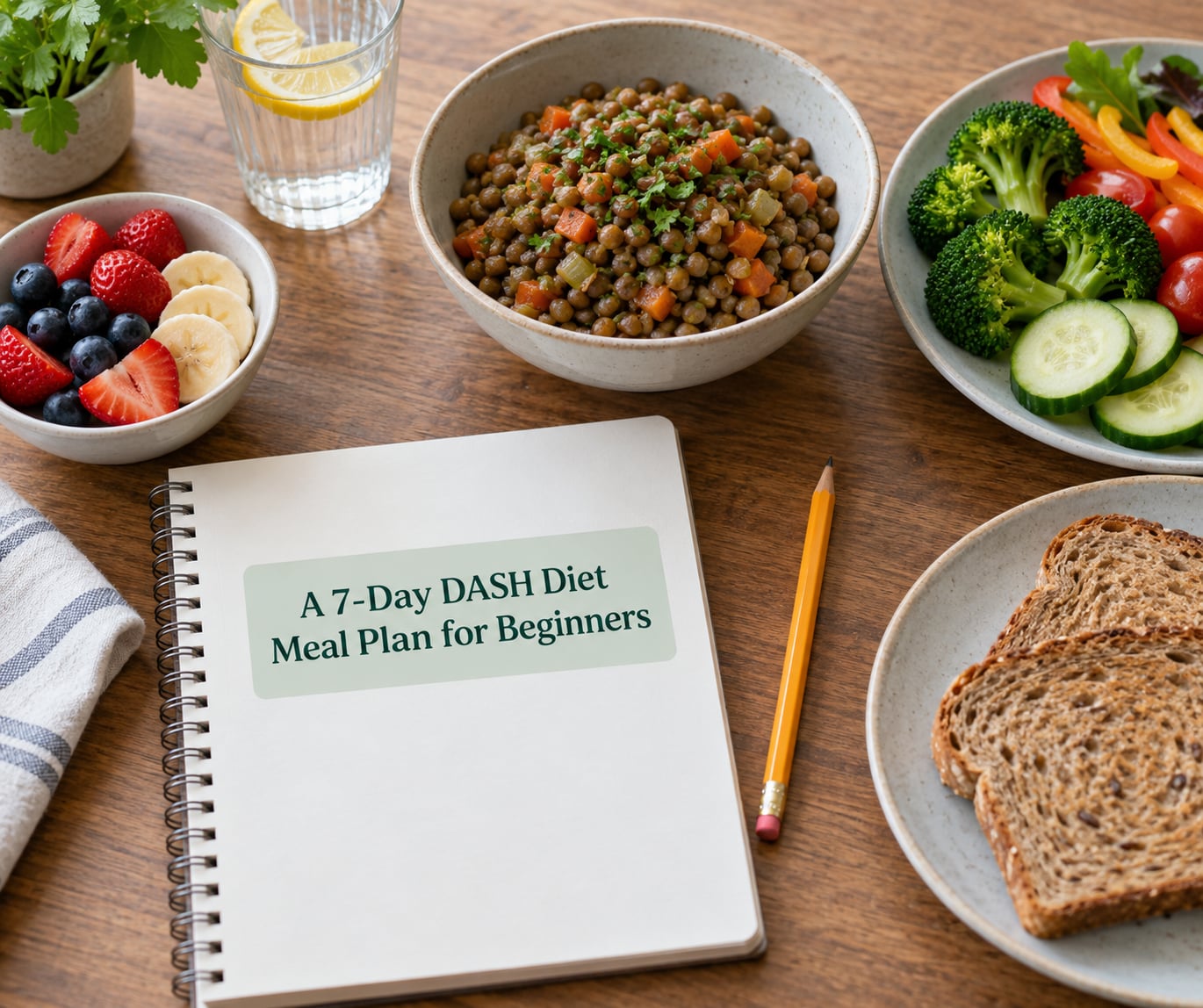
Here is a full week on the page, because the printable versions most sites offer are worth exactly what they cost. Treat it as a template, not a test. If you hate fish, swap it for beans; if mornings are not your thing, move breakfast to lunch.
| Day | Breakfast | Lunch | Dinner | Snack |
|---|---|---|---|---|
| Day 1 | Oatmeal with berries and low-fat milk | Whole-grain turkey and vegetable sandwich with apple slices | Baked salmon with roasted broccoli and brown rice | Plain Greek yogurt with a handful of unsalted almonds |
| Day 2 | Low-fat milk with unsweetened whole-grain cereal and a banana | Brown rice bowl with black beans, corn, diced tomatoes and salsa | Chicken breast roasted with lemon, served with quinoa and green beans | Two wholegrain crackers with peanut butter |
| Day 3 | Scrambled egg with spinach and tomato, one slice whole-grain toast | Lentil soup with carrots and a small whole-grain roll | Baked cod or tilapia with mashed sweet potato and broccoli | An apple with 1 tablespoon unsalted walnuts |
| Day 4 | Greek yogurt with strawberries and a teaspoon of chia seeds | Chicken salad on whole-grain bread with mixed greens and mustard dressing | Lean beef stir-fry with peppers and onions over brown rice, sauce on the side | Low-fat cottage cheese with cucumber slices |
| Day 5 | Whole-grain toast with peanut butter and a sliced pear | Chickpea and cucumber salad with olive oil and lemon, whole-grain pita | Turkey meatballs in homemade tomato sauce with whole-wheat pasta and a salad | Unsalted popcorn with a small handful of dry roasted chickpeas |
| Day 6 | Overnight oats with low-fat milk, diced apple and cinnamon | Tuna salad on lettuce with a side of grapes and a handful of walnuts | Vegetable and white bean stew with a slice of whole-grain bread | Plain low-fat yogurt with a small handful of blueberries |
| Day 7 | Vegetable omelette with mushrooms and peppers, one slice whole-grain toast | Roasted vegetable and chickpea bowl with tahini-lemon dressing | Baked chicken thighs with garlic, served with barley and roasted carrots | Frozen unsalted edamame with a small cup of fruit |
Every breakfast here is under 400 calories and every lunch is a leftovers-friendly assembly job. Most of these meals take under 30 minutes, and all of them reheat well.
One reality check worth knowing: a single restaurant entrée can carry more sodium than the entire 2,300 mg daily target. Before you measure anything else, treat restaurant meals as a known variable rather than a failure of willpower.
What Foods Should You Limit on the DASH Diet?
Limit, not forbid. The pattern works because it is sustainable, and a rigid version of it is the version people abandon in a month.
The four categories that cause the most trouble are cured and processed meats, packaged soups and broths, instant noodles and boxed mixes, and bottled sauces and condiments. Each one delivers a large share of a day’s sodium before any other food is added.
Also worth pulling back on are frozen dinners, cured cheeses, salty snacks like chips and salted nuts, canned soups, fatty cuts of red meat, coconut and palm oils, and pastries, candy and sugary drinks.
Full-fat dairy is a limit too, not a ban. Swapping whole milk for low-fat usually makes no difference to the eating pattern, but the saturated fat adds up when the daily total is already high.
How to read a label in under a minute
Check three things: the serving size (a company can choose a small one), the milligrams of sodium per serving, and how many servings are in the container. Multiply before you put anything in your basket.
Keep a simple rule of thumb: if a single serving carries more than 5 percent of the daily value for sodium, it is a big source. Products that label salt rather than sodium are using the older metric; 2,400 mg of salt works out to about 1,000 mg of sodium.
Eating out without guessing
Ask for sauces and dressings on the side and use them sparingly. Order grilled or baked rather than fried, skip anything that is smoked, cured or pickled, and skip the soup and bread to start, since both are salt carriers.
Most places will leave seasoning off a dish if you ask. Cleveland Clinic’s practical advice is to go ahead and request it, then season at the table with the herb blends you already own.
Alcohol and coffee
Alcohol adds calories and raises blood pressure, so the pattern limits it. The American Heart Association’s guidance for people who drink is up to two drinks a day for men and one for women. Coffee fits fine in moderation, and it does not need to be given up.
How Can You Make a DASH Diet Meal Plan Easier?
Flavour first. Bland food is the most common reason people quit in week two, and it is a cooking problem rather than a willpower problem. Toasted spices, fresh lemon, a splash of vinegar at the end of a pot of beans, and plenty of garlic fix most of it.
Shop your own pantry. The staples that carry a DASH week are dried lentils and beans, canned tomatoes with no added salt, brown rice, oats, frozen vegetables, frozen fish, plain low-fat yogurt, fresh lemons and limes, and a decent olive oil. Buy frozen vegetables more often than you think you should. They are picked and frozen at peak, and they cost less with no waste.
Plan snacks like meals. Two set snacks a day removes the worst decision of the evening: standing at an open cupboard with nothing decided.
Use a low-fat dairy swap where you expect a taste difference, and a small plate where you do not. Portion control is doing more work than most beginners expect, because restaurant and package serving sizes run well above the DASH reference.
If money is tight, the cheapest proteins in this plan are dried beans, lentils, eggs and canned fish packed in water. Skip the pricier nut butter and let plain yogurt, oats and frozen vegetables carry the meals.
Track what you actually eat for a week before you track anything else. A food diary is the fastest way to find the hidden sodium, and it is more useful than a blood pressure number that has not moved yet.
Finally, let it be imperfect. One salty lunch does not undo six good ones, and the people who succeed long term on DASH are the ones who treat a bad meal as one meal rather than evidence that the plan failed.
Frequently Asked Questions
How long does it take for a DASH diet meal plan to lower blood pressure?
Most people following a DASH eating pattern see changes in systolic pressure within one to two weeks, according to the research behind the plan. Some people notice it earlier within that window, others take longer. Keep measuring at the same time each day, under the same conditions, and take any change to your doctor rather than adjusting medication yourself.
Does the DASH diet help you lose weight?
It can, but it is not a weight-loss diet and it does not require calorie counting. DASH meals are built on vegetables, whole grains and lean protein, which are filling, and they push down sodium and saturated fat compared with a typical diet. Weight change tends to follow naturally for people who improve portion sizes and cut back on heavily processed food. A registered dietitian can help you adjust portions if weight is your main goal.
Do I have to count calories on the DASH diet?
No. The plan works on servings per food group rather than calories, which is one of the reasons people find it manageable. You do need to pick a calorie column though, since the 1,200, 1,500 and 2,000 versions have different serving counts for grains, fats and dairy. If you are not sure which fits you, ask your doctor or a registered dietitian before you start.
Can I eat eggs, peanut butter and Greek yogurt on the DASH diet?
All three fit. Eggs count toward the six-ounce daily limit for lean meat, poultry and fish, and they are useful for a quick breakfast with vegetables and whole-grain toast. Peanut butter counts as a serving of nuts, seeds and legumes, at about two tablespoons. Plain Greek yogurt counts as a serving of low-fat dairy. Choose unsalted nut butter and low-sodium versions, and add fruit or vegetables alongside.
Do I need to give up dairy to follow DASH?
No, and dairy is one of the foods the plan actively encourages. Low-fat or fat-free milk, yogurt and cheese appear at two to three servings a day, and the calcium in them is part of how the pattern supports blood vessel health. If you are lactose intolerant, lactose-free milk, soy milk and hard cheeses work the same way. Switching from whole to low-fat dairy is the adjustment the pattern asks for.
Should I talk to my doctor before starting DASH while on medication?
Yes, if you take blood pressure or diuretic medication, or if you have kidney disease. A significant drop in blood pressure combined with a medication change can leave you lightheaded, and your doctor may want to adjust the dose as your readings change. Kidney disease also changes how potassium should be handled, since the plan aims for about 4,700 mg a day. Bring this plan to your appointment rather than starting it on your own.
Conclusion: What to Do First
If you take one thing from this dash diet meal plan explained guide, make it the first week: keep your meal structure exactly as it is and change only the sodium. Drop the salt shaker, leave the three highest-sodium items in your basket, and read labels on what you already buy. That one change carries more of the pattern than most beginners expect.
After that, add one vegetable to a meal a day, then move breakfast to oats, whole grains or yogurt, then start assembling lunch and dinner around the half-vegetables plate. The serving table above and the seven-day menu are there to be adapted, not obeyed.
If you are managing high blood pressure, cholesterol, blood sugar or weight, and especially if you take medication, bring this to your doctor or a registered dietitian before you change your eating. They can help you pick the right calorie column and adjust for anything your health history requires.