You can tell intermittent fasting is working when, after a two to four week adjustment period, hunger becomes easier to control, cravings between meals fade, your energy holds steady through the afternoon, and your waist measurement or clothing fit drifts gradually smaller. Scale weight is the least useful signal in that list, especially in the first month.
Most people who quit fasting did not quit because it failed. They quit in week three, felt tired and hungry, stepped on a scale that had not moved, and assumed the whole thing was a dead end. That combination of early water weight, normal adaptation symptoms and an impatient measure is the single most common reason beginners walk away from a routine that would have worked for them.
This guide covers the eight signs that intermittent fasting is working, what changes in the first few weeks, how to track progress without the scale, and what to do when it clearly is not working. If you want the short version, the next section is the whole thing on one screen.
Table of Contents
- How to Know If Intermittent Fasting Is Working: Quick Guide
- What Does Intermittent Fasting Do in the First Few Weeks?
- Which Signs Show That Intermittent Fasting Is Working?
- Hunger becomes easier to handle
- Cravings between meals drop
- Energy holds steady through the afternoon
- Digestion settles down
- Sleep improves
- Meals need less planning
- The routine becomes automatic
- Measurements change gradually
- How Do You Track Progress Without Obsessing Over the Scale?
- What Is a Healthy Rate of Progress?
- What Are the Signs That Intermittent Fasting Is Not Working for You?
- How Can You Adjust Your Intermittent Fasting Routine Safely?
- Frequently Asked Questions
- How long will it take to see results from intermittent fasting?
- What are the signs that intermittent fasting isn’t working?
- Why is 16 hours the magic number for fasting?
- What are common mistakes with 16:8 fasting?
- Does fasting from 7pm to 7am work?
- Should I weigh myself every day when intermittent fasting?
How to Know If Intermittent Fasting Is Working: Quick Guide
Four things tell you fasting is working: a more manageable appetite, fewer between-meal cravings, steadier energy, and slow but real change in your measurements. They usually arrive together somewhere between week two and week six, and the first three show up before any change in body composition does.
Think of the early period as two separate stages. Weeks one and two are adaptation, where hunger and tiredness are normal and measurements often move oddly. From roughly week four onward, the metabolic adaptation is done and progress becomes easier to read, which is the point most plateau articles miss.
| Signal | Weeks 1 to 3 | Week 4 onward |
|---|---|---|
| Hunger | Loud, with strong swings around your usual meal times | Present but easy to postpone without thinking about it |
| Cravings | Triggered by boredom, smell and low sleep | Fewer episodes, and they pass without a snack |
| Energy | Afternoon dip or a first-week headache | Flat and predictable through the fasting window |
| Digestion | Possible bloating while you adjust water and fiber intake | Settles, especially by the second meal |
| Measurements | Flat or noisy, sometimes up a pound or two | Waist and clothing fit trend down slowly |
Read those rows together rather than separately. One good week on the scale during a bad month of sleep means very little, and one rough day of hunger in week one says almost nothing about month three.
What Does Intermittent Fasting Do in the First Few Weeks?
Fasting changes two things in the first month: how your body accesses fuel, and how much food you end up eating. The first is the mechanism, the second is the result most people actually notice.
While you eat, your body stores the meal’s carbohydrate as glycogen in liver and muscle, with insulin rising to move glucose into cells. As those stores run down over roughly 12 to 36 hours, insulin falls and your body increasingly burns stored fat for fuel. That transition is usually called the metabolic switch, and it is a gradual shift rather than a light switch. It is also not the only thing that matters, which is why 16 hours is not a magic number.
The second effect is simpler. A shorter eating window removes opportunities to graze. Most people who report the best results are not eating dramatically less food by design, they are just eating the same meals in a narrower box, and calorie counting paired with fasting gives the most consistent losses.
| Time period | What usually happens | How to read it |
|---|---|---|
| Week 1 to 2 | Rising hunger, possible headache, water balance shifting, digestion adjusting | Normal adaptation, not failure |
| Week 3 to 4 | Hunger waves become shorter, energy steadies, cravings depend more on context | The first signs intermittent fasting is working |
| Week 5 to 8 | Waist and clothing fit begin to change even when the scale is slow | Fat loss becoming visible |
| Week 8 and beyond | A plateau often arrives, commonly after losing 5 to 10 percent of body weight | Normal, and often worth a routine change rather than a restart |
The overnight drop that confuses people belongs here too. Someone who fasts for two days after a strict ten days can wake up three or four pounds lighter without burning that much fat. A liter of glycogen holds water with it, and losing that water shows up on the scale immediately. When it comes back with your next meal or your next cycle of salty food, it looks like the fast failed. It did not.
Your protocol also shifts the clock. A 16:8 window is a gentle introduction. An 18:6 or OMAD schedule compresses eating into fewer hours and often produces faster adaptation, and a 5:2 plan spreads the effect across two short days rather than every day, so progress looks different week to week. Fasting from 7pm to 7am follows the same pattern as 16:8, and it works well for people who hate a morning routine.
Which Signs Show That Intermittent Fasting Is Working?
These are the eight signs I would actually use, roughly in the order they tend to appear. None of them is the scale.
Hunger becomes easier to handle
The clearest early sign is that hunger stops running your day. You notice it, you decide to eat later, and you carry on with what you were doing. Early on, hunger is a countdown clock that drives every other decision of the morning, so the change is obvious once it starts.
Cravings between meals drop
Most beginners describe the same pattern: they stop thinking constantly about food. Snacking at the desk or standing at the fridge with nothing planned tends to fade first, and a craving that passes in a few minutes instead of ending in a biscuit is a good marker.
Energy holds steady through the afternoon
The three o’clock crash that used to send you to the vending machine either softens or disappears. You may also notice steadier mood, which for a lot of people is the more obvious benefit. A short dip in the first week is common and usually passes.
Digestion settles down
Less bloating, more regular bowel movements, less reflux after meals. These changes often arrive before any weight moves, and they are among the least discussed benefits because they are not visible to anyone else.
Sleep improves
Falling asleep faster, fewer wake-ups in the night, and waking without that foggy first ten minutes. Eating earlier in the day is often the reason, and recent studies on time-restricted eating have found improved sleep quality, though researchers note the effect is not guaranteed for everyone.
Meals need less planning
Two or three meals a day starts to feel normal rather than restrictive, and you spend less mental energy on food. This is a sign of the new default holding, which matters more than how strict any given day was.
The routine becomes automatic
You stop negotiating with yourself at 7pm. Skipping a late dinner stops feeling like a test you might fail, and social meals get easier because they fit inside your window without needing a decision.
Measurements change gradually
Waist circumference at the navel, the way your jeans sit, a before and after photo in the same lighting. Muscle gain can hide fat loss on the scale while waist inches still come off, particularly if you started lifting, which is why the tape matters as much as the number.
How Do You Track Progress Without Obsessing Over the Scale?
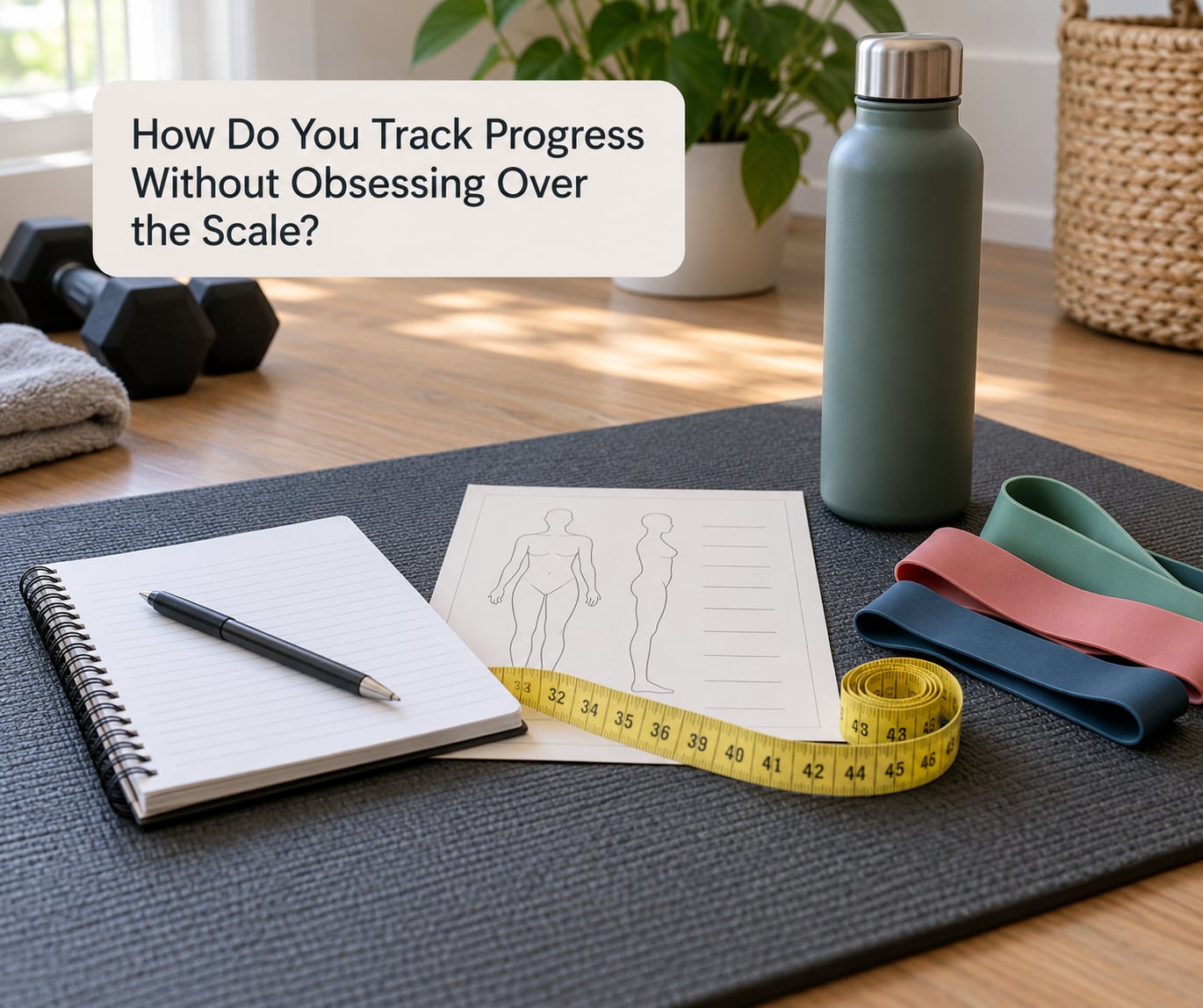
Set a baseline before you change anything, then check on a schedule and stop looking in between. The baseline should record more than a number: your waist, your usual clothing size, a photo, and honestly, how your energy and sleep are.
Conditions matter more than people expect. Weigh at the same time of day, ideally in the morning, on a similar day of the week, and treat the numbers as a set of data points rather than daily verdicts. Two or three weigh-ins a week is plenty, and looking up fewer times than that may suit you better.
| Method | What it tells you | How often |
|---|---|---|
| Waist circumference | Central fat change, often before scale change | Every 2 weeks |
| Progress photos | Posture, definition, changes you stop noticing daily | Every 4 weeks |
| Clothing fit | The most honest non-scale marker there is | Continuous |
| Strength and endurance log | Whether you are keeping muscle while losing fat | Every session |
| Energy, hunger, sleep notes | The signs that show up long before measurements do | Weekly, 1 to 5 scale |
| Blood pressure, resting heart rate | Fitness changes you cannot feel | Monthly at home |
| Blood work | Objective change in glucose, HbA1c, triglycerides, LDL | With your doctor, 2 to 3 times a year |
Lab work is the honest test when everything else feels ambiguous. Ask your doctor about fasting blood glucose, HbA1c, triglycerides and LDL, and add blood pressure and resting heart rate if you do not already track them. Improving numbers matter more for your health than any weight change, even when the scale is being difficult.
Meters and smart scales are optional. A ketone or breath meter tells you whether you are in a fasted or fat-burning state on a given morning, which is interesting once and rarely useful afterwards, because it measures a single day rather than your trend.
What Is a Healthy Rate of Progress?
One to two pounds, or roughly 0.5 to 1 kilogram, per week is the range most mainstream guidance describes as gradual and sustainable. Whether you sit at the bottom, the middle or above it says little on its own, because age, starting weight, activity, sleep, stress and the size of your calorie deficit all move the pace.
Expect the rate to be uneven rather than steady. A quiet two weeks followed by a fast fortnight is normal, and so is a strong week followed by nothing at all. What you are looking for is a downward trend across a month or six weeks, not a weekly line.
Plateaus usually show up after you have lost around 5 to 10 percent of your starting weight, and they often run four to eight weeks. A plateau is not proof that fasting stopped working. It usually means your calorie needs have shifted with your smaller body, or that your intake has drifted up, and it is a good moment to check your food quality before touching your fasting window.
What Are the Signs That Intermittent Fasting Is Not Working for You?
These are the signals that should make you reassess rather than push through. Persistent hunger that stays high even after the adjustment period, energy that gets worse rather than steadier, sleep you did not have before, training performance dropping week after week, constipation, or a cycle of restricting hard and then overeating.
Also worth naming: no meaningful trend in any measurement after eight to twelve consistent weeks. That usually points at what you eat inside the window rather than the length of the fast, because a compressed eating window still delivers the same calories if you fill it with the same food.
Some people should not fast at all without medical supervision. That includes anyone who is pregnant or breastfeeding, is underweight, has a history of disordered eating, has type 1 diabetes, or takes diabetes medication that needs to be taken with food. Fasting can be risky with a history of disordered eating, and Johns Hopkins Medicine advises checking with a doctor first if you take any medication or have a chronic condition.
Stop and contact a doctor or a registered dietitian if fasting brings on fainting, dizziness, persistent headaches, palpitations, hair thinning, feeling cold all the time, or any rapid weight change you did not intend. If someone is pregnant or has diabetes, they should talk to a clinician before changing when or how much they eat.
How Can You Adjust Your Intermittent Fasting Routine Safely?
If the signs are mixed, work through these in order rather than immediately extending your fast. The eating window matters more than the fasting window, and most people who need a change need a food change.
Start by auditing what you eat inside the window. A typical problem is a small eating window packed with sugary drinks, pastries, and refined carbs, which produces the energy spikes and crashes that get blamed on fasting. Prioritize protein, fiber and vegetables, and make sure you are eating enough overall rather than cutting too hard.
Next, look at timing. Moving your main meal earlier in the day helps some people and does nothing for others, and researchers at Mass General Brigham and elsewhere have found that earlier eating windows can improve insulin sensitivity and insulin levels in some adults.
Only then consider changing the window itself, and shorten before you lengthen. Dropping from 16:8 to 14:10 for a couple of weeks is gentler than pushing to 20 hours, and most beginners who failed on 16 hours are not ready for a longer fast. Treat movement as a separate lever too: keep resistance training, and avoid your hardest sessions on your lowest-energy days. Recent reviews also note that fasting after evening exercise may blunt muscle-building benefits, so move training to earlier in the day if you can.
Finally, get individual guidance if anything feels off. A registered dietitian or a doctor can look at your medications, your history and your blood work, and adjust the plan safely. That conversation is worth having before you start, not only after something goes wrong.
Frequently Asked Questions
How long will it take to see results from intermittent fasting?
Most people need two to four weeks to get past hunger, cravings and tiredness, and weight and measurement changes usually show up between week four and week eight. Community timelines in r/intermittentfasting cluster in that same range, with visible change most often reported around week four to eight. Ten pounds in two weeks is not a realistic or safe expectation for most people. Anyone who has not seen any change after twelve consistent weeks should reassess food quality inside the window.
What are the signs that intermittent fasting isn’t working?
The signs it is not working are persistent hunger, energy that gets worse instead of steadier, broken sleep, weaker workouts, constipation, or binge-restrict cycles. A flat scale with no change in waist or clothing after eight to twelve consistent weeks is a strong signal too. Those signs point at what you eat inside the eating window far more often than at the length of the fast. Fainting, dizziness, palpitations or unintended rapid weight change mean stop and call a doctor.
Why is 16 hours the magic number for fasting?
It is not a magic number, and the research is fairly clear about that. What matters is reaching a point where glycogen stores are drawn down and insulin levels fall, which many adults reach somewhere between 12 and 36 hours. Studies comparing 16:8 with 14:10 and 18:6 windows often find similar weight results. Shorter windows are easier to sustain, so starting at 14:10 and extending later works better for most beginners than forcing 16 hours from day one.
What are common mistakes with 16:8 fasting?
The most common mistakes are filling the eating window with high-sugar drinks and pastries, eating too few calories overall, skipping protein and fiber, and treating coffee with cream or a snack as part of the fast. Another big one is skipping water and electrolytes early on, which is why some people feel drained in week one. Moving your only meal to the evening, poor sleep and high stress also blunt results. Fix the food inside the window before you lengthen the fast.
Does fasting from 7pm to 7am work?
Yes, that is simply 16 hours of fasting with an eight-hour eating window between 7am and 7pm. It suits people who find a morning routine hard and prefer to eat earlier in the day, and it lines up with research suggesting earlier eating windows can improve insulin sensitivity. Some people feel lightheaded if they train first thing, so move demanding sessions to later or eat a little earlier. The overnight fast also skips late-night snacking, which helps many people.
Should I weigh myself every day when intermittent fasting?
Daily weighing is not required, and for some people it makes the plateaus that come with fasting much harder to ride out. Checking two or three mornings a week under consistent conditions gives you enough data to see a trend without reacting to water swings. If you do weigh daily, use a weekly average rather than any single number. Waist circumference every two weeks and progress photos every four weeks are more informative for fat loss than daily scale readings.
Start by measuring your waist and taking one photo before you change anything, then give the routine four consistent weeks and judge it on appetite, cravings and energy before the scale. If those three are improving, you are already on the right path even if the number has not moved yet. If they are not, change what you eat inside the window before you change how long you fast, and talk to a doctor or registered dietitian if anything feels wrong.