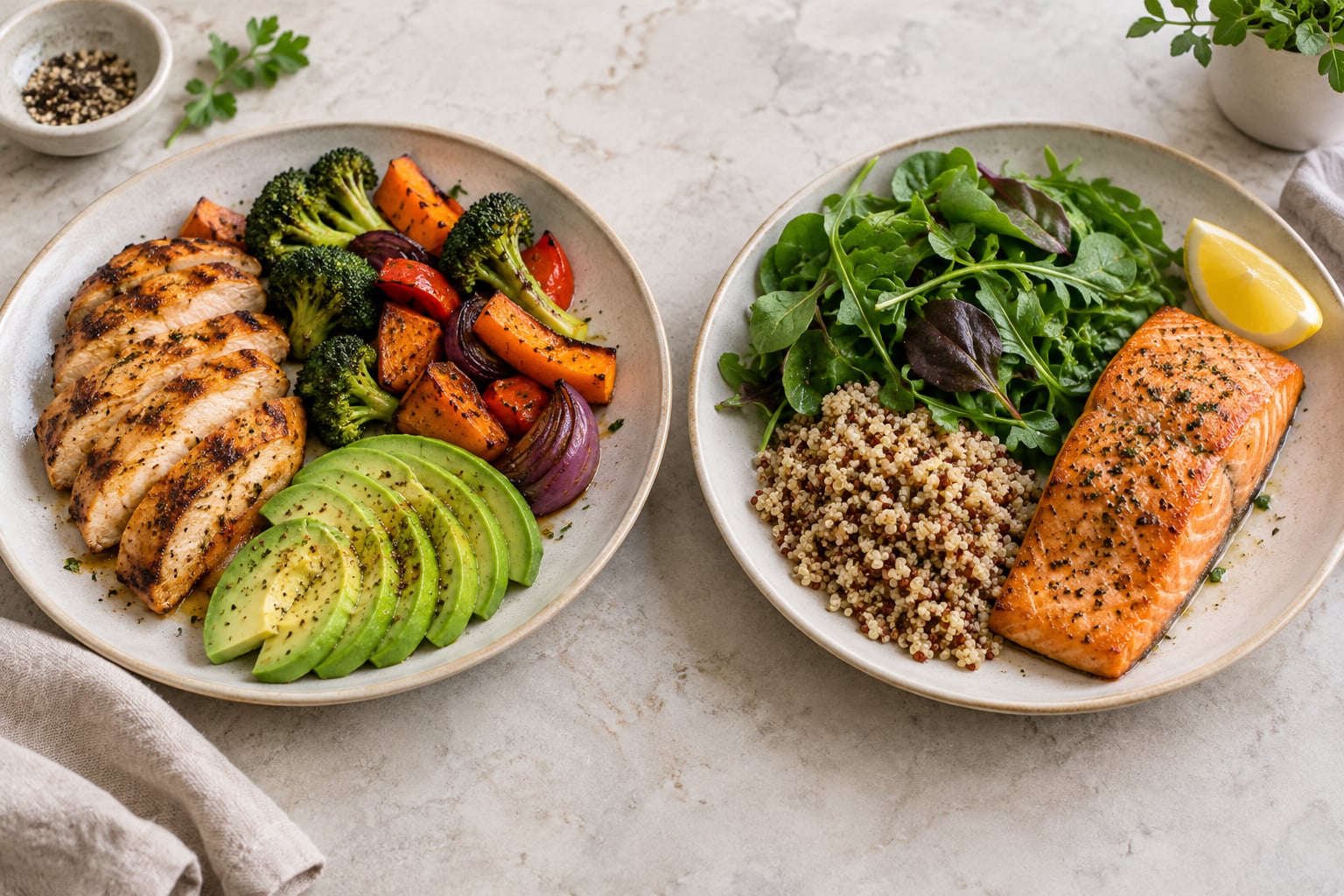
Neither low carb nor low fat is reliably better for losing weight. The best controlled trial of the two — the Stanford DIETFITS study, published in JAMA in 2018 — tracked 609 adults for 12 months and found no significant difference between the groups, with averages of about 6.0 kg lost on low carb and 5.3 kg on low fat. Weight loss comes from a calorie deficit that you can hold; the macro split mostly changes how easily you hold it.
That answer frustrates people who want a rule. So this guide breaks down what each approach actually does to hunger, blood markers, nutrient intake and your weekly routine, and where the two diverge honestly. It is general information, not personal medical advice.
Table of Contents
- Low Carb vs Low Fat for Weight Loss at a Glance
- Which Diet Produces More Weight Loss?
- How much weight do you lose in the first six months?
- How Do Low-Carb and Low-Fat Diets Affect Hunger and Appetite?
- Low Carb vs Low Fat for Weight Loss: What Happens to Nutrition?
- Which Diet Is Easier to Follow?
- What Are the Main Downsides of Each Approach?
- Which Should You Choose?
- Frequently Asked Questions
- Can you lose more weight on a low-carb diet than on a low-fat diet?
- Do I need to count calories on a low-carb or low-fat diet?
- Is a low-carb diet better for reducing belly fat?
- Can a low-fat diet still include healthy fats?
- Should I choose low carb or low fat if I exercise regularly?
- Can either eating approach cause nutrient deficiencies?
- A Practical Place to Start
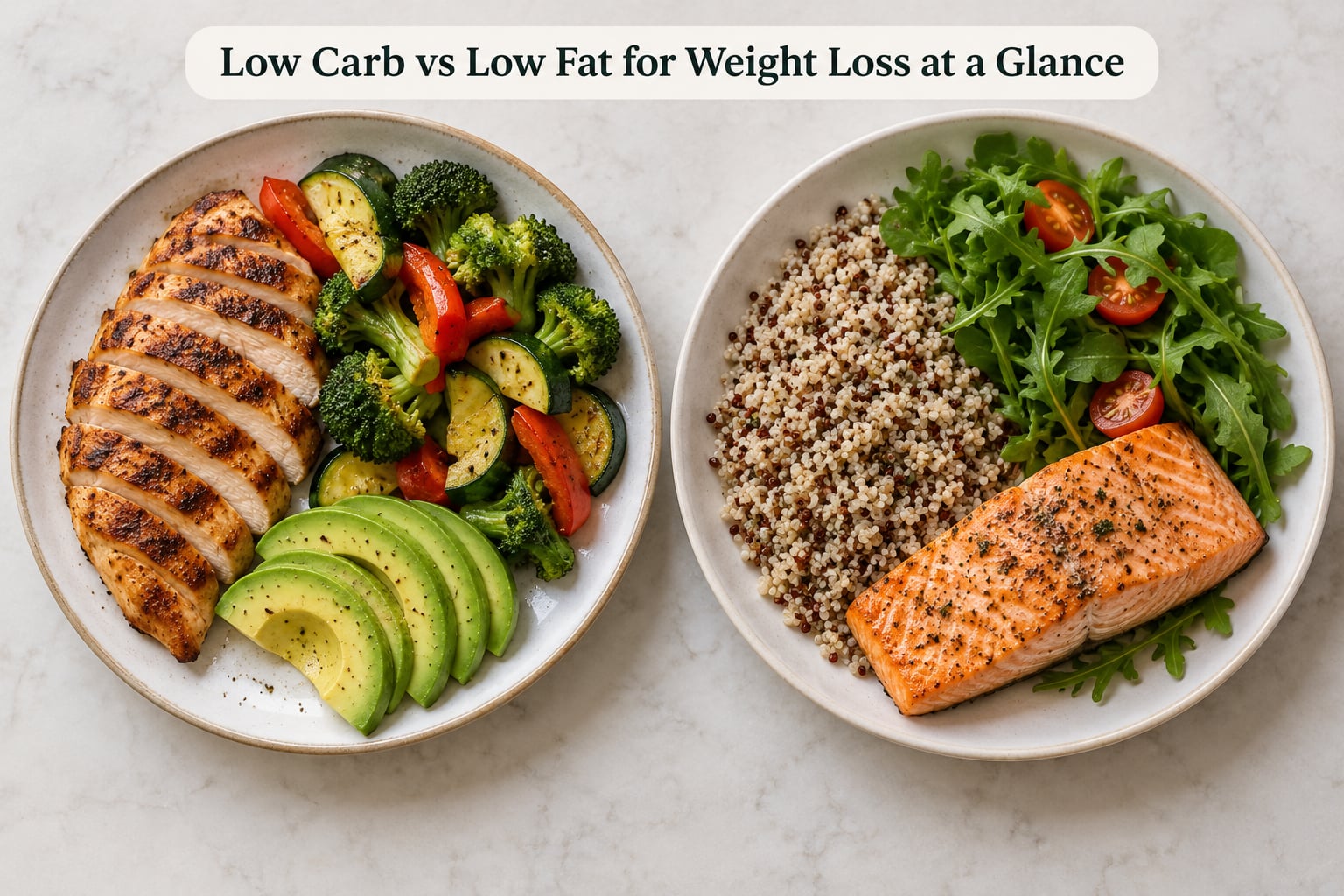
Low Carb vs Low Fat for Weight Loss at a Glance
| Factor | Low carb | Low fat |
|---|---|---|
| Typical daily target | Under about 130 g of carbohydrate; ketogenic versions sit near 20–50 g | Fat under roughly 30% of calories, often 20% or less |
| Daily target at 2,000 kcal | Roughly 130 g carbohydrate, 100–140 g protein, 60–70 g fat | Roughly 55 g fat, 75–90 g protein, 220–250 g carbohydrate |
| Foods it centres on | Meat, fish, eggs, dairy, nuts, seeds, avocado, olive oil, low-fibre vegetables | Fruit, vegetables, whole grains, beans, lean protein, small amounts of oil |
| First two weeks | Noticeable drop, much of it water | Slower, steadier start |
| Six months (DIETFITS data) | About 9.1 kg average loss | About 7.5 kg average loss |
| Twelve months (DIETFITS data) | About 6.0 kg average loss | About 5.3 kg average loss |
| Hunger control | Strong early on, especially for sweet cravings | Good if protein and fibre are high; weaker on very low-fat plans |
| Nutrient risk | Fibre, potassium, magnesium, some B vitamins if done poorly | Fat-soluble vitamins and essential fatty acids if fat drops too far |
| Cost and eating out | More planning, pricier staples | Cheaper, easier to order anywhere |
| Often suits | Constant hunger, carb cravings, high triglycerides or low HDL, insulin resistance | High LDL cholesterol, fibre-focused eating, budget constraints, social eaters |
Which Diet Produces More Weight Loss?
Over a full year, the two produce very similar results on the scale, and the calorie deficit is doing the work in both cases. The 2018 DIETFITS trial randomised 609 adults aged 18 to 50 who wanted to lose about 23 kg. Both groups were told to eat as little fat as possible, avoid refined carbohydrates and added sugar, and eat whole foods instead — the low-fat group was also told to keep fat under about 30% of calories, and the low-carb group to get under 130 g of carbohydrate a day.
Twelve months in, the groups had lost about 6.0 kg and 5.3 kg respectively, a gap that was not statistically significant. If you have read headlines claiming low carb beat low fat by two or three times, they are almost always about trials lasting three to six months, not a year.
How much weight do you lose in the first six months?
Here is the part most summaries leave out. The supplementary data from DIETFITS shows the low-carb group ahead at three months (6.9 kg versus 5.8 kg) and at six months (9.1 kg versus 7.5 kg). By 12 months the gap had closed to a difference that did not reach statistical significance. Very large early leads usually come from trials that stop before the crossover, which is exactly when adherence tends to matter most.
Two meta-analyses reach a similar picture. One pooled 23 randomised trials with 2,788 participants and found low-carb groups losing somewhat more weight, though the difference narrowed as studies got longer and better run. Another pooled 33 studies with more than 3,000 participants and found the two approaches broadly equivalent, with any edge attributable to how much each group actually cut calories and how long they stayed in the study.
Definitions are inconsistent across this literature, which is worth knowing before you trust any single number. Low-carb in some studies means under 130 g a day and in others means 60 g. Low-fat ranges from under 40% of calories down to under 20%. Comparing “low carb versus low fat” studies without checking the thresholds is comparing different diets under the same label.
Outcomes diverge between people for the same reason any diet does: how much they cut, whether they counted, what their baseline intake was, and whether they were still following it at the final measurement. Genetics, insulin levels and even commercial 3×3 genotype testing have not reliably predicted who does better on which plan — that prediction failed in the DIETFITS data and has failed in later work.
How Do Low-Carb and Low-Fat Diets Affect Hunger and Appetite?
Low carb tends to blunt hunger faster, particularly the afternoon sugar craving, because protein and fat are digested slowly and insulin demand drops. Low fat makes the same calories fill more space, because fat carries 9 kcal per gram while carbohydrate and protein carry 4, so a plate of vegetables, beans and brown rice takes up a lot of room for relatively few calories. Both are real mechanisms, and they hit different people.
Think about what a 600-calorie lunch looks like on each plan. Low carb: grilled chicken thighs, a baked potato-sized pile of cauliflower and broccoli, avocado, olive oil dressing. Low fat: lentil soup with carrots and peppers, a whole grain roll, berries, and a small amount of oil. The second plate is bulkier and higher in fibre; the first is denser and often keeps you full longer after the meal finishes.
Fibre matters more than either label suggests. Whole grains, legumes, vegetables and fruit carry fibre that slows gastric emptying and feeds the gut microbiome, and they add volume for few calories. A low-carb plan that has dropped grains, beans and fruit often loses that effect, which is why vegetable-heavy keto-style meals feel more sustainable than meat-and-cheese versions.
Low-fat plans fail in the other direction. When fat drops to about 10% of calories, meals can taste flat and unappealing, and people often replace the missing fat with refined carbohydrates — the old 1990s pattern where low-fat crackers and cookies undermined the whole attempt. Check the ingredient list, not the front of the packet. Plenty of low-fat packaged snacks are mostly sugar and starch.
Protein deserves separate attention on both plans because it is the macronutrient most often under-eaten. Aim for a palm-sized serving at each meal. Higher protein intake preserves lean mass during weight loss and increases fullness, and on a low-carb plan it is what stops you feeling like you are starving by mid-afternoon.
Low Carb vs Low Fat for Weight Loss: What Happens to Nutrition?
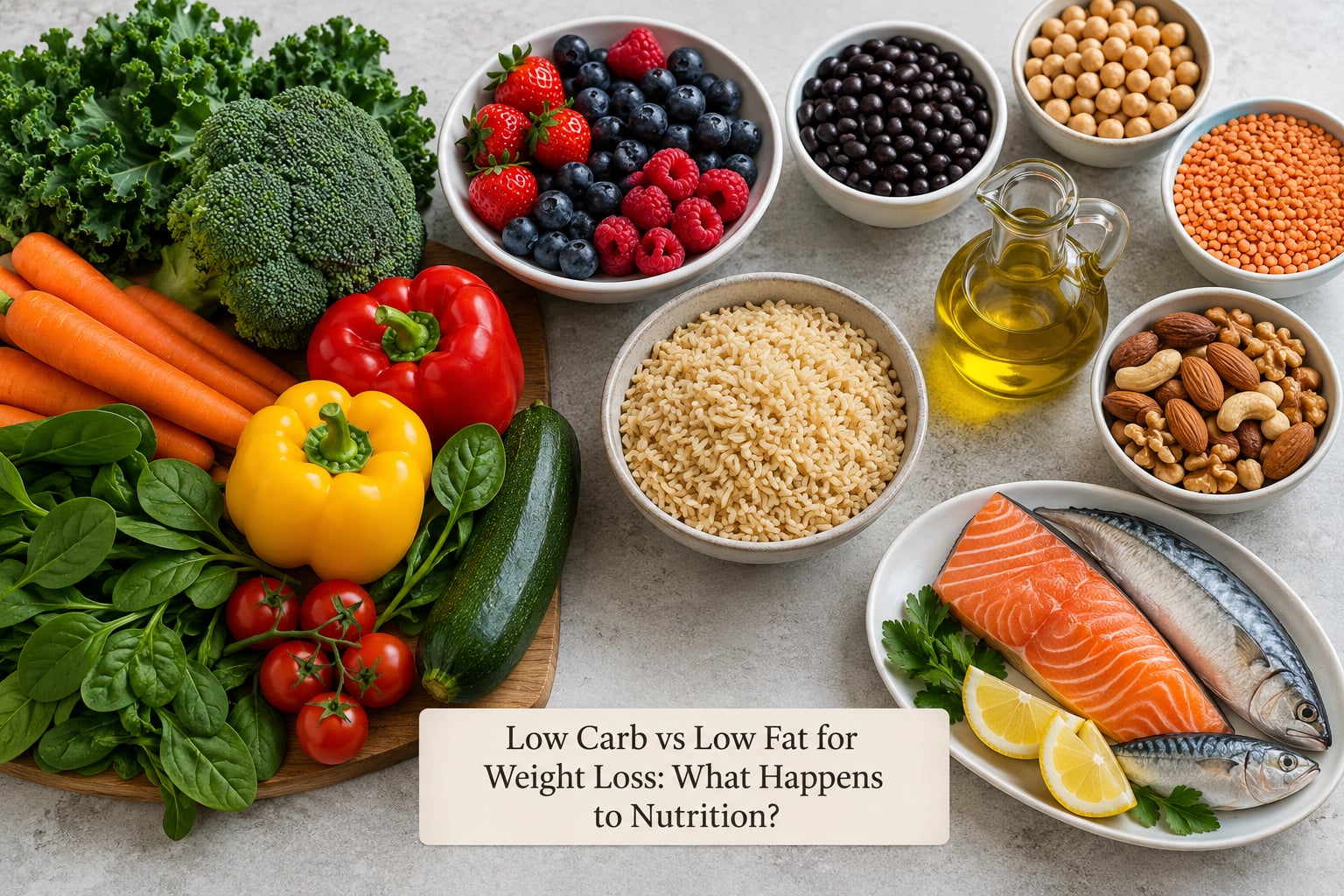
Followed rigidly, either approach can leave gaps. Low-carb plans built around meat, cheese and nuts tend to run short on fibre, potassium, magnesium, vitamin D, calcium and thiamine, because the foods that supply those are mostly plants and dairy is reduced. Low-fat plans built around cereal, bread and pasta tend to run short on fat-soluble vitamins, essential fatty acids and vitamin E, because the oils and nuts that carry those are cut out.
Fibre is the most likely casualty on the low-carb side, and fibre also drives constipation, which is one of the most common complaints people describe about their first few months. Fill your plate with low-starch vegetables first, then add berries, nuts, seeds, chia, avocado and some legumes within your carbohydrate allowance.
On the low-fat side, protect the good fats rather than simply reducing all of them. Keep olive oil, nuts, seeds, avocado and oily fish in the plan, and drop trans fats and partially hydrogenated oils entirely. There is no benefit to going below about 20% of calories from fat for weight loss, and pushing further can reduce absorption of vitamins A, D, E and K and make meals unappealing.
Alcohol and ultra-processed snacks tend to slip into either plan quietly. In DIETFITS, both groups cut calories sharply in the first two months, then drifted apart — and where people regained weight, it tracked with processed food and drinks rather than with the carbohydrate or fat target. The common denominator is refined carbs and added sugar, not fat versus carbohydrate.
Which Diet Is Easier to Follow?
Low fat is easier to follow in almost every practical way. Shopping is simpler, the staple ingredients are cheaper, and a restaurant order is straightforward: grilled anything, vegetables on the side, sauce on the side. In a consistent week you might buy chicken, beans, brown rice, frozen vegetables, fruit and one bottle of olive oil, and you will cook in batches without much thought.
Low carb costs more planning and more attention to labels. Bread, pasta, potatoes, rice, many sauces and most snacks are out, which in practice means reading more packaging at the shop and ordering more deliberately when eating out. The reward is fewer decisions about what to have next, because there is a short list of things you eat.
Social eating is where people usually quit. A low-carb plan is straightforward at a barbecue or a family dinner, and awkward at a pasta night or a bakery stop. Low-fat plans are less restrictive but require actually leaving the oil and butter off, which most people find harder than giving up bread. Whichever pattern matches your normal week is the one you will still be on in month four.
Time and cooking effort count too. Low-carb meals skew toward one-pan protein and vegetables, which is fast. Low-fat meals lean on batch-cooked grains and legumes, which front-loads work into Sunday but keeps weekday lunches cheap and reheattable.
What Are the Main Downsides of Each Approach?
The low-carb downsides cluster around food quality and, for some people, mood and energy. Very low carbohydrate intakes leave little room for fruit and whole grains, and dropping them abruptly often brings headaches, irritability and constipation in the first two weeks — a real experience forum users describe repeatedly, and the main reason people quit in month two. Restricting too hard and too fast also leaves you under-eating, which backfires if you lose muscle along with fat.
The low-fat downsides cluster around fat quality and satiety. Very low fat intakes make food bland and can push people toward sugar to compensate, and “low-fat” is heavily used on packaged goods that replaced fat with refined starch. A low-fat label tells you almost nothing about fibre, protein or added sugar.
Both share a subtler problem: food-focused thinking. Continuously evaluating every meal gets tiring, and for someone with a history of disordered eating, strict tracking of macros can make food harder rather than easier. A moderate version often serves people better — protein at every meal, vegetables at every meal, some fruit or whole grains, unsaturated fat as the main added fat, and less of the refined stuff than you eat now.
Pregnancy, a history of eating disorders, kidney or liver conditions, and certain medications that affect blood sugar or blood pressure all deserve individual medical advice before anyone restricts carbohydrates or fat seriously. Speak with a doctor or a registered dietitian first. Anyone under 18 should not be following a restrictive diet of this kind without clinical supervision.
Which Should You Choose?
Choose low carb if hunger and cravings are your main problem, if you eat rice, bread or pasta without any limit by mid-afternoon, if your triglycerides are high or your HDL is low, or if you respond better to meals built around protein and fat. Choose low fat if you need to bring LDL and total cholesterol down, if you have been told to eat more fibre-rich plant foods, if your budget and week are the deciding factors, or if the idea of giving up grains feels unsustainable.
Match by craving profile rather than by willpower. If you think about carbs most of the day, cutting carbs gives relief fast. If you overeat because meals are not filling enough, the bulk of a low-fat plan may suit you better.
There is a third option that most people who are stuck actually prefer, and it is not a compromise so much as the modern consensus: moderate carbohydrate intake from whole sources, plenty of vegetables and fruit, protein at every meal, and a clear reduction in added fat and ultra-processed food. That approach captures most of the health benefit of both camps without the social friction of either. If your blood markers are unremarkable and your real problem is what you eat rather than which macronutrient, this is where I would start.
Frequently Asked Questions
Can you lose more weight on a low-carb diet than on a low-fat diet?
Over twelve months, usually no. The Stanford DIETFITS trial found about 6.0 kg lost on low carb versus 5.3 kg on low fat, a gap that was not statistically significant. Short trials of three to six months often show low carb ahead by 1.5 to 2 kg. That early edge shrinks as months pass, so pick the pattern you can hold for a year rather than the one that drops weight fastest in week two.
Do I need to count calories on a low-carb or low-fat diet?
You do not need to, but you need some way to know you are eating less than you burn. Most people find portion control easier than tracking: protein and vegetables on every plate, measured fats, and carbohydrates or rice in portions rather than straight from the container. Counting calories for two or three weeks is still the fastest way to learn what a day of your current eating actually adds up to.
Is a low-carb diet better for reducing belly fat?
There is no strong evidence that one approach targets belly fat better than the other. Visceral fat responds to calorie deficit and to overall fat loss, not to a specific macronutrient. Waist circumference is a useful tracker because it captures changes that the scale misses. Very low carbohydrate intake can reduce the water around your midsection early on, which flatters the waist measurement without being fat loss.
Can a low-fat diet still include healthy fats?
Yes, and it should. Low fat is about cutting back on saturated and trans fats, not eliminating fat. Keep olive oil, nuts, seeds, avocado and oily fish in your plan, and aim for at least 20% of calories from fat. Below that, meals tend to become unappealing and absorption of vitamins A, D, E and K can suffer. Weight loss does not require driving fat intake to the floor.
Should I choose low carb or low fat if I exercise regularly?
Either is fine, and protein plus resistance training matter more than the split. Higher protein intake and continued strength work preserve lean mass while you lose weight, on both plans. Low-carb is often convenient around training since many people eat protein and fat before sessions without feeling heavy. If you endurance train frequently or need carbohydrate for hard sessions, the low-fat pattern may fit your workload better.
Can either eating approach cause nutrient deficiencies?
They can, particularly when followed strictly. Low-carb plans often fall short on fibre, potassium, magnesium, vitamin D and calcium once fruit, grains and beans drop away. Low-fat plans can fall short on fat-soluble vitamins, vitamin E and essential fatty acids when oils and nuts are cut back. The fix on both sides is variety: plenty of vegetables, some fruit or whole grains, protein from more than one source, and an unsaturated fat at most meals.
A Practical Place to Start
Pick the eating pattern that fits your budget, your schedule and the food you already like eating, then make two changes you can repeat for a month: protein at every meal, and vegetables at every meal. Check your waist and weight weekly, not daily, and expect the first fortnight to be misleading on a low-carb plan because glycogen stores hold water and the scale moves faster than the mirror.
If you have a medical condition, take medication, are pregnant or breastfeeding, or have a history of disordered eating, talk to your doctor or a registered dietitian before restricting either macronutrient seriously. That guidance is worth the appointment.
Updated for 2026.